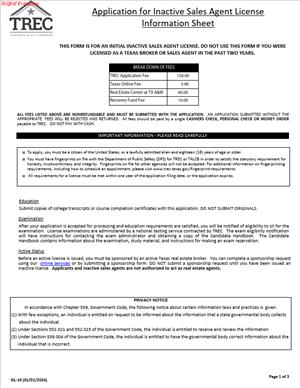
ISL-10 – Application for Inactive Sales Agent License
Fill out nowJurisdiction: United States — Texas
What is an ISL-10 – Application for Inactive Sales Agent License?
The ISL-10 is the official state form you use to place your Texas real estate sales agent license on inactive status. When your license is inactive, you remain licensed by the state, but you cannot legally perform real estate brokerage activities that require an active license. You also cannot advertise yourself as a real estate agent, negotiate transactions, show properties for compensation, or receive compensation for acts that require a license that occur while you are inactive.
Think of it as putting your license “on the shelf.” It stays valid as a license of record, but you step out of active practice until you are ready to return. The form documents your identity and license number, your request to move to inactive status, and your acknowledgment that you understand the limits of an inactive license. If you are currently sponsored by a broker, your sponsorship must end before your license can be inactive. The form allows you to manage that transition in a structured, recorded way.
Who Typically Uses This Form?
- Newly licensed sales agents who do not yet have a sponsoring broker and want to hold their license without practicing.
- Active sales agents are taking a temporary break from real estate for family, education, or another job.
- Agents whose sponsoring broker relationship has ended and who need to remove themselves from active status while they consider their next steps.
- Agents who are moving out of state or shifting to a non-licensable role and want to keep their license in good standing.
- Agents between brokerage affiliations who prefer to go inactive rather than remain active without a clear business plan.
Why You Might Need This Form
You use the ISL-10 when you want to stop performing licensed activities without letting your license expire. It preserves your license record and prevents lapses that can trigger more complex reinstatement requirements. It also protects you from accidental unlicensed practice. Once inactive, your record with the state clearly shows that you should not be engaged in acts that require a license, which helps you set boundaries with clients, colleagues, and vendors.
Typical Usage Scenarios
- You leave a brokerage and do not plan to join a new one immediately. You submit the ISL-10 to inactivate your license after sponsorship ends, so you are not shown as active without a broker.
- You take maternity or paternity leave and want to pause your practice. You go inactive to avoid CE pressure or marketing oversight while you are away and then reactivate later.
- You accept a full-time role in a related industry (for example, property management in a non-licensed capacity or a lender position) and want to avoid conflicts. You are inactive to make the boundary clear.
- Your CE or SAE is incomplete near a renewal deadline. You may choose to renew in inactive status, then complete the required education before reactivating. Going inactive can prevent late practice risk while you get compliant.
- You relocate temporarily. You hold your Texas license inactive so you can return to active status in the future without a full relicensing process.
In all cases, you preserve your license while stepping out of active practice until you meet the conditions to return.
When Would You Use an ISL-10 – Application for Inactive Sales Agent License?
Use the ISL-10 any time you want to stop practicing but keep your license current. The most common trigger is a change in your sponsoring broker. A Texas sales agent must be sponsored by a Texas broker to engage in licensed practice. If your sponsorship ends and you are not moving to another broker immediately, you should file to make your license inactive. This stops your ability to practice and shuts down questions about compensation and advertising while you regroup.
You also use the form when you want to plan a break in advance. For example, if you are planning extended travel or a sabbatical, you can set an effective date to go inactive. Doing so helps you wind down pending listings and transactions appropriately and informs your MLS access, lockbox credentials, and advertising plan.
If you are considering whether to renew active when your CE is not complete, filing to remain or become inactive may make sense. Many agents choose to renew in inactive status rather than scramble for last-minute courses. You still must renew your license to keep it current, but going inactive can reduce immediate compliance pressure. You will complete the required education before requesting active status again.
If you have compliance or disciplinary matters pending, moving to inactive does not erase them. But filing the ISL-10 can ensure you are not practicing during a period when your education or sponsorship is not in place. That can help you avoid compounding issues with unlicensed activity.
Typical users include sales agents at every career stage: new agents awaiting a first broker; mid-career agents pausing for family or business reasons; and seasoned agents stepping back from day-to-day transactions. Brokers do not use the ISL-10 for themselves; this form is specific to sales agents.
Legal Characteristics of the ISL-10 – Application for Inactive Sales Agent License
The ISL-10 is a regulatory filing with the state’s real estate licensing authority. It is not a contract between private parties. However, it is legally significant because it changes your license status in the state’s official records. By signing and submitting it, you certify that the information is accurate and that you understand you cannot perform acts that require an active license while your license is inactive.
The form’s enforceability stems from the state’s authority to regulate real estate licenses and enforce compliance with licensing laws and rules. Once the agency processes your request, your public license record is updated to reflect “Inactive.” Engaging in brokerage activities while your license is inactive is considered unlicensed practice. The state may impose administrative penalties, take disciplinary action, or pursue other remedies if you ignore the status limits.
The form usually includes affirmations or acknowledgments. These indicate that you understand the restrictions associated with inactive status and that you are submitting truthful information. False statements or misrepresentations on a state licensing form can result in discipline, denial of future applications, or legal penalties under state law. Treat every answer as a sworn statement.
Going inactive does not stop the license clock. You still must renew your license on time to keep it current. In Texas, you generally may renew in inactive status. Education requirements for renewal and reactivation can differ by circumstance. Expect to complete the required education before you reactivate to active status, even if you renewed while inactive. If you miss your renewal deadline and your license expires, you will need to follow the state’s late renewal or reinstatement process, which is different from a simple inactive-to-active change.
Inactive status also affects compensation. You may receive compensation after you go inactive for transactions you earned while your license was active, subject to the terms of your brokerage agreements and state rules requiring compensation to flow through your broker. You cannot, however, perform any new acts that require a license while inactive, and you cannot accept compensation for such acts performed while inactive. If you have open transactions at the time your status changes, coordinate closely with your broker to ensure proper handling and payment consistent with when the work was performed and your status at that time.
Advertising and representation are also legal considerations. Once inactive, you must stop advertising yourself as an active real estate professional. That includes flyers, websites, email signatures, business cards, yard signs, social media profiles, and MLS participation. Remove or pause anything that implies you are available to perform licensed activities. Misleading advertising while inactive can trigger enforcement.
Finally, you should understand that inactive status does not purge existing disciplinary records, unpaid fees, or outstanding requests for information. The state can continue investigations or audits regardless of your status. If you have outstanding issues or education deficits, going inactive does not resolve them; it only pauses your ability to practice.
How to Fill Out an ISL-10 – Application for Inactive Sales Agent License
Before you begin, gather key information: your full legal name as it appears on your license, your license number, contact details, date of birth, last four digits of your SSN for identity matching, and your current sponsoring broker’s information if you are still sponsored. Have a clear target effective date in mind. If you have any open transactions, coordinate with your broker first to determine how and when to transition them.
Follow these steps:
1) Identify the applicant (you)
- Full legal name: Use the name on your current license. If your legal name has changed, complete the state’s name change process separately before or along with this filing. Do not use nicknames.
- License type and number: Select sales agent and enter your license number exactly as issued.
- Identification details: Provide date of birth and the last four digits of your SSN, if requested, to help the agency match your record.
- Contact information: List your current mailing address, email, and phone. This becomes the agency’s contact point for you while inactive. Choose an address that will remain stable during your inactive period.
2) Current status and sponsoring broker
- Indicate whether you are currently sponsored by a Texas broker. If yes, include the broker’s legal name and license number. If your sponsorship will end before your inactive date, state the termination date, if the form asks for it.
- Understand that your license cannot be both sponsored and inactive. If you are still sponsored, you or your broker must terminate the sponsorship as part of or prior to this request. Some forms include a signature area for the broker to acknowledge the end of sponsorship; others require a separate sponsorship termination process. Coordinate with your broker to avoid gaps or misunderstandings.
3) Request inactive status
- Effective date: Choose “effective immediately” or specify a future date. If you pick a future date, be realistic. Give yourself enough time to wind down listings, update advertising, and arrange referral coverage if needed.
- Reason (if requested): Briefly state the reason, such as “ending sponsorship,” “temporary leave,” “awaiting new broker,” or “relocation.” Keep it factual and concise.
4) Acknowledgments and restrictions
- Read each acknowledgment carefully. Common items include agreeing not to perform any act that requires an active license while inactive, agreeing not to advertise as a real estate professional, and understanding that compensation for licensed acts must be earned while active and paid through a broker.
- Some versions include statements about continuing obligations to renew on time and to update your contact information with the agency. Check each box or initial as instructed. Do not skip acknowledgments; they are part of what makes your request complete and enforceable.
5) Education and renewal status
- If the form asks about CE or SAE status, answer accurately. If you plan to reactivate soon, it helps to know whether you have completed the required hours. You may renew in inactive status, but you will need to complete the required education before reactivating. Record your current status truthfully.
- If your renewal date is approaching, decide whether to renew before going inactive, go inactive first, or renew in inactive status. The form does not perform your renewal; it only changes your license status. Handle renewal separately if it is due.
6) Disclosures and pending matters
- If the form asks whether you have pending complaints, audits, or disciplinary proceedings, answer truthfully. Going inactive does not halt these matters, but accurate disclosure avoids further issues.
- If you owe administrative penalties or fees, resolve them promptly. Unpaid obligations can delay processing or complicate reactivation later.
7) Attachments or schedules (if applicable)
- Name change documentation: If your current legal name differs from your license record and you are updating it in the same packet, include the required supporting documents in the schedule or attachment section.
- Identification or supplementary forms: If the form asks for additional identity verification or a separate sponsorship termination, include those documents. Label attachments clearly so the agency can process your packet without confusion.
- Effective-date riders: If you are coordinating a specific effective date to align with the end of sponsorship, note that in an attached statement if the form instructions permit. Keep it simple: a brief statement of intent with dates is usually enough.
8) Signatures
- Applicant signature: Sign and date the application. Your signature certifies that all information is true and correct. Use ink if you are filing a paper form. Digital signatures may be accepted by online filing systems if you submit electronically.
- Broker signature (if required): If the form includes a field for the current sponsoring broker to acknowledge the termination of sponsorship or consent to the inactive request, obtain the broker’s signature and date. Not every version requires it, but if there is a signature line for the broker, complete it to avoid rejection.
- Keep a copy of the signed form and any attachments for your records.
9) Fees and payment
- Some filings carry a small processing fee, especially if submitted by paper. If a fee is required, include the correct amount and payment method that the agency accepts. Submitting the wrong fee is a common reason for processing delays.
- If no fee is required for an online status change, you can still choose paper filing for a record trail, but confirm whether a paper processing fee applies.
10) Submission and processing
- Submit through the state’s accepted channels. Online submission is often processed faster than paper mail. Paper mail should be sent with tracking so you can verify receipt.
- Processing times vary by volume. Do not assume same-day processing. Plan for a reasonable window and avoid performing any licensed acts after your requested effective date (or after submission if you requested an immediate status change).
11) Confirm your inactive status
- After submission, verify your license record shows “Inactive.” Keep a record (screenshot or confirmation) with the effective date.
- Notify your MLS, board, teams, and clients as appropriate. Remove active advertising, update or take down your website, and adjust email signatures. Return or disable lockbox keys and cancel optional services you no longer need.
12) Handle open transactions and compensation
- For deals already under contract, consult your broker before submitting your inactive request. You may need to delay the effective date until after closing, or arrange for another active agent to take over, with compensation handled per your brokerage agreement.
- Commissions for work performed while you were active can be paid after you go inactive, if earned during the active period and paid through your broker. Document the timeline and keep communications in writing.
13) Plan for reactivation
- To return to active status later, you will need a sponsoring broker and must meet all education and renewal requirements at that time. The reactivation process typically includes filing the appropriate activation or sponsorship form and paying any required fee.
- If you renewed while inactive without completing CE or SAE, complete those requirements before requesting active status. Processing for reactivation can be delayed if your education is incomplete or if you have any outstanding compliance holds.
Practical tips
- Choose a clean, effective date. If you have multiple listings or buyer clients, set an effective date far enough out to transition responsibly.
- Communicate early. Tell your broker and team about your plans. Decide who will take over active clients and how to handle leads that come in after you go inactive.
- Audit your marketing. Search your name online and remove or pause pages and profiles that imply active practice. Update voicemail and autoresponders to reflect your inactive status without offering services that require a license.
- Keep your contact details current with the state. Even while inactive, you must respond to regulatory communications and renew on time.
- Track requirements for your first reactivation. Save your completion certificates for CE or SAE, and calendar your renewal date. Being organized reduces downtime when you are ready to return.
Common mistakes to avoid
- Filing to go inactive, but forgetting to end your broker sponsorship. Your request may stall if the records still show an active sponsorship.
- Assuming you can keep advertising. You must stop all advertising that implies licensed activity once inactive.
- Missing renewal deadlines. Inactive does not mean “ignore renewals.” Renew on time to avoid expiration.
- Expecting to get paid for new work done while inactive. Compensation for licensed activities performed while inactive is not permitted.
- Submitting incomplete forms. Missing signatures, wrong license numbers, or omitted attachments cause delays.
If you follow the steps above, your ISL-10 will clearly record your intention to pause practice, align your license status with your actual activities, and keep your path back to active status straightforward when you are ready.
Legal Terms You Might Encounter
- Sales agent. You hold this license category. You must have a sponsoring broker to practice. This form places your license on inactive status. That means you cannot practice until you reactivate.
- Inactive status. This is a license status. You remain licensed, but you cannot perform real estate brokerage activities. You cannot receive compensation for brokerage work while inactive. This form requests that status.
- Sponsoring broker. A sales agent must have a broker to be active. Your broker supervises your work. To be inactive, you must not have a sponsor. This form confirms that change.
- Termination of sponsorship. This ends your broker’s supervision. Once terminated, your license becomes inactive unless you add another sponsor. The form may reflect that change if needed.
- Reactivation. This returns your license to active status. Reactivation requires a sponsoring broker. You must also meet education and fee requirements. You cannot work until reactivation is approved.
- Renewal. This extends your license for another term. You may renew while active or inactive. Your status does not change by renewal alone. It only changes when an activation or inactivation request is approved.
- Continuing education (CE). These are the required education hours to keep your license current. You must complete CE to activate a license, even if you renewed inactive. Check your hours before you plan to reactivate.
- Post-licensing education. New sales agents must complete post-licensing coursework within set timelines. If you renew inactive without it, you still must finish before you can go active. Plan your coursework early.
- Attestation. You sign to confirm your statements are true. This includes your identity and your intent to hold inactive status. False statements can lead to discipline.
- Disciplinary action. The agency may act if you violate the license law. Practicing while inactive can trigger discipline. Accurate, timely filings help you avoid problems.
- Effective date. This is when the agency makes your status change official. It is not the date you mail the form. Do not practice until the effective date shows your new status.
- License number. This unique number identifies you. Use it exactly as issued on the form. Mistakes can delay processing.
FAQs
Do you need a sponsoring broker to file this form?
No. You use this form when you do not want a sponsor. You cannot have a sponsor while you hold an inactive status.
Do you have to stop all brokerage activity once you go inactive?
Yes. You must stop all brokerage work. You cannot advertise, show property, write offers, or collect brokerage fees. Wait until your license is active again.
Do you need to complete your education while inactive?
You may renew as inactive without completing all education. But you must finish the required education before activation. Do not plan to go active until you meet those requirements.
Do you have to pay a fee to request inactive status?
A filing fee may apply. Fees can change. Check your current renewal and change fees in your account before you submit.
Do you need to terminate your current broker first?
Yes. You cannot hold an inactive status while linked to a sponsor. End your sponsorship before or with this request. Confirm the termination date aligns with your plans.
Do you keep your license number while inactive?
Yes. Your license number remains the same. Your status changes, but your identifier does not.
Do you need to return signs, cards, and access devices?
Yes. Return brokerage materials when you go inactive. Remove your name from team and office ads. Update online profiles to reflect your inactive status.
Do you need to notify clients?
Yes. Notify any clients of your status change. Do not take on new tasks or attend negotiations. Ask your broker to assign active agents to any pending matters.
Checklist: Before, During, and After the ISL-10 – Application for Inactive Sales Agent License
Before signing
- Confirm your current license status and expiration date.
- End your broker sponsorship, or plan its termination date.
- Gather your license number and legal name as shown on the records.
- Verify your mailing address, email, and phone number.
- Review your education history and any outstanding hours.
- Check the current fee, if any, and accepted payment methods.
- Identify any recent name or contact changes you must report.
- Prepare a brief reason for inactivation, if the form requests it.
- Confirm you have no pending transactions that require your work.
- Decide on your planned inactive start date, subject to approval timing.
During signing
- Enter your legal name exactly as on your license.
- Enter your license number without transposed digits.
- Verify your date of birth and identifiers, if requested.
- Select “inactive” as the requested status.
- Confirm your broker sponsorship has ended or will end.
- Review any attestations for accuracy and truthfulness.
- Answer any fitness or background questions, if included.
- Sign and date the form in the correct field.
- Add payment details, if a fee applies.
- Review each field for completeness and legibility.
After signing
- Submit the form using the accepted method.
- If you mailed it, use a trackable method and keep proof.
- If you filed online, save the confirmation receipt.
- Monitor your account for the official status change.
- Do not perform brokerage work until the status shows inactive.
- Notify your broker of submission and effective date once posted.
- Update or remove your name from ads and profiles.
- Return physical access devices and materials to your broker.
- Store a copy of the form and proof of submission.
- Add a reminder to check your renewal date and education plan.
Common Mistakes to Avoid ISL-10 – Application for Inactive Sales Agent License
Don’t forget to end your sponsorship.
- Consequence: Your request can be delayed or denied. You cannot be inactive while linked to a broker.
Don’t practice before the status is official.
- Consequence: You risk discipline and fines. Wait for the status change to post.
Don’t enter the wrong license number or name.
- Consequence: Processing can stall or misapply to another record. Match your license profile exactly.
Don’t ignore education planning.
- Consequence: You may not reactivate when planned. Complete the required hours before you seek activation.
Don’t omit payment when a fee applies.
- Consequence: The agency will not process your request. You may remain active longer than intended.
Don’t miss renewal deadlines while inactive.
- Consequence: Your license can expire. Renewal issues add time and cost to reactivate.
What to Do After Filling Out the Form ISL-10 – Application for Inactive Sales Agent License
- File your request. Submit the completed form as allowed by the agency. Pay the required fee, if any. Keep a copy of the form and payment receipt.
- Track your submission. Check your account for updates. Processing times vary. Do not assume immediate inactivation. Wait for confirmation.
- Confirm your status change. Once posted, confirm the effective date. Save a screenshot or printout for your records. Share the confirmation with your broker.
- Stop all brokerage activity. Cease showings, negotiations, and advertising. Remove your name from signs, websites, and team pages. Update your email signature and voicemail.
- Transfer client matters. Ask your broker to reassign open files. Notify clients that another agent will assist them. Provide a smooth handoff to avoid delays.
- Set your compliance reminders. Note your renewal date. Plan your education timeline now. If you plan to reactivate soon, enroll early in the required courses.
- Handle amendments or corrections. If you notice an error, contact the agency promptly. You may need to submit an updated form. Provide your license number and proof of submission.
- Reactivating later. To go active, secure a sponsoring broker. Complete the required education. File the activation request and pay any fees. Wait for approval before you resume work.
- Keep records organized. Store your form, receipts, and status confirmations. Keep them for several renewal cycles. These records help resolve future questions.
- Coordinate with third parties. Notify any board, association, or marketplace of your status change. Pause or cancel subscriptions tied to active practice. This prevents compliance issues and extra costs.
Disclaimer: This guide is provided for informational purposes only and is not intended as legal advice. You should consult a legal professional.