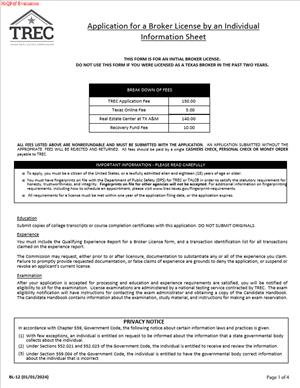
BL-12 – Application for a Broker License by an Individual
Fill out nowJurisdiction: Country: United States | Province or State: Texas
What is a BL-12 – Application for a Broker License by an Individual?
The BL-12 is the formal application you submit to request a Texas real estate broker license as an individual. You use it to show that you meet experience, education, and fitness requirements for broker-level authority. The form captures your identity, license history, education, real estate experience, and background disclosures. It also includes your certification that the information is true and complete.
You typically use this form when you want to upgrade from a sales agent license to a broker license. You also use it if you already hold a broker license in another state and want a Texas broker license as an individual. If you plan to run your own brokerage or supervise agents, this is the entry point. If you plan to serve as the designated broker for a business entity, you still begin with the individual broker license application.
You need this form to qualify for broker-level practice in Texas. A broker can own a brokerage, sponsor sales agents, and manage trust accounts. You gain the authority to supervise and take responsibility for brokerage operations. Without a broker license, you cannot sponsor agents or operate a brokerage independently.
Typical usage scenarios include upgrading your career, starting a firm, or stepping into leadership. Many applicants want to open a boutique brokerage and need a broker authority. Some want the flexibility to sponsor a small team and control branding. Others seek leverage for commercial deals or property management oversight. If you are relocating and want to continue your broker career in Texas, you use this form to qualify. If you will be the designated broker for a company, you use this form to secure the individual license before or alongside any entity filings.
In short, the BL-12 is the gateway to broker status for a single person. It tests your readiness through proof of education, verified transaction experience, and a background review. Your submission tells the regulator you are qualified to handle broker-level duties and supervision.
When Would You Use a BL-12 – Application for a Broker License by an Individual?
You use the BL-12 when you are ready to move from sales agent to broker after meeting experience and education thresholds. For example, you have several years of active practice and a full education portfolio. You now want to supervise agents and run your own shop. You use this application to start that process.
You also use it if you already hold a broker license in another state and want to practice in Texas. Texas applies its own standards. You complete the application and satisfy Texas requirements, even if you are already a broker elsewhere. This helps you maintain your career across state lines while meeting local rules.
If you are the planned designated broker for a newly formed business entity, you use this form to secure your individual license. An entity cannot practice real estate without a designated broker. You can apply as an individual, pass the exam, and then be designated to the entity once your license is active.
Property managers often use this route when they want to manage trust accounts and supervise leasing agents. Commercial practitioners may apply to support larger teams or complex deals. A broker license can also help if you want to mentor new agents formally. You must have a broker license to sponsor their licenses.
If your role requires signing brokerage agreements as the responsible broker, you need the broker license. If you want to add a DBA for marketing and branding while supervising agents, you need this license. Finally, if you want to prevent career bottlenecks tied to a sponsoring broker, you use this form to gain independence.
Legal Characteristics of the BL-12 – Application for a Broker License by an Individual
The BL-12 is a regulatory application, not a negotiated contract. Your signature makes your statements sworn and enforceable. By signing, you certify that your education, experience, and background disclosures are true and complete. False statements can lead to denial, discipline, or later revocation. The form also contains consent to background checks and identity verification. These elements give the Commission authority to confirm your qualifications and fitness.
It is legally binding in the sense that you attest under penalty of law. You also agree to follow the Commission rules that govern brokers. The Commission relies on your disclosures to decide if you qualify. Your application triggers a review that can require extra documents or explanations. If you omit material facts, that can be treated as a violation even after approval.
Enforceability comes from the Commission’s licensing authority and rules. The Commission sets minimum education and experience standards. It also mandates fingerprints and a background check. It can deny an application for cause. It can also set conditions for approval, like extra documentation. Once licensed, you must follow broker obligations, including supervision and trust account rules. You must also keep your contact information current with the Commission.
General legal considerations include accuracy and completeness. The Commission can audit your education and experience claims. It can verify your transaction history through your sponsoring brokers. It can also review court records if your background answers indicate criminal or civil issues. If you answer “Yes” to a background question, you must provide details. If you change your legal name, you must provide supporting documents. If you intend to use an assumed name, you must disclose that. If you will serve as the designated broker for an entity, additional filings may be required by rule.
Finally, you should expect fees to be non-refundable once processing starts. If your application expires before you pass the required exams, you may need to reapply and pay. You have to complete fingerprints if you have not done so for a Texas real estate license. You also must sit for and pass the broker exam before the license can be issued. Approval is conditional until all steps are complete.
How to Fill Out a BL-12 – Application for a Broker License by an Individual
Follow these steps to complete the BL-12 accurately and avoid delays.
1) Confirm basic eligibility
- Make sure you are at least 18 years old.
- Confirm lawful presence in the United States.
- Ensure you meet Texas experience and education standards.
- Verify that your sales agent license, if any, is in good standing.
- Resolve any outstanding disciplinary or criminal matters that require disclosure.
2) Gather documents and information
- Government-issued identification data. Ensure your name matches across records.
- Contact information. Include a reliable email. The exam notice goes there.
- Education transcripts and course completion certificates. Organize by course type and hours.
- Real estate experience records. Prepare an experience report with transaction points.
- Employment history in real estate. Include dates, firms, and supervising brokers.
- Background documents, if applicable. Collect court orders, dispositions, and explanations.
- Name change documents, if applicable. Include a marriage certificate or a court order.
- Assumed name details, if you intend to use a DBA.
3) Complete Applicant Identifying Information
- Enter your full legal name. Use the same name on your ID and education records.
- Provide your date of birth and identification number as required.
- Add your residence and mailing addresses. Do not use a P.O. Box for your residence.
- Provide your email and phone. Use an email you check daily.
- If you have used other legal names, list them in the prior names section.
4) Disclose license history
- List your current Texas license number, if any.
- Report any licenses held in other states. Include type, number, and status.
- Disclose denials, suspensions, or revocations. Provide dates and agencies.
- If you have pending applications elsewhere, disclose them.
5) Report education
- Enter all qualifying real estate courses required for a Texas broker.
- Include course titles, providers, and completion dates.
- Attach transcripts and certificates that show hours completed.
- If you claim related education, include official transcripts and course descriptions.
- If you have a degree, include proof. It may help meet related hours.
Tip: Align your education entries with your attachments. Titles and dates should match.
6) Document experience
- Complete the experience report that supports your broker application.
- Identify each transaction by address, date, role, and type.
- Assign the appropriate experience points per transaction type.
- Tally points to meet the minimum required total.
- Identify the supervising broker for each transaction.
- Obtain required signatures or verifications from supervising brokers.
- If a broker is unavailable, prepare alternate verification evidence.
Tip: Use clear, consistent property identifiers. Confirm dates and roles to avoid rejections.
7) Answer background and fitness questions
- Read each question carefully. Answer “Yes” or “No.”
- If you answer “Yes,” provide a detailed written explanation.
- Include certified court documents, orders, and final dispositions.
- Explain rehabilitation steps if applicable. Provide proof of completion.
- Disclose unpaid judgments or liens and status. Include payment plans.
- Disclose any disciplinary actions by other licensing bodies.
Tip: Be complete and candid. Omissions cause bigger problems than disclosures.
8) Business and practice intentions
- Indicate if you plan to act as a sole individual broker or as a designated broker for an entity.
- If you plan to be a designated broker, provide the entity’s legal name and identification number, if known.
- Disclose any assumed names you intend to use in advertising.
- If you plan to sponsor sales agents at license issuance, note that plan.
- Understand that separate filings may be needed to activate entity practice.
9) Fingerprinting and background check
- If you have not submitted fingerprints for a Texas real estate license, complete this step.
- Use the state-approved process to submit fingerprints for the background check.
- Use your legal name as it appears on your ID to avoid mismatches.
- Keep your receipt and tracking number for your records.
10) Applicant certifications and consents (the “clauses” you agree to)
- You certify that all statements are true and complete.
- You consent to a criminal background check and record review.
- You agree to comply with Commission rules and broker duties.
- You acknowledge that fees are non-refundable once processing begins.
- You understand that misrepresentation may result in denial or later discipline.
Read these statements carefully. Your signature indicates your agreement.
11) Signatures
- Sign and date the application where indicated.
- Use your legal name as signed on your ID.
- If the experience report requires a supervising broker verification, obtain their signatures.
- Some attachments may require notarization. Follow the instructions on those pages.
- Keep copies of every signed page for your records.
12) Fee payment
- Calculate the required fees shown on the application.
- Pay by an accepted method. Follow instructions for checks, money orders, or electronic payment.
- If you are paying for both the application and exam eligibility, include full payment.
- Keep proof of payment with your records.
13) Assemble and submit
- Order your packet in the same sequence as the form sections.
- Include the application, education proof, experience report, background documents, and any name change records.
- Double-check that all pages are present and legible.
- Submit as directed by the application. Follow the mailing or online submission steps.
- Note the estimated processing timeline. Build in buffer time for review.
14) After you submit
- Watch your email for deficiency notices or requests for more information.
- Respond quickly and completely to any request.
- Once the Commission deems you eligible, you will receive exam instructions.
- Schedule the broker exam with the approved exam provider.
- Prepare thoroughly and pass the exam within the eligibility window.
- If required, complete fingerprints if not already done.
- After passing, monitor your license status for activation.
- If you will sponsor agents, ensure your systems and supervision are in place.
- If you will be designated broker for an entity, complete entity filings to activate practice.
15) Activation and ongoing duties
-
- Update your contact information if it changes.
- Set written office policies for supervision and advertising.
- Establish trust account controls if you handle client funds.
- Maintain records as required by rule.
- Renew on time and complete the required continuing education.
Common Mistakes to Avoid
- Listing education that does not match your attachments.
- Missing signatures on the experience report.
- Incomplete addresses or dates on transactions.
- Failing to disclose prior names delays background checks.
- Ignoring a deficiency notice or missing an exam deadline.
- Submitting poor-quality scans that are not readable.
- Paying the wrong fee or omitting the exam fee when required.
- Using a different name across documents without proof of a name change.
Practical examples
- You are a sales agent with several years of active deals. You want to open a boutique brokerage in Austin. You prepare a complete experience report with verifiable transactions. You attach proof of qualifying and related education. You disclose an old misdemeanor with court records and a brief explanation. You pass the exam and activate your broker license. You then file the steps to sponsor agents under your brand.
- You are a commercial broker licensed in another state. You are moving to Texas. You compile your education and request transcripts. You prepare an experience report with commercial leases and sales. Your former supervising brokers verify entries. You disclose no disciplinary history. You pass the exam and receive your Texas broker license. You later become the designated broker for your new Texas entity.
- You manage residential rentals and need broker authority to supervise assistants. You gather your leasing and property management transactions. You document trust account training in your education list. You complete fingerprints. You pass the exam and set written trust account procedures. You then sponsor a small team and supervise advertising and compliance.
Tips for a smoother review
- Use consistent property identifiers in your experience report. Include unit numbers when needed.
- Summarize your “Yes” background answers in a clear timeline. Attach court dispositions.
- Keep a master checklist of every attachment. Check off as you insert each item.
- Save PDFs with clear names, like “Education-Transcripts” or “Experience-Report.”
- Reply to Commission emails within two business days when possible.
- If a supervising broker cannot be reached, prepare alternate proof and a short memo explaining your efforts.
Understanding the roles and “parties.”
- You are the applicant. You certify facts and consent to review.
- The Commission is the licensing authority. It reviews, approves, or denies.
- Your supervising broker(s) may serve as verifiers of your past transactions.
- If you will be a designated broker, your business entity becomes your later responsibility.
Understanding schedules and attachments
- Education schedule: Transcripts and certificates organized by course and date.
- Experience schedule: Deal list with addresses, dates, roles, and points.
- Background schedule: Court documents, explanations, and proof of completion.
- Identity schedule: Name change documents and prior name list.
- Business schedule: Assumed name details and any planned designation information.
Before you sign, do a final audit
- Does your total experience meet the required points?
- Do your education hours meet the thresholds?
- Are your “Yes” answers fully explained with documents?
- Do your names match across all records?
- Have all required parties signed where needed?
By following these steps, you complete the BL-12 accurately and avoid common pitfalls. You give the Commission clear evidence of your readiness to practice as a Texas broker. With a complete file, you move faster to exam eligibility and license issuance. Once licensed, you can supervise agents, run a compliant brokerage, and build the business you want.
Legal Terms You Might Encounter
- Broker of Record (Designated Broker). This is the individual broker responsible for a licensed business entity. If you plan to act as the broker for a company, BL-12 asks you to identify that role. You accept supervision duties and compliance responsibility for the firm and its sponsored sales agents.
- Active vs. Inactive License. BL-12 lets you choose whether your broker license begins as active or inactive. Active means you can perform brokerage activities and supervise others. Inactive means you hold the license but cannot broker or sponsor agents until you activate it later.
- Sponsorship. Sponsorship is the relationship where a broker oversees a sales agent. If you check that you will sponsor agents on BL-12, you accept supervisory obligations. You must also make sure your policies, advertising, and trust account practices support that role.
- Qualifying Education. These are coursework requirements that must be completed before approval. BL-12 requires you to report your education and attach documentation if requested. If any hours are in progress, note that only completed and verifiable education counts.
- Experience Credit. Broker applicants must show sufficient real estate experience. BL-12 asks you to list transactions or an experience summary. You should only claim transactions you actually performed and can document, such as closings, listings, or management activity recognized for credit.
- Assumed Name (DBA). An assumed name is any business name that isn’t your legal name. If you will advertise or practice under a DBA, BL-12 requires you to disclose it. Make sure the name matches your other filings and marketing material to avoid confusion or compliance issues.
- Fitness Determination. This is the regulator’s review of your character and background. BL-12 includes questions about criminal history, judgments, and disciplinary actions. If you answer “Yes,” you must attach complete explanations and supporting documents. Honesty and detail are essential.
- Fingerprints and Background Check. Fingerprinting is part of the background review process. BL-12 asks whether you have been fingerprinted for a real estate license. If not, you will need to complete that step after filing. Prior fingerprints from other agencies usually do not satisfy this requirement.
- Supervisory Responsibility. If you indicate on BL-12 that you will supervise agents or property management, you must maintain policies and oversight systems. This includes training, recordkeeping, and advertising review. Your selection on the form signals the regulator that you accept these duties.
- Disciplinary Action. This is any past or current action against your license or professional status. BL-12 requires disclosure of suspensions, revocations, fines, or consent orders. Disclose fully, attach all relevant orders and explanations, and be consistent with other applications you have filed.
FAQs
Do you need to submit fingerprints if you already did as a sales agent?
Yes, unless the regulator confirms you have fingerprints on file for a real estate license. Prints taken for other professions or agencies usually do not transfer. If BL-12 shows no record of current fingerprints, plan to schedule and complete them after you submit the application.
Do you need to be sponsored to apply for a broker license?
No. You can apply as an individual and select inactive status. If you want to start practicing and supervise others on day one, choose active and be ready to meet supervision obligations. You can also activate later once your license is issued.
Can you apply while your sales agent license is active?
Yes. Many applicants hold an active sales agent license when they file BL-12. Keep your agent license in good standing until your broker license is approved. If you plan to switch to a broker immediately, plan how you will handle pending transactions and notifications.
What if you answer “Yes” to a background or disciplinary question?
Provide a complete written explanation for each event. Include dates, facts, outcomes, and copies of final orders or court documents. Incomplete disclosures cause delays or denials. Address each “Yes” response separately so reviewers can match explanations to specific events.
Do you need to list every transaction you’ve ever done??
No. BL-12 asks you to show experience that meets the standards. List transactions you can document through closing statements, listing agreements, management contracts, or other records. Provide enough detail for reviewers to verify your role and the nature of each transaction.
How long does processing take?
Timelines vary based on workload, background checks, and completeness of your file. The most common delays come from missing documents, unclear transaction descriptions, or background items with no supporting papers. Submitting a clean, complete BL-12 helps your application move faster.
Can you be a broker for an entity and also keep your individual license?
Yes. Your individual license remains your credential. If you serve as the broker for a company, you’ll be listed as its broker of record. BL-12 allows you to indicate your intended role. Make sure the entity is properly formed and authorized before you hold out the company as licensed.
What name should you use on the application?
Use your legal name exactly as it appears on your government ID. If you have a change of name, attach the supporting documents. If you plan to use an assumed name in advertising, disclose it on BL-12 and ensure it matches any separate filings you have made.
Checklist: Before, During, and After the BL-12 – Application for a Broker License by an Individual
Before signing
- Personal details. Legal name, former names, date of birth, current residential and mailing addresses, contact information.
- Identification. Government-issued ID for accuracy checks. Be ready to provide any personal identifiers the form requires.
- License history. Current license number, prior license history, and any previously held licenses in other professions or jurisdictions.
- Education records. Certificates or transcripts showing completed qualifying education.
- Experience summary. Transaction list or experience log with dates, addresses, roles, and documentation references.
- Background documentation. Court records, orders, or settlement documents for any “Yes” answers in the background section.
- Entity information (if applicable). Legal name of the business entity, formation details, and your role if you will be the broker of record.
- Assumed names. Any DBAs you will use, exactly as filed elsewhere.
- Payment method. Ensure the correct fee and acceptable payment method are ready.
- Fingerprint status. Know whether you have fingerprints on file for a real estate license, and be ready to schedule if not.
During signing
- Exact legal name. Match your ID and previous licensing records.
- Active vs. inactive selection. Choose the correct initial license status for your plans.
- Sponsorship and supervision. Confirm whether you intend to sponsor sales agents and supervise staff.
- Experience entries. Verify the accuracy of dates, property identifiers, your role, and transaction type. Avoid rounding or estimates.
- Education entries. Confirm course titles, providers, and completion dates match your certificates.
- Background answers. Double-check all “Yes/No” responses. If “Yes,” attach detailed explanations and documents for each event.
- Entity and DBA disclosures. Confirm names and spellings exactly match other filings.
- Signatures and dates. Sign where required, initial where prompted, and date the form.
- Fee and payment. Confirm the correct fee and that the payment information matches your submission method.
After signing
- Submission. File BL-12 using the submission method stated on the form instructions. Include payment and all attachments in one package.
- Confirmation. Save your filing confirmation and a full copy of what you submitted, including attachments and proof of payment.
- Fingerprints. If not already on file, schedule and complete fingerprinting promptly to avoid processing delays.
- Follow-up requests. Monitor email and mail for deficiency notices. Respond quickly with any missing documents or clarifications.
- Exam scheduling (if applicable). Once notified of eligibility, schedule your examination within the allowed window.
- Status changes. If you filed inactive but plan to activate, prepare the activation request and sponsorship details.
- Recordkeeping. Keep your BL-12 copy, receipts, and confirmations in a secure file for compliance and audit purposes.
Common Mistakes to Avoid
- Listing experience you can’t document. If you can’t produce closing statements, listings, management contracts, or similar records when asked, your application could be delayed or denied. Don’t guess; only list verifiable transactions.
- Omitting or softening background disclosures. Failing to disclose a past event—or offering vague explanations—often leads to extended review or denial. Don’t forget to attach final orders, court documents, and a clear explanation for each “Yes” response.
- Selecting the wrong initial status. Choosing active when you’re not ready to supervise agents or manage trust accounts can create immediate compliance risk if you need time to set up systems, start inactive and activate when ready.
- Mismatched names and DBAs. Using one spelling on BL-12 and a different spelling on your other filings can trigger questions and delays. Align your legal name, entity name, and assumed names across all documents.
- Paying the wrong fee or using an unacceptable method. Incorrect fees or unsupported payment types lead to returned applications. Verify the fee and payment instructions before you submit. Don’t forget to include proof of payment.
What to Do After Filling Out the Form
- Submit BL-12 with payment. File using the method shown in the form instructions. Include all attachments in one submission to reduce back-and-forth.
- Complete fingerprints if needed. If you don’t have fingerprints on file for a real estate license, schedule and complete them right away. Processing won’t finish until the background check clears.
- Track your application. Note the date you filed and monitor for emails or letters. If you receive a deficiency notice, gather the requested materials and respond promptly.
- Prepare for the exam (if required). Once you receive authorization, schedule and take the exam within the allowed time. Use your experience records and education to guide your study plan.
- Decide on activation and sponsorship. If you are inactive, prepare your activation request when you’re ready to practice. If you will sponsor sales agents, finalize written policies, onboarding, and advertising standards before activation.
- Set up compliance systems. Draft office policies, record retention procedures, and supervision protocols. If you will handle client funds, establish a trust account and internal controls before you go active.
- Update your business details. If you will operate under an entity or assumed name, ensure those names match what you disclosed on BL-12. Align your signage, website, business cards, and other advertising with your license records.
- Keep your records. Save a complete copy of BL-12, all attachments, payment proof, fingerprint confirmation, and exam notices. Maintain these records securely in case of audit or inquiries.
- Plan your first renewal and training. Review renewal timelines and any training expectations tied to supervising others. Mark key dates on your calendar to avoid lapses.
Disclaimer: This guide is provided for informational purposes only and is not intended as legal advice. You should consult a legal professional.