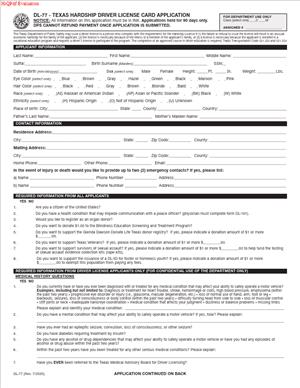
DL-77 – Texas Hardship Driver License Card Application
Fill out nowJurisdiction: Country: United States | Province or State: Texas
The DL-77 – Texas Hardship Driver License Card Application is a document used in Texas when you are asking for limited driving privileges after your license has been suspended. It is designed for people who have a valid reason to drive but are not currently eligible for a regular driver license.
If you are about to complete this form, you are likely trying to restore some ability to drive for essential purposes. This could include work, school, or necessary household duties. The form is part of a larger process that involves review by a court and state agencies.
A hardship driver license is not the same as a full, unrestricted license. It allows you to drive under specific conditions. The application is one of the first steps in requesting that limited privilege.
Understanding what this document does, and what it does not do, helps you avoid delays. Small errors or missing information can slow down your request. Knowing how the form fits into the overall process makes the completion clearer and less stressful.
What is DL-77 – Texas Hardship Driver License Card Application?
Clear definition
The DL-77 – Texas Hardship Driver License Card Application is a formal request submitted in Texas to seek a hardship driver license. It is typically used when your regular driver license has been suspended, revoked, or denied, but you need limited driving privileges due to a demonstrated hardship.
This form collects identifying information, details about your driving record, and the reason you are requesting restricted driving rights. It allows the reviewing authority to evaluate whether you meet the general eligibility requirements for a hardship license.
The document itself does not grant permission to drive. It is part of the application process that must be reviewed and approved before any restricted license is issued.
Who typically uses this form?
You may use this form if your driver license is currently suspended or if you have been denied a license and need limited driving privileges. Many applicants are individuals who rely on driving to maintain employment or attend school.
Parents or guardians may use the form on behalf of a minor in certain situations. In those cases, a court may need to review and approve the request before the license is issued.
People with prior traffic violations, uninsured accidents, or other driving-related issues may also find themselves completing this form. The common thread is that the person cannot legally drive without some form of special authorization.
In many cases, the applicant is acting without a lawyer. The form is structured so that a self-represented person can provide the required information clearly and directly.
Why might you need this form?
You might need this form because your daily life depends on driving. In Texas, public transportation may be limited depending on where you live. Without the ability to drive, getting to work or school can become extremely difficult.
If your income supports your household, losing driving privileges can affect more than just you. A hardship license application often explains how the suspension impacts your ability to meet financial responsibilities.
You may also need this form to comply with court-related requirements. In some situations, a court order authorizing a hardship license is part of the process. The form provides the official record of your request.
Another reason you may need this form is to avoid further legal trouble. Driving while your license is suspended can lead to additional penalties. A hardship license, if approved, gives you defined and lawful limits under which you can drive.
Typical real-life scenarios
- You receive notice that your license has been suspended due to too many traffic violations within a short period. You still need to commute to your job every weekday. Without driving, you risk losing employment. You use this form to request limited driving privileges so you can continue working.
- A parent of a teenager learns that their child’s license has been suspended after a driving-related offense. The teenager must drive to attend school and part-time employment. The parent helps complete the application and gathers the required supporting documents.
- You recently moved and did not receive certain notices about insurance requirements. As a result, your license was suspended. You now need to drive to fulfill job responsibilities that involve travel between work sites. The form allows you to explain your situation and request restricted privileges.
- You are a student enrolled in a program that requires in-person attendance at a campus outside walking distance. Your license was suspended, but you have no alternative transportation. The hardship license application becomes a way to show that driving is necessary for your education.
- You are the primary caregiver in your household. You must transport children or other dependents to school, medical appointments, or essential services. The inability to drive creates significant disruption. This form gives you a way to formally request limited driving rights tied to those responsibilities.
When would you use DL-77 – Texas Hardship Driver License Card Application?
You would use DL-77 – Texas Hardship Driver License Card Application when your driver license has been suspended, revoked, or denied, and you believe you qualify for limited driving privileges due to hardship.
Timing matters. You typically complete this form after you learn of the suspension and determine that you meet the basic conditions for requesting a hardship license. In many cases, this follows a court proceeding or administrative action related to your driving record.
If a court has indicated that you may request a hardship license, this form is often part of the required paperwork. It may be submitted along with other documents, such as proof of insurance, financial responsibility filings, or a court order.
Parents or guardians may use the form when a minor’s driving privileges have been affected and the minor needs to drive for essential reasons. In such cases, the adult usually provides information and signs where required.
You would not use this form to renew a regular driver license or to apply for a first-time unrestricted license. It is specifically for requesting restricted driving privileges due to hardship. Using the wrong form for your situation can lead to rejection or delays.
Legal characteristics of DL-77 – Texas Hardship Driver License Card Application
This application is an official government document. It requires accurate and truthful information. When you sign it, you confirm that the information provided is correct to the best of your knowledge.
For the application to be effective, it must be complete. Missing identifying details, incorrect driver license numbers, or inconsistent information about your suspension can lead to processing issues. In some cases, incomplete forms are returned without action.
Supporting documents are often required. While the form itself gathers key details, approval may depend on additional materials such as proof of identity, insurance, or court authorization. The form works together with those materials as part of a larger submission.
Rejection commonly occurs when the applicant does not meet basic eligibility requirements. For example, some suspensions may not qualify for a hardship license, or there may be mandatory waiting periods. The form cannot override statutory restrictions.
There can be differences in how hardship licenses are processed depending on the nature of the suspension. Administrative suspensions, court-ordered suspensions, and suspensions related to specific offenses may involve slightly different procedures. The form is a standard application, but the review process may vary depending on the underlying issue.
It is important to understand what this document does not do. It does not automatically reinstate your driving privileges. It does not cancel fines, remove violations from your record, or shorten a suspension period by itself. It is a request for limited permission to drive under defined conditions.
Is it legally binding?
The DL-77 form, often referred to simply as DL-77, is not a contract between private parties. It is an official application submitted to a government authority. When you sign it, you are making formal statements that can carry legal consequences if false.
Your signature affirms that the information is accurate. Providing false information can lead to denial of the request and may create additional legal problems. In that sense, the statements you make on the form are legally significant.
The approval of a hardship license, if granted, creates binding conditions. Those conditions may limit where and when you can drive. Violating those limits can result in further suspension or penalties. The application itself does not bind you to new obligations beyond honesty and compliance with the process, but any license issued as a result does impose enforceable restrictions.
How to fill out DL-77 – Texas Hardship Driver License Card Application
Step 1 – Read the entire form before writing anything
Start by reviewing every section of the document. Take note of what information is requested and whether additional documents are mentioned. This overview helps you gather everything in advance and avoid incomplete answers.
Step 2 – Provide your full legal name and identifying details
Enter your name exactly as it appears on your existing or most recent driver license or official identification. Include your date of birth, driver license number if available, and current residential address. Make sure the information matches your official records to prevent processing delays.
Step 3 – Describe the status of your driver license
Indicate whether your license is suspended, revoked, or denied. Provide the date of the action if requested. If the form asks for the reason for the suspension, answer clearly and consistently with any notices you received.
Step 4 – Explain the hardship you are claiming
Use the space provided to describe why you need limited driving privileges. Focus on essential activities such as employment, school attendance, or necessary household duties. Be specific about how the loss of driving privileges affects your daily responsibilities.
Step 5 – Identify the purpose and scope of requested driving privileges
If the form asks you to specify when and where you need to drive, provide realistic and accurate details. This may include work hours, school schedules, or recurring obligations. Clear information helps the reviewing authority understand the limits you are requesting.
Step 6 – Review insurance or financial responsibility information
If the application requires proof of insurance or financial responsibility, confirm that the information you provide matches your current policy or filings. Enter policy numbers or related details carefully, if requested on the form.
Step 7 – Check for required attachments
Before signing, confirm whether you must include supporting documents. This may involve a court order, proof of enrollment, employment verification, or other records. Attach copies as instructed and keep originals for your records unless the form specifically requires originals.
Step 8 – Read the certification statement carefully
Locate the section where you affirm that the information is true and correct. Read this statement in full. Make sure you understand that you are certifying the accuracy of everything written on the application.
Step 9 – Sign and date the application
Sign your name exactly as required. Enter the date of signing. If a parent or guardian must also sign, ensure that signature is included in the appropriate space. Unsigned forms are typically not processed.
Step 10 – Make a complete copy for your records
Before submitting the application, make a full copy of the completed form and all attachments. Keeping a copy allows you to refer back to what you submitted and respond clearly if questions arise later in the review process.
Legal terms you might encounter in DL-77 – Texas Hardship Driver License Card Application
- Hardship Driver License: A restricted driver license issued to someone whose regular driving privileges are suspended. It allows you to drive only for specific, approved purposes. On this form, you request this limited privilege and explain why you qualify.
- Occupational License: Another term often used for a hardship license. It refers to a court-authorized license that lets you drive for work, school, or essential household duties. The form may reference this concept when asking why you need to drive.
- Suspension: A temporary withdrawal of your driving privileges. The form asks you to identify the reason your license is suspended and the dates involved. You must provide accurate details because your eligibility depends on your suspension status.
- Revocation: A more serious action than suspension. Revocation cancels your license and usually requires you to reapply after a set period. If your driving record shows a revocation, you may need additional documents before this form can be processed.
- Essential Household Duties: Driving tasks necessary to maintain your household. This can include taking a family member to medical appointments or buying groceries. The form may require you to describe these duties clearly and specifically.
- Financial Responsibility: Proof that you can pay for damages if you cause a crash. This often means showing valid auto insurance. The form may require you to confirm that you have or will obtain proof of financial responsibility.
- SR-22: A certificate filed by an insurance company confirming you carry required coverage. If your suspension requires an SR-22, you must ensure it is on file before your hardship license can be approved.
- Court Order: A signed document from a judge granting you permission to apply for or receive a hardship license. In many cases, this form works together with a court order. You must ensure the information matches exactly.
- Affidavit: A written statement made under oath. Some parts of the form may function as an affidavit, meaning you are swearing the information is true. False statements can lead to penalties.
- Driving Record: Your official history of traffic violations, suspensions, and license status. The information you enter on the form should match your driving record. Discrepancies can delay or block approval.
FAQs
Do I need a court order before submitting DL-77 – Texas Hardship Driver License Card Application?
In many situations, yes. This document is often part of a larger process that begins with a judge granting you permission to drive on a restricted basis. Before you submit anything, confirm whether a signed court order is required in your case and make sure the dates and restrictions match what you enter on the application.
What information must match exactly with my driving record?
Your full legal name, date of birth, driver license number, and the status of your suspension must be identical to what appears in your official record. Even small differences, like a missing middle name or incorrect digit, can cause processing delays. Review your record carefully before completing this form.
How specific do I need to be when describing my hardship?
You should be detailed and concrete. If you are driving to work, include your employer’s name, work address, and typical hours. If you are driving for school, list the institution and class schedule. Vague statements such as “for personal reasons” are usually not enough to support approval.
What attachments should I include with this document?
Check whether you must include a copy of your court order, proof of financial responsibility, or other supporting paperwork. If your suspension requires special insurance filing, confirm it is active before you apply. Missing attachments are a common reason applications are returned unprocessed.
When does the hardship license become effective?
The effective date usually depends on approval and, in some cases, a court’s order. The date is not automatically the day you submit the paperwork. You should confirm the start date in writing before you begin driving under restricted privileges.
Do I have to list every place I plan to drive?
You need to identify the types of travel and main locations tied to your hardship. This typically includes work, school, medical appointments, and essential household errands. Be accurate and realistic. If you later drive outside approved purposes, you risk penalties.
What happens if I make a mistake on DL-77 – Texas Hardship Driver License Card Application after I submit it?
If you discover an error, act quickly. Contact the appropriate office and ask about correction procedures. In some cases, you may need to submit a corrected version of the DL-77 – Texas Hardship Driver License Card Application or provide written clarification to avoid delays.
Will this form change my public driving record?
Approval of this document does not erase a suspension or violation from your record. It authorizes limited driving privileges under specific conditions. Your driving history will still reflect the original suspension or revocation period.
Checklist: Before, During, and After DL-77 – Texas Hardship Driver License Card Application
Before
- Confirm your current license status and suspension dates.
- Obtain a certified copy of any required court order.
- Gather proof of financial responsibility or required insurance filings.
- Review your work, school, or medical schedules.
- Verify your full legal name matches your identification documents.
- Check whether waiting periods apply to your case.
- Prepare payment for any required fees.
- Make a list of essential driving purposes and locations.
During
- Print clearly in black or blue ink if completing by hand.
- Enter your driver license number exactly as issued.
- Double-check dates related to suspension or revocation.
- Provide detailed explanations of your hardship.
- Attach all required supporting documents.
- Review restrictions listed in any court order.
- Read the certification statement carefully.
- Sign and date the application where indicated.
After
- Make a full copy of everything you submitted.
- Confirm receipt if you submit in person.
- Track processing times and mark follow-up dates.
- Do not drive until you receive confirmation of approval.
- Store your hardship license and court order together.
- Calendar renewal or expiration dates.
- Update your employer or school if proof of restricted privileges is required.
- Keep insurance active and avoid lapses.
Common mistakes to avoid with DL-77 – Texas Hardship Driver License Card Application
- Mistake: Leaving sections blank because you are unsure, which happens when instructions feel unclear, can lead to rejection or delays, so do not forget to seek clarification and complete every required field.
- Mistake: Providing vague hardship reasons, often due to rushing, can result in denial because the reviewing authority cannot verify necessity, so do not forget to include specific locations, names, and schedules.
- Mistake: Listing incorrect suspension dates, which happens when you rely on memory instead of your record, may cause processing problems, so do not forget to verify all dates against official documents.
- Mistake: Forgetting required attachments, often due to not reviewing a checklist, can stop your application from moving forward, so do not forget to include court orders and proof of financial responsibility.
- Mistake: Signing before reviewing, which happens when you focus only on submission speed, can lock in errors under oath, so do not forget to read the certification carefully before signing.
- Mistake: Driving before approval, often because you assume submission equals permission, can lead to further penalties, so do not forget to wait for official confirmation.
- Mistake: Allowing required insurance filings to lapse, which may happen if you overlook renewal dates, can invalidate your restricted privileges, so do not forget to monitor coverage continuously.
- Mistake: Using a nickname instead of your legal name, which can occur out of habit, may cause mismatched records, so do not forget to match your identification exactly.
What to do after filling out DL-77 – Texas Hardship Driver License Card Application
Once you complete the form, slow down. Review every page. Look for missing signatures, unchecked boxes, or skipped lines. Small errors create big delays.
- Step 1: Make a complete copy of the signed form and all attachments for your records.
- Step 2: Confirm you have included any required court order and proof of financial responsibility.
- Step 3: Verify payment method and amount, if a fee applies.
- Step 4: Submit the application through the appropriate channel, such as in person or by approved delivery method.
- Step 5: Request a receipt or confirmation of submission.
- Step 6: Mark your calendar with an estimated response timeframe.
- Step 7: Check your mail or official communication method regularly for updates or requests for additional information.
- Step 8: Do not drive under hardship privileges until you receive clear approval.
- Step 9: Once approved, review all restrictions carefully, including allowed times and purposes.
- Step 10: Keep your hardship license card and any court order in your vehicle when driving.
- Step 11: Maintain continuous insurance coverage and any required filings.
- Step 12: Track the expiration date and begin renewal steps early if needed.
Stay organized. Keep a dedicated folder for all related documents. If your address changes, update your contact information promptly so you do not miss important notices. Careful follow-through protects the limited driving privileges you worked to obtain.
Disclaimer: This guide is provided for informational purposes only and is not intended as legal advice. You should consult a legal professional.