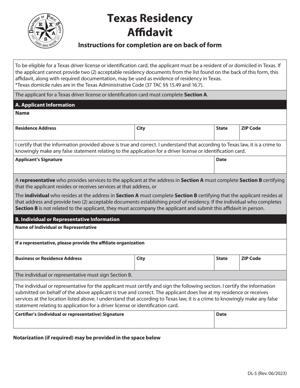
DL-5 – Texas Residency Affidavit
Fill out nowJurisdiction: Country: United States | Province or State: Texas
If you are applying for a Texas driver license or identification card and cannot provide standard proof of address, the DL-5 – Texas Residency Affidavit may become part of your paperwork. This form is used to confirm that you live at a specific Texas address.
The DL-5 – Texas Residency Affidavit is not a general residency statement. It is tied to identification and licensing matters handled by the Texas Department of Public Safety. It works alongside other documents in your application.
You might encounter this form if you live with someone else and do not have utility bills or lease agreements in your own name. It gives the state a way to verify your address through another person’s sworn statement.
When you are about to complete this form, you need to understand who signs it, what information it requires, and how it fits into your overall application. Small mistakes can delay your submission or require you to start over.
This guide walks you through what the form is, when it is used, and how to fill it out clearly and correctly.
What is DL-5 – Texas Residency Affidavit?
Clear definition
The DL-5 – Texas Residency Affidavit is a sworn statement confirming that an individual resides at a specific address in Texas. It is generally used when the person applying for a driver license or identification card cannot independently prove their Texas residency with standard documents.
An affidavit is a written statement made under oath. By signing this document, the person completing it is declaring that the information provided is true. Because it is sworn, false statements can carry legal consequences.
This form is not a lease, not a contract, and not proof of property ownership. It is a supporting document used to establish where someone lives for identification purposes.
Who typically uses this form?
This form is commonly used by individuals who live with family members, friends, or other hosts and do not have bills or official mail in their own name. Young adults living with parents often fall into this category.
It may also be used by people who recently moved to Texas and have not yet established utility accounts or other records reflecting their new address.
In many situations, the person who actually fills out and signs the affidavit is the host or homeowner. That person confirms that you live at the address listed on the form.
Why might you need this form?
Most driver license and identification applications require proof of Texas residency. Applicants are often asked to provide documents showing their name and residential address.
If you do not have enough qualifying documents, the affidavit may serve as an alternative way to confirm your address. It bridges the gap between your living situation and the formal documentation requirements.
The form helps the state confirm that the address you provide is real and that someone at that address can verify your residence. It supports the integrity of the identification process.
Typical real-life scenarios
- You are 18 and living with your parents. You do not pay utilities and your name is not on the lease. When applying for your first Texas driver license, you cannot provide standard proof of residency in your own name. A parent completes the affidavit to confirm that you live at their address.
- You recently moved in with a relative after relocating from another state. You have not yet updated your banking or employment records to reflect your new Texas address. The relative signs the form to confirm your residence while you gather additional documentation.
- You are temporarily living with a friend while searching for your own apartment. You need a Texas identification card for employment or school. Because you do not have official mail at the new address, your friend provides a sworn statement using the form.
- You are an elderly individual who moved in with an adult child for care. Most household bills remain in your child’s name. The affidavit helps confirm your residency at that shared address for identification purposes.
When would you use DL-5 – Texas Residency Affidavit?
You would use this form when you are applying for or updating a Texas driver license or identification card and cannot meet residency requirements through standard documents alone.
It often comes into play during first-time applications. Young applicants frequently rely on a parent or guardian to verify their residence.
It may also be relevant when updating your address on an existing license. If you have recently moved and do not yet have documents reflecting your new address, the affidavit may be used to support the change.
The form is typically part of a broader filing process. You may submit it together with other identification documents, proof of identity, and any required application forms.
In most cases, two roles are involved. One person is the applicant seeking the license or ID. The other is the individual who provides the sworn statement confirming that the applicant resides at the listed address.
Legal characteristics of DL-5 – Texas Residency Affidavit
This document functions as a sworn declaration. Its effectiveness depends on accurate information, proper completion, and a valid signature. In many cases, it must be signed in front of a notary public or authorized official to confirm the identity of the person making the statement.
Because it is an affidavit, the person signing it affirms the truth of the statements under oath. Providing false information can expose the signer to penalties associated with false statements.
The form generally requires complete details, including full names and the residential address. Missing fields, inconsistent information, or unreadable handwriting may lead to rejection or delays in processing.
Although this form supports proof of residency, it does not replace other identification requirements. It does not establish citizenship, immigration status, or driving eligibility. It addresses only the residency portion of the overall application.
Requirements can vary slightly depending on the specific licensing transaction. Some offices may require additional supporting documents from the host, such as proof that the host resides at the stated address.
Is it legally binding?
Yes, in the sense that it is a sworn statement made under oath. When someone signs the affidavit, they are legally affirming that the information is true to the best of their knowledge.
Its binding nature relates to the truthfulness of the statements. If the information is intentionally false, the signer may face consequences tied to making a false sworn statement.
However, it is not legally binding in the way a contract is. It does not create obligations between the applicant and the host. It does not transfer property rights or create tenancy rights. It serves a limited administrative purpose.
Its legal effect is focused on verifying residency for identification records. Once accepted, it becomes part of the official file supporting the license or ID issuance.
How to fill out DL-5 – Texas Residency Affidavit
Step 1 – Review the entire form before writing
Read the DL-5 – Texas Residency Affidavit from top to bottom before filling anything in. This helps you understand who must provide information and which sections apply to your situation. Confirm that you have the full legal names and correct residential address ready.
Step 2 – Enter the applicant’s full legal name
Write the applicant’s full legal name exactly as it appears on other identification documents. Avoid nicknames or shortened versions. Consistency across documents reduces the risk of processing delays.
Step 3 – Provide the complete Texas residential address
Enter the full street address where the applicant resides. Include apartment or unit numbers if applicable. Ensure the city, state, and ZIP code are correct and match other records used in the application.
Step 4 – Identify the person making the affidavit
The host or homeowner completing the affidavit must provide their full legal name. This should match their government-issued identification. Accuracy here is important because their identity may need to be verified.
Step 5 – Confirm the relationship and residency statement
The form typically includes language where the host states that the applicant resides at the listed address. Read this section carefully before signing. Make sure the statement accurately reflects the living arrangement.
Step 6 – Provide supporting details if required
Some versions of the form request additional information about the host, such as their driver license number or other identifying details. Enter this information clearly and double-check for accuracy.
Step 7 – Sign the affidavit in the proper setting
Sign the document only in the presence of the required official, if notarization or witnessing is part of the form’s process. Bring valid identification so your identity can be confirmed. Do not sign in advance unless the form explicitly allows it.
Step 8 – Verify completeness before submission
Review every section after signing. Confirm that names, addresses, and signatures are legible and complete. Ensure no required fields are left blank. Once confirmed, include the affidavit with the rest of your application documents for submission.
Legal terms you might encounter in DL-5 – Texas Residency Affidavit
- Affidavit: An affidavit is a written statement made under oath. When you sign this document, you are swearing that the information you provided about your Texas residence is true. False statements can lead to penalties because the statement is made under penalty of perjury.
- Affiant: The affiant is the person who makes and signs the sworn statement. In many cases, this is the person confirming residency, which may be you or someone who can verify where you live. The form will require the affiant’s signature.
- Notary Public: A notary public is an authorized official who verifies your identity and witnesses your signature. The notary confirms that you signed voluntarily and understood what you were signing. The affidavit is not valid unless properly notarized.
- Principal Residence: This refers to your main home where you actually live on a regular basis. The address you list must be your physical Texas residence, not a mailing address or a post office box. The form focuses on where you physically reside.
- Penalty of Perjury: This phrase means you could face legal consequences if you knowingly provide false information. When you sign the affidavit, you agree that everything stated is true to the best of your knowledge. This is why accuracy matters.
- Supporting Documentation: These are documents that back up your claim of residency. While the affidavit is a sworn statement, you may also need additional proof such as utility bills or lease agreements. The affidavit does not always replace the need for other records.
- Identification Information: This includes your full legal name, date of birth, and possibly your driver license or identification number. The details must match your official records exactly. Even small differences can cause delays.
- Signature Block: The signature block is the section where you sign and date the document. It often includes space for the notary’s seal and signature. Do not sign until you are in front of the notary.
- Jurats: A jurat is the notary’s certification that you swore or affirmed the statement before signing. It usually includes wording such as “Subscribed and sworn before me.” Without a completed jurat, the affidavit may be rejected.
FAQs
Do I have to sign the DL-5 – Texas Residency Affidavit in front of a notary?
Yes. This document is an affidavit, which means it must be signed under oath. You should wait to sign until you are physically in front of a notary public who can verify your identity and complete the notary section.
What address should I list if I recently moved?
You should list the physical address where you currently live in Texas. If you moved very recently, make sure the address matches what you are using for your identification records. The address you write should reflect your actual residence at the time you sign this form.
Can someone else complete this document on my behalf?
Another person may act as the affiant if they are confirming your residency, but they must provide accurate information and sign in front of a notary. You cannot sign for someone else unless the form specifically allows it and you have proper authority. Always check that the names and details are entered exactly as required.
What happens if my name on this form does not match my identification?
If your name does not match your official identification records, the affidavit may not be accepted. Make sure your full legal name appears exactly as it does on your driver license or identification card. Include any suffixes or middle names if they are part of your legal name.
Do I need to attach proof of residency to this affidavit?
The affidavit itself is a sworn statement, but you may still be asked to provide supporting documents. Requirements can vary depending on your situation. Review any instructions you received and gather documents that show your Texas address, such as lease agreements or recent bills.
When does the residency statement become effective?
The statement is effective as of the date you sign it in front of the notary. That date is written next to your signature and confirmed in the notary’s jurat. Make sure the date reflects the actual day you appear before the notary.
Will filing this document update my address automatically everywhere?
No. This document is typically used for a specific administrative purpose. It does not automatically change your address with other agencies or institutions, so you may need to update your address separately where required.
What if I make a mistake after signing the affidavit?
If you notice an error after signing, you should not alter the notarized document. Changes after notarization can invalidate it. You will likely need to complete a new DL-5 – Texas Residency Affidavit and have it notarized again.
Checklist: Before, During, and After DL-5 – Texas Residency Affidavit
Before
- Confirm your full legal name as it appears on your identification.
- Verify your complete physical Texas residential address.
- Gather any supporting residency documents you may need.
- Review the entire form to understand what is required.
- Check whether another person needs to act as the affiant.
- Locate a notary public and confirm availability.
- Bring valid government-issued identification for notarization.
During
- Print clearly in black or blue ink if completing by hand.
- Enter your full legal name without abbreviations.
- Provide the complete street address, including apartment number if applicable.
- Double-check all numbers, including zip code and ID numbers.
- Do not leave required fields blank.
- Wait to sign until you are in front of the notary.
- Ensure the notary completes all required sections, including seal and date.
After
- Review the notarized document for completeness.
- Make a copy for your personal records.
- Submit the original as instructed.
- Confirm receipt if submission is in person.
- Store your copy in a safe and accessible place.
- Update any related records if your address recently changed.
- Keep supporting documents together with your copy.
Common mistakes to avoid with DL-5 – Texas Residency Affidavit
- Mistake: Signing before meeting the notary, which happens when you try to save time, can invalidate the affidavit because it was not sworn properly, so do not forget to wait and sign only in front of the notary.
- Mistake: Listing a mailing address instead of your physical residence, often due to confusion about which address to use, can lead to rejection, so do not forget to provide the actual street address where you live.
- Mistake: Misspelling your legal name or leaving out a middle name, which happens when you rely on memory, may cause delays, so do not forget to match your identification exactly.
- Mistake: Leaving blank spaces in required sections because you assume they do not apply can result in processing issues, so do not forget to review every line before signing.
- Mistake: Making handwritten corrections after notarization, often done to fix small errors, can void the document, so do not forget to complete a new form if changes are needed.
- Mistake: Forgetting to bring valid identification to the notary, which can prevent notarization entirely, so do not forget to carry an acceptable government-issued ID.
What to do after filling out DL-5 – Texas Residency Affidavit
Once you complete and notarize the affidavit, your next steps matter just as much as filling it out correctly. Proper handling ensures it serves its intended purpose without delay.
Start by reviewing the entire document again. Check the spelling of your name, the accuracy of your address, and the date next to your signature. Confirm that the notary completed every required field, including their signature and seal.
- Step 1: Make at least one clear copy of the fully notarized affidavit for your records.
- Step 2: Organize any supporting residency documents you gathered and keep them with your copy.
- Step 3: Submit the original document according to the instructions you were given, whether in person or by mail.
- Step 4: If submitting in person, ask for confirmation that it was received and accepted.
- Step 5: If submitting by mail, consider using a method that provides delivery confirmation so you know it arrived.
- Step 6: Note the date of submission and any reference number connected to your transaction.
- Step 7: Monitor your application or record status to ensure there are no follow-up requests.
- Step 8: Respond promptly if you are contacted for additional information or clarification.
- Step 9: Store your copy in a safe place with other important identification records.
- Step 10: Update your address separately with any other agencies, employers, schools, or financial institutions if you have not already done so.
Keep your copy for future reference. If questions come up later about when or how you confirmed your Texas residency, you will have a clear record of what you submitted and when you signed it.
Disclaimer: This guide is provided for informational purposes only and is not intended as legal advice. You should consult a legal professional.