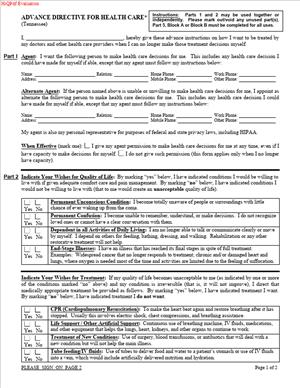
Advance Directive for Health Care
Fill out nowJurisdiction: Country: United States | Province or State: Tennessee
An Advance Directive for Health Care is a written document that explains your health care wishes if you cannot speak for yourself. It focuses on medical decisions, not money or property. You complete it while you have capacity, so others can rely on it later.
This document matters when illness or injury makes communication impossible or unclear. It gives guidance during stressful moments. It also reduces confusion and conflict among family members and medical staff.
The Advance Directive for Health Care usually combines two ideas. One part lets you name someone to make health care decisions. Another part records your treatment preferences in advance.
You can complete the form at any age. Many people wait until a health event. Others complete it during routine planning. Either way, it is meant to be used when decisions must be made quickly.
What is an Advance Directive for Health Care?
Clear definition
An Advance Directive for Health Care is a written statement of your medical decision-making preferences. It becomes relevant if you cannot communicate informed choices yourself. The document speaks for you when you cannot.
It commonly includes instructions about life-sustaining treatment. It may also name a health care agent. That agent acts as your voice within the limits you set.
The form does not provide medical treatment. It communicates consent or refusal ahead of time. Health care providers look to it for direction.
Who typically uses this form/document?
Adults of all ages use this document. Some complete it after a diagnosis. Others complete it as part of general planning.
People with chronic conditions often rely on it. People who travel frequently may also use it. Anyone who wants control over future care can complete it.
Family caregivers also benefit from this document. It gives them clarity when speaking with doctors. It reduces guesswork during emotional moments.
Why you might need this form/document
Medical decisions can arise suddenly. You may be unconscious or sedated. Without written guidance, others may struggle to decide.
This document lets you define limits on care. It also lets you express values about the quality of life. Those values guide choices that are not black and white.
Hospitals and clinicians often ask whether you have an advance directive. Having one ready avoids delay. It also prevents default decisions that may not match your wishes.
Typical real-life scenarios
- A person has a severe stroke and cannot speak. Doctors need guidance about life support. The Advance Directive for Health Care provides that guidance.
- Someone develops complications during surgery. Decisions about continued treatment must be made quickly. The named agent can act immediately.
- An older adult with dementia reaches a point where communication is unreliable. The document helps providers follow previously stated preferences.
- A person is injured in an accident while away from home. Family members disagree about care. The written directive helps resolve uncertainty.
When would you use an Advance Directive for Health Care?
You use this document when you cannot make or communicate health care decisions. It is not meant for everyday medical visits. It becomes relevant during serious illness or injury.
Doctors may look to it when you are unconscious or confused. Hospitals often ask for it at admission. Emergency situations may also trigger its use.
The person you name as an agent may use it when speaking with providers. That role often involves consent, refusal, or withdrawal of treatment. The document frames that authority.
Family members may rely on it when making decisions together. It sets expectations. It reduces the risk of conflict during high-stress situations.
Legal Characteristics of an Advance Directive for Health Care
This document has specific requirements to be considered valid. Those requirements relate to signing and witnessing. They exist to show that the document reflects your intent.
Incomplete forms can cause problems. Missing signatures, improper witnessing, or unclear language may delay use. Providers may hesitate if the document looks altered.
Rules vary by state in the United States. Details about witnesses or notarization can differ. Forms are often designed to match local expectations.
This document does not control non-medical matters. It does not distribute property. It does not name a guardian for children. It focuses only on health care decisions.
Is it legally binding?
An Advance Directive for Health Care is generally treated as legally effective when completed correctly. Health care providers usually follow it when it applies to the situation. They rely on it as an expression of your wishes.
Its effect depends on circumstances. It applies only when you lack capacity. If you can still decide, your current wishes control.
There are limits. Providers may not follow instructions that are medically inappropriate or impossible. The document guides decisions within standard medical practice.
How to fill out an Advance Directive for Health Care
Step 1 – Review the entire form before writing
Start by reading the full Advance Directive for Health Care from beginning to end. This helps you understand how the sections connect. It also prevents contradictory entries later.
Pay attention to optional sections. Some parts allow you to leave items blank. Others ask you to choose between options.
Reading first gives you context. It makes the completion process smoother and more intentional.
Step 2 – Enter your personal identifying information
The form begins by identifying you. This usually includes your full legal name. It may also request an address or date of birth.
Use consistent information. Match the name you use in medical records when possible. Clear identification helps providers link the document to you.
Avoid nicknames or shorthand. The goal is clarity, not brevity.
Step 3 – Designate a health care agent
Many forms allow you to name a health care agent. This is the person authorized to make decisions if you cannot. The agent acts only within the scope of the document.
Choose someone you trust to communicate clearly. This role may involve stressful conversations. Availability and willingness matter.
Write the agent’s full name and contact information. Accurate details help providers reach the right person quickly.
Step 4 – Name alternate or backup agents
Some forms allow you to name alternate agents. These people act if the primary agent is unavailable or unwilling. This provides continuity.
Alternates should understand your values. They should also be reachable. Listing more than one can prevent delays.
Make sure the order of priority is clear. Providers rely on the document to know who acts first.
Step 5 – Describe general treatment preferences
This section often addresses life-sustaining treatment. It may refer to situations like terminal illness or permanent unconsciousness. Read each option carefully.
You may be asked to choose between continuing or limiting certain treatments. The language can feel broad. Focus on the outcome you find acceptable.
Your selections guide decisions when circumstances match the description. They do not predict every medical scenario.
Step 6 – Address artificial nutrition and hydration
Some forms ask about feeding tubes or IV fluids. These are considered medical treatments. You may see separate choices for them.
Consider how you feel about these interventions in serious conditions. The form records your preference ahead of time.
If you are unsure, some forms allow you to defer to your agent. That choice gives flexibility.
Step 7 – Include instructions about pain relief and comfort care
Comfort care focuses on relief from pain and distress. Many people want this regardless of other choices. The form may ask you to confirm that preference.
This section clarifies priorities. It tells providers whether comfort is always desired. It also reassures family members.
Clear language here helps avoid misunderstandings about intent.
Step 8 – State any additional wishes or limitations
Some forms include space for personal statements. This can cover values, beliefs, or goals. It can also clarify what matters most to you.
Use plain language. Avoid vague phrases. Specific guidance is easier to apply.
This section can help your agent interpret choices not covered elsewhere.
Step 9 – Address organ or tissue donation, if included
Certain Advance Directives for Health Care forms include donation preferences. This section is optional in many cases. It may ask you to indicate yes or no.
Read the choices carefully. Donation decisions are separate from treatment decisions. One does not control the other.
If you complete this section, make sure it aligns with any other records you have.
Step 10 – Review for consistency and completeness
Before signing, review every section. Look for skipped lines or conflicting choices. Inconsistencies can create delays.
Check names and contact information. Small errors can cause big problems later.
Make changes cleanly if needed. Follow the form’s instructions for corrections.
Step 11 – Sign and date the form
Your signature shows that the document reflects your wishes. Sign using the name you listed earlier. Date the signature clearly.
The timing matters. The document generally speaks from the date of signing. A missing date can raise questions.
Sign only when you are ready. This is the final confirmation step.
Step 12 – Complete witnessing or notarization requirements
Many forms require witnesses or a notary. The rules vary by location. The form usually explains who can serve.
Witnesses confirm that you signed voluntarily. They do not approve of the content. Their role is procedural.
Complete this step carefully. Improper witnessing can affect acceptance.
Step 13 – Share copies with relevant people
After completion, make copies of the signed document. Provide them to your health care agent. Consider sharing with close family.
Health care providers may also keep a copy. Having it available increases the chance it is used when needed.
Store the original in a place others can access. The document is only helpful if it can be found.
Legal terms you might encounter in an Advance Directive for Health Care
- Health care agent: This is the person you name to make medical decisions for you if you cannot speak for yourself. In this document, you identify the agent by full legal name and contact details. The agent’s authority begins only when your capacity is impaired, not while you can decide on your own.
- Alternate agent: This is a backup decision-maker. The form usually lets you name one or more alternates in case your primary agent cannot be reached, declines to act, or is disqualified. Alternates step in only if the primary agent is unavailable.
- Incapacity: This refers to your inability to understand, evaluate, or communicate medical decisions. The form relies on this concept to trigger your agent’s authority. It does not mean you are unconscious; it can also mean confusion or severe cognitive impairment.
- Life-sustaining treatment: These are medical measures that keep you alive when you would otherwise die. In the document, you are asked to accept or refuse these treatments under certain conditions. Examples often include breathing support, dialysis, or medications that maintain blood pressure.
- Artificial nutrition and hydration: This term covers feeding or fluids provided through tubes or intravenous lines. The form typically asks whether you want these measures continued, limited, or stopped in specific situations. Your answer guides providers when you cannot eat or drink on your own.
- Terminal condition: This describes an illness that cannot be cured and is expected to result in death. The form uses this term to frame when certain instructions apply. Your preferences may differ depending on whether recovery is possible.
- Persistent vegetative state: This refers to a condition where you are awake but not aware, with no reasonable chance of regaining consciousness. Some forms use this term to ask about long-term treatment decisions. Your selections clarify whether continued medical support aligns with your wishes.
- Comfort care: This focuses on relieving pain and discomfort rather than curing illness. In the document, comfort care is often the default if you refuse aggressive treatment. It includes pain control, emotional support, and basic care.
- Organ or tissue donation: This section records whether you want to donate organs or tissues after death. The form may ask you to specify which organs or leave it broad. Your choice can also affect how medical care is managed at the end of life.
FAQs
When does this form actually take effect?
This document becomes effective when you lack the ability to make or communicate your own health care decisions. You do not need to file it with a court for it to work. You should confirm that the effective trigger is clearly stated in the form and that your agent understands it.
Do I still make my own decisions after signing?
Yes. As long as you can understand your options and communicate a choice, you remain in charge. This form only shifts authority when incapacity is determined. Make sure nothing in your entries suggests you are giving up control earlier than intended.
Who decides that I am no longer able to decide?
Usually, a medical professional evaluates your condition and records a finding of incapacity in your medical record. Your agent does not decide this alone. You should check that the form does not require extra steps you did not intend.
Can I name more than one decision-maker at the same time?
Most versions ask you to name one primary agent, not co-agents. If you try to give equal authority to two people, it can cause conflict or delays. Use the alternate agent section instead and list people in a clear order.
What if my agent disagrees with my written wishes?
Your written instructions control. The agent’s role is to follow what you recorded or, if unclear, to apply your values. This is why you should be specific and review the consistency of all sections before signing.
Do I need witnesses or a notary for it to count?
Many forms require witnesses, a notary, or both to be valid. You must complete that section exactly as written, including signatures and dates. Missing this step can make the document unusable when it is needed.
Can I change or cancel it later?
Yes. You can revoke or replace this document at any time while you have capacity. If you update it, make sure the old version is clearly marked as revoked and removed from circulation.
Will hospitals and doctors accept it right away?
Most providers will honor a properly completed Advance Directive for Health Care once they receive a copy. You may need to confirm that it has been added to your medical record. Always keep a copy available in case systems are not connected.
Checklist: Before, During, and After Advance Directive for Health Care
Before
- Read the entire form once without writing anything.
- Think about your values around quality of life and independence.
- Choose a health care agent you trust and can reach quickly.
- Talk with that person about your wishes and expectations.
- Consider situations where you would or would not want life-sustaining treatment.
- Gather full legal names and contact details for agents and alternates.
- Check whether witnesses or notarization will be required.
During
- Enter your legal name exactly as it appears on identification.
- Clearly designate a primary agent and at least one alternate.
- Mark treatment preference boxes carefully and consistently.
- Write additional instructions in plain, direct language.
- Review sections on artificial nutrition and hydration closely.
- Complete organ or tissue donation choices if included.
- Sign and date the form in the correct place.
- Complete all witness or notary sections as instructed.
After
- Make several clear copies of the signed document.
- Give a copy to your health care agent and alternates.
- Provide a copy to your primary care provider.
- Ask whether it has been added to your medical record.
- Store the original in a safe but accessible location.
- Tell close family members where copies are kept.
- Review the document periodically for changes in wishes.
- Replace it promptly if your situation or preferences change.
Common mistakes to avoid with an Advance Directive for Health Care
- Mistake: Naming an agent without discussing your wishes, which happens because people avoid hard conversations, leads to guesswork in emergencies, and means you must not forget to talk through scenarios first.
- Mistake: Leaving treatment sections blank due to uncertainty, which happens when forms feel overwhelming, causes delays or default care you might not want, and means you must not forget to mark clear choices.
- Mistake: Using vague language like “no heroic measures,” which happens from copying phrases, creates confusion for providers and means you must not forget to be specific.
- Mistake: Forgetting to complete witness or notary requirements, which happens because signing feels final, invalidates the document, and means you must not forget the execution section.
- Mistake: Listing outdated contact information, which happens over time, prevents reaching your agent, and means you must not forget to update details.
- Mistake: Naming co-agents with equal authority, which happens to avoid hurt feelings, causes conflicts, and means you must not forget to choose a single decision-maker.
- Mistake: Failing to distribute copies, which happens after signing the relief, makes the document unavailable and means you must not forget to share it.
- Mistake: Assuming it covers all end-of-life decisions, which happens from misunderstanding the scope, leaves gaps, and means you must not forget to review related documents if needed.
What to do after filling out an Advance Directive for Health Care
Once the document is complete, your focus shifts to making sure it can actually be used. A signed form that no one can find or verify will not help in an emergency. You are responsible for distribution, confirmation, and upkeep.
- Step 1: Make several clean copies of the signed and witnessed or notarized document. Keep the original intact.
- Step 2: Give a copy to your primary health care agent and each alternate. Walk them through the key instructions so they understand your priorities.
- Step 3: Provide a copy to your primary care provider and ask that it be added to your medical record. Confirm the office knows how to flag it.
- Step 4: If you receive care at multiple facilities, share a copy with each one. Do not assume records are automatically shared.
- Step 5: Keep a copy in a place that is easy to access in an emergency. Avoid locking it away where no one can reach it.
- Step 6: Tell close family members or trusted friends that the document exists and where it is stored. This reduces disputes later.
- Step 7: Review the document every few years or after major life events. Changes in health, relationships, or beliefs may require updates.
- Step 8: If you revise or replace it, clearly mark older versions as revoked. Collect and destroy outdated copies when possible.
- Step 9: Update related personal records so names, dates, and preferences stay consistent across documents.
- Step 10: Reconfirm acceptance with your provider after any update to ensure the current version is on file.
Disclaimer: This guide is provided for informational purposes only and is not intended as legal advice. You should consult a legal professional.