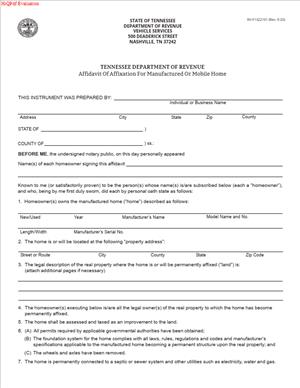
RV-F1322101 – Affidavit Of Affixation For Manufactured Or Mobile Home
Fill out nowJurisdiction: Country: United States | Province or State: Tennessee
If you own a manufactured or mobile home in Tennessee and have permanently attached it to land you own, you may come across the RV-F1322101 – Affidavit Of Affixation For Manufactured Or Mobile Home. This form plays a key role in changing how your home is legally classified.
Manufactured and mobile homes often begin as personal property, similar to a vehicle. When they are permanently attached to real estate, their status can change. This document helps reflect that change in official records.
The RV-F1322101 – Affidavit Of Affixation For Manufactured Or Mobile Home is filed with the Tennessee Department of Revenue. It connects the home to the land and confirms that it is no longer intended to be moved.
If you are refinancing, selling property, settling an estate, or updating title records, this filing can become important. Understanding what it does and how to complete it can prevent delays and confusion.
What is RV-F1322101 – Affidavit Of Affixation For Manufactured Or Mobile Home?
Clear definition
The RV-F1322101 – Affidavit Of Affixation For Manufactured Or Mobile Home is a sworn statement. It declares that a manufactured or mobile home has been permanently attached to a specific piece of real property.
By signing this affidavit, the property owner confirms that the home is affixed to land they own and that it is intended to remain there permanently. The document is used to update state records so the home is treated as part of the real estate rather than as movable personal property.
In practical terms, it links the home’s identifying information, such as the serial or VIN number, to a legal description of the land. This creates a formal connection between the structure and the property.
Who typically uses this form?
This form is most commonly used by property owners who have placed a manufactured or mobile home on land they own. The land may be residential, rural, or part of a larger parcel.
Lenders may become involved when a homeowner refinances or takes out a mortgage. A lender may require proof that the home is legally part of the real estate before approving financing secured by the property.
Title holders and lienholders may also be connected to the process. If there is an existing title to the manufactured home, that title may need to be addressed as part of the affixation process.
In some cases, estate representatives or heirs use this form when settling property after a death. It helps clarify whether the home is treated as real property or personal property for record purposes.
Why might you need this form?
You might need this form if your manufactured or mobile home was originally titled like a vehicle and you have since permanently installed it on land you own. Filing the affidavit can help align the legal records with the physical reality.
Without this document, the home may still appear in state records as personal property. That can complicate a sale, refinancing, or transfer of ownership. A buyer or lender may question whether the home is properly tied to the land.
The form may also be relevant when you want the home to be taxed as real property instead of personal property. How a home is classified can affect assessment and recordkeeping.
If you are converting a manufactured home to be part of your primary residence on owned land, this filing often becomes part of the documentation trail that confirms the change.
Typical real-life scenarios
- A homeowner buys a piece of rural land and places a new manufactured home on a permanent foundation. The home is connected to utilities and is not intended to be moved. The owner files the affidavit to reflect that the home is now part of the real estate.
- A family inherits property that includes a manufactured home sitting on a permanent foundation. When preparing to sell, they discover that the home is still titled separately. They use the affidavit to clarify its status before listing the property.
- A borrower applies for a mortgage to refinance both the land and the manufactured home. The lender reviews records and requests documentation showing that the home is affixed. The affidavit becomes part of the loan process.
- A property owner previously financed the home separately from the land. After paying off the loan, the owner wants to combine the home and land into a single real estate asset. The affidavit supports that transition.
When would you use RV-F1322101 – Affidavit Of Affixation For Manufactured Or Mobile Home?
You would use this form when a manufactured or mobile home has been permanently attached to land that you own, and you want official records to reflect that fact. Timing often depends on your next transaction.
For example, if you are preparing to sell the property, it may come up during the title review. A title company or closing agent may notice that the home is still listed as personal property. Filing the affidavit can help align the property description before closing.
If you are applying for financing, a lender may request confirmation that the home is part of the real estate securing the loan. This document supports that classification.
You might also use it after completing the installation of the home on a permanent foundation. Once the home is no longer movable and is integrated with the land, the affidavit helps document that change.
The form may also be used after resolving liens or ownership issues tied to the home’s original title. Once those issues are addressed, the affidavit can serve as the next step in formally affixing the home to the land.
Legal characteristics of RV-F1322101 – Affidavit Of Affixation For Manufactured Or Mobile Home
This document is an affidavit. That means it is a sworn statement made under penalty of perjury. The person signing declares that the information provided is true and accurate.
For the form to be effective, it typically must be fully completed, signed by the appropriate owner or owners, and notarized. Missing signatures, incomplete property descriptions, or incorrect serial numbers can delay processing.
The affidavit usually includes detailed information about the home, such as the manufacturer, model year, and identification numbers. It also includes a legal description of the land, not just a street address. The legal description ties the home to a specific parcel in official records.
If there are existing liens on the home, those interests may need to be addressed before or during the affixation process. An unresolved lien can create conflicts in ownership records.
High-level requirements can vary between states. Some states require surrender of the original certificate of title. Others may have separate procedures through local offices. In Tennessee, the form is connected to state revenue and title records.
It is important to understand what this affidavit does not do. It does not transfer ownership of the land. It does not create a new deed. It does not automatically remove all liens. Its purpose is to declare and record that the home has been permanently affixed to specific real property.
Is it legally binding?
Yes, an affidavit of affixation is generally legally binding once properly completed and notarized. Because it is sworn, the signer is legally responsible for the truth of the statements made.
Its binding effect comes from two main elements. First, the affidavit is made under oath. Second, it is submitted to a government agency for official record purposes. False or misleading information can carry legal consequences.
However, its legal impact is limited to what it states. It confirms that a manufactured or mobile home has been permanently affixed to certain land. It does not override other legal documents such as deeds, mortgages, or court orders.
The form becomes part of the public or official record once processed. From that point forward, it can affect how the property is treated in transactions, taxation, and financing.
How to fill out RV-F1322101 – Affidavit Of Affixation For Manufactured Or Mobile Home
Step 1 – Identify the property owner
Enter the full legal name of the property owner or owners. The name should match the name on the deed to the land. If there are multiple owners, list each one exactly as it appears in property records.
Step 2 – Provide the property address and legal description
Include the physical address of the property where the home is located. Then add the full legal description of the land. This may be found on your deed or prior closing documents. The legal description is essential because it precisely identifies the parcel.
Step 3 – Enter manufactured or mobile home details
Provide detailed information about the home. This usually includes the manufacturer, model, model year, and the serial number or VIN. Double-check these numbers against the home and any existing title documents to avoid errors.
Step 4 – Reference title information
If the home was previously titled as personal property, include the title number and related information requested on the form. This helps connect the affidavit to the existing state record for that home.
Step 5 – Address lienholder information
If there is or was a lien on the manufactured or mobile home, complete the section that lists lienholder details. Provide names and any requested identifying information. Make sure the information is consistent with prior title or loan records.
Step 6 – Review statements of affixation
Read the sworn statements carefully. These statements typically confirm that the home is permanently attached to the land, that the affixation is intended to be permanent, and that the signer is the lawful owner.
Ensure that the facts match your situation. The affidavit is a sworn declaration, so accuracy is critical.
Step 7 – Sign in the presence of a notary
Sign the form where indicated. This must usually be done in front of a notary public. The notary will verify your identity and witness your signature. The notary then completes the acknowledgment section.
Step 8 – Prepare the form for submission
After signing and notarizing, review the entire document for completeness. Confirm that all required fields are filled in and that attachments, if any, are included. The form is then ready for submission to the appropriate state office for processing.
Legal terms you might encounter in RV-F1322101 – Affidavit Of Affixation For Manufactured Or Mobile Home
- Affidavit: An affidavit is a written statement made under oath. When you sign this document, you swear that the information you provide is true. Because it is sworn, false statements can lead to legal consequences.
- Affixation: Affixation means permanently attaching the manufactured or mobile home to real property. On this form, you confirm that the home is physically attached to land you own and is intended to remain there as a permanent improvement.
- Real Property: Real property refers to land and anything permanently attached to it, such as buildings or fixtures. By filing this document, you are stating that the manufactured or mobile home is now part of the real property rather than personal property.
- Personal Property: Personal property includes movable items that are not permanently attached to land. Manufactured homes are often treated as personal property until they are affixed. This document records the change from personal property status to real property status.
- Certificate of Title: A certificate of title shows legal ownership of the manufactured or mobile home when it is treated like a vehicle. This form typically requires information from the existing title so the state can connect the home to its prior ownership record.
- Lienholder: A lienholder is a lender or other party that has a legal claim against the home as security for a debt. If there is an outstanding loan, the lienholder’s information must be listed. Their interest may need to be addressed before the home’s status changes.
- Legal Description: A legal description precisely identifies the land where the home is located. It is more detailed than a street address and may include lot numbers, subdivision names, or metes and bounds. The form relies on this description to tie the home to the correct parcel.
- Notary Public: A notary public is an official who verifies your identity and witnesses your signature. The notary confirms that you signed voluntarily. The notarization makes the affidavit acceptable for recording.
- Recording: Recording means officially filing the document with the appropriate public office so it becomes part of the public record. Once recorded, the affixation is visible to lenders, buyers, and title companies.
FAQs
Do I need to file this form if my manufactured home is already sitting on my land?
If your home is on land you own but is still titled like a vehicle, this document is used to show that it is permanently attached and should be treated as part of the real estate. Simply placing the home on your property is not the same as legally changing its status. You use this form to connect the home to the legal description of the land and to update the public record.
What information from the title do I need to complete this document?
You usually need the title number, vehicle identification number (VIN), and the exact owner’s name as it appears on the title. The name must match what is listed in ownership records. If there is a lien listed on the title, you must also include the lienholder’s details so the record is accurate.
What if there is still a loan on the home?
If a lender is listed as a lienholder, you must confirm whether their interest has been released or remains in place. Some filings require proof that the lien has been satisfied or written consent from the lender. If you leave out lien information, the filing may be rejected or cause delays in future sales or refinancing.
When does the change from personal property to real property become effective?
The change is generally recognized when the RV-F1322101 – Affidavit Of Affixation For Manufactured Or Mobile Home is properly completed, notarized, and accepted for recording. The effective date may be tied to the recording date. You should check that the recorded copy shows a stamped or marked filing date.
Who must sign this form?
All legal owners listed on the title and the land records typically need to sign. If ownership of the land and the home differ, you must make sure the signer has authority to declare the affixation. If an entity owns the property, the person signing must have authority to act for that entity.
What happens to the original certificate of title after filing?
Once the home is treated as real property, the certificate of title is no longer used in the same way. The RV-F1322101 – Affidavit Of Affixation For Manufactured Or Mobile Home helps transition the record so ownership is tracked through land records instead of vehicle title records. Keep any surrendered or marked documents for your files.
Can I use this document when I am selling the property?
You can use this document before or as part of a sale if the home has not yet been legally affixed. Buyers and lenders often require confirmation that the home is real property. Filing this document in advance can prevent closing delays.
What if my name is slightly different on the land deed and the home title?
The names must match or be clearly connected. Even small differences, such as a missing middle initial, can cause questions. You may need supporting documents that show the names refer to the same person. Review every name entry carefully before signing the RV-F1322101 – Affidavit Of Affixation For Manufactured Or Mobile Home.
Checklist: Before, During, and After RV-F1322101 – Affidavit Of Affixation For Manufactured Or Mobile Home
Before
- Confirm you own both the manufactured or mobile home and the land where it is located.
- Locate the certificate of title and verify the VIN and title number.
- Review the deed to obtain the full legal description of the property.
- Check for any active liens on the home and gather lienholder details.
- Make sure all owners are available to sign.
- Verify that the home is permanently attached to a foundation.
- Prepare a valid photo ID for notarization.
During
- Enter the owner names exactly as shown on official records.
- Carefully copy the legal description without abbreviating or skipping lines.
- Double-check the VIN and title number for accuracy.
- List all lienholders, if any, in the correct section.
- Read each sworn statement before signing.
- Sign only in front of a notary public.
- Confirm the notary completes all required fields and applies a seal.
After
- Make at least two copies of the signed and notarized document.
- Submit the original to the appropriate recording office.
- Pay any required filing or recording fees.
- Obtain confirmation that the document was accepted and recorded.
- Request a stamped or certified copy for your records.
- Store the recorded copy with your deed and property documents.
- Update your personal property records to reflect the change.
- Notify your lender, if applicable, that the filing is complete.
Common mistakes to avoid with RV-F1322101 – Affidavit Of Affixation For Manufactured Or Mobile Home
- Mistake: Entering a street address instead of the full legal description because it seems easier, which can cause rejection or misidentification of the property; do not forget to copy the complete legal description from your deed.
- Mistake: Listing a VIN with one incorrect digit due to a typing error, which can disconnect the home from its title record; do not forget to verify the VIN directly from the title and the home itself.
- Mistake: Failing to include a lienholder because you believe the loan is nearly paid off, which can delay recording or create title problems later; do not forget to confirm the exact lien status before filing.
- Mistake: Signing the document before meeting with a notary, which can invalidate the notarization and require you to redo the form; do not forget to wait and sign in the notary’s presence.
- Mistake: Using a nickname or shortened name that does not match the deed or title, which may raise questions about ownership; do not forget to use your full legal name exactly as shown on official records.
- Mistake: Assuming the filing is complete once you mail it, which can leave you unaware of a rejection or deficiency; do not forget to confirm acceptance and obtain proof of recording.
- Mistake: Keeping only one copy of the recorded document, which can create stress if the original is lost; do not forget to store multiple copies in safe locations.
What to do after filling out RV-F1322101 – Affidavit Of Affixation For Manufactured Or Mobile Home
Once you have completed and notarized the document, your focus shifts to proper filing and recordkeeping. The goal is to make sure the change in status is officially recognized and easy to prove later.
- Step 1: Review the entire document one more time for accuracy.
- Step 2: Make at least two complete copies before submission.
- Step 3: Submit the original signed and notarized form to the appropriate recording office.
- Step 4: Pay the required recording fee and request a receipt.
- Step 5: Confirm the document has been accepted, not rejected for corrections.
- Step 6: Obtain a recorded copy showing the filing date and any instrument number.
- Step 7: Place the recorded copy with your deed and other real estate records.
- Step 8: Update your personal files to reflect that the home is now part of the real property.
- Step 9: Provide a copy to your lender if there is an active mortgage or loan.
- Step 10: Keep proof of recording accessible for future refinancing or sale.
After recording, treat the manufactured or mobile home as part of your real estate documentation. When you refinance, sell, or transfer the property, this recorded affidavit helps show that the home and land are legally connected. Keeping organized records now can prevent delays and questions later.
Disclaimer: This guide is provided for informational purposes only and is not intended as legal advice. You should consult a legal professional.