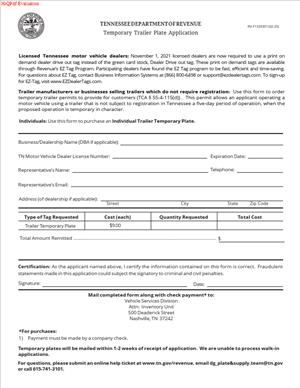
RV-F1320301 – Temporary Trailer Plate Application
Fill out nowJurisdiction: Country: United States | Province or State: Tennessee
The RV-F1320301 – Temporary Trailer Plate Application is a state-issued form used to request a temporary plate for a trailer. If you recently bought a trailer or need to move one before full registration is complete, this document allows you to lawfully operate it for a limited time.
You are likely looking at the RV-F1320301 – Temporary Trailer Plate Application because you need a quick, lawful way to move or transport a trailer. This form connects your trailer to a temporary registration record in the state system.
Temporary plates are not permanent registration. They are short-term authorizations. They give you time to complete ownership transfers, inspections, or full registration without leaving the trailer unregistered.
Understanding what this form does and what it does not do helps you avoid delays. It also reduces the risk of rejection due to missing information. When you fill it out carefully, you create a clear record of who owns the trailer and why a temporary plate is needed.
What is RV-F1320301 – Temporary Trailer Plate Application?
Clear definition
RV-F1320301 – Temporary Trailer Plate Application is a written request submitted to the Tennessee Department of Revenue to obtain a temporary license plate for a trailer. It gathers identifying information about the trailer, the owner, and the reason for the temporary plate.
The form acts as an official request for limited registration. It links the trailer’s vehicle identification number, ownership details, and contact information to a temporary plate issued for a specific period.
This is not a bill of sale and not a permanent title application. It is a short-term registration document designed to bridge the gap between purchase or transfer and full registration.
Who typically uses this form?
Individuals who purchase a new or used trailer often use this form. This includes buyers of utility trailers, boat trailers, travel trailers, or other towable units that require registration.
Dealers may also be involved in the process, especially when a trailer is sold and needs to be transported before permanent plates are issued. In some cases, businesses that move trailers for resale or transfer use the form as part of their transaction process.
Private sellers and buyers completing a transfer may rely on this application when the trailer must be moved from one location to another before full registration is complete.
Why might you need this form?
You may need this form if you just bought a trailer and cannot complete permanent registration immediately. A temporary plate allows you to tow it legally while the paperwork is being finalized.
You might also need it if you are transferring ownership and require short-term authorization to move the trailer to your home, storage site, or inspection location.
In some situations, administrative delays occur. The temporary plate helps ensure the trailer is not being operated without registration during that gap.
Typical real-life scenarios
- You purchase a used utility trailer from a private seller in another county. The title transfer process is not complete the same day. You apply for a temporary plate so you can tow it home legally.
- You buy a new trailer from a dealer. The dealer processes title and registration paperwork, but permanent plates are not ready. A temporary plate allows you to use the trailer in the meantime.
- You inherit a trailer and are working through ownership documentation. You need to relocate it from a family property to your own address. A temporary plate provides lawful movement during the transition.
- You restore an older trailer that was previously unregistered. While gathering documents for permanent registration, you request a temporary plate to move it for inspection or repairs.
When would you use RV-F1320301 – Temporary Trailer Plate Application?
You use RV-F1320301 – Temporary Trailer Plate Application when a trailer requires registration but only temporary authorization is needed. This commonly happens during ownership changes, recent purchases, or pending paperwork.
The timing usually falls between acquisition and full registration. For example, you may have a signed title but not yet completed the full registration process. The temporary plate fills that time gap.
This form may also be used when relocating a trailer across counties within the state. If the trailer must be transported before official plates are issued, the temporary plate provides limited permission.
Businesses involved in trailer sales or transfers often coordinate this application as part of closing a transaction. Individuals typically use it during private sales or personal purchases.
You would not use this form for permanent registration. Nor would you use it if the trailer is already fully registered and plated. Its purpose is limited and specific.
Legal characteristics of RV-F1320301 – Temporary Trailer Plate Application
This application becomes effective once approved and processed by the appropriate state authority. The form itself is a request. It does not grant rights until the temporary plate is officially issued.
For the application to be valid, the information provided must be complete and accurate. This typically includes the trailer’s identification number, ownership details, and applicant information. Missing or inconsistent data may delay or prevent issuance.
Common issues that lead to rejection include incorrect vehicle identification numbers, mismatched ownership names, unsigned forms, or incomplete contact information. Even small errors can create discrepancies in the registration record.
The form is generally tied to a specific period of validity. Temporary plates usually expire after a set number of days. Once expired, they no longer authorize the operation of the trailer.
Requirements may vary depending on the type of trailer and the circumstances of ownership. For example, commercial trailers and personal trailers may involve different supporting documentation. The exact process can differ slightly depending on where and how the application is submitted.
It is important to understand what this form does not do. It does not transfer ownership by itself. It does not replace a title. It does not create permanent registration. It only supports temporary authorization to operate or move the trailer.
Is it legally binding?
The RV-F1320301 – Temporary Trailer Plate Application is a legally recognized government form. When you sign it, you are certifying that the information provided is true and correct to the best of your knowledge.
Your signature typically confirms that you understand the temporary nature of the plate and that you meet the eligibility conditions for issuance. Providing false information may carry legal consequences under general state registration rules.
The application becomes legally effective only after approval and issuance of the temporary plate. Until then, it is simply a submission under review.
Once a temporary plate is issued, operating the trailer within the authorized time frame is generally permitted under state registration rules. Operating outside those limits may lead to enforcement issues.
How to fill out RV-F1320301 – Temporary Trailer Plate Application
Step 1 – Review the Form Header and Instructions
Start by reading the title and any instructions printed at the top of the form. Confirm that you are completing the correct document for a temporary trailer plate. Look for details about eligibility and required attachments.
This first review helps you understand what information you will need before writing anything. Gather ownership documents, identification details, and trailer information in advance.
Step 2 – Enter Applicant Information
Provide your full legal name as it appears on your identification and ownership documents. Include your current address and contact information as requested.
Make sure the name matches the title or transfer paperwork. Differences in spelling or initials can create delays. If the trailer is owned jointly, follow the format indicated on the form for multiple owners.
Step 3 – Provide Trailer Details
Enter the trailer’s vehicle identification number carefully. This number is often found on the frame or listed on the title. Double-check each character before moving on.
Include the make, model, year, and body type if requested. These details help confirm the trailer’s identity and classification within the registration system.
Accuracy in this section is critical. A single incorrect digit in the identification number can cause the application to be rejected or misapplied to the wrong record.
Step 4 – State the Reason for the Temporary Plate
Indicate why you are requesting a temporary plate. This may include recent purchase, pending registration, or transfer of ownership.
Be clear and consistent with supporting documents. The reason you provide should align with the title, bill of sale, or other paperwork connected to the trailer.
This explanation helps officials determine whether the request meets the general conditions for temporary issuance.
Step 5 – Confirm Ownership and Certification Statements
Read the certification section carefully. This part usually confirms that the information provided is true and that you understand the temporary nature of the plate.
Review each statement before signing. Make sure all information above this section is complete and accurate.
Your signature typically affirms your responsibility for the trailer during the temporary period.
Step 6 – Sign and Date the Application
Sign your name exactly as listed in the applicant section. Enter the date of signing in the format requested on the form.
If there are multiple owners, ensure each required party signs in the appropriate place. Missing signatures are a common reason for processing delays.
Dating the form accurately helps establish when the request was made and supports proper recordkeeping.
Step 7 – Attach Required Supporting Documents
Review the form to see what additional documents must accompany the application. This may include proof of ownership or identification information.
Confirm that copies are legible and that identifying numbers match what you entered on the form. Attach everything securely to avoid separation during processing.
Incomplete submissions can delay issuance of the temporary plate.
Step 8 – Submit the Completed Application
After reviewing the entire document, submit it through the method indicated on the form. This may involve presenting it in person or through an approved submission channel.
Keep a copy of the completed form and any supporting documents for your records. Having your own copy allows you to verify the information provided if questions arise later.
Once submitted, the application will be reviewed. If approved, a temporary trailer plate will be issued for the limited period authorized.
Legal terms you might encounter in RV-F1320301 – Temporary Trailer Plate Application
- Temporary Plate: A temporary plate is a short-term registration authorization that allows you to legally operate your trailer for a limited period. On this form, you request permission to display a temporary plate until you complete full registration. The plate usually has an expiration date printed on it. You must stop using it once that date passes.
- Applicant: The applicant is the person or business requesting the temporary trailer plate. This is the name that must match the ownership documents for the trailer. If you are signing on behalf of a business, the business is the applicant, not you personally.
- Vehicle Identification Number (VIN): The VIN is a unique serial number assigned to your trailer. You must enter it exactly as it appears on the trailer and title documents. Even one wrong digit can cause delays or rejection because the VIN confirms the trailer’s identity.
- Gross Weight Rating: This refers to the maximum weight the trailer is designed to carry, including its own weight and cargo. The form may ask for this to determine proper classification. You should check the manufacturer’s label or title for the correct number.
- Statement of Ownership: This is your confirmation that you legally own the trailer or have the right to register it. By signing, you affirm that the information you provide is accurate. False statements can result in penalties or cancellation of the temporary plate.
- Certification: The certification section is where you declare that all details on the application are true. It usually includes language about penalties for providing false information. Your signature makes this certification legally meaningful.
- Expiration Date: The expiration date tells you when the temporary plate is no longer valid. You are responsible for completing permanent registration before this date. Driving with an expired temporary plate can result in fines or citations.
- Authorized Signature: An authorized signature is required to make the document valid. If the trailer is owned by a business, the signer must have authority to act for that business. The name and title of the signer should be clear and match any business records.
- Issuing Authority: This refers to the government office that reviews and processes your application. They verify the information and issue the temporary plate if everything is complete. If something is missing, they may return or reject the application.
FAQs
How long is a temporary trailer plate valid?
The validity period is printed on the temporary plate or provided when your application is approved. You should check the expiration date carefully before using the trailer on public roads. The temporary authorization only covers the specific time listed. Once it expires, you must have permanent registration in place or stop operating the trailer.
What information must match exactly on this form?
Your name, address, and the trailer’s VIN must match your supporting ownership documents. If there is a title, bill of sale, or manufacturer’s certificate, compare each line carefully. Even small differences in spelling, spacing, or numbers can cause delays. Always review the VIN character by character before submitting.
Can someone else sign the RV-F1320301 – Temporary Trailer Plate Application for me?
Yes, but only if they are legally authorized to do so. If the trailer is owned by a business, an officer or authorized representative must sign and may need to list their title. If you personally own the trailer, you generally must sign yourself. The signature confirms the certification section, so it cannot be casual or informal.
What happens if I make a mistake on this document after I submit it?
If the issuing office has not yet processed your application, you may be able to correct it by contacting them quickly. If it has already been processed, you may need to submit a corrected application. Errors involving the VIN, owner name, or weight details are more serious and often require formal correction. Acting quickly reduces the risk of rejection or cancellation.
Do I need proof of ownership when filing this form?
In most cases, yes. You should be prepared to provide a title, bill of sale, or other ownership document that matches the information you entered. The issuing office uses this to confirm that you have the right to request a temporary plate. Missing documents can delay approval of the RV-F1320301 – Temporary Trailer Plate Application.
Does filing this form change the permanent registration record?
No. This document only authorizes temporary operation. It does not replace full registration or permanently update the vehicle record. You still need to complete the standard registration process separately.
What if the trailer was just purchased and the title is still being transferred?
You can often request a temporary plate while waiting for the title transfer to finalize. Make sure the seller’s information and your purchase date are consistent across all paperwork. Enter the purchase date carefully because it may determine eligibility. Keep copies of all documents in case questions arise.
How do I know if my RV-F1320301 – Temporary Trailer Plate Application was accepted?
You will typically receive the temporary plate or confirmation from the issuing office once it is approved. If you submitted in person, you may receive it immediately. If you submitted through another method, watch for official communication confirming issuance. Do not assume approval until you receive the plate or formal notice.
Checklist: Before, During, and After RV-F1320301 – Temporary Trailer Plate Application
Before
- Confirm you are the legal owner or authorized representative.
- Gather ownership documents such as title or bill of sale.
- Verify the trailer’s VIN directly from the trailer frame.
- Check the trailer’s gross weight rating on the manufacturer label.
- Confirm your legal name and address as they appear on official records.
- Review any instructions attached to the application.
- Make sure you understand the temporary plate’s time limits.
- Prepare payment for any required fees.
During
- Write or type clearly to avoid misreading.
- Enter the VIN slowly and double-check each character.
- Match your name and address exactly to ownership documents.
- Fill in all required fields; do not leave mandatory sections blank.
- State the correct reason for requesting the temporary plate.
- Read the certification language before signing.
- Sign and date in the correct location.
- Confirm that any business title is included with your signature.
After
- Make a complete copy of the signed application.
- Attach all required supporting documents.
- Submit the application using the approved method.
- Keep proof of submission or receipt.
- Monitor for confirmation or issuance of the temporary plate.
- Check the expiration date immediately once issued.
- Begin the permanent registration process right away.
- Store your documents in a safe place for future reference.
Common mistakes to avoid with RV-F1320301 – Temporary Trailer Plate Application
- Mistake: Entering the wrong VIN because you copied it from memory instead of the trailer, which happens often and can lead to rejection or delays, so always verify directly from the trailer and do not forget to double-check each character.
- Mistake: Using a nickname or shortened business name because it feels informal, which can cause a mismatch with ownership records and prevent approval, so always use the exact legal name and do not forget to match spelling precisely.
- Mistake: Forgetting to sign the certification section because you focused on technical details, which makes the application invalid and delays issuance, so always review the signature area and do not forget to date it.
- Mistake: Leaving required fields blank because you were unsure of the answer, which may cause the issuing office to reject or return the application, so clarify missing details first and do not forget to complete every mandatory line.
- Mistake: Submitting without supporting ownership documents because you assumed they were optional, which can halt processing and require resubmission, so attach copies as instructed and do not forget to confirm they match your entries.
- Mistake: Waiting too long to apply for permanent registration because you relied on the temporary plate, which can result in driving with an expired authorization, so track the expiration date and do not forget to begin the full registration process promptly.
- Mistake: Signing as a business representative without listing your title, which creates doubt about your authority and may delay approval, so clearly state your role and do not forget to ensure you are authorized.
- Mistake: Providing outdated address information because you recently moved, which can cause record inconsistencies and missed notices, so confirm your current address and do not forget to update related records if needed.
What to do after filling out RV-F1320301 – Temporary Trailer Plate Application
Once you complete the form, pause before submitting it. Read it from top to bottom. Look for missing signatures, skipped boxes, or mismatched numbers. This final review prevents most rejections.
- Step 1: Make a full copy of the signed application for your records.
- Step 2: Gather copies of your ownership documents and confirm they match the information on the form.
- Step 3: Confirm you have included any required fee payment in the correct form.
- Step 4: Submit the application using the approved submission method.
- Step 5: Obtain proof that you submitted it, such as a receipt or confirmation notice.
- Step 6: Wait for issuance or confirmation before operating the trailer.
- Step 7: Once you receive the temporary plate, check the expiration date immediately.
- Step 8: Display or attach the temporary plate exactly as instructed so it is clearly visible.
- Step 9: Mark the expiration date on your calendar to avoid accidental lapse.
- Step 10: Begin or continue the permanent registration process without delay.
- Step 11: Store your temporary plate documents with your other vehicle records.
- Step 12: Keep copies of everything in case you need to prove compliance later.
Taking these steps protects you from avoidable penalties. It also ensures your trailer remains legally authorized for road use while you complete permanent registration.
Disclaimer: This guide is provided for informational purposes only and is not intended as legal advice. You should consult a legal professional.