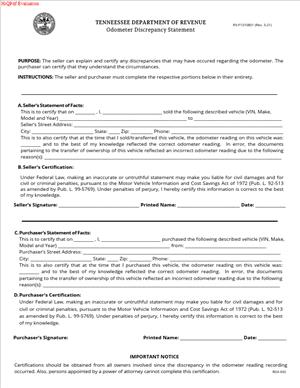
RV-F1310801 – Odometer Discrepancy Statement
Fill out nowJurisdiction: Country: United States | Province or State: Tennessee
The RV-F1310801 – Odometer Discrepancy Statement is a form used in Tennessee when a vehicle’s mileage reading does not accurately reflect the true miles traveled. If you are transferring ownership of a vehicle and the odometer reading is incorrect, this document explains why.
You may encounter this form during a vehicle sale, title transfer, or registration process. It helps document the difference between the odometer reading and the vehicle’s actual mileage. This creates a written record for state records and for the buyer.
If you are filling out the RV-F1310801 – Odometer Discrepancy Statement, you are likely dealing with a vehicle that has an issue such as a replaced instrument cluster, a broken odometer, or mileage that exceeds the odometer’s limits. The form allows you to clearly state what happened.
Understanding this document before you complete it can prevent delays. Errors or missing information can slow down title processing. Knowing what the form asks for makes the completion process smoother.
What is RV-F1310801 – Odometer Discrepancy Statement?
Clear definition
The RV-F1310801 – Odometer Discrepancy Statement is a written declaration used to explain why a vehicle’s current odometer reading does not match its actual mileage. It provides space to describe the reason for the discrepancy and identify the vehicle involved.
An odometer discrepancy typically means that the mileage shown on the dashboard cannot be relied on as the true total miles driven. The form creates a formal record of that issue for the vehicle’s title history.
Who typically uses this form?
Vehicle owners often use this form when selling or transferring a vehicle with an inaccurate odometer. Sellers may complete it as part of the title transfer process.
Buyers may also encounter the form if they are purchasing a vehicle with known mileage issues. In some situations, a dealer or individual handling paperwork may prepare it for signature.
Anyone responsible for submitting title documents to the state may need to include this form if a mileage problem exists.
Why might you need this form?
You may need this form if the odometer has been replaced and the mileage was not set to match the original reading. Replacement of an instrument cluster is a common cause of discrepancies.
You might also need it if the odometer stopped working and the vehicle continued to be driven. In that case, the displayed reading will be lower than the actual miles.
Some older vehicles have five-digit odometers that roll over after reaching their maximum number. When this happens, the reading resets to zero. The form can document that rollover.
If the mileage is unknown or cannot be verified, this document provides a way to disclose that uncertainty during a title transfer.
Typical real-life scenarios
- You are selling a car that had its dashboard replaced after damage. The new odometer started at zero, and no one recalibrated it. The mileage shown is far lower than the true mileage. This form explains the situation.
- You purchased a used truck years ago with a broken odometer. You drove it for several years without repairing it. Now you are transferring the title. The current reading does not reflect actual use. The discrepancy statement documents that gap.
- You are transferring ownership of a classic vehicle. The odometer has rolled over more than once. The number displayed cannot show the full mileage history. The form clarifies that the vehicle has exceeded the displayed miles.
- You are inheriting a vehicle from a family member. There are no service records, and the odometer reading appears inconsistent with the vehicle’s age and condition. The form may be used to state that the actual mileage is unknown.
- In each of these situations, the document provides transparency. It reduces confusion and helps create a written explanation attached to the vehicle’s records.
When would you use RV-F1310801 – Odometer Discrepancy Statement?
You use this form when transferring ownership of a vehicle, and the odometer reading is inaccurate. This usually happens during a sale, gift, inheritance, or other change of ownership.
The form may be required as part of a title application submission. If the mileage declared on the title does not reflect the true mileage, an explanation is often necessary.
Sellers commonly complete it before signing over a title. Buyers may review and sign it as an acknowledgment of the discrepancy.
Dealers or individuals assisting with paperwork may present the form if they discover that the odometer reading does not match service records or other documentation.
It is typically used at the same time as other title transfer documents. The form becomes part of the vehicle’s official file.
Legal characteristics of RV-F1310801 – Odometer Discrepancy Statement
This form functions as a written statement of fact about the vehicle’s mileage. It identifies the vehicle by key details such as make, model, year, and vehicle identification number.
For the form to be effective, it must be complete and accurate. Missing vehicle information, unclear explanations, or unsigned statements can lead to processing delays.
The statement generally requires the person making the declaration to sign it. A signature confirms that the information provided is true to the best of that person’s knowledge.
If the explanation is vague, inconsistent, or conflicts with other documents, it may raise questions during title review. Clear, specific details help avoid that issue.
Mileage disclosure rules can vary depending on vehicle age and federal requirements. Some older vehicles may be exempt from certain mileage reporting rules. Even so, a discrepancy statement can still serve as a record of the issue.
This document does not repair the odometer. It does not correct the mileage. It simply documents that the displayed reading is not accurate and explains why.
It also does not determine vehicle value. Buyers and sellers may consider mileage when negotiating, but this form only addresses the discrepancy itself.
Is it legally binding?
When signed, the form generally serves as a formal declaration. The person signing is stating that the information is true to the best of their knowledge. In that sense, it carries legal weight as a signed statement.
It becomes part of the official record associated with the vehicle’s title. False statements on signed vehicle documents can have serious consequences.
However, the form does not create a contract between buyer and seller. It does not set sale terms or warranties. Its purpose is disclosure and documentation.
Its legal effect depends on proper completion and submission with the related title documents. An unsigned or incomplete form may not be accepted as part of the title process.
How to fill out RV-F1310801 – Odometer Discrepancy Statement
Step 1 – Identify the vehicle
Enter the full vehicle identification number exactly as it appears on the vehicle and title. Include the year, make, and model. Double-check each character in the identification number to avoid processing issues.
Step 2 – Record the current odometer reading
Write the mileage currently displayed on the odometer. Do not estimate or adjust the number. Record the reading exactly as shown, including whether it reflects tenths of a mile if applicable.
Step 3 – Explain the discrepancy
Provide a clear and specific explanation of why the odometer reading does not reflect the actual mileage. State whether the odometer was replaced, repaired, stopped working, or rolled over. If the actual mileage is known, explain how it was calculated. If it is unknown, state that clearly.
Step 4 – Provide additional relevant details
If there are supporting facts, include them in the space provided. For example, note the date of an odometer replacement or the approximate mileage at the time it stopped working. Keep the explanation factual and straightforward.
Step 5 – Enter the name of the person making the statement
Print the full legal name of the person declaring the discrepancy. This is often the current owner listed on the title. Ensure the name matches the related title documents.
Step 6 – Sign and date the form
Sign the form in the designated signature area. Enter the date of signing. Review the entire document before signing to confirm that all information is accurate and complete.
Legal terms you might encounter in RV-F1310801 – Odometer Discrepancy Statement
- Odometer Disclosure: This is the written statement of a vehicle’s mileage at the time of transfer. On this form, you confirm what the odometer currently shows. The disclosure becomes part of the vehicle’s official record and follows the vehicle through future sales.
- Actual Mileage: This term means the number shown on the odometer reflects the true distance the vehicle has traveled. If you cannot confidently say the reading is accurate, you must not mark it as actual mileage. This form exists because there is doubt about its accuracy.
- Mileage Discrepancy: A mileage discrepancy means the odometer reading does not match prior records or is otherwise unreliable. In this document, you explain why the numbers do not line up. The explanation helps the state and future buyers understand what happened.
- Not Actual Mileage: This designation signals that the mileage displayed should not be relied on as the vehicle’s true distance traveled. You use this when the odometer has rolled over, been replaced, or altered. Checking this status affects how the vehicle is viewed in future transactions.
- Odometer Rollback: A rollback occurs when the mileage is intentionally reduced. Even if you did not cause it, you may need to disclose evidence of a rollback. This form documents that the current reading cannot be trusted due to past tampering.
- Odometer Replacement: If the odometer was replaced, the new unit may start at zero or another number. You must explain when and why it was replaced and, if known, what the previous mileage was. This prevents confusion between the old and new readings.
- Transferor: The transferor is the person or entity transferring ownership of the vehicle. This person usually completes and signs the statement about the mileage discrepancy. The name must match the name on the title or assignment documents.
- Transferee: The transferee is the person or entity receiving the vehicle. While the transferor typically completes the mileage statement, the transferee may need to review it and keep a copy. The transferee relies on this information when registering or titling the vehicle.
- Vehicle Identification Number (VIN): The VIN is a unique 17-character code assigned to the vehicle. You must enter it exactly as it appears on the vehicle and title. An incorrect VIN can cause rejection or delays in processing.
- Certification: Certification is your signed statement that the information you provided is true and complete. When you sign, you confirm that your explanation of the discrepancy is accurate to the best of your knowledge. False certification can carry serious consequences.
FAQs
What if I am not sure whether the mileage discrepancy is significant enough to report?
If the odometer reading does not match prior paperwork, service records, or inspection documents, you should treat it as a discrepancy. This document is used when the mileage cannot be confidently stated as accurate. Review past titles, bills of sale, and maintenance records before you decide how to describe the issue.
Do I need to attach proof of the odometer problem to this form?
You are not always required to attach documents, but supporting records can help. If you have repair invoices for an odometer replacement, prior titles showing different mileage, or inspection reports, gather them. Check the submission instructions to see whether copies should be included with this form when you file it.
Who is allowed to sign this document?
The person listed as the transferor on the vehicle title typically signs. If the owner is a business, an authorized representative signs and may need to indicate their title or role. Make sure the name on the signature line matches the name shown on the ownership documents.
What happens if the VIN on this document does not match the title?
A mismatch can cause the filing to be rejected or delayed. Before you submit the RV-F1310801 – Odometer Discrepancy Statement, compare the VIN on the vehicle, the title, and this document character by character. Even a single incorrect digit can prevent the record from being accepted.
Will this form change the official mileage shown on the vehicle record?
This form does not “correct” the mileage to a new number. Instead, it flags that the current reading is not reliable and explains why. The public record may reflect that the mileage is not actual or that a discrepancy exists.
Can I complete this form after the title has already been transferred?
It is best to complete it at the time of transfer. If the title has already been processed and a discrepancy is discovered later, you may need to submit this document separately and reference the existing title information. Contact the filing office to confirm how to link it to the correct vehicle record.
Do both the buyer and seller need to keep a copy?
Yes. The seller should keep a copy of their sale records in case questions arise later. The buyer should keep a copy of the new title and registration documents to show future purchasers or agencies that the discrepancy was disclosed.
Is the RV-F1310801 – Odometer Discrepancy Statement required for every vehicle sale?
No. It is used when there is a known or suspected issue with the accuracy of the odometer reading. If the mileage is accurate and matches prior records, a standard odometer disclosure is usually sufficient, and this document would not be necessary.
Checklist: Before, During, and After RV-F1310801 – Odometer Discrepancy Statement
Before
- Review the current vehicle title for the correct owner name and VIN.
- Check the odometer reading and compare it with prior titles or service records.
- Gather documents that show past mileage readings.
- Confirm whether the odometer was ever repaired or replaced.
- Make sure you understand why the discrepancy exists.
- Verify who is legally authorized to sign as transferor.
- Confirm where and how the completed form must be submitted.
During
- Enter the VIN exactly as shown on the vehicle and title.
- Write the current odometer reading without rounding.
- Clearly mark whether the mileage is not actual.
- Provide a detailed but concise explanation of the discrepancy.
- Avoid leaving any required field blank.
- Print names clearly where requested.
- Sign in the correct signature block.
- Date the form accurately on the day you sign.
After
- Make a clear copy of the signed document for your records.
- Provide a copy to the other party in the transaction.
- Attach supporting documents if required.
- Submit the form with the title paperwork if filing together.
- Confirm that the filing office has accepted the submission.
- Store your copy with the bill of sale and title documents.
- Update your personal vehicle records to note the discrepancy disclosure.
Common mistakes to avoid with RV-F1310801 – Odometer Discrepancy Statement
- Mistake: Entering the wrong VIN because you copied it from memory, which happens easily with long numbers, leading to rejection or misfiled records, so do not forget to double-check every character directly from the vehicle and title.
- Mistake: Marking mileage as actual when you are unsure, often due to pressure to complete the sale quickly, which can create legal exposure later, so do not forget to accurately reflect any doubt about the reading.
- Mistake: Giving a vague explanation like “mileage off,” which happens when you rush, resulting in questions or delays, so do not forget to clearly state whether the odometer was replaced, rolled over, or altered.
- Mistake: Forgetting to sign or date the form, a common oversight during busy transactions, which makes the document incomplete, so do not forget to review the signature and date lines before submission.
- Mistake: Using a nickname or business shorthand instead of the full legal name, which causes mismatches with the title record, so do not forget to match the name exactly as it appears on ownership documents.
- Mistake: Failing to keep a copy, often because you assume the filing office will store it, which leaves you without proof of disclosure, so do not forget to make and safely store your own copy.
What to do after filling out RV-F1310801 – Odometer Discrepancy Statement
Once you complete and sign the form, your job is not quite finished. You need to make sure it is properly submitted, accepted, and stored with your records.
- Step 1: Review the completed form line by line for accuracy.
- Step 2: Compare the VIN and mileage one more time against the vehicle and title.
- Step 3: Make at least one clear copy for your personal records.
- Step 4: Provide a copy to the other party involved in the transfer.
- Step 5: Attach the form to the title application or transfer paperwork if they are being submitted together.
- Step 6: Submit the documents through the required method, such as in person or by mail, following the filing instructions.
- Step 7: Confirm that the submission was accepted, either by receiving a stamped copy, receipt, or written confirmation.
- Step 8: If notified of an error or rejection, correct the issue promptly and resubmit.
- Step 9: Store your copy with related documents, including the bill of sale and any odometer repair records.
- Step 10: Update your personal files to reflect that a mileage discrepancy was formally disclosed.
Keep your copy in a safe place. If questions arise months or years later, you will have proof that you disclosed the discrepancy in writing. That record can protect you and clarify the vehicle’s history for future owners.
If you are the buyer, monitor the new title once issued. Check that it reflects any required notation about mileage status. If something appears incorrect, raise the issue quickly so the record can be reviewed.
Treat this document as part of the vehicle’s permanent history. Careful completion and proper follow-up help prevent disputes and protect everyone involved in the transaction.
Disclaimer: This guide is provided for informational purposes only and is not intended as legal advice. You should consult a legal professional.