RV-F1310501 – Affidavit Of Inheritance
Fill out nowJurisdiction: Country: United States | Province or State: Tennessee
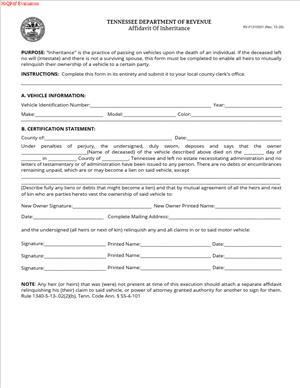
If you are handling a loved one’s property after their death, the RV-F1310501 – Affidavit Of Inheritance is a document you may come across. This form is used in Tennessee to confirm who has inherited certain property when the original owner has died.
You are usually filling it out because something needs to be transferred. That might be a vehicle title, registration record, or another asset connected to the Department of Revenue. The agency needs written confirmation of who the lawful heirs are before it updates its records.
An affidavit is a sworn statement. When you sign this form, you are stating that the information you provide is true. You are doing so under penalty of perjury. That gives the document legal weight.
This form is often used when there is no probate court order available, or when the estate qualifies for a simpler transfer process. It allows the Department of Revenue to rely on your sworn statement instead of a full court file.
Before you start filling it out, it helps to understand what the form does, who can use it, and what information must be accurate. That way, you can complete the submission correctly the first time.
What is RV-F1310501 – Affidavit Of Inheritance?
Clear definition
The RV-F1310501 – Affidavit Of Inheritance is a sworn written statement used to identify the legal heirs of a deceased person for purposes related to Tennessee revenue records. It confirms that a person has inherited specific property and is entitled to have ownership transferred.
It is not a court judgment. It is not a will. It is a declaration made by someone with knowledge of the family situation and the deceased person’s estate.
When you sign this document, you are affirming facts such as the date of death, whether the deceased left a will, and who the surviving heirs are. The Department of Revenue relies on this information to update ownership records.
Who typically uses this form?
You may use this form if you are an heir of someone who has passed away and you need to transfer property into your name. In many cases, this involves a vehicle or other titled property managed by the state revenue agency.
Sometimes a surviving spouse completes the form. In other situations, an adult child or another relative does so. The person signing is often someone who has personal knowledge of the deceased’s family relationships.
This form may also be used by a personal representative or informal estate administrator when a formal probate process is not being used for that particular asset. The key factor is that the person completing the document can truthfully confirm the inheritance details.
Why might you need this form?
You might need this form because the property is still legally titled in the deceased person’s name. The state agency cannot change ownership without proper documentation.
If there is no court order transferring the asset, the agency may accept a sworn affidavit instead. This can streamline the process in estates that are small or straightforward.
The form also creates a written record of who is claiming the property. That record protects the state from liability if another person later claims an interest. It also clarifies the chain of ownership for future transactions.
In short, the form serves as proof of inheritance when formal probate documentation is not available or not required for the specific property.
Typical real-life scenarios
- A common scenario involves a surviving spouse who needs to transfer a vehicle title after their partner’s death. The vehicle is still registered solely in the deceased spouse’s name. The spouse uses the affidavit to confirm their inheritance rights.
- Another situation involves adult children inheriting a parent’s vehicle when there is no will. Under Tennessee’s intestacy rules, the children may share equal ownership. The affidavit lists all heirs and confirms their relationship to the deceased.
- You may also see this form used when a will exists, but probate has not been opened for certain assets. If the will names a beneficiary for a vehicle and no court order has been issued yet, the affidavit can help establish the right to transfer.
- In blended families, the form may clarify which individuals qualify as heirs under state law. For example, if the deceased had children from a prior marriage and a current spouse, the affidavit outlines the surviving relatives and their relationship.
- In estates with minimal assets, families often avoid a lengthy probate process. Instead, they rely on simplified procedures for specific properties. The affidavit supports those simplified transfers.
- In some cases, more than one heir must sign or acknowledge the document. This can occur when multiple individuals have equal rights to the property. The form documents their agreement about who will take title.
When would you use RV-F1310501 – Affidavit Of Inheritance?
You would use the RV-F1310501 – Affidavit Of Inheritance when a property owner has died, and a transfer of ownership must occur through the Tennessee Department of Revenue.
This usually arises when you are applying for a new title, updating registration, or completing another official filing related to inherited property. The agency needs confirmation that you are legally entitled to act.
The form is commonly used in estates where no formal probate court order has been issued for the specific asset. It can also be used when probate is unnecessary under state thresholds or when the property falls outside the court’s direct involvement.
You might be the surviving spouse seeking sole ownership. You might be one of several heirs agreeing to transfer the asset to one person. You might be a family member helping manage the estate’s paperwork.
The timing often comes soon after the death certificate is issued. Once you have proof of death and understand who the heirs are, you can prepare the affidavit for submission with other required documents.
If a financial institution, insurance company, or government office requires proof of inheritance before releasing or retitling property, this form may be part of that package.
Legal characteristics of RV-F1310501 – Affidavit of Inheritance
This document is an affidavit, which means it is a sworn statement. Its effectiveness depends on truthful and complete information. When properly signed and notarized, it carries legal weight because you are attesting to facts under oath.
For the form to be accepted, it typically must be filled out completely. Missing dates, incomplete heir information, or inconsistent names can delay processing. The agency reviewing the submission may reject it if details do not match supporting documents.
Accuracy is critical. Names should match the death certificate and any existing title or registration records. Dates must be correct. Relationships should be clearly stated.
Notarization is usually required. A notary verifies your identity and witnesses your signature. Without proper notarization, the document may not be valid for filing.
Different states have different forms and procedures for inherited property. In Tennessee, the Department of Revenue has its own format and requirements. Using the correct version for the correct state matters.
This affidavit does not transfer ownership by itself. It supports a transfer. The actual change in ownership occurs when the agency processes the submission and issues updated records.
The form also does not resolve disputes among heirs. If family members disagree about who inherits, that issue typically requires a separate legal process. The affidavit assumes that the listed heirs and facts are accurate and not contested.
Providing false information on a sworn statement can have serious consequences. Because the document is signed under oath, intentional misstatements may expose the signer to penalties.
Is it legally binding?
Yes, in the sense that it is a sworn statement made under penalty of perjury. When you sign the affidavit before a notary, you are legally affirming that the information is true to the best of your knowledge.
It becomes binding as a declaration of fact. Government agencies rely on it to make official record changes. If the information is later shown to be false, the signer can be held responsible for the statement.
However, the form does not create inheritance rights. It reflects them. The underlying right to inherit comes from a valid will or from Tennessee’s intestacy laws if there is no will.
The affidavit also does not override a court order. If a probate court later issues instructions that differ from what was stated in the affidavit, the court’s order generally controls the final outcome.
In practical terms, the document is legally significant because it enables the administrative transfer of property. Its binding nature rests on the oath and the reliance placed on it by the agency.
How to fill out RV-F1310501 – Affidavit of Inheritance
Step 1 – Review the entire form before writing anything
Start by reading the full document from top to bottom. This helps you see what information is required and what supporting documents you may need.
Look for sections requesting personal details, information about the deceased, and details about the property. Make sure you understand each field before you begin writing.
Step 2 – Enter the deceased person’s full legal name
Write the full legal name exactly as it appears on the death certificate and any existing title or record. Include middle names or initials if they appear in official documents.
Consistency is important. If the name on the property record differs slightly, use the legal name and ensure other documents clarify any variation.
Step 3 – Provide the date of death and place of death
Enter the exact date of death as shown on the death certificate. Accuracy here is essential because this date determines when inheritance rights began.
If the form asks for the location of death, include the city and state. Match the wording on the official certificate whenever possible.
Step 4 – State whether the deceased left a will
Indicate clearly whether there was a valid will at the time of death. If there was a will, the form may ask whether it has been admitted to probate.
Answer this section truthfully and clearly. The existence of a will affects how inheritance is determined.
Step 5 – Identify all legal heirs
List the names of all surviving heirs as required by the form. This may include a spouse, children, or other relatives, depending on the family situation.
Provide complete names and, if requested, addresses or relationship descriptions. Do not omit anyone who may have a legal claim under state inheritance rules.
Step 6 – Describe the property being transferred
Enter specific details about the property. If the form relates to a vehicle, include identifying information such as the make, model, year, and vehicle identification number.
Accuracy is critical. Double-check numbers and spelling. Errors in identification details can delay the transfer.
Step 7 – Confirm your relationship to the deceased
State your relationship clearly, such as surviving spouse, son, daughter, or other qualifying relation. This establishes your connection to the estate.
If you are signing on behalf of multiple heirs, ensure the form reflects that role accurately.
Step 8 – Review all statements carefully
Before signing, read each statement in the affidavit. Confirm that every fact is correct and complete.
Check for missing information, spelling errors, and inconsistent dates. Correct any mistakes before proceeding to the signature section.
Step 9 – Sign the affidavit in the presence of a notary
Do not sign the form in advance. Wait until you are in front of a notary public.
Bring proper identification. Sign your name exactly as it appears in the document. The notary will complete their section and apply their seal.
Step 10 – Attach required supporting documents
Gather the documents that typically accompany the affidavit. This may include a certified copy of the death certificate and any existing title or ownership record.
Ensure that copies are clear and legible. Keep personal copies of everything you submit for your records.
Step 11 – Submit the completed form to the appropriate office
Once the affidavit is signed and notarized, submit it along with all required attachments to the designated Tennessee Department of Revenue office handling the transfer.
Make sure the submission is complete. An incomplete filing may be returned or delayed, which can slow down the ownership update process.
Legal terms you might encounter in RV-F1310501 – Affidavit Of Inheritance
- Affiant: The affiant is the person who signs the affidavit and swears that the information is true. On this form, you are the affiant if you are completing and signing it. Your name, address, and signature appear near the end, and you must sign in front of a notary.
- Decedent: The decedent is the person who has died. You will enter the decedent’s full legal name exactly as it appears on official records. Accuracy matters because this name connects the affidavit to tax and property records.
- Heir at Law: An heir at law is someone who inherits under state law when there is no valid will. This form may require you to list all heirs, not just yourself. You must identify each heir clearly and state their relationship to the decedent.
- Intestate: Intestate means the person died without a valid will. If the decedent was intestate, the inheritance passes according to state law. The form may ask you to confirm whether the decedent died intestate and whether a probate case was opened.
- Testate: Testate means the person died with a valid will. If a will exists, you may need to confirm that it has been admitted to probate or that the property described is passing under its terms. You must ensure the information matches court or estate documents.
- Personal Representative: This is the person appointed to handle the estate, sometimes called an executor or administrator. If one were appointed, you may need to provide that person’s name and confirm their authority. This helps establish who has the legal right to act for the estate.
- Probate: Probate is the court process that validates a will and oversees the distribution of assets. The form may ask whether probate has been opened and, if so, in which court. You should provide consistent details that match any court filings.
- Notarization: Notarization is the process of signing the affidavit in front of a notary public. The notary verifies your identity and witnesses your signature. Without notarization, the affidavit is usually not valid for filing.
- Legal Description: A legal description precisely identifies real property. If the affidavit involves real estate, you may need to include the full legal description, not just a street address. This ensures the property can be correctly recorded or transferred.
- Tax Clearance: Tax clearance refers to confirmation that required taxes have been addressed. Because this form relates to inheritance and revenue matters, you may need to show that inheritance or related taxes are paid or not due. Keep any supporting letters or confirmations with your records.
FAQs
Do I have to file RV-F1310501 – Affidavit Of Inheritance if there was a will?
You may still need to complete this form even if a will exists. The key question is whether the property or tax issue covered by this document requires a sworn statement about heirs or inheritance. Review the section asking whether the decedent died testate or intestate and make sure your answer matches the estate records and any probate filings.
What if I do not know all of the heirs?
You are expected to list all known legal heirs. If you are unsure, review family records, prior court documents, and death certificates to confirm relationships. Leaving someone out can delay acceptance of this document and may create disputes later.
Does this form transfer property by itself?
This form is generally used to support recognition of inheritance for tax or record purposes. It does not replace a deed or court order if those are required. Check which office will receive the document and confirm whether additional paperwork must be filed at the same time.
What date should I use as the effective date?
Use the decedent’s actual date of death as shown on the death certificate. Do not use the date you sign the affidavit as the date of inheritance. The date of death is what determines when rights are passed and how records should be updated.
Do I need to attach a death certificate?
In most cases, yes. The receiving office often requires a certified copy of the death certificate to confirm the information you state. Make sure the name and date of death on the certificate match exactly what you entered on this form.
Who is allowed to sign the affidavit?
The person signing must have personal knowledge of the family relationships and the estate facts stated. Often this is an heir or someone closely connected to the estate. The signature must be notarized, and the name you sign should match the name printed in the affiant section.
What happens if the information on this document conflicts with probate records?
Inconsistencies can cause rejection or delays. The reviewing office may require clarification or corrected filings before accepting RV-F1310501 – Affidavit Of Inheritance. Always compare your answers with any court orders, letters of administration, or admitted wills before you sign.
How will I know if the form has been accepted?
Acceptance usually means the office has processed and recorded the affidavit or updated its records. You may receive a stamped copy, confirmation letter, or updated tax account statement. Keep that confirmation with your estate documents in case questions arise later.
Checklist: Before, During, and After RV-F1310501 – Affidavit Of Inheritance
Before
- Obtain a certified copy of the death certificate.
- Gather any will, probate orders, or letters of administration.
- Confirm the full legal name of the decedent from official records.
- Make a complete list of all legal heirs and their contact details.
- Collect property descriptions, parcel numbers, or account numbers involved.
- Verify whether any taxes related to the inheritance are due or resolved.
- Review prior filings to ensure names and dates are consistent.
- Prepare a valid government-issued photo ID for notarization.
During
- Read every section of the form slowly before entering information.
- Print or type names exactly as shown on official documents.
- State clearly whether the decedent died testate or intestate.
- List every heir and describe each person’s relationship to the decedent.
- Provide complete legal descriptions for any real property.
- Double-check dates, especially the date of death.
- Review the sworn statement language so you understand what you are affirming.
- Sign only in the presence of a notary and ensure the notary completes their section fully.
After
- Make several copies of the signed and notarized affidavit.
- Attach required supporting documents, including the death certificate.
- Submit the original to the appropriate revenue or recording office.
- Pay any required filing or processing fees.
- Request a stamped or confirmed copy for your records.
- Confirm that tax or property records have been updated.
- Store the affidavit with other estate and tax documents.
- Provide copies to other heirs if appropriate for transparency.
Common mistakes to avoid with RV-F1310501 – Affidavit Of Inheritance
- Mistake: Leaving out an heir because you assume they are not entitled, which often happens in blended families, can lead to disputes, rejection of the filing, and possible legal challenges; do not forget to list every legal heir even if their share is small.
- Mistake: Using nicknames or shortened names for the decedent or heirs, which happens when you rely on memory instead of documents, can cause mismatches in public records; do not forget to copy names exactly from official identification and certificates.
- Mistake: Entering the wrong date of death because you rely on an obituary, which can affect tax calculations and record updates; do not forget to confirm the date directly from the certified death certificate.
- Mistake: Failing to attach required documents due to assuming the office already has them, which can delay processing; do not forget to include all supporting documents each time you submit the affidavit.
- Mistake: Signing before meeting with a notary because you want to save time, which invalidates the notarization; do not forget to wait and sign only in the notary’s presence.
- Mistake: Providing an incomplete property description because you think the street address is enough, which can prevent proper recording; do not forget to include the full legal description where required.
- Mistake: Ignoring small inconsistencies between this affidavit and probate filings, which often happens when documents were prepared at different times, can trigger review or rejection; do not forget to cross-check every detail before signing.
- Mistake: Keeping no personal copy after filing because you assume you can request one later, which can complicate future transactions; do not forget to keep a complete, stamped copy in your permanent records.
What to do after filling out RV-F1310501 – Affidavit Of Inheritance
Once you complete and notarize the affidavit, your job is not finished. You need to make sure it reaches the correct office and that the information is properly reflected in official records.
Start by organizing the signed affidavit with all required attachments. Place the death certificate and any probate documents behind the affidavit in a logical order. This makes review easier and reduces the chance of rejection.
- Step 1: Make at least two photocopies of the fully signed and notarized affidavit.
- Step 2: Confirm the correct submission address or office handling inheritance and revenue matters.
- Step 3: Prepare payment for any required filing or processing fees.
- Step 4: Submit the original affidavit and attachments using the accepted delivery method.
- Step 5: Request written confirmation, a stamped copy, or a receipt showing the date of filing.
- Step 6: Follow up within a reasonable time if you do not receive confirmation.
- Step 7: Check that related tax accounts or property records reflect the updated ownership or inheritance status.
- Step 8: Notify other heirs that the affidavit has been filed, if appropriate.
- Step 9: Store your confirmed copy in a secure location with other estate documents.
- Step 10: Update your own financial or recordkeeping files to reflect the inheritance.
After submission, monitor any correspondence from the reviewing office. If they request clarification or additional documents, respond promptly and keep copies of everything you send. Delays often occur because follow-up requests are overlooked.
Finally, think ahead. You may need this affidavit in the future when selling property, closing accounts, or resolving tax questions. Keep it accessible but secure. Clear records now will save you time and stress later.
Disclaimer: This guide is provided for informational purposes only and is not intended as legal advice. You should consult a legal professional.