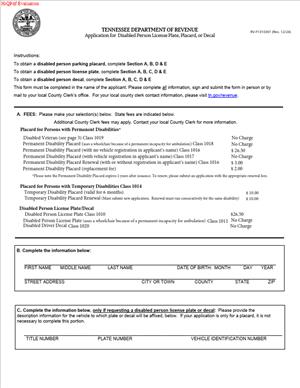
RV-F1310301 – Application for Disabled Person License Plate, Placard, or Decal
Fill out nowJurisdiction: Country: United States | Province or State: Tennessee
If you have a qualifying disability that limits your mobility, parking can become one of the hardest parts of daily life. The RV-F1310301 – Application for Disabled Person License Plate, Placard, or Decal is the document used in Tennessee to request special parking privileges.
This form allows you to apply for a disabled person license plate, a placard that hangs from your rearview mirror, or a decal for certain types of vehicles. Each option serves a similar purpose: to give you access to designated accessible parking spaces.
You complete this document as part of a formal filing with the state. It requires personal information and medical certification. That certification confirms that you meet the eligibility standards.
Understanding how this form works before you start can save time. It helps you avoid common errors and incomplete submissions that may delay processing.
What is RV-F1310301 – Application for Disabled Person License Plate, Placard, or Decal?
Clear definition
The RV-F1310301 – Application for Disabled Person License Plate, Placard, or Decal is a state-issued application used to request disabled parking privileges in Tennessee. It is not a contract between private parties. It is a formal request submitted to a government agency.
By completing this form, you are asking the state to issue one of three things: a disabled person license plate, a temporary or permanent placard, or, in certain cases, a decal. Each type of credential identifies a vehicle or driver as eligible to use accessible parking spaces.
The form collects identifying details about you and your vehicle. It also includes a section that must be completed by an authorized medical professional who verifies your qualifying condition.
Who typically uses this form?
You use this form if you have a physical condition that substantially limits your ability to walk or move safely over a distance. The condition may be permanent or temporary.
Individuals with chronic mobility impairments often apply for a permanent plate or placard. Someone recovering from surgery or a serious injury may apply for a temporary placard.
Parents or guardians may use the form on behalf of a minor with a qualifying disability. In some cases, an organization that transports people with disabilities may also complete the application.
Medical professionals are also involved. They complete the certification portion to confirm that the applicant meets the state’s criteria.
Why might you need this form?
You may need this form if walking long distances causes significant pain, instability, or health risk. Accessible parking spaces are located closer to building entrances and often provide extra space for ramps or mobility devices.
Without an approved plate or placard, you generally cannot legally park in designated disabled spaces. Displaying the correct credentials helps avoid parking citations or vehicle towing.
The form is also necessary if you want a disabled license plate instead of a standard plate. A plate attaches directly to your vehicle. A placard can be moved between vehicles, as long as you are present and using it.
If your temporary placard has expired and your condition continues, you may need to submit a new application with updated medical certification.
Typical real-life scenarios
- You recently had knee replacement surgery, and your doctor expects a six-month recovery period. Walking across large parking lots is difficult and unsafe. You complete the form to request a temporary placard during recovery.
- You have a permanent spinal condition that limits your ability to walk more than short distances without rest. You apply for a permanent disabled person license plate for your primary vehicle.
- Your child uses a wheelchair due to a neuromuscular disorder. You apply for a placard so you can use accessible parking when transporting your child to school, medical appointments, and activities.
- You provide transportation services for individuals with disabilities as part of a nonprofit organization. The organization applies for appropriate credentials for vehicles used to transport eligible passengers.
- You have a heart condition that severely restricts physical exertion. Your physician certifies the condition, and you submit the form to obtain a placard that allows you to park closer to entrances.
When would you use RV-F1310301 – Application for Disabled Person License Plate, Placard, or Decal?
You use this form when you are requesting disabled parking privileges for the first time. It is the starting point for obtaining a qualifying plate, placard, or decal.
You may also use it when changing from one type of credential to another. For example, you might switch from a temporary placard to a permanent plate if your condition becomes long-term.
If your existing placard has expired and the qualifying condition continues, you may need to complete a new submission. The medical certification section may need to be updated, depending on the type of placard requested.
Organizations that regularly transport individuals with disabilities may use the form when adding a new vehicle to their fleet that requires accessible parking privileges.
In practical terms, you use this document whenever the state requires updated medical verification or a new request for disabled parking credentials. It is part of an administrative process rather than a court proceeding.
Legal characteristics of RV-F1310301 – Application for Disabled Person License Plate, Placard, or Decal
This form is an official government filing. It becomes effective when properly completed, signed, and accepted by the appropriate state office. Approval is not automatic. The agency reviews the submission to confirm eligibility and completeness.
The document typically requires accurate identifying information. Errors in your name, address, vehicle identification, or license number can delay processing. Missing signatures are another common reason for rejection.
The medical certification portion is central to the form’s validity. It must usually be completed by a licensed healthcare provider who is authorized to diagnose and certify qualifying conditions. If that section is incomplete or unclear, the application may not be processed.
Different states have different standards for disabled parking privileges. Even small differences in eligibility definitions or documentation requirements can matter. This form applies specifically within Tennessee and reflects that state’s framework.
It is important to understand what this form does not do. It does not automatically grant broader disability benefits. It does not serve as proof of eligibility for federal programs. It does not change your driver’s license status. It only addresses parking privileges tied to the issued plate, placard, or decal.
Misuse of a disabled placard or plate can carry penalties. The form itself often includes statements that the information provided must be truthful. Providing false information or using a placard when the eligible person is not present may result in enforcement action.
Is it legally binding?
The form is legally binding in the sense that you are making a formal declaration to a government agency. By signing it, you are confirming that the information provided is accurate to the best of your knowledge.
The medical professional who completes the certification section is also making a formal statement. That certification supports the state’s decision to issue or deny the requested credential.
However, the form is not a contract between you and another individual. It does not create private legal rights between parties. Instead, it functions as an administrative request subject to review and approval by the state.
If the form is incomplete, unsigned, or does not meet eligibility standards, it may not result in issued credentials. Approval depends on compliance with the stated requirements and proper submission.
How to fill out RV-F1310301 – Application for Disabled Person License Plate, Placard, or Decal
Step 1 – Review the form and choose the type of credential
Start by reading the entire form before writing anything. Identify whether you are applying for a disabled person license plate, a temporary placard, a permanent placard, or a decal. Make sure you understand the differences so you select the option that fits your situation.
Step 2 – Enter applicant information
Fill in your full legal name, residential address, and contact details exactly as they appear on your identification. If you are applying on behalf of a minor or another individual, provide the required identifying information for that person as requested by the form.
Step 3 – Provide vehicle details if required
If you are requesting a disabled license plate or decal, enter the vehicle information carefully. This may include the vehicle identification number, current plate number, and registration details. Double-check for accuracy, as errors in these numbers can delay processing.
Step 4 – Indicate the nature of the disability
Complete the section that describes whether the condition is permanent or temporary. Do not guess about medical terminology. Provide the information requested in the format shown on the form, leaving the medical determination to the certifying professional.
Step 5 – Obtain medical certification
Schedule an appointment with an authorized healthcare provider if needed. The provider must complete and sign the medical certification section. Ensure that all required fields in that section are filled in before you leave the appointment.
Step 6 – Review all statements and declarations
Read the applicant certification carefully. By signing, you confirm that the information is true and that you understand the rules regarding use of the plate, placard, or decal. Make sure you understand these statements before signing.
Step 7 – Sign and date the application
Sign your name exactly as required. Include the date of signing. If another party is signing in a representative capacity, confirm that the form allows it and that the correct relationship is indicated.
Step 8 – Prepare for submission
Check that every required section is complete. Confirm that the medical certification is signed and dated. Make a copy of the completed form for your records before submitting it to the appropriate state office.
Legal terms you might encounter in RV-F1310301 – Application for Disabled Person License Plate, Placard, or Decal
- Applicant: This is the person requesting the disabled plate, placard, or decal. On this form, you must enter your full legal name, address, and identifying information exactly as it appears on your government-issued identification and vehicle records. If the applicant is a minor or cannot sign, a legal guardian or representative may complete parts of the document.
- Permanent Disability: This refers to a medical condition that substantially limits mobility and is not expected to improve. On the form, you will see a section where a medical professional confirms whether your condition qualifies as permanent. A permanent designation may affect how long your plate or placard remains valid before renewal.
- Temporary Disability: This describes a short-term medical condition that limits mobility for a limited period. The medical certification portion of the form usually requires the provider to estimate how long the condition will last. Temporary placards often expire sooner and require reapplication.
- Medical Certification: This is the portion completed by a licensed healthcare provider. The provider must confirm that you meet the eligibility criteria and may need to sign and include license details. Without a completed certification, your application will not be processed.
- Placard: A placard is a removable sign you hang from your rearview mirror when parked. The form allows you to request this type of credential if you do not want or need a specialized license plate. Placards are tied to you, not to a specific vehicle.
- Disabled License Plate: This is a permanent metal plate issued for a specific vehicle. If you request this option, you must provide vehicle information on the form. The plate remains with the vehicle unless transferred or surrendered.
- Decal: A decal is an additional marker placed on a license plate to indicate disabled parking authorization. The form may allow you to request a decal under certain circumstances. Decals are generally issued in connection with a specific plate.
- Certification Statement: This is the declaration section where you confirm that all information provided is true and correct. By signing, you acknowledge that false statements can result in penalties or denial. This section is legally significant because it binds you to the accuracy of the form.
- Authorized Representative: If you cannot sign or complete the application yourself, an authorized representative may do so on your behalf. This person may need to indicate their relationship to you and provide identifying information. The form may require proof of authority in some cases.
FAQs
What if my name on this form does not exactly match my driver’s license or vehicle registration?
You should use your full legal name exactly as it appears on your current government identification and vehicle records. Even small differences, such as a missing middle initial or a shortened first name, can delay processing. If your name has recently changed, make sure your identification and vehicle records are updated before submitting this document.
How do I know whether to choose a placard, plate, or decal on the RV-F1310301 – Application for Disabled Person License Plate, Placard, or Decal?
Look at how you plan to use the credential. A placard is tied to you and can be used in different vehicles, while a license plate is tied to one specific vehicle and requires vehicle details. Review the selection section carefully and check only the option that matches your situation.
Who must complete the medical certification section?
A licensed healthcare provider must complete and sign the medical certification portion. You cannot fill out this section yourself. Make sure the provider includes all required information, such as license number and signature, because missing details are a common reason for rejection.
What happens if I forget to sign the certification statement?
If you do not sign the certification statement, your application will not be considered complete. The issuing office will typically return or reject the document. Before submitting, double-check that both you and your medical provider have signed where required.
Do I need to include vehicle information for every type of request?
Vehicle details are required when you request a disabled license plate or a decal connected to a plate. If you are only applying for a placard, you usually do not need to list vehicle information. Read the vehicle section carefully and complete it only if it applies to your selection.
How will I know if my application has been approved?
After you submit the RV-F1310301 – Application for Disabled Person License Plate, Placard, or Decal, processing times vary. You may receive your plate or placard by mail or be notified when it is ready for pickup, depending on how you filed. Keep any receipt or confirmation given at submission so you can follow up if needed.
What should I do if my condition changes after I submit this form?
If your temporary condition becomes permanent or improves sooner than expected, you may need to submit a new application reflecting the updated status. The credential issued is based on the medical certification provided. Do not continue using an expired or no-longer-valid placard.
Can someone else submit the form on my behalf?
Yes, another person may submit the document for you, but the required signatures must still be completed. If you are unable to sign, an authorized representative may sign in the designated area. Make sure the representative’s information is clearly written so there is no confusion during review.
Checklist: Before, During, and After RV-F1310301 – Application for Disabled Person License Plate, Placard, or Decal
Before
- Confirm that you meet the eligibility criteria for a disabled plate, placard, or decal.
- Decide whether you need a placard, a license plate, or both.
- Gather your driver’s license or state identification card.
- Collect current vehicle registration details if applying for a plate or decal.
- Schedule an appointment with a licensed healthcare provider for medical certification.
- Review the entire form once to understand all required sections.
- Check whether there are any applicable fees and acceptable payment methods.
- Prepare any supporting documents that may be required for special situations.
During
- Print clearly in black or blue ink if completing a paper copy.
- Enter your full legal name and current residential address accurately.
- Provide complete vehicle information if requesting a plate or decal.
- Ensure the healthcare provider fills out every required field in the medical section.
- Verify that license numbers and dates are written legibly.
- Check that you have selected the correct credential type.
- Read the certification statement carefully before signing.
- Sign and date the form in the correct location.
- Review the entire application once more for missing information.
After
- Make a copy of the completed form for your records.
- Attach any required fees or payment documentation.
- Submit the application through the appropriate filing method.
- Keep any receipt or confirmation provided at submission.
- Track the expected processing time.
- Follow up if you do not receive a response within a reasonable period.
- Store your placard properly once issued to avoid damage.
- Note the expiration date and set a reminder for renewal if applicable.
Common mistakes to avoid with RV-F1310301 – Application for Disabled Person License Plate, Placard, or Decal
- Mistake: Leaving required fields blank because you assume they do not apply, which happens when people skim the form, and this can result in delays or rejection, so do not forget to review every line and write “N/A” where appropriate.
- Mistake: Submitting the form without a complete medical certification, which often occurs after a rushed appointment, and this leads to automatic denial, so do not forget to confirm that the provider signed and dated the section.
- Mistake: Selecting the wrong credential type due to confusion about placards versus plates, which can require reapplication, so do not forget to match your choice to how you plan to use the parking privilege.
- Mistake: Using a nickname or outdated address, which happens when records are not updated, and this can cause processing issues, so do not forget to ensure all information matches your official identification.
- Mistake: Forgetting to sign the applicant certification statement, which is common when focusing only on the medical section, and this makes the application incomplete, so do not forget your own signature and date.
- Mistake: Failing to include required fees when applicable, which delays issuance, so do not forget to verify the correct amount and acceptable payment method before submission.
- Mistake: Not keeping a copy of the completed application, which leaves you without proof of what was submitted, so do not forget to save a copy for your records.
- Mistake: Continuing to use an expired placard because you overlooked the expiration date, which can lead to penalties, so do not forget to check the validity and apply for renewal on time.
What to do after filling out RV-F1310301 – Application for Disabled Person License Plate, Placard, or Decal
Once you complete the form, pause before submitting it. A careful review now can prevent weeks of delay later. Read every section from top to bottom and confirm that names, numbers, and dates are correct.
- Step 1: Make a clear copy or scan of the fully completed and signed application for your personal records.
- Step 2: Confirm that the medical certification section is fully completed, signed, and dated by the provider.
- Step 3: Verify that any required vehicle information matches your current registration exactly.
- Step 4: Confirm the correct fee amount, if a fee applies, and prepare an acceptable payment.
- Step 5: Submit the application using the approved filing method, such as in person or by mail, as instructed on the form.
- Step 6: Obtain and keep any receipt, tracking number, or stamped copy as proof of submission.
- Step 7: Mark your calendar with an estimated processing time so you know when to follow up.
- Step 8: Once you receive your plate, placard, or decal, review it for accuracy, including your name and expiration date.
- Step 9: If you receive a placard, hang it only when parked and remove it before driving.
- Step 10: Store approval letters or related paperwork with your important vehicle documents.
- Step 11: Set a reminder several weeks before expiration so you can begin the renewal process if needed.
- Step 12: If your address, name, or medical status changes, update your records promptly to keep your parking privileges valid.
Staying organized after submission protects your rights and helps you avoid unnecessary penalties. Treat your issued plate, placard, or decal as an official credential. Keep it secure, use it properly, and monitor its validity so you remain in compliance.
Disclaimer: This guide is provided for informational purposes only and is not intended as legal advice. You should consult a legal professional.