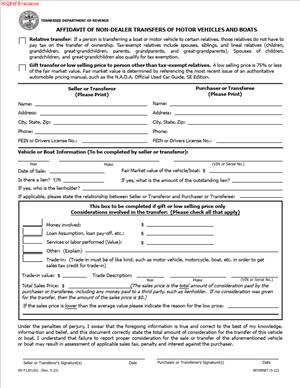
RV-F1301201 – Affidavit of Non-Dealer Transfers of Motor Vehicles and Boats
Fill out nowJurisdiction: Country: United States | Province or State: Tennessee
If you are transferring a vehicle or boat in Tennessee without going through a dealership, you may be asked to complete the RV-F1301201 – Affidavit of Non-Dealer Transfers of Motor Vehicles and Boats. This document is used to confirm details about a private transfer. It supports how the transaction is reported for registration and tax purposes.
The RV-F1301201 – Affidavit of Non-Dealer Transfers of Motor Vehicles and Boats is commonly used when a vehicle or boat changes hands between private individuals. It helps document the facts of the transfer in a clear, sworn statement.
You might be filling this out because you bought a car from a neighbor. Or because you received a boat as a gift from a family member. In these situations, there is no dealer paperwork to rely on. This form fills that gap.
Understanding what the form does can make the process smoother. When you know why each section matters, you can complete it with confidence and avoid delays.
What is RV-F1301201 – Affidavit of Non-Dealer Transfers of Motor Vehicles and Boats?
Clear definition
RV-F1301201 – Affidavit of Non-Dealer Transfers of Motor Vehicles and Boats is a sworn statement used in Tennessee to document the transfer of a motor vehicle or boat when the transfer is not handled by a licensed dealer. It records key information about the buyer, the seller, and the property being transferred.
An affidavit is a written statement made under oath. By signing this form, you are confirming that the information you provide is true to the best of your knowledge. The form becomes part of the official record connected to the title and registration process.
This document is typically submitted as part of a title application or registration filing. It supports the reported sales price, the nature of the transfer, or any claim that the transfer qualifies for special tax treatment.
Who typically uses this form?
Private buyers and sellers most often use this form. If you sell your car directly to another person, you may need to complete the paperwork together.
Individuals who receive a vehicle or boat as a gift may also use it. In that case, the person giving the gift and the person receiving it may both provide information on the affidavit.
Family members transferring ownership between themselves commonly complete this form. It can also be used when ownership is transferred due to divorce, inheritance, or similar personal arrangements.
In some cases, the person applying for the title completes and signs the form alone, especially when confirming facts about how the property was acquired.
Why might you need this form?
When a licensed dealer sells a vehicle, the dealer usually prepares standardized sales documents. Those documents include pricing and tax details. In a private transaction, that structure does not exist.
This form provides a formal way to state the purchase price or to explain that the transfer was not a traditional sale. It may affect how taxes are calculated during the registration process.
You might also need the form if the stated sale price is lower than the expected market value. The affidavit gives you a way to explain the reason for that amount.
Without this document, the title or registration process may be delayed. The form helps clarify the transaction for state records.
Typical real-life scenarios
- You buy a used car from a coworker for a negotiated cash price. There is no dealership invoice. The affidavit is used to state the agreed purchase amount and confirm that it was a private sale.
- A parent gives a boat to an adult child. No money changes hands. The affidavit explains that the transfer was a gift rather than a sale, which can affect how taxes are assessed.
- Two siblings transfer ownership of a vehicle after settling an estate. The form helps document how the vehicle moved from one name to another outside of a retail transaction.
- A person sells an older motorcycle for a price well below the typical market value because it needs repairs. The affidavit provides a place to describe the actual sales price and confirm that it reflects the true agreement between the parties.
- A couple finalizes a divorce, and one spouse transfers sole ownership of a vehicle to the other. The affidavit may be used to clarify that the transfer is part of a legal settlement rather than a standard sale.
When would you use RV-F1301201 – Affidavit of Non-Dealer Transfers of Motor Vehicles and Boats?
You would use this form when a motor vehicle or boat is transferred between private individuals and not through a licensed dealership. The key factor is that the transaction does not involve a dealer preparing the sales paperwork.
It is commonly used during the title application process. When you apply to put the vehicle or boat in your name, the office handling the title may request this affidavit to confirm transaction details.
The form may also be required if there is a question about the reported purchase price. If the amount listed on the title or bill of sale appears unusually low, the affidavit can help explain the circumstances.
You might use it when claiming that a transfer qualifies as a gift. In that situation, the form provides a structured way to state that no money was paid and to identify the relationship between the parties.
Executors or administrators of estates may use it when transferring a vehicle from a deceased person’s estate to an heir. The affidavit can support how the transfer occurred and whether any payment was involved.
Individuals involved in correcting a prior title issue may also use this form. For example, if ownership was transferred informally and now needs to be properly documented, the affidavit can help clarify the timeline and terms.
In short, you use this document whenever you need to formally explain the facts of a non-dealer vehicle or boat transfer as part of a state filing.
Legal characteristics of RV-F1301201 – Affidavit of Non-Dealer Transfers of Motor Vehicles and Boats
This form is an affidavit, which means it is a sworn statement. Its legal strength comes from the fact that the signer declares the information to be true. Providing false information on a sworn document can carry serious consequences.
For the affidavit to be effective, it must be completed clearly and signed as required. Many affidavits require notarization, which means a notary public verifies the identity of the signer and witnesses the signature. If notarization is required and not completed, the form may be rejected.
Accurate vehicle or boat identification is essential. Errors in the vehicle identification number, hull identification number, or other key details can lead to delays. Even a single incorrect digit can prevent proper processing.
Common reasons for rejection include missing signatures, incomplete sections, inconsistent information between the affidavit and the title, and unclear statements about the purchase price or transfer type. Leaving blanks in required fields can also cause problems.
While the overall purpose of the form is consistent, specific procedures may vary depending on the local office handling the submission. Some offices may require additional supporting documents, such as a bill of sale or proof of relationship in gift situations.
It is important to understand what this affidavit does not do. It does not replace a title. It does not automatically transfer ownership by itself. It supports the title and registration process, but must be submitted along with other required documents.
It also does not serve as a full sales contract. If you and the other party want detailed terms about payment timing, warranties, or responsibilities, those would typically be handled in a separate agreement.
Is it legally binding?
An affidavit is legally binding in the sense that you are making a sworn statement. By signing, you are affirming that the information is accurate. That declaration has legal weight.
However, the form itself is not a contract between buyer and seller in the traditional sense. It does not create new obligations beyond confirming the facts of the transfer. Its main function is to document and verify what has already occurred.
If the information is truthful and the form is properly signed and, when required, notarized, it becomes part of the official record connected to the vehicle or boat. If false information is provided, the legal consequences generally relate to making a false sworn statement rather than breaching a contract.
The binding nature of the form depends on proper completion. If it is unsigned, incomplete, or altered after signing, its validity may be questioned.
How to fill out RV-F1301201 – Affidavit of Non-Dealer Transfers of Motor Vehicles and Boats
Step 1 – Review the entire form before writing
Start by reading through the entire document from top to bottom. This gives you a clear picture of what information is required. Pay attention to sections that ask for details about the vehicle or boat, the buyer, the seller, and the nature of the transfer.
By reviewing it first, you reduce the chance of making inconsistent entries. You can also gather any needed documents, such as the title, bill of sale, or identification, before you begin filling it out.
Step 2 – Enter vehicle or boat identification details
Carefully copy the identifying information from the existing title or registration. This often includes the vehicle identification number or hull identification number, year, make, model, and other descriptive details.
Write each character clearly. Double-check every number and letter. Errors in these fields are a common cause of processing delays.
Make sure the description on the affidavit matches the title exactly. Even small differences can raise questions during review.
Step 3 – Provide seller information
Enter the full legal name of the person transferring the vehicle or boat. Use the name as it appears on the current title. If there are multiple owners listed, include each one as required by the form.
Provide the seller’s address and any other requested identifying information. Accuracy is important because it connects the affidavit to the current record of ownership.
If more than one seller is involved, confirm that each person’s information is correctly entered and clearly legible.
Step 4 – Provide buyer information
Enter the full legal name of the person receiving the vehicle or boat. This should match the name that will appear on the new title application.
Include the buyer’s address and other requested details. Make sure the spelling and formatting are consistent with other documents you are submitting.
If there will be multiple new owners, include each name exactly as it should appear on the updated title.
Step 5 – State the nature of the transfer
Locate the section that asks about the type of transfer. This may include options such as sale, gift, or other non-dealer transactions.
If the transfer was a sale, enter the actual purchase price. Use the exact amount agreed upon by the parties. Do not round unless the agreement was for a rounded figure.
If the transfer was a gift, indicate that no money was exchanged. If the form asks for the relationship between the parties in a gift situation, provide that information clearly.
If there are special circumstances, describe them in the space provided. Keep your explanation factual and concise.
Step 6 – Review tax-related statements
Many versions of this affidavit include statements related to sales or use tax. Read these carefully before signing.
Confirm that the reported purchase price matches any bill of sale or supporting document. Inconsistencies between documents can slow down processing.
If the form includes declarations about exemptions or special tax treatment, make sure you understand what you are affirming before completing that section.
Step 7 – Sign the affidavit
Once all information is filled in, review the entire form again. Look for blank fields, spelling errors, and incorrect numbers.
Sign your name exactly as required in the signature section. If both buyer and seller must sign, ensure each person signs in the correct place.
Do not sign until the form is fully completed. Alterations after signing can create issues.
Step 8 – Complete notarization if required
If the form includes a notary section, do not sign it in advance. Bring valid identification to the notary.
Sign the affidavit in the presence of the notary. The notary will verify your identity and complete the notarization section.
Check that the notary has filled in all required information, including date, signature, and seal, before leaving.
Step 9 – Attach supporting documents and submit
Gather any related documents that are part of the same filing, such as the title certificate, bill of sale, or registration application.
Ensure that the information on all documents is consistent. Names, dates, and identification numbers should match exactly.
Submit the completed affidavit along with the other required paperwork as part of your title or registration process. Once submitted, keep a copy of the signed form for your records.
Legal terms you might encounter in RV-F1301201 – Affidavit of Non-Dealer Transfers of Motor Vehicles and Boats
- Affidavit: An affidavit is a written statement made under oath. When you sign this document, you are declaring that the information you provided is true. Providing false information can lead to penalties because the form is a sworn statement.
- Non-Dealer Transfer: This refers to a sale or transfer between private individuals, not involving a licensed dealer. The form is designed specifically for these private transactions. If a dealer is involved, a different process usually applies.
- Consideration: Consideration means the value exchanged for the vehicle or boat. It is often money, but it can also include other property or services. The amount of consideration may affect how taxes are calculated.
- Fair Market Value: This is the price the vehicle or boat would sell for on the open market between willing buyers and sellers. If the sale price is unusually low, the agency may look at fair market value to determine tax obligations. You may need to confirm that the stated price reflects reality.
- Transferor: The transferor is the person giving up ownership. On this form, the transferor must provide identifying details and sign to confirm the transfer. This person is often the seller.
- Transferee: The transferee is the person receiving ownership. The transferee’s legal name and address must match the name that will appear on the new title. Any mismatch can delay processing.
- Vehicle Identification Number (VIN): The VIN is a unique number assigned to a motor vehicle. You must copy it exactly as it appears on the vehicle and the current title. Even a single incorrect digit can cause rejection.
- Hull Identification Number (HIN): For boats, the HIN serves the same purpose as a VIN. It identifies the specific watercraft. You need to ensure it matches the number physically marked on the boat.
- Notarization: Notarization means a notary public verifies the identity of the person signing the affidavit. Some transfers require notarization to confirm authenticity. If required, the notary must complete their section fully.
- Tax Liability: Tax liability refers to the amount of tax owed because of the transfer. This form may affect how the tax is assessed. Your entries directly influence whether full tax, reduced tax, or an exemption applies.
FAQs
Do I have to complete RV-F1301201 – Affidavit of Non-Dealer Transfers of Motor Vehicles and Boats for every private sale?
You complete this form when a private, non-dealer transfer requires clarification about the transaction details, especially for tax purposes. If the title assignment and bill of sale do not clearly explain the sale price or nature of the transfer, this document helps fill that gap. Always confirm whether your specific transaction calls for it before filing.
What effective date should I enter?
Use the actual date ownership changed hands. This is usually the date the buyer paid and took possession. Make sure the date matches the title assignment and any bill of sale so the record is consistent.
What if the sale price is different from the vehicle’s market value?
Enter the true sale price you and the other party agreed on. If it is lower than the typical market value, be prepared to explain the reason if asked. The information you provide may be compared to valuation data to determine the correct tax amount.
Does the name on this document have to match the title exactly?
Yes. The buyer’s and seller’s names should match the names shown on the title and identification documents. Even small differences, such as missing middle initials or suffixes, can delay processing or require correction.
Who must sign this document?
Both parties typically sign to confirm the details of the transfer. Each signer must have authority to act for the named person. If someone signs on behalf of another person, they should confirm they have proper authorization before signing.
Do I need to attach other documents when submitting this form?
You may need to include the assigned title, a bill of sale, proof of identification, and any tax payment documents. Check that all documents show consistent information. Missing attachments can cause the filing to be rejected.
What happens after I submit RV-F1301201 – Affidavit of Non-Dealer Transfers of Motor Vehicles and Boats?
The information is reviewed as part of the title and registration process. The details you entered may be used to determine tax due and update ownership records. If something is unclear or inconsistent, you may be contacted to correct or clarify it.
Can I correct an error after signing this document?
If you notice an error before submission, complete a new form to avoid confusion. If you already submitted it, you may need to provide a corrected affidavit or additional written explanation. Act quickly to prevent delays in updating the ownership record.
Checklist: Before, During, and After RV-F1301201 – Affidavit of Non-Dealer Transfers of Motor Vehicles and Boats
Before
- Confirm the transfer is a private, non-dealer transaction.
- Gather the current title and verify ownership details.
- Locate the correct VIN or HIN directly on the vehicle or boat.
- Agree in writing on the sale price or nature of the transfer.
- Check that names match government-issued identification.
- Review whether notarization is required.
- Collect any supporting documents, such as a bill of sale.
- Verify the correct spelling of all addresses.
During
- Print clearly in dark ink if completing by hand.
- Enter the full VIN or HIN without skipping characters.
- State the exact sale price or describe the transfer accurately.
- Use the correct legal names of both parties.
- Double-check dates for consistency with other documents.
- Read every certification statement before signing.
- Ensure both parties sign in the correct spaces.
- Complete notarization properly if required.
After
- Make a full copy of the signed document for your records.
- Attach the affidavit to the title and related paperwork.
- Submit all required documents together.
- Confirm payment of any taxes or fees due.
- Track the submission date and method.
- Watch for confirmation or returned documents.
- Respond promptly if additional information is requested.
- Store your copy in a safe place for future reference.
Common mistakes to avoid with RV-F1301201 – Affidavit of Non-Dealer Transfers of Motor Vehicles and Boats
- Mistake: Entering an incorrect VIN or HIN because you copied it from memory instead of the vehicle, which can cause rejection of the transfer and delay title issuance, so do not forget to verify the number directly from the physical plate.
- Mistake: Listing a sale price that does not match the bill of sale because of a last-minute change, which may trigger questions or reassessment of tax, so do not forget to align all documents before signing.
- Mistake: Using nicknames or shortened names because they are commonly used, which can create mismatches in official records and processing delays, so do not forget to use full legal names exactly as shown on the title.
- Mistake: Forgetting to include the transfer date because you assumed it was optional, which can affect tax calculation and record accuracy, so do not forget to confirm the exact date ownership changed.
- Mistake: Signing without reading the sworn statement because you were in a hurry, which can expose you to penalties if the information is inaccurate, so do not forget to review each certification line carefully.
- Mistake: Skipping notarization when it is required because you believed signatures alone were enough, which can result in rejection of the filing, so do not forget to confirm whether notarization is mandatory.
- Mistake: Submitting the affidavit separately from the title because you thought it would be processed later, which can stall the ownership update, so do not forget to include it with the complete transfer package.
- Mistake: Failing to keep a copy because you trusted the other party to store it, which can leave you without proof of what was declared, so do not forget to retain your own signed copy.
What to do after filling out RV-F1301201 – Affidavit of Non-Dealer Transfers of Motor Vehicles and Boats
Once you complete and sign the form, your focus shifts to proper submission and recordkeeping. A well-prepared submission reduces the chance of delays. Stay organized and move step by step.
- Step 1: Review the entire document one more time for accuracy, including names, identification numbers, dates, and sale price.
- Step 2: Make at least one clear copy of the signed affidavit for your personal records before submitting it.
- Step 3: Attach the affidavit to the properly assigned title and any required supporting paperwork.
- Step 4: Confirm that all signatures are present and that notarization is complete if required.
- Step 5: Calculate any taxes or fees that must be paid at the time of submission and prepare payment in the accepted form.
- Step 6: Submit the complete package through the appropriate filing channel, keeping proof of submission if available.
- Step 7: Monitor the status of the title transfer and registration update to ensure it is processed.
- Step 8: Respond quickly if you receive notice of missing information or errors.
- Step 9: Once ownership records are updated, confirm that the new title reflects the correct buyer name and vehicle details.
- Step 10: Store your copy of the affidavit, proof of submission, and confirmation documents together in a safe location.
Keeping thorough records protects you if questions arise later about the transfer date, sale price, or tax paid. Organized documentation also makes future transactions smoother. Treat the completed affidavit as part of your permanent vehicle or boat file.
Disclaimer: This guide is provided for informational purposes only and is not intended as legal advice. You should consult a legal professional.