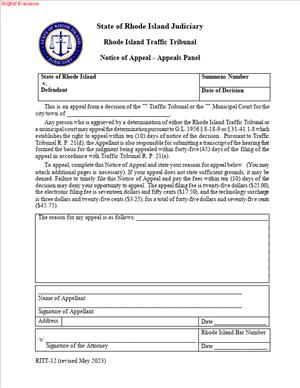
Notice of Appeal – Appeals Panel
Fill out nowJurisdiction: Country: United States | Province or State: Rhode Island
The Notice of Appeal – Appeals Panel is a formal filing that starts the appeal process within the Rhode Island Traffic Tribunal system. It tells the tribunal that you are asking for a review of a prior decision. This document matters because it is often the first and required step to have an Appeals Panel look at what happened in your case.
People usually encounter this form right after a hearing decision they disagree with. You may feel rushed or uncertain about what information belongs on the page. Understanding the purpose of the Notice of Appeal – Appeals Panel helps you focus on accuracy and completeness rather than argument.
This document does not ask you to explain everything about your case. It mainly records key identifying details and your intent to appeal. Because of that, small errors can cause delays even when your reasons for appealing are important.
Filling out the form carefully helps keep your appeal moving. It also creates a clear record of when and how you asked for review. That record often becomes important later in the process.
What is Notice of Appeal – Appeals Panel?
Clear definition
The Notice of Appeal – Appeals Panel is a written notice submitted to the Traffic Tribunal to request review by an Appeals Panel. It formally states that you are appealing a decision already issued in your case. The document signals that you want a higher level of review within the same tribunal system.
This form is procedural rather than persuasive. Its primary function is to open the appeal file and connect it to the original case. The Appeals Panel relies on this document to confirm jurisdiction, timing, and the identity of the appealing party.
The form typically requires basic case information. That often includes names, case numbers, dates, and the decision being appealed. It does not usually ask for evidence or testimony.
Who typically uses this form/document?
Individuals who appeared before the Rhode Island Traffic Tribunal commonly use this form. This includes drivers, vehicle owners, and sometimes registered agents for companies. Most users are self-represented and are handling the appeal without a lawyer.
People who received traffic-related decisions, such as findings after a hearing, are typical users. These decisions may involve violations, penalties, or administrative actions. The form is used by the person directly affected by the decision.
In some cases, a representative may complete the form on behalf of another person. That can happen when a business or organization was named in the original case. The form still centers on the party listed in the original tribunal decision.
Why you might need this form/document
You might need this document when you believe the tribunal’s decision was incorrect. Filing the Notice of Appeal – Appeals Panel preserves your ability to have that decision reviewed. Without this filing, the original decision usually remains in place.
The form also establishes deadlines and procedural rights. It marks the official start of the appeal timeline. This can affect when records are prepared and when the Appeals Panel considers the case.
Another reason for using the form is clarity. It creates a single, clear statement that you are appealing. That avoids confusion about whether a request, letter, or conversation counted as an appeal.
Typical real-life scenarios
A driver attends a Traffic Tribunal hearing and is found responsible for a violation. After reviewing the outcome, the driver believes the hearing officer misunderstood key facts. The Notice of Appeal – Appeals Panel becomes the way to request further review.
A vehicle owner receives a written decision after a missed hearing. The owner later learns about the decision and wants it reviewed by an Appeals Panel. Filing the form starts that process.
A company vehicle is cited, and a representative appears at the hearing. The decision affects company records and fines. The company uses the form to appeal the ruling through the proper channel.
A person believes the procedure at the original hearing was unfair or incomplete. Rather than rearguing the case immediately, the person files the Notice of Appeal – Appeals Panel to trigger the review process.
When would you use Notice of Appeal – Appeals Panel?
You would use the Notice of Appeal – Appeals Panel after a Traffic Tribunal decision has already been issued. It is not used before a hearing or while a decision is pending. The form comes into play only once there is something to appeal.
This filing is commonly used within a limited time after the decision. Timing often matters, even though the form itself may look simple. People often focus on gathering arguments, but the notice is about preserving the appeal right first.
Drivers, vehicle owners, and named respondents typically use the form when they disagree with findings or penalties. In broader terms, anyone listed as a party in the original case may use it. The document helps ensure the appeal goes to the correct Appeals Panel.
The form is not used to ask questions or request explanations. It is also not used to negotiate outcomes. Its role is narrow and procedural, focused on initiating review.
Legal characteristics of Notice of Appeal – Appeals Panel
The effectiveness of the Notice of Appeal – Appeals Panel depends on accuracy and completeness. The form usually must clearly identify the case being appealed. Missing or incorrect information can cause processing problems.
Common issues include incorrect case numbers, unclear party names, or missing signatures. These problems may lead to delays or rejection of the filing. The form often needs to be legible and submitted in an accepted format.
At a high level, appeal procedures can vary by jurisdiction. While the general idea of a notice of appeal is similar across systems, details like timing and filing methods may differ. The Rhode Island Traffic Tribunal has its own internal process for Appeals Panel review.
This document does not replace other appeal requirements. It does not present legal arguments, submit evidence, or guarantee a different outcome. It simply opens the door to the appellate stage.
Is it legally binding?
The Notice of Appeal – Appeals Panel is not legally binding in the sense of creating obligations between parties. It does not settle rights or impose penalties. Instead, it functions as a formal procedural request.
Once accepted, the form has legal effect in starting the appeal process. It triggers internal steps within the tribunal, such as record preparation and panel review. That procedural effect is why accuracy matters.
The form does not bind the Appeals Panel to rule in your favor. It also does not pause all consequences automatically. Its binding nature is limited to acknowledging that an appeal has been initiated under the tribunal’s rules.
How to fill out Notice of Appeal – Appeals Panel
Step 1 – Identify the case
Begin by entering the case number exactly as it appears on the original Traffic Tribunal decision. This number connects your appeal to the correct record. Double-check for extra digits or transposed numbers, as small errors can misdirect the filing.
Step 2 – List the appealing party
Provide the full name of the person or entity appealing the decision. This should match the name used in the original case. Consistency helps the tribunal confirm that the correct party is requesting review.
Step 3 – Reference the decision being appealed
Indicate the date of the decision or hearing you are appealing. This clarifies which ruling the Appeals Panel will review. When multiple events exist in a case, this detail helps avoid confusion.
Step 4 – Provide contact information
Include current contact details such as address and phone number. This information allows the tribunal to send notices and updates about the appeal. Outdated contact information can cause missed communications.
Step 5 – Confirm the request for appeal
The form typically includes a statement indicating that you are requesting review by an Appeals Panel. Read this section carefully to understand what you are affirming. Signing or checking the required box confirms your intent to appeal.
Step 6 – Sign and date the form
Sign the Notice of Appeal – Appeals Panel where indicated and include the date of signing. This shows that the information is being submitted intentionally. An unsigned form may be treated as incomplete.
Step 7 – Review before submission
Before submitting, read through the entire form once more. Check names, numbers, and dates for accuracy. This final review reduces the chance of delays caused by correctable errors.
Legal terms you might encounter in Notice of Appeal – Appeals Panel
- Appellant: This is the person or entity asking for the appeal. In this document, you are the appellant if you disagree with the prior decision and want it reviewed by an appeals panel. Your name must match how it appears in the case record.
- Appeals Panel: This refers to the group that reviews the decision you are challenging. The form records your request for this panel to examine what already happened, not to start a new case. You are not asking for a new trial here.
- Underlying Decision: This is the ruling you are appealing. The form usually asks for the date and type of decision so the correct record is pulled. Accuracy here ensures the panel reviews the right outcome.
- Case Number: This is the unique identifier assigned to your case. It appears on prior notices and orders. The form uses this number to link your appeal to the correct file.
- Date of Entry: This is the date the original decision was officially entered into the record. You must locate this date in the decision document, not guess. The appeal timeline is often measured from this date.
- Grounds for Appeal: This refers to the reason you believe the decision should be reviewed. On this form, you may only be asked to indicate that you are appealing, not to argue your case. Detailed arguments usually come later.
- Service: This means providing a copy of the filed document to the required parties. The form may ask you to confirm that the service will occur or has occurred. Keep proof of when and how you did it.
- Signature: This shows that you are the person requesting the appeal and that the information is accurate. Unsigned forms are often rejected. The signature also ties you personally to the request.
- Filing: This is the act of officially submitting the document to the correct office. Filing is different from preparing or mailing the form. The appeal process starts only after the filing is accepted.
FAQs
How do I know which decision I am appealing on the Notice of Appeal – Appeals Panel?
You must look at the written decision you received and find the date it was entered and the case number. This document does not rely on hearing dates or verbal rulings. The information you enter tells the clerk exactly which decision to review.
What if my name on this form is slightly different from earlier paperwork?
Your name should match the case record as closely as possible. Differences in spelling or order can slow processing because the file may not match automatically. Check prior notices and copy the name format used there.
Where do I find the date of entry for the decision?
The date of entry is usually printed on the written decision or order, often near the signature or stamp. Do not use the hearing date unless it is clearly labeled as the entry date. This document records that specific date for tracking deadlines.
Do I need to explain why I am appealing in this document?
This form typically only records that you are requesting review. You are not required to argue facts or law here unless a specific space asks for it. Save explanations and evidence for later steps in the appeal process.
Who is allowed to sign this form?
You should sign if you are the party appealing. If someone signs for you, their authority must already be recognized in the case. The signature confirms who is responsible for the request.
Can I correct the form after I submit it?
Minor errors may be corrected, but you usually must act quickly. If the mistake affects the identification of the case or decision, the appeal may not move forward. Review carefully before filing to avoid delays.
What happens after the filing is accepted?
Once accepted, this document becomes part of the public case record. The case is then routed for appellate review steps. You may receive notices about schedules or next requirements.
Does filing this form stop the original decision from taking effect?
Filing alone does not automatically change what the original decision requires. This document only records your request for review. Any change to enforcement depends on separate rules and actions.
Checklist: Before, During, and After Notice of Appeal – Appeals Panel
Before
- Locate the written decision you want reviewed.
- Confirm the exact case number from the record.
- Verify the date of entry of the decision.
- Check that your name matches prior filings.
- Review whether all required sections are present.
- Plan how you will submit the form.
- Make space for your signature and date.
During
- Print or type clearly in every required field.
- Enter the case number without adding extra digits.
- Write the decision date exactly as shown in the record.
- List your full name as the appealing party.
- Read any statements you are confirming before signing.
- Sign and date the form where indicated.
- Make at least one copy for your records.
After
- Submit the form using the accepted filing method.
- Confirm the form was received and accepted.
- Keep proof of filing or receipt.
- Provide copies to the required parties if applicable.
- Organize the appeal paperwork together.
- Watch for follow-up notices or deadlines.
- Update your personal case timeline.
Common mistakes to avoid with Notice of Appeal – Appeals Panel
- Mistake: Using the hearing date instead of the date of entry because the decision document was not reviewed closely, which can cause deadline confusion, so always confirm the correct date before filing.
- Mistake: Leaving the case number incomplete due to copying from memory, which can misroute the appeal, so always copy it directly from the record.
- Mistake: Signing in the wrong place or not signing at all because the signature line was overlooked, which can lead to rejection, so always check for signature and date fields.
- Mistake: Listing a nickname or shortened name because it feels familiar, which can delay matching the file, so always use the name exactly as it appears in the case.
- Mistake: Assuming arguments must be written on the form due to a misunderstanding of its purpose, which can clutter the filing, so only enter what the form asks for.
- Mistake: Failing to keep a copy because the focus was on quick submission, which creates problems later, so always retain a complete copy.
- Mistake: Missing confirmation of acceptance because follow-up was ignored, which can leave you unsure of status, so always check that the filing was processed.
What to do after filling out the Notice of Appeal – Appeals Panel
After completing the form, your focus shifts from preparation to follow-through. This document starts the appeal process, but it does not finish it. Staying organized now helps you respond quickly later.
- Step 1: Make at least two copies of the completed and signed form, one for your records and one for reference.
- Step 2: Submit the original using the filing method that applies to your case, ensuring it reaches the correct office.
- Step 3: Confirm that the submission was accepted, not just sent, and note the confirmation date.
- Step 4: Store the confirmation with your copy of the form in a dedicated folder.
- Step 5: Provide copies to any required parties if the process calls for service.
- Step 6: Review any instructions or notices you receive after filing and note new deadlines.
- Step 7: Update your personal case summary to reflect that an appeal is pending.
- Step 8: Keep all future appeal-related documents together to avoid confusion.
- Step 9: Prepare to respond promptly if the appeals panel requests additional information.
- Step 10: Monitor your contact information to ensure you receive all communications.
Disclaimer: This guide is provided for informational purposes only and is not intended as legal advice. You should consult a legal professional.