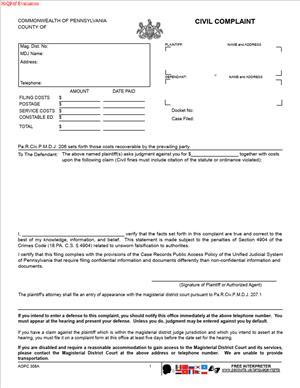
AOPC 308A – Civil Complaint
Fill out nowJurisdiction: Country: United States | Province or State: Pennsylvania
The AOPC 308A – Civil Complaint is the standard form used to start a civil lawsuit in Pennsylvania courts. When you file this document, you are formally asking the court to resolve a dispute between you and another party. It is the first step in many non-criminal court cases.
If you are representing yourself, this form can feel overwhelming. You may be dealing with unpaid debts, property damage, contract issues, or other disputes. The AOPC 308A – Civil Complaint sets out your side of the story in writing and tells the court what you want.
This document matters because it officially begins your case. Once filed and properly served, it notifies the other party that legal action has started. The court relies on the information in this form to understand the nature of the dispute.
Filling it out carefully helps prevent delays. Incomplete or unclear information can lead to rejection by the court or problems later in the process. Understanding how the form works makes the filing process more manageable.
What is AOPC 308A – Civil Complaint?
Clear definition
The AOPC 308A – Civil Complaint is a court document used to initiate a civil action in Pennsylvania. It outlines who is involved in the dispute, what happened, and what relief you are requesting from the court.
A “civil complaint” is different from a criminal charge. It deals with private disputes between individuals, businesses, or organizations. The person filing the complaint is often called the plaintiff. The person or entity being sued is called the defendant.
This form serves as the official record of your claims. It tells the court the legal and factual basis for your case. It also sets the stage for everything that follows, including responses, hearings, and possibly a trial.
Who typically uses this form?
Individuals who believe they have been harmed financially or legally often use this form. For example, someone seeking payment for unpaid work or services may file it. A landlord pursuing unpaid rent may also use it, depending on the type of case.
Small business owners sometimes use this form to resolve disputes with customers, contractors, or suppliers. It can also be used in cases involving property damage or breach of agreement.
Self-represented litigants frequently encounter this form. While attorneys regularly prepare civil complaints, Pennsylvania courts provide standardized versions like AOPC 308A – Civil Complaint to make the process more accessible.
Court staff does not complete the form for you. You are responsible for ensuring that the information is accurate and complete before submission.
Why might you need this form?
You may need this form when informal attempts to resolve a dispute have failed. If the other party refuses to pay, repair damage, or comply with an agreement, filing a complaint formally brings the matter before a judge.
A written demand or conversation may not be enough to resolve certain disputes. The court system provides a structured process for resolving disagreements. This form begins that process.
You might also need this document to preserve your rights within certain time limits. Civil claims are generally subject to deadlines. Filing the complaint within the allowed period is often necessary to keep your claim active.
The form creates a clear record of your allegations. It also defines the scope of the case. The court and the other party will look to this document to understand what issues are being raised.
Typical real-life scenarios
- A contractor completes home improvement work and is not paid. After repeated requests for payment, the contractor files a civil complaint seeking the amount owed.
- A driver’s vehicle is damaged in an accident, and the insurance coverage does not fully compensate for the repairs. The driver files a complaint against the other party to recover additional costs.
- A person loans money to a friend with an agreement to repay by a specific date. The repayment does not happen. The lender files a complaint asking the court to order payment.
- A tenant claims that a landlord wrongfully kept a security deposit without explanation. The tenant files a civil complaint to seek the return of the funds.
- A business claims that a supplier failed to deliver goods as promised under a written agreement. The business files a complaint seeking financial compensation for losses.
- In each of these situations, the AOPC 308A – Civil Complaint functions as the formal start of the court case.
When would you use AOPC 308A – Civil Complaint?
You use this form when you are ready to bring a civil dispute before a Pennsylvania court. It is typically used at the beginning of a case, not after one has already started.
The timing often follows unsuccessful attempts to resolve the issue privately. This might include sending a written request for payment, discussing the matter in person, or attempting mediation. When those efforts do not resolve the dispute, filing the complaint may be the next procedural step.
The form is used by plaintiffs. If you are being sued, you would not use this document to respond. Instead, you would file an answer or other responsive pleading.
This form is generally used in civil matters involving money damages, contract disputes, property damage, and similar claims. It is not used for criminal cases. It is also not used for appeals of prior decisions.
In many situations, the filing of the complaint triggers deadlines for the defendant. Once the complaint is served, the defendant typically has a limited time to respond. The form, therefore, plays a key role in moving the case forward.
Legal characteristics of AOPC 308A – Civil Complaint
The AOPC 308A – Civil Complaint has legal significance because it initiates a court action. Once properly filed and accepted by the court, it becomes part of the official court record.
For the complaint to be effective, it must generally include certain core elements. These often include the correct names of the parties, accurate contact information, a clear statement of the claim, and a specific request for relief. Missing or unclear information may delay processing.
Clarity matters. Courts expect factual statements that explain what happened, when it happened, and how it caused harm. Vague or incomplete descriptions can create confusion and may weaken your position.
The form must usually be signed. By signing, you confirm that the information provided is true to the best of your knowledge. False statements can lead to serious consequences, including dismissal of the case or sanctions.
Improper formatting, incorrect court selection, or incomplete sections can result in rejection by the clerk. Court staff review submissions for compliance with procedural requirements. They do not evaluate the strength of your case at this stage.
The complaint itself does not prove your claim. It simply states your allegations. Evidence and testimony are addressed later in the process.
Civil procedures can vary depending on the level of court and the type of claim. While the structure of the complaint remains consistent, filing fees, service requirements, and procedural steps may differ.
Is it legally binding?
The AOPC 308A – Civil Complaint is legally significant once filed with the court. It binds the plaintiff to the claims made within it. You are formally asserting those allegations and requesting judicial action.
However, the complaint does not create a binding judgment on its own. It does not automatically result in payment or other relief. A binding outcome generally occurs only after a court decision, settlement, or other resolution.
If the defendant does not respond within the required time, the court may enter a default judgment under certain circumstances. In that situation, the complaint can form the basis of a binding court order.
If the case proceeds to a hearing or trial, the court will examine the facts and evidence beyond what is written in the complaint. The document begins the process but does not determine the final result by itself.
How to fill out AOPC 308A – Civil Complaint
Step 1 – Identify the Court
At the top of the form, you will enter the name of the appropriate Pennsylvania court. This includes the county and the specific court division. Make sure the information matches the location where the case is being filed.
Step 2 – List the Parties
Enter your full legal name as the plaintiff. Provide your address and contact information as required. Then list the full legal name and address of each defendant. Accuracy here is critical because this information is used for service of process.
Step 3 – Provide Case Information
Some versions of the form include spaces for docket numbers or case classifications. If the case has not yet been assigned a number, that portion may be completed by the clerk. Follow the structure of the form carefully and complete all applicable sections.
Step 4 – State the Facts of the Case
In the section designated for your claim, describe what happened. Use clear and concise sentences. Include dates, locations, and relevant actions taken by both parties. Focus on facts rather than opinions.
Step 5 – Explain the Legal Basis
After outlining the facts, connect them to your claim. For example, you might state that the defendant failed to pay under an agreement or caused damage through specific actions. This section explains why you believe the defendant is legally responsible.
Step 6 – Specify the Relief Requested
Clearly state what you are asking the court to award. This may include a specific dollar amount or another form of relief permitted in civil cases. Be precise. The court relies on this section to understand your request.
Step 7 – Review for Completeness
Read the entire form carefully before signing. Check names, dates, and amounts. Confirm that every required section is filled in and that the information is consistent throughout the document.
Step 8 – Sign and Date the Form
Sign your name where indicated. Enter the date of signing. Your signature confirms that the statements made in the AOPC 308A – Civil Complaint are true to the best of your knowledge and that you are submitting the document in good faith.
Step 9 – File the Complaint with the Court
Submit the completed form to the appropriate court office. This may involve paying a filing fee and providing additional copies. Once accepted, the complaint becomes part of the official court record, and the case formally begins.
Legal terms you might encounter in AOPC 308A – Civil Complaint
- Plaintiff: The plaintiff is the person or business starting the lawsuit. On this form, you are the plaintiff if you are filing the complaint. Your name must match your legal identification or business registration because the court record will reflect it exactly as written.
- Defendant: The defendant is the person or business you are suing. You must list the defendant’s correct legal name and address. If you misspell the name or list the wrong entity, the service may fail, and your case can be delayed or dismissed.
- Cause of Action: This is the legal reason you are suing. On the form, you explain what the defendant did and why the law allows you to seek relief. You do not need long legal arguments, but you must clearly connect the facts to a recognized legal claim.
- Jurisdiction: Jurisdiction means the court’s authority to hear your case. When completing the complaint, you are confirming that this court has the power to decide the dispute. This usually depends on where the events happened or where the defendant lives or does business.
- Venue: Venue refers to the specific location or court division where the case is filed. Even if a court system has authority, the venue must be appropriate. The address or county information you provide helps establish that the chosen court is the proper place.
- Relief Requested: This is what you are asking the court to order. It can include money damages, return of property, or another specific remedy. The form requires you to state this clearly so the defendant understands what is at stake.
- Damages: Damages are the monetary amount you claim you are owed. You may need to state an exact dollar figure. Be precise and realistic because the amount you claim can affect filing procedures and how the case moves forward.
- Verification: A verification is a statement that the facts in your complaint are true to the best of your knowledge. By signing, you are confirming accuracy. Providing false information can lead to penalties.
- Service of Process: This is the formal delivery of the complaint to the defendant. Filing the complaint is not enough. The defendant must receive official notice in a legally accepted way before the court can proceed.
- Docket Number: This is the case number assigned by the court after filing. It appears on all future documents related to your case. You must use this number on every filing to ensure it is added to the correct case file.
FAQs
Do I need to attach evidence when I file AOPC 308A – Civil Complaint?
You are not always required to attach every piece of evidence at the time of filing. However, if your claim is based on a written contract, invoice, or other document, attaching a copy can strengthen your filing and clarify your claim. Make sure any attachments are clearly labeled and referenced in the body of the complaint so the court understands how they relate to your facts.
What address should I use for the defendant on this form?
You should use the defendant’s current and correct physical or business address where they can reliably receive mail or service. If you use an outdated address, the service may fail, and your case may stall. Double-check leases, contracts, public listings, or prior correspondence to confirm accuracy before submitting the document.
What happens if I make a mistake after filing this document?
If you discover an error after filing, you may need to correct it by submitting an amended complaint or other corrective filing. Minor spelling issues may be easier to address than incorrect party names or dollar amounts. Act quickly once you notice the mistake so the court record stays accurate and service is not affected.
How specific do I need to be when describing what happened?
You should provide enough detail so that someone reading the complaint understands who did what, when it happened, and how you were harmed. Include dates, locations, and clear actions. Avoid emotional language and focus on facts that support your claim for relief.
Do I have to calculate the exact amount of money I am claiming?
If you are asking for money, you should state a specific amount whenever possible. Review invoices, receipts, contracts, or repair estimates to calculate your total. If you are unsure, make sure your estimate is supported by facts and that the amount you list matches the relief section of the form.
Who is allowed to sign the complaint?
The person bringing the claim must sign the document. If the plaintiff is a business, an authorized representative must sign. The signature confirms that the statements in the complaint are true and complete to the best of your knowledge.
Will filing this form automatically notify the defendant?
No. Filing creates the court record, but the defendant must still be formally served. You must follow the required service procedure so the court can move forward. Keep proof that the service was completed because the court may require confirmation.
What changes in the public record once the AOPC 308A – Civil Complaint is filed?
Once accepted, the case becomes part of the court’s official docket. The names of the parties, the claims, and the amount sought are recorded. Future filings, court dates, and judgments will also appear under the assigned docket number.
Checklist: Before, During, and After AOPC 308A – Civil Complaint
Before
- Confirm the correct legal name and address of each defendant.
- Gather contracts, invoices, photos, and written communications related to your claim.
- Calculate the exact amount of damages you are requesting.
- Verify that the court you plan to use has authority over the dispute.
- Prepare a clear timeline of events with dates and locations.
- Check spelling of all names to match official identification or business records.
- Review any filing fees and acceptable payment methods.
- Make sure you understand the basic service requirements.
During
- Write clearly and legibly if completing the form by hand.
- List all parties in the correct sections of the form.
- State facts in chronological order.
- Connect each fact to how it harmed you.
- Specify the exact relief requested, including dollar amounts.
- Attach copies of supporting documents if relevant.
- Review each page for completeness before signing.
- Sign and date the complaint where required.
After
- Make at least two copies of the completed complaint.
- File the original with the court clerk.
- Pay the required filing fee or submit any fee waiver request.
- Obtain the assigned docket number.
- Arrange for proper service on the defendant.
- Keep proof of service for your records.
- Track any deadlines for responses or hearings.
- Store copies of all documents in a dedicated case file.
Common mistakes to avoid with AOPC 308A – Civil Complaint
- Mistake: Listing the wrong legal name for the defendant because you rely on a nickname or trade name, which can cause failed service or dismissal; do not forget to verify the exact registered name.
- Mistake: Writing vague statements about what happened because you feel overwhelmed, which makes it harder for the court to understand your claim; do not forget to include specific dates, actions, and amounts.
- Mistake: Claiming an unsupported dollar amount because you estimated quickly, which can reduce credibility; do not forget to base your damages on documents and clear calculations.
- Mistake: Forgetting to sign the complaint because you focus on the facts section, which can result in rejection by the clerk; do not forget to review the signature and date lines before filing.
- Mistake: Assuming filing alone is enough because you submitted paperwork, which delays the case when service is not completed; do not forget to arrange proper service and keep proof.
- Mistake: Ignoring court notices after filing because you think the next step is automatic, which can lead to missed hearings or dismissal; do not forget to monitor mail and court communications.
- Mistake: Attaching original documents instead of copies because you want to show authenticity, which risks losing important records; do not forget to keep originals in your own file.
- Mistake: Using emotional or accusatory language because the dispute feels personal, which can distract from the legal issues; do not forget to keep your statements factual and focused.
What to do after filling out AOPC 308A – Civil Complaint
Once you complete the form, your focus shifts from writing to procedure. The next steps determine whether your case moves forward smoothly or gets delayed.
- Step 1: Make at least two complete copies of the signed complaint, including all attachments.
- Step 2: Organize your documents in order, with the complaint first and attachments behind it.
- Step 3: File the original complaint with the appropriate court office and pay the required fee or submit a fee request form if applicable.
- Step 4: Obtain confirmation that the complaint has been accepted and ask for the assigned docket number.
- Step 5: Write the docket number on every copy you keep.
- Step 6: Arrange for proper service of the complaint on each defendant using an approved method.
- Step 7: Obtain written proof that the service was completed and file that proof if required.
- Step 8: Calendar all important dates, including deadlines for the defendant’s response.
- Step 9: Prepare a dedicated folder, physical or digital, to store every notice, receipt, and filing related to your case.
- Step 10: Review the court’s next instructions carefully and respond promptly to any scheduling orders or notices.
Stay organized. Check your mail regularly. Keep copies of everything you send or receive. A well-prepared file makes it easier to respond to questions from the court and to present your case clearly if a hearing is scheduled.
Disclaimer: This guide is provided for informational purposes only and is not intended as legal advice. You should consult a legal professional.