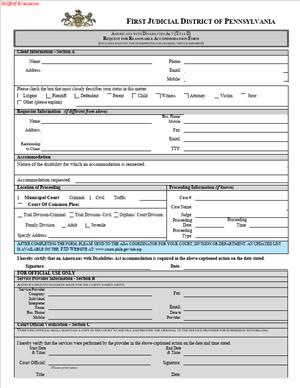
ADA – Request for Reasonable Accommodation Form
Fill out nowJurisdiction: Country: United States | Province or State: Pennsylvania
What is an ADA – Request for Reasonable Accommodation Form?
This form lets you ask the court for the help you need because of a disability. It applies to the First Judicial District of Pennsylvania. That includes Philadelphia County courts and related court services. The form helps you get equal access to court programs, services, and activities.
You use this form to describe your disability-related needs. The court then reviews and arranges reasonable accommodations. Common accommodations include assistive listening devices, American Sign Language interpreters, captioning, accessible formats, and seating changes. You can also request schedule adjustments tied to a disability need. You can request help for a court hearing, a filing, jury duty, or a court program.
People who typically use this form include self-represented litigants, attorneys, jurors, witnesses, and victims. Family members or support persons may also use it when they attend with you. Guardians or advocates may file it for a child or an adult who needs help. You can use it if you need an accommodation in any court division. That includes Civil, Criminal, Family, Orphans’, and Municipal Courts.
You would use this form when your disability limits your ability to access a court service. For example, you may need CART captioning for a hearing. You may need a sign language interpreter for a trial. You may need large print or accessible electronic documents to read pleadings. You may need breaks during a long hearing because of a health condition. You may need a wheelchair-accessible route, seating, or restroom access. You may need a quiet waiting area before you testify. The form creates a clear record of your request.
The form focuses on access, not advantage. It does not change the law or court rules. It helps ensure you can participate on equal terms. It is not a request to change a judge’s decision or alter the outcome of a case. It is not a request for legal advice. It is also not the process for employees of the courts. Court employees use an internal employment process.
There is no fee to ask for a disability accommodation. You should submit the form as early as possible. Early notice helps the court plan and secure services. If you have an urgent matter, explain the time sensitivity. The court will try to assist in time-sensitive situations.
When Would You Use an ADA – Request for Reasonable Accommodation Form?
Use this form when you have a disability that affects your ability to access a court service or proceeding. You might be a tenant scheduled for a Municipal Court hearing who needs a sign language interpreter. You might be a landlord with low vision who needs large-print notices. You might be a small business owner in a civil case who needs an accessible digital copy of exhibits. You might be a domestic violence survivor who needs a quiet space to prepare before a Protection From Abuse hearing because of PTSD. You might be a juror with a hearing disability who needs an assistive listening system in the jury box. You might be a witness who needs extra time to process questions because of a cognitive disability. You might be a parent in Family Court who needs plain-language documents or accessible forms. You might be an attorney who needs captioning for a complex multi-day trial.
You should use this form for any court-hosted service or program. That includes hearings, trials, conferences, mediations, arbitrations, jury service, pretrial services, probation appointments, and clerk counter visits. It also includes education programs run by the court and online platforms the court uses for remote proceedings. If you need access to a courthouse, courtroom, jury room, public counter, or waiting area, this form covers those needs.
If you are not sure whether your need qualifies, submit the form and explain your limitation. The standard is whether the accommodation helps you access a court program. The need can be temporary or long-term. For example, if you broke your leg and need accessible seating for a hearing, submit the form. If you need a service animal to attend court, you do not need to ask permission for the animal. You may still use the form if you need related arrangements, such as seating space.
If your request is for spoken language interpretation because you do not speak English well, that is a language access need. That uses a different process. If your request relates to a hearing disability, such as ASL or captioning, use this ADA form. If your request is to reschedule a hearing for non-disability reasons, use standard scheduling procedures. If you need a change in case deadlines for disability reasons, you can request that here. The court will review whether a schedule change is reasonable for access.
Legal Characteristics of the ADA – Request for Reasonable Accommodation Form
The form itself is not a contract. It is a formal request that triggers the court’s duty to consider accommodations. Courts must provide equal access to programs, services, and activities. The First Judicial District applies this requirement to all its divisions and units. When you submit this form, you start an interactive process. The court reviews your request, considers options, and communicates next steps.
A reasonable accommodation is one that provides effective access without changing the court’s essential functions. The court may provide the specific accommodation you request. It may offer an equally effective alternative if your request is not feasible. The court may deny a request that would fundamentally alter a program or create an undue burden. The court may also deny a request that would pose a direct safety threat that cannot be reduced. If the court denies your request, it should explain the reasons and propose alternatives when possible.
Your request should aim for effective communication and access. For example, an ASL interpreter provides effective communication for a deaf party. CART captioning may serve a late-deafened attorney who uses English text. Large-print or accessible electronic documents serve people with low vision or blindness. A different courtroom may be needed to ensure wheelchair access. Short breaks may be needed to manage a medical condition. These are typical, reasonable solutions in court settings.
Your medical information stays confidential within the accommodation process. The court should not place details in the public case file. You do not need to share a diagnosis. You should describe how your disability limits access and what will help. Provide enough detail for the court to understand your needs. The court may ask for more information if needed to tailor the accommodation.
There is no fee for approved accommodations. The court pays for services like sign language interpreters and captioning for court proceedings. The accommodation applies to court programs only. It does not extend to private meetings between parties. It does not cover non-court facilities. It does not give you strategic advantages in your case. It puts you on equal footing to participate.
If you disagree with a decision, you can ask for reconsideration. The First Judicial District provides a grievance process for ADA accommodation decisions. You should act quickly, especially when a hearing is near. You can also raise access issues to the judge at the start of a proceeding if an urgent need arises. Keep records of your request, the court’s response, and any alternatives provided. Documentation helps if you need to escalate.
Timing matters for enforceability. Submit the form as early as you can. Early requests help the court reserve qualified interpreters and equipment. Urgent requests will still be reviewed. The court will try to meet them where possible. Provide specific dates, times, and locations to avoid delays. Clear, complete requests produce faster responses.
How to Fill Out an ADA – Request for Reasonable Accommodation Form
1) Confirm that the request relates to the First Judicial District.
Use this form for Philadelphia court programs and services. If your matter is in another county, use that court’s request process. If you are a court employee, contact your HR representative instead.
2) Identify the person who needs the accommodation.
Write the full legal name. State whether you are the person seeking the accommodation or filing on someone’s behalf. If you are filing for another person, state your relationship. For a child, list the child’s name and your role, like parent or guardian.
3) Provide your contact information.
Include a phone number, email, and mailing address. State your preferred method of contact. If privacy is a concern, mark any contact details as confidential. Provide an alternative contact if you cannot be reached during business hours.
4) Identify your role in the court matter.
State whether you are a party, self-represented litigant, attorney, juror, witness, victim, support person, or observer. If you work with a legal aid group or attorney, list that contact as well.
5) Enter case information, if known.
Include the case caption, docket number, and the court division. Identify the courthouse address and courtroom, if available. Provide the scheduled date and time. If you do not have a date yet, explain the expected timeframe. If the request covers multiple dates, list each date or describe the period.
6) Describe your access need.
Focus on functional limitations, not diagnosis. For example, write, “I cannot hear speech without captioning or an interpreter.” Or write, “I need large-print documents to read pleadings.” Or write, “I require a wheelchair-accessible route and seating.” Provide concise, concrete details. This helps the court identify effective solutions.
7) List the accommodation you are requesting.
Be specific. For hearing access, state whether you need an ASL interpreter, a Certified Deaf Interpreter, oral transliteration, or CART captioning. For visual access, request large print, Braille, or accessible electronic formats. For mobility, request wheelchair-accessible seating or a different courtroom if needed. For cognitive or mental health needs, request short breaks, a quiet waiting area, or extra time to review forms. For remote access, explain why a video appearance is needed for disability access. For communication, you may request plain-language forms or help with reading aloud documents. If you need technology support, request a hearing loop or portable assistive listening device. If you have a service animal, you do not need to request permission, but you can ask for seating space.
8) Explain timing and duration.
Clarify whether this is for a single date or ongoing. If you have a multi-day trial, list all dates. If the schedule is uncertain, ask the court to note your file. That way, staff can plan for any future docketed events.
9) Offer alternatives, if any.
If your preferred accommodation is not available, suggest backups. For example, if an ASL interpreter is not available, request CART captioning. If large print is not available for a specific form, request an accessible PDF to use with a screen reader. Alternatives help the court act quickly.
10) Share relevant past accommodations.
If you have used an accommodation before in court, mention it. If it worked well, say so. If it did not work, explain why. Prior experience guides the court on what is effective.
11) Provide supporting information only if helpful.
You usually do not need medical records. The court needs enough detail to understand your limitations and what works. If you have a short note from a provider that explains functional needs, you may include it. Do not include unnecessary medical history. Keep supporting documents brief and relevant.
12) Note any equipment you will bring.
If you use personal devices, say so. For example, you might bring a personal amplification device. The court still needs to ensure compatibility with courtroom systems. Declaring your equipment helps staff plan.
13) Address confidentiality.
If you want your request handled confidentially, state that clearly. Ask that medical details not be placed in the public case file. Provide a safe point of contact for communication.
14) Read any acknowledgments on the form.
These often confirm that your statements are true. They may authorize the court to contact you for planning. They may state that the court will provide a reasonable, effective accommodation. They will clarify that not every request can be granted as requested if an alternative is effective.
15) Sign and date the form.
Use your legal signature. If you cannot sign, you may make a mark. An assistant can help complete the form at your direction. If you are signing for someone else, include your name, your role, and your contact information. Notarization is generally not required.
16) Submit the form to the correct court office.
Send it to the ADA Coordinator for the relevant division or program. You can submit by email, mail, fax, or in person. If your hearing is soon, state the urgency in your submission. Keep a copy of everything you submit for your records.
17) Confirm receipt and next steps.
You should receive a response confirming what the court will provide. If you do not hear back in a reasonable time, follow up. If your date is within a few days, call and email to ensure staff saw your request. Document your follow-up.
18) Prepare for the hearing or appointment.
Arrive early to test any equipment. Check in with the courtroom staff or the coordinator. If the accommodation is not in place, notify staff immediately. The judge can address access issues on the record if needed.
19) If your request is denied or adjusted, review the explanation.
The court should give reasons and offer alternatives if possible. If you disagree, ask for reconsideration. Use the court’s grievance process if needed. File a grievance quickly, as hearings move fast. Keep all emails and letters.
20) Update the court if your needs change.
If your condition changes or improves, tell the coordinator. If you have future dates, repeat only the parts of the form that changed. Reference your prior request to save time.
21) Use clear, plain language throughout.
Keep your request factual and specific. Avoid medical jargon. Explain what you need to access the program and why. Specific requests receive faster, more accurate solutions.
22) Do not wait for a formal hearing date to make a request.
If you know a proceeding will occur soon, submit now and update later. Early notice helps the court schedule qualified interpreters and reserve equipment.
23) Remember the scope of the form.
This form covers access to court programs in the First Judicial District. It does not apply to private mediation outside the court. It does not cover private attorney-client meetings. It does not replace motions in your case. For schedule changes tied to disability, include details here and, if needed, file the proper motion.
24) Bring a copy of your approved accommodation to court.
Keep it with your case materials. If a staff change occurs, your document helps the new staff support you. Present the approval if anyone has questions.
25) After your proceeding, share feedback if invited.
Let the coordinator know what worked and what did not. Feedback improves future accommodations for you and others.
By following these steps, you give the court what it needs to act quickly. You also create a clear record for future dates. The First Judicial District’s goal is effective access for every court user. Your clear, timely request makes that possible.
Legal Terms You Might Encounter
- Reasonable accommodation means a change that helps you access court programs or services. It could be assistive technology, communication aids, schedule changes, or physical access help. On this form, you describe the accommodation you need to participate.
- Qualified individual means you are eligible to use court services and have a disability under the law. You do not need to be a party to a case. Jurors, witnesses, attorneys, and visitors can be qualified individuals. The form confirms you qualify and states what you need.
- Disability means a physical or mental impairment that substantially limits major life activities. It also includes a record of such an impairment or being regarded as having one. On the form, you do not need to label your diagnosis. You explain the functional need tied to your court role.
- Auxiliary aids and services are tools that support effective communication. Examples include sign language interpreters, real-time captioning, or assistive listening devices. When you request them on the form, specify the type, date, and event.
- Effective communication is the legal standard that the accommodation must meet. The court must communicate with you as effectively as with others. Your form should state how the requested aid will make communication effective for you.
- Interactive process is the back-and-forth discussion between you and the court. It ensures the court understands your needs and timelines. The form starts this process. Provide enough detail so the court can engage quickly and offer options if needed.
- Undue burden refers to a request that would cause significant difficulty or expense for the court. If a request is an undue burden, the court will consider alternatives. Use the form to list acceptable alternatives that still meet your needs.
- Fundamental alteration means a change that would alter the basic nature of a court service. Courts do not need to grant requests that would change outcomes or legal standards. On the form, focus on access, not case advantages.
- Confidentiality relates to how your disability information is handled. The court should limit disclosure to staff who need it to arrange your accommodation. The form often includes a privacy notice. Share only what is necessary to explain your need.
- Verification or supporting documentation may be optional proof of need. The court may ask for a brief note describing functional limitations. The form may say you do not need to submit medical records. If you provide documentation, keep it minimal and relevant.
FAQs
Do you need to submit medical records with this request?
No. You usually do not need full medical records. You may be asked for brief verification of the functional need. You can describe how the disability affects access without naming your diagnosis. Only include what the court requires to arrange the accommodation.
Do you have to be a party to request an accommodation?
No. You can request an accommodation if you are a party, juror, witness, attorney, interpreter, or visitor. The form should ask for your role. Select the role that matches why you need access to the court.
Do you need to file a new form for every court date?
Often, yes, especially for one-time services like interpreters or CART. If you need ongoing support, note the time frame on the form. Ask if the court can apply the approval to multiple dates. Always update the court if your schedule changes.
Do you request spoken language interpreters on this ADA form?
No. Spoken language services are typically handled through a separate language access process. Use this ADA form for disability-related communication aids, such as sign language or captioning. If you are unsure, explain your need and ask the court to route it.
Do you have to disclose your specific diagnosis?
No. You can describe your limitations and the accommodation needed. For example, write “I am hard of hearing and need CART.” Avoid sharing sensitive details that are not required. Keep your description focused on access.
Do you need to request accommodations for remote hearings?
Yes. Virtual proceedings still require effective communication and access. On the form, note the platform and the tools you need. Common needs include CART integration, dial-in options, or screen reader–friendly files.
Do you get a written decision on your request?
You should receive confirmation, either written or by phone or email. Ask for written confirmation if you need it. If you do not hear back, follow up before your court date. Bring a copy of your form to the courthouse.
Do you risk penalties if you submit close to your hearing?
No penalties, but late requests may be hard to fulfill. Submit as early as you can. For last-minute needs, file immediately and call to alert the court. Offer alternatives that could work on short notice.
Checklist: Before, During, and After the ADA – Request for Reasonable Accommodation Form
Before you sign
- Your full name and contact information.
- Your role (party, juror, witness, attorney, visitor).
- Case caption, case number, and judge, if known.
- Date, time, and location of the proceeding or service.
- Each accommodation you need is stated clearly and specifically.
- Why do you need each accommodation, in plain, functional terms?
- Time frame for your request (single date or ongoing).
- Backup dates or alternative solutions that would work.
- Any brief verification if requested (keep details minimal).
- Your preferred contact method for follow-up.
- Any safety or privacy concerns you want noted.
- Names of any support people who should receive notices.
During signing and review
- Verify the spelling of your name and all contact details.
- Confirm the case number and event date are correct.
- Check that your requested accommodation is specific.
- Ensure your explanation links to the need for court access.
- Verify whether attachments are required. Include only what is needed.
- Confirm you listed all dates you need covered.
- Read any acknowledgments about privacy and follow-up.
- Sign and date the form. Keep a copy for your records.
After signing: filing, notifying, and storing
- File the form with the court’s ADA contact using an accepted method.
- If a deadline is near, file immediately and notify the court.
- Ask for confirmation of receipt and the expected response time.
- Calendar the event date and a follow-up reminder.
- If you receive an approval, read it carefully and note the conditions.
- If you receive a partial or alternative approval, consider whether it works.
- Notify any attorneys or support people of the decision if needed.
- Store your form and any decision letters securely.
- Bring a copy to your event. Arrive early to test equipment if needed.
- If your hearing is rescheduled, update your request right away.
Common Mistakes to Avoid
Don’t use vague language.
- If you write “I need help,” the court will not know what to provide. Be specific, such as “Real-time captioning for a two-hour hearing.” Vague requests can delay approval or lead to the wrong service.
Don’t wait until the last minute.
- Late requests are harder to fulfill, especially for interpreters or equipment. You may face rescheduling or proceed without full access. Submit as early as you can and follow up.
Don’t overshare medical details.
- You rarely need to disclose diagnoses or full records. Oversharing risks privacy and may slow processing. Give only the functional information the court needs to arrange the service.
Don’t request changes that affect case outcomes.
- Requests cannot alter legal standards or rules. If your request would change how the case is decided, it will likely be denied. Focus on access, not advantage.
Don’t forget to update changed dates or locations.
- If your court date or courtroom changes, your service may not be there. Tell the court right away. Otherwise, you may arrive without the needed accommodation.
What to Do After Filling Out the Form
Submit the form promptly.
- Use the court’s accepted submission methods. Include all pages and attachments. Ask for confirmation of receipt. If the date is near, notify the court after filing.
Track your request.
- Record when you submitted and to whom. Set a reminder to follow up. Keep your phone and email open for questions from the court. Respond quickly to any requests for clarification.
Prepare for alternatives.
- If your first choice is not available, propose acceptable alternatives. For example, if an in-person interpreter is unavailable, consider remote interpreting or CART. State your preferences on the form and in follow-up.
Confirm logistics.
- Once approved, confirm the date, time, and location. Ask where to meet service providers. If equipment is involved, ask whether testing happens before the hearing. Arrive early to allow setup.
Coordinate with your case team.
- If you have an attorney, share the approval details. If you have a support person, tell them the plan. Ensure everyone knows the schedule and any check-in location.
Amend if your needs change.
- If your hearing schedule or location changes, send an update. If your functional needs shift, submit an amended request. Reference your original request and the event date.
Handle denials or partial approvals.
- If denied, ask for the reason and possible alternatives. Provide any missing information and resubmit if appropriate. If you still cannot resolve it, ask about the process to elevate your concern.
Document everything.
- Keep copies of your request, approval, and any emails or notes. Bring a copy to court. After the event, note what worked well and what needs improvement. Use that note if you need future accommodations.
Plan for ongoing matters.
- If your case has multiple dates, ask about a standing arrangement. Confirm how far in advance the court needs reminders. Calendar reminders for each session.
Close the loop after your event.
- If the accommodation worked, let the court know briefly if it did not; provide constructive feedback. Clear feedback helps future requests go smoothly.
Disclaimer: This guide is provided for informational purposes only and is not intended as legal advice. You should consult a legal professional.