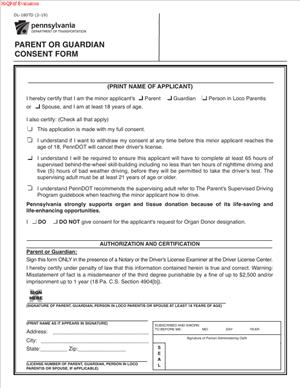
DL-180TD – Parent or Guardian Consent Form
Fill out nowJurisdiction: Country: United States | Province or State: Pennsylvania
The DL-180TD – Parent or Guardian Consent Form is a document used when a minor in Pennsylvania applies for a learner’s permit. It records a parent’s or legal guardian’s consent for the minor to begin the licensing process. Without this signed consent, the application typically cannot move forward.
If you are about to complete this form, you are likely helping a teenager apply for driving privileges. This document connects your approval to the minor’s permit application. It confirms that you understand and accept certain responsibilities tied to that permit.
This form matters because driving is a regulated activity. For minors, the state requires an adult to be involved. The DL-180TD – Parent or Guardian Consent Form creates a written record of that involvement.
You will usually submit this document along with other required paperwork. It becomes part of the minor’s licensing file. Completing it correctly helps avoid delays or rejection at the licensing stage.
Understanding what this form does, and what it does not do, will make the process smoother. The details you provide must match the minor’s application and identification records.
What is DL-180TD – Parent or Guardian Consent Form?
Clear definition
The DL-180TD – Parent or Guardian Consent Form is a written consent document required for certain minor driver’s license applicants in Pennsylvania. It allows a parent, guardian, or person with legal custody to formally approve the minor’s application for a learner’s permit.
It is not a driving test document. It is not the permit itself. It is a supporting form that confirms adult consent and acknowledges responsibility connected to the minor’s driving privileges.
This form typically becomes effective once it is properly completed, signed, and submitted with the permit application. It is part of the overall licensing process administered by the state transportation authority.
Who typically uses this form?
Most often, the person completing this form is a parent of a teenager under 18 who wants to obtain a learner’s permit. In some cases, a court-appointed guardian or another adult with legal custody may sign instead.
The minor applicant does not complete the consent portion. The adult providing consent fills in their own identifying information and signs the document.
Licensing staff reviews the completed form during the permit application process. They use it to confirm that the minor has proper authorization to proceed.
Why might you need this form?
You need this form when a minor cannot legally apply for a learner’s permit without adult consent. Pennsylvania requires documented parental or guardian approval before issuing certain driving privileges to individuals under 18.
The form helps ensure that an adult understands the risks and responsibilities associated with a minor driving. It also links the minor’s driving record to a responsible adult in specific situations.
Without this signed consent, the permit application may not be processed. The form acts as a required step in the broader application package.
Typical real-life scenarios
- A 16-year-old schedules a learner’s permit test. Before the appointment, their parent completes the consent form so it can be submitted with the application.
- A teenager studies for the knowledge test and gathers required identification documents. At the same time, their guardian fills out the consent form to avoid delays at the licensing center.
- A minor who lives with a court-appointed guardian wants to begin driving. The guardian provides consent using this document, confirming their legal authority to do so.
- A parent who shares custody reviews the permit application process and signs the form to acknowledge their approval of the minor starting supervised driving.
When would you use DL-180TD – Parent or Guardian Consent Form?
You use this form when a minor in Pennsylvania applies for a learner’s permit and requires documented parental or guardian consent. This usually occurs at the beginning of the licensing journey.
The form is typically completed before or at the time of the learner’s permit application. It is not something you file after the permit has already been issued. It supports the initial submission.
If the minor is under a certain age threshold set by state rules, consent is generally mandatory. Once the applicant reaches adulthood, this form is no longer required because adult applicants apply on their own authority.
You may also use this form when a previous consent is no longer valid. For example, if there was an earlier incomplete application or if information has changed, a new consent form may be required to match the current filing.
In practice, this form is part of a package. The package often includes identification documents, proof of residency, medical or vision information, and the permit application itself. The consent form fits into that larger process.
Legal characteristics of DL-180TD – Parent or Guardian Consent Form
This form has legal significance because it documents informed consent. By signing, the parent or guardian confirms their identity and their relationship to the minor. They also acknowledge certain responsibilities connected to the minor’s driving status.
For the form to be effective, it must be completed accurately. Names, addresses, and other identifying details typically need to match official records. Incomplete fields, missing signatures, or inconsistent information can lead to rejection.
The signature is a key element. In many cases, the signing adult must appear in person or provide verification as required by licensing procedures. If the signature cannot be verified, the application may be delayed.
The form does not grant driving privileges by itself. It does not replace the need for tests, identification checks, or other statutory requirements. It simply confirms that the minor has proper consent to proceed in the licensing process.
Requirements may vary slightly depending on administrative updates or procedural changes. However, the general purpose remains consistent: to ensure adult authorization for a minor applicant.
Errors often occur when the wrong person signs the document. Only a parent, legal guardian, or person with recognized legal custody authority can provide valid consent. If custody is shared or restricted by court order, additional documentation may be necessary to establish signing authority.
Another common issue is outdated information. If the minor’s name or address differs from other application materials, staff may question the accuracy of the consent form. Consistency across documents helps prevent processing problems.
Is it legally binding?
Yes, in a practical sense, this form is legally binding once signed and submitted as part of the licensing process. By signing, the parent or guardian makes a formal declaration of consent and may acknowledge certain responsibilities under state law.
The binding nature comes from the fact that it is a signed statement submitted to a government agency. Providing false information or signing without proper authority can have legal consequences.
At the same time, the form does not create a private contract between the parent and the minor. It does not override custody orders or other court rulings. It functions within the framework of state licensing regulations.
If the minor later violates traffic laws or causes damage, liability questions are handled under broader legal rules. The consent form itself is not a complete statement of financial or legal responsibility, but it may connect the parent or guardian to the minor’s driving record in certain situations.
How to fill out DL-180TD – Parent or Guardian Consent Form
Step 1 – Review the entire form before writing
Start by reading the full DL-180TD – Parent or Guardian Consent Form from top to bottom. Identify the sections that apply to the minor and the sections that apply to you as the parent or guardian. This overview helps you gather the correct information before you begin.
Step 2 – Enter the minor’s identifying information
Provide the minor’s full legal name exactly as it appears on their identification documents. Include other requested details, such as date of birth or address, if required. Make sure this information matches the learner’s permit application to avoid discrepancies.
Step 3 – Provide parent or guardian details
Fill in your own full legal name and current address. If the form asks for your relationship to the minor, state whether you are a parent, legal guardian, or another authorized custodian. Use accurate and up-to-date information.
Step 4 – Confirm legal authority
If you are signing as a guardian rather than a biological parent, ensure the form reflects your legal authority. Some situations require you to indicate that you have court-appointed guardianship or legal custody. The information you enter must align with any official documentation.
Step 5 – Read the consent statement carefully
Locate the section that explains what you are agreeing to by signing. This often includes acknowledgment of responsibility and understanding of the minor’s driving status. Read this section fully so you understand the declaration you are making.
Step 6 – Sign in the designated signature area
Sign your name exactly as requested in the signature field. Use your normal legal signature. Do not sign outside the designated space, and do not allow the minor to sign on your behalf.
Step 7 – Provide the date of signing
Write the date you sign the form. Ensure the date is clear and follows the format requested on the document. The signing date may need to be recent at the time of submission.
Step 8 – Verify completion before submission
Review the entire form once more. Check for blank fields, spelling errors, or mismatched information. Confirm that your signature and date are present. Once verified, the form is ready to be submitted along with the rest of the minor’s learner’s permit application materials.
Legal terms you might encounter in DL-180TD – Parent or Guardian Consent Form
- Minor Applicant: This is the person under 18 who is applying for a learner’s permit or driver’s license. On this document, the minor’s full legal name, date of birth, and identifying details must match their other application paperwork. Any mismatch can delay processing.
- Parent or Legal Guardian: This refers to the adult who has legal authority over the minor. The form requires this person to confirm their relationship to the minor. If you are signing, you must have recognized legal custody or guardianship status.
- Consent: Consent means you are formally agreeing to allow the minor to apply for driving privileges. By signing, you accept certain responsibilities connected to that privilege. This is not casual permission. It becomes part of the official record.
- Financial Responsibility: This term refers to liability for damages or injuries the minor may cause while driving. By signing, you acknowledge potential responsibility for the minor’s driving actions. This can include financial consequences under applicable motor vehicle laws.
- Certification: Certification is your written confirmation that the information you provided is true. When you sign the form, you certify that all statements are accurate. False information can result in penalties or denial of the application.
- Signature of Record: This is the official signature that becomes part of the state’s motor vehicle file. It must be completed as instructed, often in the presence of an authorized agent. An incomplete or altered signature may invalidate the form.
- Notarization: In some situations, a notary public may be required to witness the signature. Notarization confirms the identity of the person signing. If required and missing, the form will not be accepted.
- Proof of Relationship: This may refer to documents that establish that you are the parent or legal guardian. Examples can include birth certificates or court custody orders. If your relationship is not obvious from the application, supporting documents may be requested.
- Application for Driving Privileges: This is the broader process the minor is completing. The consent form is only one part of that application. It works together with identification documents, knowledge testing forms, and other required materials.
FAQs
Do both parents have to sign the DL-180TD – Parent or Guardian Consent Form?
Usually, only one parent or legal guardian with proper authority needs to sign this form. You should check the signature section carefully to confirm whether one or more signatures are required. If custody is shared or restricted by court order, make sure the signing parent has legal authority. If you are unsure, review any custody documents before signing.
What if the parent signing does not have the same last name as the minor?
If your last name differs from the minor’s, you may need to provide documentation that shows your relationship. This could include a birth certificate, adoption record, or court order. Make sure the names on all documents are spelled exactly the same. Any discrepancy can cause delays or require additional proof.
Can this document be signed ahead of time at home?
That depends on whether a witness or authorized agent must observe the signature. Some motor vehicle forms require in-person signing to verify identity. Before signing at home, confirm whether witnessing is required. If witnessing is required and you sign early, you may have to complete a new copy.
What happens if there is a mistake on the form?
If you notice an error before submission, complete a new, clean copy. Avoid crossing out or using correction fluid unless the instructions clearly allow it. Altered forms are often rejected. Double-check spelling, dates, and identification numbers before signing.
Does signing this form make me legally responsible for everything my child does while driving?
By signing the DL-180TD – Parent or Guardian Consent Form, you acknowledge potential financial and legal responsibility connected to the minor’s driving. This can include liability for damages caused by the minor. The exact scope depends on applicable motor vehicle laws. You should understand that this is more than simple permission; it carries accountability.
What identification information must match the minor’s main application?
The minor’s full legal name, date of birth, and other identifying details must be consistent across all documents. If the minor recently changed their name, updated documentation must support that change. Mismatched information can delay or block approval. Always compare this document side by side with the permit application before submission.
Can a court-appointed guardian sign instead of a biological parent?
Yes, if you are a legally appointed guardian with proper documentation. You must be able to show proof of guardianship if requested. Bring copies of court orders or official guardianship papers. Without proof, the signature may not be accepted.
What if the minor turns 18 before the application is processed?
If the applicant reaches the age of majority before the licensing process is completed, parental consent may no longer be required. However, if the DL-180TD – Parent or Guardian Consent Form was required at the time of application, it must be properly completed. Check the minor’s exact age on the date of signing and submission. Timing can affect whether consent is necessary.
Checklist: Before, During, and After DL-180TD – Parent or Guardian Consent Form
Before
- Confirm the minor’s full legal name matches their identification documents.
- Verify the minor’s exact date of birth.
- Review any custody or guardianship orders to confirm signing authority.
- Gather proof of relationship documents in case they are requested.
- Check whether the signature must be witnessed or notarized.
- Read the consent and liability language carefully.
- Make sure you understand the responsibilities you are accepting.
During
- Print clearly using black or blue ink if completing by hand.
- Enter the minor’s information exactly as shown on official documents.
- Provide your full legal name without abbreviations.
- Confirm your address and contact details are current.
- Review every field before signing.
- Sign only in the designated signature area.
- Date the form accurately on the day you sign.
After
- Make a clear copy or take a photo for your records.
- Attach any required proof of relationship documents.
- Submit the form together with the minor’s full application packet.
- Confirm that the receiving office accepts the document.
- Store your copy in a safe place with other licensing records.
- Monitor the application status if tracking is available.
- Update your insurance provider if required once the minor is licensed.
Common mistakes to avoid with DL-180TD – Parent or Guardian Consent Form
- Mistake: Signing without legal authority because you assume being a relative is enough, which happens in blended families, leading to rejection of the application, so do not forget to confirm you have formal parental or guardianship rights.
- Mistake: Using a nickname or shortened name for the minor, which happens out of habit, causing mismatched records and processing delays, so do not forget to use the exact legal name from official identification.
- Mistake: Leaving required fields blank because they seem unimportant, which often results from rushing, leading to incomplete submission and return of the paperwork, so do not forget to review every line before signing.
- Mistake: Signing in the wrong place or outside the designated area, which can occur when forms look crowded, causing the signature to be invalid, so do not forget to follow the signature instructions precisely.
- Mistake: Failing to bring proof of guardianship when applicable, which happens when you assume your word is sufficient, resulting in refusal at the counter, so do not forget to carry supporting court documents.
- Mistake: Altering the form with corrections or white-out after signing, which happens when errors are noticed late, leading to rejection, so do not forget to complete a fresh copy if changes are needed.
- Mistake: Forgetting to date the form on the actual day of signature, which can create confusion about validity, potentially delaying processing, so do not forget to enter the correct signing date.
What to do after filling out DL-180TD – Parent or Guardian Consent Form
Once the form is complete and signed, your job is not finished. You need to make sure it is properly submitted and recorded as part of the minor’s licensing process.
Start by reviewing the entire application packet. The consent form must accompany the minor’s permit or license application. If it is separated, the application may be considered incomplete.
- Step 1: Make at least one clear copy of the signed form for your personal records.
- Step 2: Confirm that any required supporting documents are attached.
- Step 3: Check whether submission must be done in person or can be mailed.
- Step 4: Ensure the signature was witnessed or notarized if required.
- Step 5: Submit the form together with all other required application materials.
- Step 6: Ask for confirmation that the documents were accepted.
- Step 7: Keep any receipt, confirmation slip, or reference number provided.
- Step 8: Monitor the progress of the minor’s permit or license application.
- Step 9: Once the minor is licensed, review your insurance coverage and add the minor as required.
- Step 10: Store your copy of the form with insurance and vehicle records for future reference.
You should also talk with the minor about the responsibility that comes with driving. By signing, you have acknowledged potential liability. Make sure expectations are clear about safe driving and compliance with traffic laws.
Finally, keep your records organized. If questions arise later about when consent was given or who signed, your copy will provide proof. Good recordkeeping protects you and supports a smooth licensing process.
Disclaimer: This guide is provided for informational purposes only and is not intended as legal advice. You should consult a legal professional.