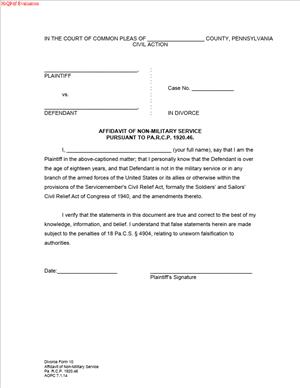
Form 10 – Affidavit of Non-Military Service Pursuant to PA.R.C.P. 1920.46
Fill out nowJurisdiction: Country: United States | Province or State: Pennsylvania
Form 10 – Affidavit of Non-Military Service Pursuant to PA.R.C.P. 1920.46 is a court document used in certain family law cases in Pennsylvania. You complete it to confirm that the other party is not currently on active military duty. Courts require this confirmation before entering specific types of orders.
If you are representing yourself, this form can feel technical. In reality, it serves a focused purpose. It tells the court whether federal military protections apply to the other person in your case.
This matters because active-duty service members receive special legal protections. Courts must take extra steps before issuing default judgments or certain final orders against them. The affidavit helps the judge determine whether those protections are triggered.
You usually file this document when the other party has not responded to your complaint. It is often part of the paperwork required before the court can move your case forward without that person’s participation.
Understanding what this form does will help you complete it accurately and avoid delays in your case.
What is Form 10 – Affidavit of Non-Military Service Pursuant to PA.R.C.P. 1920.46?
Clear definition
Form 10 – Affidavit of Non-Military Service Pursuant to PA.R.C.P. 1920.46 is a sworn written statement filed with the Pennsylvania Court of Common Pleas in certain family law matters. In it, you state whether the opposing party is in military service.
An affidavit is a statement made under oath. By signing this form, you are declaring that the information you provide is true to the best of your knowledge. You are also acknowledging that false statements can carry legal consequences.
The reference to PA.R.C.P. 1920.46 points to a rule in the Pennsylvania Rules of Civil Procedure that applies to family law cases. This rule addresses situations where one party seeks relief and the other has not responded or appeared.
The form connects state court procedure with federal law. Federal law provides protections to service members in civil cases. The court uses your affidavit to determine how to proceed.
Who typically uses this form?
This form is commonly used by a plaintiff in a divorce action. The plaintiff is the person who started the case by filing a complaint.
It may also be used in other family law matters governed by Rule 1920, such as annulment or certain custody-related proceedings when a default situation arises. The key factor is that one party is asking the court to act without the other party’s participation.
Self-represented individuals often complete this form when the defendant does not file an answer. Attorneys also use it as part of standard filing procedures before requesting a final decree or order.
Court staff review the document as part of the case file. The judge relies on it when deciding whether the case can move forward.
Why might you need this form?
You need this form when you are asking the court to enter a decision, and the other party has not responded. Before doing so, the court must determine whether that person is protected by federal military service laws.
Active-duty service members are entitled to certain safeguards. These may include delays or special representation if they cannot appear due to military duties. The court cannot ignore these protections.
The affidavit provides the court with basic information about the other party’s military status. Without it, the court may refuse to enter a default judgment or final decree.
Filing this document is often a required procedural step. If it is missing or incomplete, your case may stall.
Typical real-life scenarios
- You file for divorce and properly serve your spouse. The required response period passes, and your spouse does not file an answer. Before requesting a final divorce decree, you complete this affidavit to confirm your spouse is not on active military duty.
- You start an annulment action. The other party was served but does not participate. The court requires confirmation of non-military status before granting the relief you requested.
- You are seeking a final order after the expiration of a notice period. The rules require that you establish whether the absent party is in military service before the court acts.
- You believe your spouse lives out of state and has had limited contact with you. You want the court to proceed without their input. The affidavit gives the judge assurance that the person is not on active duty and therefore not entitled to specific federal protections tied to military service.
When would you use Form 10 – Affidavit of Non-Military Service Pursuant to PA.R.C.P. 1920.46?
You typically use Form 10 – Affidavit of Non-Military Service Pursuant to PA.R.C.P. 1920.46 when you are requesting a default judgment or final relief in a family law case and the other party has not responded within the required time.
In many divorce cases, there is a waiting period and a response deadline. If the defendant does not file an answer or enter an appearance, you may move forward under the applicable procedural rule. Before the court grants your request, it often requires confirmation of the defendant’s military status.
You may also use this form when submitting paperwork for a final decree after notices have been sent and deadlines have passed. The court needs assurance that proceeding without the other party will not violate federal protections.
The form becomes relevant when the case is moving forward without both parties actively participating. If both sides are present and engaged in the process, this affidavit may not be necessary.
The timing of the submission usually aligns with your request for final action from the court. It is commonly filed together with other documents required for the entry of a decree or order.
Legal characteristics of Form 10 – Affidavit of Non-Military Service Pursuant to PA.R.C.P. 1920.46
This document is a sworn statement. Its legal effect comes from the fact that you sign it under oath. The court treats the information as testimony provided in writing.
For the affidavit to be effective, it must be complete and accurate. It generally must identify the parties, reference the case, and clearly state whether the defendant is in military service. Missing case numbers, incorrect names, or unsigned forms can lead to rejection or delay.
Courts expect you to have a reasonable basis for your statement. Simply guessing about someone’s military status can create problems. If the court questions the accuracy of your affidavit, it may require additional information.
Federal law, often referred to as the Servicemembers Civil Relief Act, provides protections to active-duty service members. The affidavit helps the court comply with that law. If the defendant is on active duty, the court may need to appoint counsel or delay proceedings.
Procedural requirements can vary slightly between counties within Pennsylvania. Formatting, filing methods, or accompanying documents may differ. However, the core purpose of the affidavit remains the same.
This form does not prove the facts of your divorce or other family law claims. It does not establish grounds, property division, or custody arrangements. Its function is limited to confirming military status for procedural purposes.
It also does not replace proper service of the complaint. You still must follow the rules for notifying the other party of the case. The affidavit addresses military status, not service of process.
Is it legally binding?
Yes, in the sense that it is a sworn statement filed with a court. When you sign the affidavit, you are making a declaration under oath. False statements in sworn documents can carry serious consequences.
The binding nature applies to you as the person signing. You are accountable for the truthfulness of the information you provide. The court relies on your declaration when deciding how to proceed.
However, the affidavit does not create a contract between you and the other party. It does not resolve the underlying dispute. Its legal force is procedural, not substantive.
If the information later turns out to be incorrect, the court may revisit actions taken based on that affidavit. This is why accuracy and clarity matter.
How to fill out Form 10 – Affidavit of Non-Military Service Pursuant to PA.R.C.P. 1920.46
Step 1 – Complete the caption
At the top of the form, fill in the court name exactly as it appears on your other filings. Include the county and the designation “Court of Common Pleas.” Enter the names of the plaintiff and defendant exactly as they appear in your complaint. Add the docket number assigned to your case.
Step 2 – Identify yourself
In the body of the affidavit, state your name as the person making the statement. Confirm that you are the plaintiff or otherwise identify your role in the case. This connects you to the case and establishes who is making the sworn declaration.
Step 3 – Identify the other party
Provide the full name of the defendant or opposing party. Make sure the spelling matches the caption and prior filings. Consistency avoids confusion in the court record.
Step 4 – State the military status
Read the statement section carefully. Indicate whether the defendant is not in military service, is in military service, or whether you are unable to determine their status. Select or complete the portion that accurately reflects your knowledge.
If the form requires additional information about how you know the defendant’s status, provide a clear and factual explanation. Keep the language direct and limited to what you know.
Step 5 – Review the sworn statement
Before signing, read the verification language at the end of the form. It typically states that the information is true to the best of your knowledge and that false statements may be subject to penalties. Make sure every part of the form is complete.
Step 6 – Sign and date the affidavit
Sign your name on the designated line. Print your name if the form requests it. Add the date of signing. If the form requires notarization, sign in the presence of a notary and ensure the notary completes their section.
Step 7 – File the form with the court
Submit the completed affidavit to the Prothonotary or filing office for the Court of Common Pleas in your county. File it together with any other documents required for your requested relief. Confirm that the case number appears on every page before submission.
Legal terms you might encounter in Form 10 – Affidavit of Non-Military Service Pursuant to PA.R.C.P. 1920.46
- Affidavit: A written statement you swear or affirm is true. In this document, you are declaring under oath that the other party is not in active military service. Because it is sworn, false information can lead to serious consequences.
- Non-Military Service: This means the person you are identifying is not currently serving on active duty in the United States armed forces. The court needs this confirmation before entering certain orders. It protects service members from default judgments without proper safeguards.
- Active Duty: Full-time duty in the military, including the Army, Navy, Air Force, Marine Corps, Coast Guard, and certain activated National Guard or Reserve service. The form focuses on whether the other party is on active duty at the time you sign the affidavit. Timing matters because military status can change.
- Default Judgment: A court decision entered because one party did not respond or appear. Before a court can grant a default in many family law matters, it must confirm the absent party is not on active duty. This affidavit supports that step.
- Servicemembers Civil Relief Act (SCRA): A federal law that protects active-duty military members from certain legal and financial actions. The court relies on this affidavit to help ensure it does not violate those protections. The SCRA can delay or restrict court proceedings if someone is serving.
- Verification: Your confirmation that the facts in the document are true. On this form, verification is tied to your signature and your sworn statement. You are not just filling out blanks; you are certifying the accuracy of the information.
- Caption: The heading at the top of the court document. It includes the names of the parties, the court name, and the docket number. The caption must match the rest of your case filings exactly.
- Docket Number: The unique number assigned to your case by the court. You must include the correct docket number so the clerk files the affidavit in the right case. An incorrect number can delay processing.
- Notarization: The process where a notary public witnesses your signature and confirms your identity. Many affidavits require notarization because they are sworn statements. Check whether your version of the form requires a notary before filing.
- Personal Knowledge: Information you know directly, not based on rumors or assumptions. When you state the other party is not in military service, you are expected to rely on personal knowledge or reliable verification. Guessing is not enough.
FAQs
Do I have to file Form 10 – Affidavit of Non-Military Service Pursuant to PA.R.C.P. 1920.46 in every divorce case?
You generally file this document when you are asking the court to move forward without the other party’s participation, such as seeking a default. The court needs confirmation about military status before entering certain orders. Check your procedural posture. If the other party has responded and is actively participating, this form may not be required at that stage.
What exact date does this affidavit cover?
This document speaks as of the date you sign it. You are stating that, to your knowledge, the other party is not on active duty at that time. If there has been a long delay between signing and requesting court action, you may need to confirm the status again to ensure it is still accurate.
How do I confirm someone’s military status before I sign?
You should rely on reliable information. That may include your direct knowledge, written communication from the other party, or independent verification through official channels. Before you sign, make sure the name and identifying details you check match exactly with the name listed in the case caption.
What happens if I am not completely sure about the other party’s status?
You should not guess. If you are uncertain, you need to take additional steps to verify before signing. Filing an affidavit with inaccurate information can delay your case and may require corrective filings. The court expects you to make a reasonable effort to confirm the facts.
Does this form change anything in the public record?
This document becomes part of your court file. It records your sworn statement about military status at a specific time. It does not change custody, property, or support terms by itself. It simply allows the court to determine whether it can proceed without violating federal protections.
Do I need to attach proof of non-military status to this document?
In many cases, you are not required to attach proof, but you must be confident in your statement. If you used a verification report or other documentation, keep a copy for your records. If the court questions your affidavit, you may need to show how you confirmed the information.
Who is allowed to sign this affidavit?
The person with direct knowledge of the facts signs it. In most cases, that is you, the filing party. Make sure your printed name, signature, and the date all match your other filings so the clerk can easily connect this document to your case.
What if the other party enters the military after I file this form?
This document reflects the facts as of the date you signed it. If circumstances change before the court enters its order, that new information may affect how the case proceeds. You should ensure the court is not relying on outdated information before final action is taken.
Checklist: Before, During, and After Form 10 – Affidavit of Non-Military Service Pursuant to PA.R.C.P. 1920.46
Before
- Confirm the correct case caption and docket number from your most recent court filing.
- Verify the full legal name of the other party as it appears in the case.
- Check the current military status of the other party using reliable information.
- Review whether notarization is required for your version of the affidavit.
- Gather any documentation you used to verify military status for your records.
- Make sure you understand why the court requires this affidavit at your case stage.
- Confirm that no recent changes in circumstances affect the accuracy of your statement.
During
- Carefully type or print the names exactly as shown in the caption.
- Enter the correct docket number without transposing digits.
- State clearly that the other party is not in active military service.
- Read every line of the sworn statement before signing.
- Double-check spelling of names and dates.
- Sign and date the affidavit on the same day you complete the statement.
- If required, sign in front of a notary and ensure the notary section is complete.
After
- Make at least two copies of the signed affidavit.
- File the original with the Clerk of the Court of Common Pleas.
- Confirm the clerk stamps or time-records your copy as proof of filing.
- Keep a copy in your personal case file.
- Attach it to any related default or procedural request if required.
- Monitor your case docket to confirm the court received and recorded it.
- Bring a filed copy to any scheduled hearing in case the judge asks for it.
Common mistakes to avoid with Form 10 – Affidavit of Non-Military Service Pursuant to PA.R.C.P. 1920.46
- Mistake: Guessing about military status because you have not spoken to the other party recently, which happens when communication breaks down, leading to inaccurate statements and possible court delays, so do not forget to verify before signing.
- Mistake: Using the wrong docket number because you copied it from an old document, which can cause misfiling in another case and processing delays, so do not forget to cross-check the number with the latest court paperwork.
- Mistake: Signing without reading the sworn verification, which happens when you rush through paperwork, exposing you to penalties for false statements, so do not forget that you are signing under oath.
- Mistake: Forgetting notarization when required, often because you assume all forms are the same, resulting in rejection by the clerk, so do not forget to confirm whether a notary must witness your signature.
- Mistake: Misspelling the other party’s legal name, which happens when you rely on informal versions of their name, causing inconsistencies in the court record, so do not forget to match the exact caption.
- Mistake: Filing the affidavit too early and letting months pass before requesting court action, which can make the information outdated and unusable, so do not forget that military status must be current at the time of court review.
- Mistake: Failing to keep a copy for your records, which often occurs when filing in person under time pressure, leaving you without proof of submission, so do not forget to retain a stamped copy.
What to do after filling out Form 10 – Affidavit of Non-Military Service Pursuant to PA.R.C.P. 1920.46
Once you complete and sign the affidavit, your focus shifts to proper filing and follow-through. This document supports your procedural request. It does not move the case forward by itself unless it is correctly submitted and reflected on the docket.
- Step 1: Review the signed affidavit for completeness, including caption, docket number, date, and signature.
- Step 2: Confirm whether notarization is required and ensure the notary section is fully completed if applicable.
- Step 3: Make at least two clear copies—one for your records and one for service or backup if needed.
- Step 4: File the original with the Clerk of the Court of Common Pleas in the same county where your case is pending.
- Step 5: Ask the clerk to time-stamp your copy so you have proof of filing.
- Step 6: Check the case docket after filing to confirm the document appears in the record.
- Step 7: Attach or reference the filed affidavit in any motion or praecipe requesting default or other relief.
- Step 8: Keep your copy organized with all prior pleadings and orders in your case file.
- Step 9: Monitor for court notices, scheduling orders, or additional requirements related to your request.
- Step 10: If significant time passes before the court acts, re-confirm the other party’s military status to ensure your sworn statement remains accurate.
Stay organized. Keep your paperwork consistent. Courts value accuracy and clarity. When your filings are complete and properly recorded, your case can proceed without unnecessary delays.
Disclaimer: This guide is provided for informational purposes only and is not intended as legal advice. You should consult a legal professional.