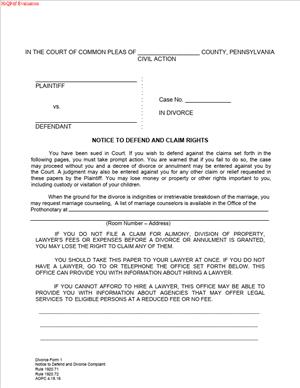
Form 1 – Notice to Defend and Divorce Complaint
Fill out nowJurisdiction: Country: United States | Province or State: Pennsylvania
If you are starting a divorce in Pennsylvania, you will likely encounter the Form 1 – Notice to Defend and Divorce Complaint. This document begins the formal divorce process in the Court of Common Pleas – Civil Division.
The Form 1 – Notice to Defend and Divorce Complaint is more than a simple form. It tells your spouse that you are filing for divorce and explains the claims you are making. It also informs them of their right to respond.
If you are the person filing for divorce, you prepare and file this document. If you are the spouse receiving it, this form tells you what has been filed and what steps may follow.
Understanding how this document works helps you avoid delays. It also helps you see how the court views your case from the start.
What is Form 1 – Notice to Defend and Divorce Complaint?
Clear definition
The Form 1 – Notice to Defend and Divorce Complaint is a combined court filing used to start a divorce case in Pennsylvania. It includes two main parts.
The first part is the “Notice to Defend.” This section informs the other spouse that a legal action has been filed against them. It explains that they have the right to respond within a certain period.
The second part is the “Divorce Complaint.” This section sets out basic information about the marriage and the grounds for divorce. It tells the court what you are asking for, such as a divorce decree and possibly related relief.
Once filed with the Court of Common Pleas, this document opens the case and assigns a docket number. From that point on, the case becomes part of the court’s official record.
Who typically uses this form?
This form is typically used by a spouse who wants to legally end a marriage in Pennsylvania. That person is often called the “plaintiff.”
The other spouse, called the “defendant,” receives a copy of the completed filing. The defendant does not prepare this form but must review it carefully once served.
Self-represented individuals often use this form when they are handling their own divorce. Attorneys also use the same form when representing clients.
In most situations, this document is the first formal step in a divorce action.
Why might you need this form?
You need this form if you want the court to grant a divorce. Without filing it, the court does not have a case before it.
The form formally notifies your spouse that you are seeking a divorce. Courts require proper notice before moving forward with any legal proceeding.
It also outlines the legal basis for the divorce. In Pennsylvania, divorces are commonly filed under “no-fault” grounds, but fault-based grounds may also be included in some cases.
Filing this document creates a clear starting point for deadlines, responses, and further filings.
Typical real-life scenarios
- You and your spouse have been living separately for some time and have agreed that the marriage is over. One of you files this document to formally begin the divorce process so the court can eventually issue a decree.
- You want a divorce, but your spouse does not agree. Filing this form starts the legal process even if the other person does not consent.
- There are disagreements about property or support. Filing the complaint allows the court to gain authority over the marriage and, in some cases, related claims.
- You need a legal divorce to remarry or to settle financial matters. This document begins the process that can lead to a final order.
- When would you use Form 1 – Notice to Defend and Divorce Complaint?
You use this form when you are ready to start a divorce case in the Court of Common Pleas in Pennsylvania. It is not used for legal separation alone. It is specifically for initiating a divorce action.
The timing often depends on your circumstances. Some people file after a period of separation. Others file shortly after deciding that reconciliation is not possible.
If you and your spouse agree on most issues, you may still need to file this document to obtain a final divorce decree. Even uncontested divorces usually begin with a formal complaint.
If there are disputes about property division, alimony, or other related matters, this filing opens the door for those issues to be addressed within the court system.
This form is also used whether you are filing under mutual consent grounds or under a separation-based ground. The details you include may differ, but the structure of the filing remains the same.
Legal characteristics of Form 1 – Notice to Defend and Divorce Complaint
This document becomes effective once it is properly completed, filed with the court, and served on the other spouse according to court rules. Filing alone is not enough. Proper service is a key part of the process.
The complaint must contain accurate information about the marriage, including dates and residency details. Errors in these sections can delay the case or require amendments.
Common problems include incomplete information, incorrect names, missing signatures, or failure to follow formatting requirements set by the court. If the document does not meet court standards, the clerk may reject it or require corrections.
The form does not automatically grant a divorce. It only starts the case. Additional steps, waiting periods, and possibly other filings are usually required before a judge can issue a final decree.
While Pennsylvania has statewide rules for divorce, local counties may have specific filing procedures or administrative requirements. The core document remains the same, but the submission process may vary slightly from one county to another.
This document also does not decide issues such as property division or support by itself. It can request relief, but the court must later address and resolve those matters.
Is it legally binding?
The Form 1 – Notice to Defend and Divorce Complaint itself is not a final judgment. It does not dissolve the marriage on its own.
However, once properly filed and served, it has legal effect. It places the defendant on formal notice that a legal action has begun. From that point, deadlines for responding may apply.
Statements made in the complaint are presented to the court as formal allegations. Providing false information in a court filing can carry serious consequences.
The document becomes part of the official court record. It sets the framework for what the court will consider in the divorce case.
The marriage remains legally intact until the court issues a final divorce decree. This form is the starting point, not the ending point.
How to fill out Form 1 – Notice to Defend and Divorce Complaint
Step 1 – Complete the caption
At the top of the form, fill in the name of the Court of Common Pleas and the specific county where you are filing. Enter your name as the plaintiff and your spouse’s name as the defendant. Leave the docket number blank if it has not yet been assigned. The court will provide that number after filing.
Step 2 – Review and include the Notice to Defend section
The Notice to Defend section contains standard language informing the defendant of their rights. Ensure this section appears exactly as required by the court. Do not alter the wording unless the court’s instructions specifically allow it.
Step 3 – Provide residency information
State that you or your spouse meets the residency requirement for filing in Pennsylvania. Include the length of time one of you has lived in the state, as required by the form. This establishes the court’s authority to hear the case.
Step 4 – Enter marriage details
Provide the date and place of the marriage. Include the city or county and the state where the marriage occurred. Accuracy here is important because the final decree will rely on these details.
Step 5 – State separation information
If the form asks for separation details, include the date of final separation. This is often the date when one spouse moved out or when you both clearly ended the marital relationship. Use a specific date rather than an estimate whenever possible.
Step 6 – Identify the grounds for divorce
Indicate the legal ground under which you are filing for divorce. This may involve mutual consent, a period of separation, or other recognized grounds. Select the option that matches your situation and ensure the information aligns with the facts of your case.
Step 7 – Address related claims if included
Some versions of the complaint allow you to request additional relief, such as alimony or other related matters. If you include these claims, clearly state what you are requesting. Only include information that applies to your circumstances.
Step 8 – Sign and date the complaint
Review the entire document carefully before signing. Confirm that names, dates, and other details are correct. Sign and date the form where indicated. Your signature confirms that the information is true to the best of your knowledge.
Step 9 – Make copies and prepare for filing
After completing and signing the form, make the required number of copies. You will need at least one copy for yourself and one for service on your spouse. Submit the original and copies to the appropriate office of the Court of Common Pleas – Civil Division for filing.
Legal terms you might encounter in Form 1 – Notice to Defend and Divorce Complaint
- Plaintiff: The plaintiff is the spouse who starts the divorce case. On this form, the plaintiff’s name appears in the caption at the top of the page. If you are filing the complaint, you are the plaintiff, and your name must match your legal name as it appears on other court documents.
- Defendant: The defendant is the other spouse. This person receives the complaint and the notice to defend. The defendant’s full legal name must be written exactly as it appears in official records, so there is no confusion about who is being sued for divorce.
- Caption: The caption is the heading at the top of the first page. It lists the court name, the names of both parties, and space for a docket number. The clerk assigns the docket number after filing, and you must use that number on every document in your case.
- Notice to Defend: This is a formal warning to the defendant. It explains that the defendant has a limited time to respond and that failing to do so can lead to a judgment being entered without further notice. This language must appear exactly as required because it protects the defendant’s due process rights.
- Grounds for Divorce: These are the legal reasons you state for ending the marriage. The complaint includes specific statements you must check or complete to identify your grounds. The grounds you choose affect how the case moves forward and what additional steps may be required.
- Service of Process: Service of process means officially delivering the filed complaint to the defendant. The court requires proof that the defendant received the documents in a proper way. Without a valid service, the case cannot proceed.
- Affidavit: An affidavit is a written statement made under oath. In divorce cases, affidavits are often used later in the process to confirm facts such as separation dates or consent. While the complaint itself may not be notarized, you must ensure that any affidavit connected to your case is signed correctly.
- Verification: A verification is a signed statement at the end of the complaint confirming that the facts you listed are true to the best of your knowledge. You sign this section. By signing, you accept responsibility for the accuracy of the information.
- Docket Number: The docket number is the court’s tracking number for your case. The clerk assigns it when you file. You must include this number on all future filings, envelopes, and related paperwork.
- Relief Requested: Relief requested refers to what you are asking the court to order. In a divorce complaint, this usually includes dissolving the marriage and may include additional claims such as costs or other related matters. What you request here sets the scope of what the court can grant.
FAQs
What happens after I file Form 1 – Notice to Defend and Divorce Complaint with the court?
After you file this document with the clerk, the court assigns a docket number and stamps your copies. Filing alone does not notify your spouse. You must arrange proper service so the defendant receives a copy. Keep the time limits in mind, because the response period starts based on the date of service, not the date you prepared the paperwork.
Do I need to notarize this form before filing it?
In most cases, the complaint includes a verification that you sign, but does not require notarization. Check the signature block at the end. If it says you are verifying the statements subject to penalties for false statements, you sign and date it as instructed. Do not leave the verification unsigned, because the clerk may reject the filing.
How do I know if the court accepted my filing?
When you submit the paperwork, the clerk will either stamp it as filed or return it for correction. A filed copy will show a filing date and a docket number. If you submit electronically, you will receive a confirmation notice. Review the accepted version to confirm that names, dates, and the case number are correct.
What if I made a mistake on the Form 1 – Notice to Defend and Divorce Complaint after filing it?
If you discover an error after filing, you may need to prepare an amended complaint. The correction must clearly state what is being changed. Once accepted, the amended version must also be served on the defendant. Do not ignore errors in names, dates of separation, or grounds, because those details become part of the official court record.
What name should I use if I recently changed my name?
Use your current legal name as it appears on government identification. If your name changed during the marriage, make sure it matches what appears on other court filings. Consistency prevents delays and avoids confusion in the docket. If the marriage certificate lists a different name, that is fine as long as your current legal name is clear in the caption.
When does the response deadline start for the defendant?
The deadline starts when the defendant is properly served, not when you file the complaint. The notice to defend explains the number of days the defendant has to respond. You should record the exact date of service and calculate the deadline carefully. Missing this detail can affect your ability to request further action from the court.
Can I include claims about property or support in this document?
This form allows you to raise related claims if you choose to include them. You must clearly state any additional relief you are requesting in the appropriate section. If you leave those claims out, you may need separate filings later. Read each section carefully so you understand what you are asking the court to address.
Does filing this form automatically finalize my divorce?
No. Filing this document only begins the case. The court will not issue a final divorce decree until all legal steps are completed, including service, waiting periods, and any required additional filings. You must follow through with each stage of the process before the marriage is legally dissolved.
Checklist: Before, During, and After Form 1 – Notice to Defend and Divorce Complaint
Before
- Confirm that you meet residency requirements before starting the case.
- Gather your marriage certificate and confirm the exact date of marriage.
- Verify the correct legal names and current addresses for both spouses.
- Decide which grounds for divorce apply to your situation.
- Review whether you want to include related claims such as property or support.
- Prepare payment for filing fees or complete a fee waiver request if needed.
- Check the court’s formatting requirements for margins and copies.
During
- Complete the caption with the correct court name and party names.
- Leave the docket number blank if it has not yet been assigned.
- Select and complete the correct grounds section without skipping required language.
- Fill in all dates carefully, especially the date of separation.
- Review the notice to defend text to ensure it appears exactly as required.
- Sign and date the verification section.
- Make at least two copies of the completed complaint before filing.
- Submit the original to the clerk and obtain a time-stamped copy.
After
- Arrange proper service of the filed complaint on the defendant.
- Complete and file proof of service with the court.
- Record the service date and calculate the response deadline.
- Store your stamped copy in a safe, organized file.
- Monitor the docket for any response or court notices.
- Prepare for the next required filing based on your grounds for divorce.
- Update your personal records with the assigned docket number.
Common mistakes to avoid with Form 1 – Notice to Defend and Divorce Complaint
- Mistake: Misspelling a party’s legal name because you rely on memory; this happens often and can cause service problems or delays, so do not forget to match the spelling exactly to official identification.
- Mistake: Listing the wrong separation date because you estimated instead of confirming; this can affect timelines and affidavits later, so do not forget to verify the exact date before writing it down.
- Mistake: Leaving the verification unsigned because you overlooked the last page; the clerk may reject the filing, so do not forget to sign and date where required.
- Mistake: Altering the notice to defend language to “simplify” it; required wording must remain intact, or the court may not accept it, so do not forget to keep the standard text unchanged.
- Mistake: Failing to make copies before filing because you are in a hurry; without stamped copies, you may lack proof of filing, so do not forget to prepare duplicates in advance.
- Mistake: Assuming filing alone notifies your spouse; without proper service, the case cannot proceed, so do not forget to complete and document service correctly.
- Mistake: Omitting related claims unintentionally because you do not read each section carefully; this may limit what the court can decide, so do not forget to review every request for relief before submitting.
What to do after filling out Form 1 – Notice to Defend and Divorce Complaint
Once you complete the complaint, your next focus is proper filing and service. Accuracy and follow-through matter as much as the information you entered.
- Step 1: Review the entire document from top to bottom for errors in names, dates, and checked boxes.
- Step 2: Make at least two complete copies of the signed complaint for your records and for service.
- Step 3: File the original with the Clerk of the Court of Common Pleas – Civil Division and pay the required filing fee or submit an approved fee waiver.
- Step 4: Obtain a time-stamped copy that shows the docket number assigned to your case.
- Step 5: Arrange for proper service of the filed complaint on the defendant using an accepted method.
- Step 6: Complete proof of service and file it with the court so the docket reflects when and how service occurred.
- Step 7: Calculate the defendant’s response deadline starting from the date of service and mark it on your calendar.
- Step 8: Monitor the case docket regularly to see whether an answer or other response has been filed.
- Step 9: Prepare the next required documents based on whether the divorce is contested or uncontested.
- Step 10: Keep all filed copies, proof of service, and court notices organized in a dedicated folder for easy access throughout the case.
Staying organized will make the process smoother. Keep a written timeline of filing dates, service dates, and response deadlines. Store both paper and digital copies if possible. If the court sends notices by mail, read them immediately and respond within any stated timeframe. Careful tracking now prevents avoidable delays later in your divorce case.
Disclaimer: This guide is provided for informational purposes only and is not intended as legal advice. You should consult a legal professional.