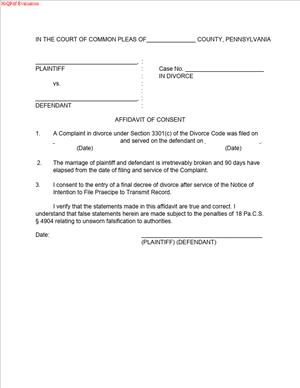
Affidavit of Consent
Fill out nowJurisdiction: Country: United States | Province or State: Pennsylvania
An Affidavit of Consent is a sworn written statement where you formally confirm that you agree to a specific legal action. In Pennsylvania family court matters, this document is commonly used to show that you voluntarily consent to a request before the court.
If you are representing yourself, this form can feel intimidating. It is not just a simple agreement. It is a sworn statement, meaning you are declaring under oath that your consent is knowing and voluntary.
In the Pennsylvania Court of Common Pleas – Family Law division, the Affidavit of Consent is often connected to divorce proceedings. It plays a key role in no-fault divorce cases based on mutual consent.
Before you complete this form, you need to understand what you are agreeing to, how it affects your case, and why the court requires it. The details matter. Small mistakes can delay your filing or cause the document to be rejected.
This guide explains what the form does, when it is used, and how to fill it out clearly and accurately.
What is an Affidavit of Consent?
Clear definition
An Affidavit of Consent is a written statement signed under oath in which you confirm that you agree to move forward with a legal action. In Pennsylvania family law, it is most commonly used in divorce cases where both spouses consent to the divorce.
By signing this document, you are telling the court that you agree to the entry of a final decree. You are also confirming that your consent is voluntary and not the result of pressure, threats, or misunderstanding.
Because it is an affidavit, it must be signed in front of an authorized person, such as a notary public. Your signature carries legal weight. You are affirming that the information in the document is true.
Who typically uses this form?
In Pennsylvania, this form is usually used by spouses in a no-fault divorce based on mutual consent. Each spouse signs their own separate affidavit.
You may use this form if you and your spouse agree that the marriage is irretrievably broken and both want the court to grant a divorce without proving fault.
It is also used by self-represented individuals who are handling their divorce without an attorney. The court requires the form even when both parties agree on everything.
Why might you need this form?
You may need this form to move your divorce case forward. In a mutual consent divorce, the court cannot finalize the divorce until each spouse files an Affidavit of Consent after the required waiting period.
The document shows that both parties still agreed to the divorce at the time of filing. It confirms that your consent has not changed since the complaint was filed.
Without this form, the judge does not have the required written confirmation to issue a final decree. The case may remain open and inactive until proper documents are submitted.
Typical real-life scenarios
- You and your spouse have decided to divorce and agree on property division and other issues. After the divorce complaint is filed and the waiting period passes, each of you signs and files an affidavit so the court can finalize the divorce.
- You filed for divorce months ago, and your spouse did not contest it. Now that the required time has passed, you both want to complete the process. The affidavit is the final confirmation needed before the decree is entered.
- You and your spouse resolved financial matters through a written agreement. The Affidavit of Consent is used to confirm that you still agree to end the marriage and are ready for the court to issue the divorce order.
- One spouse filed the divorce complaint, and the other accepted service. After the waiting period, both parties complete and file their affidavits separately to show continued agreement.
- In each of these situations, the form acts as formal proof of mutual consent at a specific stage of the case.
When would you use an Affidavit of Consent?
You use this form in a Pennsylvania no-fault divorce based on mutual consent. It is typically filed after a waiting period that begins once the divorce complaint is served.
The timing matters. Courts generally require that a certain number of days pass before you can sign and file the affidavit. This waiting period allows both parties time to reconsider and ensures the decision is not rushed.
Each spouse completes their own form. One person’s signature does not replace the other’s. Both documents must be properly completed and filed before the court can proceed to issue a final decree.
You would not use this form in a fault-based divorce where one party alleges misconduct and must prove it in court. It is designed specifically for cases where both parties agree that the marriage is irretrievably broken.
You may also encounter this form if your case began as contested but later became mutual. If both sides decide to proceed by consent, the required affidavits may become part of the filing process.
Legal characteristics of Affidavit of Consent
An Affidavit of Consent is a sworn statement. This means you are making your declaration under penalty of perjury. If the information is false, there can be legal consequences.
For the form to be effective, it must be complete, accurate, and properly signed. Missing case numbers, incorrect names, or unsigned sections can lead to rejection by the clerk’s office.
The document must typically be signed before a notary or other authorized official. If it is not notarized when required, the court may not accept it as valid.
The affidavit is tied to a specific case. It must match the caption of your divorce complaint, including the names of the parties and the docket number. Even small inconsistencies can cause delays.
This form does not resolve property division, custody, or support by itself. It only confirms your consent to the divorce. Any separate agreements or court orders addressing other issues must be handled independently.
Procedural requirements can vary slightly by county within Pennsylvania. Formatting, filing methods, and related cover sheets may differ. The core purpose of the affidavit remains the same, but local practices can affect submission details.
Is it legally binding?
Yes, an Affidavit of Consent is legally binding in the sense that it is a sworn statement filed with the court. Once submitted, it represents your formal and voluntary agreement to the divorce.
By signing, you are confirming that you understand the nature of the proceeding and that you consent to the entry of a divorce decree. The court relies on this confirmation when issuing its final order.
However, the affidavit itself does not create a divorce. The divorce becomes effective only when the court signs and enters the final decree. The affidavit is one required step in that process.
If circumstances change before the court enters the decree, procedural options may exist, but those depend on timing and case status. The key point is that your signature signals serious and deliberate consent.
How to fill out Affidavit of Consent
Step 1 – Review the case information
Start by reviewing your divorce complaint and any court documents already filed. Confirm the exact spelling of both parties’ names and the docket number assigned by the court. The information on your affidavit must match the existing case record exactly.
Step 2 – Complete the caption
At the top of the form, fill in the court name, county, parties’ names, and docket number. This section is called the caption. Copy the information exactly as it appears on prior filings. Do not shorten names or change formatting.
Step 3 – Identify yourself clearly
In the body of the form, you will state your name and your role in the case, such as plaintiff or defendant. Make sure you select or write the correct designation. This tells the court who is giving consent.
Step 4 – Confirm the required waiting period
The form may include language confirming that a required number of days has passed since service of the divorce complaint. Check the relevant dates carefully. Ensure that the waiting period has elapsed before signing.
Step 5 – Declare that the marriage is irretrievably broken
You will affirm that the marriage is irretrievably broken and that you consent to the divorce. Read this statement carefully before signing. This is the core declaration the court relies on to grant a mutual consent divorce.
Step 6 – Verify voluntariness
The affidavit typically includes a statement that your consent is given freely and not as a result of force, fraud, or duress. Review this language slowly. By signing, you confirm that your decision is voluntary.
Step 7 – Sign in the presence of a notary
Do not sign the document until you are in front of a notary public or other authorized official, if required by the form. Bring valid identification. Sign your name exactly as it appears in the caption. The notary will complete their portion and apply their seal.
Step 8 – Make copies and prepare for filing
After the document is signed and notarized, make copies for your records. Follow the court’s filing process for submitting the original to the clerk of the Court of Common Pleas in your county. Ensure the submission is complete and matches the rest of your case file.
Legal terms you might encounter in Affidavit of Consent
- Affiant: The affiant is the person who signs the document and swears that the statements in it are true. In this form, you are the affiant if you are the spouse confirming your consent to the divorce. Your printed name and signature must match the court record.
- Irretrievably Broken: This phrase means the marriage cannot be repaired. When you sign, you are formally stating that there is no reasonable chance of reconciliation. This statement becomes part of the official court file.
- Separation Date: This is the date you and your spouse stopped living together as a married couple. The form may require you to confirm that a required separation period has passed. Use the exact date previously stated in your case documents.
- Waiting Period: This refers to the required amount of time that must pass before a divorce can be finalized. The form often confirms that this period has expired. Filing too early can delay the case.
- Voluntary Consent: This means you are signing freely, without pressure, threats, or coercion. By signing, you are declaring that your decision is your own. The court relies on this statement when granting a no-fault divorce.
- Notary Public: A notary is an official who verifies your identity and witnesses your signature. You must sign in front of the notary, not beforehand. The notary completes a section confirming that you appeared and signed voluntarily.
- Caption: The caption is the heading at the top of the form that lists the court name, the parties’ names, and the docket number. It must match your other court filings exactly. Even small errors can cause processing delays.
- Docket Number: This is the unique case number assigned by the court. It connects your document to your divorce case. Always double-check that the number is accurate before filing.
- Verification: A verification is a sworn statement that the information provided is true to the best of your knowledge. Your signature before a notary serves as this confirmation. False statements can have serious consequences.
FAQs
Do both spouses have to file an Affidavit of Consent?
In most mutual consent divorce cases, each spouse signs and files their own document. You are only responsible for completing and filing yours unless the court instructs otherwise. Check the case docket to confirm whether both have been submitted.
When can I sign this form?
You can sign only after the required waiting period has passed from the date the divorce complaint was served. Look at your proof of service or prior filings to confirm the correct date. Signing too early can cause the court to reject your filing.
What date should I put next to my signature?
Use the actual date you sign in front of the notary. Do not pre-date or backdate the document. The signature date must reflect the day you physically appeared before the notary.
Does this document mean I agree with everything in the divorce complaint?
By signing this form, you confirm that you consent to the divorce itself. It does not automatically mean you agree to every detail unless those terms are incorporated elsewhere in your case. Review any settlement agreement separately to be sure you understand what is being filed.
What happens if my name is spelled differently than on earlier court papers?
Your name must match the court record exactly. If there is a discrepancy, correct it before filing or address it through the proper court process. Inconsistent names can delay acceptance or create confusion in the docket.
Do I need to attach anything to this form?
Typically, this document is filed on its own, but you may need to confirm that other required filings are already in the record. Review your case checklist to ensure nothing is missing. Missing companion documents can prevent the judge from entering a final decree.
How do I know the court received my filing?
After submission, check the docket or request confirmation from the clerk’s office. You should see the document listed under your case number. Keep proof of submission for your records.
Can I withdraw my consent after filing?
Once filed, your statement becomes part of the court record. If you change your mind before the divorce is finalized, you may need to take additional formal steps with the court. Timing matters, so review the case status before assuming anything can be undone.
Checklist: Before, During, and After Affidavit of Consent
Before
- Confirm the required waiting period has fully passed.
- Review the divorce complaint and ensure you understand what is being requested.
- Verify the correct spelling of both parties’ names.
- Locate your docket number and prior filings.
- Check that your separation date matches earlier documents.
- Read the entire form carefully before signing.
- Make sure you have valid photo identification for the notary.
- Confirm where and how the document must be filed.
During
- Complete the caption exactly as it appears in your case.
- Print your full legal name clearly.
- Enter accurate dates, especially the separation and signature dates.
- Review each statement before signing.
- Sign only in the presence of the notary.
- Ensure the notary completes all required sections.
- Double-check that the docket number is correct.
- Ask for a stamped or acknowledged copy if filing in person.
After
- Make at least two copies of the signed and notarized form.
- File the original with the appropriate court office.
- Confirm the document appears on the case docket.
- Keep a copy in a safe and organized file.
- Monitor the case status for entry of the final decree.
- Follow up if you do not receive confirmation within a reasonable time.
- Update personal records once the divorce is finalized.
- Store the final decree together with this document.
Common mistakes to avoid with Affidavit of Consent
- Mistake: Signing before the waiting period ends, which often happens due to confusion about service dates, leading to rejection by the court; do not forget to confirm the exact date the complaint was served.
- Mistake: Signing without a notary present, usually because someone signs at home first, which makes the form invalid; do not forget to appear before a notary and bring identification.
- Mistake: Using the wrong docket number, often copied from another case or written from memory, which can misfile your document; do not forget to verify the number directly from court records.
- Mistake: Misspelling a party’s name, which happens when rushing or relying on informal versions of a name, causing processing delays; do not forget to match the spelling exactly as it appears on prior filings.
- Mistake: Leaving blank fields, often overlooked when sections seem repetitive, which can result in rejection; do not forget to review every line before signing.
- Mistake: Forgetting to keep copies, which commonly occurs when filing in person under time pressure, making it hard to prove submission later; do not forget to make and store duplicates.
- Mistake: Assuming filing alone finalizes the divorce, which happens due to misunderstanding the process, leading to missed follow-up steps; do not forget to monitor the docket for the final decree.
- Mistake: Providing inconsistent separation dates, often due to memory errors, which can raise questions about eligibility; do not forget to confirm the date used in earlier documents.
What to do after filling out the Affidavit of Consent
Once you complete and notarize the form, your next focus is proper filing and follow-through. The document does not finalize your divorce by itself. It becomes effective only when accepted into the court record and combined with the other required filings in your case.
Start by organizing your paperwork. Keep the signed original separate from your copies. If you are filing in person, bring identification and any required filing fee information. If filing by mail, use a secure method and include any required cover sheet.
- Step 1: Make at least two clear copies of the notarized document before submitting the original.
- Step 2: Confirm the correct filing location within the Court of Common Pleas Family Law division.
- Step 3: Submit the original according to the accepted filing method, whether in person or by mail.
- Step 4: Request or retain proof of submission, such as a time-stamped copy or confirmation notice.
- Step 5: Check the docket after filing to confirm the document appears under your case number.
- Step 6: Verify that all other required divorce documents have been filed by both parties.
- Step 7: Monitor the case for entry of the final divorce decree.
- Step 8: Obtain a certified copy of the final decree once issued.
- Step 9: Update your personal records, including name changes if applicable.
- Step 10: Store your decree and a copy of this filed document in a secure place.
After the decree is entered, review it carefully. Make sure names are spelled correctly and dates are accurate. If you plan to change your name, use the decree as proof with government agencies and financial institutions.
Keep all divorce-related paperwork together. You may need these records for property transfers, refinancing, retirement account updates, or future legal matters. Staying organized now prevents problems later.
Disclaimer: This guide is provided for informational purposes only and is not intended as legal advice. You should consult a legal professional.