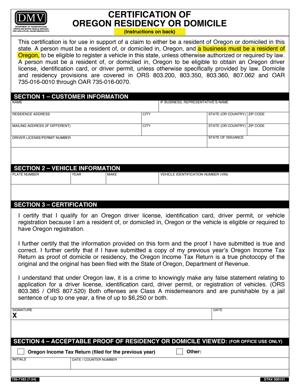
DMV 735-7182- Certification of Oregon Residency or Domicile
Fill out nowJurisdiction: Country: United States | Province or State: Oregon
The DMV 735-7182- Certification of Oregon Residency or Domicile is a form used to confirm that you live in Oregon or consider Oregon your legal home. You complete it when you need to formally state your residency status for motor vehicle or driver-related matters.
If you are at the DMV counter and do not have standard proof of address, this document can serve as a written certification. It allows you to declare where you live or that Oregon is your domicile. Domicile generally means the place you treat as your permanent home.
This form matters because residency affects your eligibility for certain licenses, identification cards, vehicle registrations, and related benefits. Oregon agencies rely on accurate residency information to determine what you qualify for and what fees may apply.
You are responsible for the information you provide on the form. Signing it confirms that your statements are true to the best of your knowledge. False information can lead to delays, denial of services, or other consequences.
Understanding how this document works helps you avoid mistakes during completion and submission. When you know what it is asking for, you can fill it out clearly and confidently.
What is DMV 735-7182- Certification of Oregon Residency or Domicile?
Clear definition
The DMV 735-7182- Certification of Oregon Residency or Domicile is a written statement used to certify that you reside in Oregon or consider Oregon your legal domicile. It is typically submitted to the state’s motor vehicle authority as part of an application or update process.
“Residency” usually refers to where you physically live. “Domicile” often means your permanent home, even if you are temporarily living elsewhere. The form allows you to clarify which of these applies to your situation.
By completing the document, you are making a formal declaration. The information becomes part of your motor vehicle or driver record. This is why accuracy and clarity are important.
Who typically uses this form?
You may use this form if you are applying for an Oregon driver’s license or identification card and need to confirm your Oregon address. It can also apply when registering a vehicle in Oregon.
New residents who recently moved to Oregon often use this document. Individuals returning to Oregon after living out of state may also complete it to reestablish residency.
Students, military members, or individuals with temporary housing arrangements may use the form to clarify their domicile. In some cases, people without traditional address documents may rely on this certification to support their application.
The form can also be relevant if your living situation is unusual. For example, if you live with family or do not have bills in your name, you may need to formally certify your residency.
Why might you need this form?
You might need this form if you do not have enough standard documents showing your Oregon address. The certification provides a way to state your residency in writing.
It may also be required when there is a question about whether you are an Oregon resident for motor vehicle purposes. For example, different rules may apply to residents and nonresidents.
If you are changing your address on file, the agency may request confirmation. This document helps verify that your new address is accurate and current.
In some cases, residency affects fees, eligibility periods, or identification privileges. The form supports your claim that Oregon is your home state.
Typical real-life scenarios
- You recently moved to Oregon for work. You want to apply for an Oregon driver’s license, but your utility bills have not started yet. You complete this form to certify that you now live at your new Oregon address.
- You are a college student attending school in Oregon. You consider Oregon your permanent home and want to register your vehicle in the state. You use the certification to confirm your domicile.
- You live with relatives and do not have a lease or mortgage in your name. When applying for an identification card, you submit this document to state that you reside at that address.
- You moved out of Oregon temporarily for a short-term job, but kept Oregon as your permanent home. Upon returning, you complete the form to clarify that your domicile has remained in Oregon.
- You are updating your vehicle registration after relocating within the state. The agency asks you to certify your new address. You complete the document as part of that update.
When would you use DMV 735-7182- Certification of Oregon Residency or Domicile?
You would use this form during a transaction involving an Oregon driver’s license, permit, identification card, or vehicle registration when proof of residency is required. It often accompanies other application materials.
This document may be part of a first-time application process. If you are new to the state, residency must typically be established before certain credentials are issued.
You might also use it when transferring an out-of-state license to Oregon. The agency may need confirmation that you now reside or are domiciled in Oregon.
Another common situation is an address change. If you move within Oregon and your records need updating, this form can serve as written confirmation of your new residence.
It can also be relevant if there is a discrepancy in your records. For example, if your mailing address and residential address differ, you may need to clarify which address reflects your actual domicile.
The form may be used by adults of all ages. In the case of minors, a parent or legal guardian may be involved in completing or supporting the certification as part of a broader application process.
Legal characteristics of DMV 735-7182- Certification of Oregon Residency or Domicile
This document functions as a sworn or certified statement, depending on how it is structured at the time of signing. By signing it, you are affirming that the information provided is true and correct.
For the form to be effective, it must generally be complete, legible, and signed. Missing information, altered details, or inconsistent answers can lead to delays or rejection. The agency may compare your statement with other records on file.
Common problems include listing an address that does not match other documents, failing to sign and date the form, or providing incomplete identifying information. Even small errors can slow processing.
Residency rules can vary by state. While this form applies within Oregon, other states may define residency or domicile differently. The document is intended for use within Oregon’s motor vehicle system.
It is important to understand what the form does not do. It does not automatically change your tax status, voter registration, or residency for other government programs. Those matters are handled separately and may require different filings.
Submitting the form does not guarantee approval of your application. The agency may request additional documents or clarification if needed.
Is it legally binding?
Yes, in a practical sense, the form carries legal weight because you are certifying information under penalty of providing false statements. Your signature indicates that you understand the importance of accuracy.
If the form includes language stating that false information is subject to penalties, that language reinforces its seriousness. Making false statements on government forms can lead to administrative or legal consequences.
At the same time, the form’s primary purpose is to verify residency for motor vehicle matters. It does not create a contract between you and the state in the way a private agreement would. Instead, it serves as an official declaration used in an administrative process.
Its binding effect relates to the truthfulness of your statements. If the information is accurate and complete, the form functions as a valid certification of your Oregon residency or domicile for the specific transaction involved.
How to fill out DMV 735-7182- Certification of Oregon Residency or Domicile
Step 1 – Review the entire form before writing
Read through the full document from top to bottom. Identify what information is requested, such as your full legal name, current address, and details about your residency or domicile. This helps you gather accurate information before you begin.
Step 2 – Enter your full legal name and identifying details
Write your name exactly as it appears on your driver’s license, permit, or identification card, if you have one. Include any requested identifying information, such as a date of birth or customer number, if the form asks for it. Make sure the information matches your other records.
Step 3 – Provide your Oregon residential address
Enter the physical address where you live in Oregon. Use a complete address, including street number, street name, apartment or unit number if applicable, city, state, and ZIP code. If the form distinguishes between residential and mailing addresses, complete each section as directed.
Step 4 – Indicate your residency or domicile status
Carefully read the statements regarding residency and domicile. Mark or complete the section that applies to your situation. Ensure that your selection accurately reflects whether you physically reside in Oregon, consider Oregon your permanent home, or both.
Step 5 – Confirm the accuracy of your statements
Review all information you entered. Check spelling, numbers, and dates. Confirm that your address is current and that there are no blank fields left unanswered unless the form clearly allows it.
Step 6 – Sign and date the form
Sign your name in the space provided. Use your usual legal signature. Add the date you are signing. By signing, you are certifying that the information on the DMV 735-7182- Certification of Oregon Residency or Domicile is true and correct to the best of your knowledge.
Step 7 – Submit the form as part of your application or transaction
Provide the completed document to the appropriate office handling your driver or vehicle matter. This may occur during an in-person visit or as part of a broader submission process. Ensure the form is included with any other required materials for your specific transaction.
Legal terms you might encounter in DMV 735-7182- Certification of Oregon Residency or Domicile
- Residency: Residency means you live in Oregon and consider it your home. On this form, you are stating that your physical address is in Oregon and that you actually reside there. It is about where you currently live, not just where you receive mail.
- Domicile: Domicile is your permanent legal home. You can have more than one residence, but only one domicile at a time. In this document, declaring domicile means you intend Oregon to be your fixed and principal home.
- Principal Residence: This refers to the main place where you live. If you split time between states, your principal residence is where you spend most of your time and maintain your primary home. The form relies on this concept to confirm that Oregon is your main home.
- Certification: A certification is a written statement you sign to confirm that something is true. By signing, you are formally stating that the information you provided is accurate. The certification section is where you take responsibility for your statements.
- Attestation: An attestation is a sworn statement or affirmation. On this form, your signature serves as an attestation that you meet Oregon’s residency or domicile requirements. It signals that you understand the seriousness of the declaration.
- False Statement: A false statement is information you know is untrue. The form warns that giving false information may lead to penalties. This means you must be careful and honest when entering your address and residency details.
- Mailing Address: A mailing address is where you receive mail. It may be different from your residential address. If the form asks for both, you must clearly distinguish between where you live and where you get correspondence.
- Physical Address: A physical address is the actual location of your home. Post office boxes are not physical addresses. This document focuses on your physical presence in Oregon.
- Applicant: The applicant is the person completing and signing the form. You are the applicant if you are using this certification to support a DMV transaction. Your name on this form must match the name used in your related application.
- Supporting Documentation: Supporting documentation refers to other records that may be required to confirm your residency. While this certification is a statement from you, it may be used alongside documents that show your Oregon address.
FAQs
What is the main purpose of DMV 735-7182- Certification of Oregon Residency or Domicile?
The main purpose of DMV 735-7182- Certification of Oregon Residency or Domicile is to formally record your statement that you live in Oregon or consider Oregon your permanent home. It supports a DMV transaction where proof of residency or domicile is required. When you complete it, you are confirming your physical address and your intent to treat Oregon as your legal home.
Do I need to provide documents along with this form?
This document itself is your written statement, but it may be submitted as part of a larger application that requires proof of your Oregon address. You should check what other materials are required for your specific transaction. Make sure the address on any supporting documents matches what you enter on this form.
What address should I list if I recently moved?
You should list your current physical Oregon address where you actually live. If you have not yet updated other records, this form should still reflect your present residence. Ensure the move has already occurred before you certify the address, because you are confirming that it is true as of the date you sign.
Can I use a P.O. box as my residence on this document?
No. A P.O. box is a mailing address, not a physical residence. If the form asks for your residential address, you must provide the street address where you live. If there is a separate space for mailing address, you can list your P.O. box there.
What if my name is slightly different on my other paperwork?
Your name on this form should match your legal name as used in your DMV records. If you recently changed your name, make sure the name on this document aligns with your current legal identification. Inconsistent names can delay processing or cause your submission to be questioned.
When does this certification become effective?
This certification becomes effective on the date you sign it. The date next to your signature shows when you affirmed the information. It does not apply retroactively to a time before you actually met the residency or domicile requirements.
Can someone else sign this form for me?
In most cases, you must sign for yourself because you are personally certifying your residency or domicile. If someone has legal authority to act on your behalf, that authority must be properly established in related documents. The signature must clearly reflect who is making the certification.
What happens if the information on this document is incorrect?
If the information is incorrect, your related application may be delayed, rejected, or flagged for review. Providing inaccurate details can also expose you to penalties for false statements. If you realize you made an error after signing, you should correct it promptly rather than ignoring the mistake.
Checklist: Before, During, and After DMV 735-7182- Certification of Oregon Residency or Domicile
Before
- Confirm that you currently live in Oregon or consider it your permanent home.
- Gather your full legal name exactly as it appears on your identification.
- Verify your complete physical street address, including apartment or unit number.
- Check whether you also need a separate mailing address.
- Review any related DMV application you are submitting with this certification.
- Ensure your address is consistent across your supporting documents.
- Make sure you understand the difference between residency and domicile.
During
- Read every instruction on the form slowly before writing anything.
- Print your full legal name clearly and legibly.
- Enter your complete physical Oregon address without abbreviations that create confusion.
- Double-check the spelling of your city and the accuracy of your ZIP code.
- Fill in all required fields; do not leave mandatory sections blank.
- Review the certification language so you understand what you are affirming.
- Sign your name exactly as it appears on your identification.
- Write the correct date next to your signature.
After
- Make a copy or take a clear photo of the completed form for your records.
- Attach the certification to your related DMV application, if required.
- Confirm that all pages are included before submission.
- Submit the form using the method required for your transaction.
- Watch for confirmation that your application has been received.
- Keep your copy in a safe place with your other important records.
- Update any personal files to reflect that you certified your Oregon residency.
- Follow up if you do not receive confirmation within a reasonable time.
Common mistakes to avoid with DMV 735-7182- Certification of Oregon Residency or Domicile
- Mistake: Listing a mailing address as your residence because you receive bills there, which happens when people confuse mailing and physical addresses, leading to processing delays or rejection; do not forget to provide the actual street address where you live.
- Mistake: Signing the form before you actually move to Oregon, which often occurs during planned relocations, risking a false certification; do not forget that your statement must be true on the date you sign.
- Mistake: Using a nickname or shortened name, which happens out of habit, causing mismatches with official records; do not forget to use your full legal name as it appears on your identification.
- Mistake: Leaving required fields blank because they seem unimportant, which can result in an incomplete submission; do not forget to review the entire form and complete every mandatory section.
- Mistake: Forgetting to date your signature, which is common when signing quickly, potentially making the certification invalid; do not forget to enter the correct date next to your signature.
- Mistake: Providing outdated address information after a recent move, which happens when records have not been updated, leading to inconsistencies; do not forget to confirm that all details reflect your current living situation.
- Mistake: Failing to keep a copy, which often occurs when submitting paperwork in person, making it harder to resolve disputes later; do not forget to retain proof of what you submitted.
- Mistake: Assuming the certification alone is enough for every transaction, which happens when instructions are not fully read, causing delays; do not forget to check whether additional documents are required.
What to do after filling out DMV 735-7182- Certification of Oregon Residency or Domicile
Once you complete the form, pause before submitting it. A short review now can prevent weeks of delay later. Read every line you filled in. Make sure your address, name, and date are accurate and consistent with your other paperwork.
- Step 1: Compare the name and address on the form with your identification and any related application to ensure they match exactly.
- Step 2: Make a clear copy or take a high-quality photo of the signed form for your personal records.
- Step 3: Confirm whether the form must be submitted in person, by mail, or as part of a larger application packet.
- Step 4: If submitting in person, bring your identification and any supporting documents that show your Oregon address.
- Step 5: If mailing, use the correct address and ensure all pages are included in the envelope.
- Step 6: Note the date you submitted the form and how you submitted it.
- Step 7: Monitor your mail or account notifications for confirmation or follow-up requests.
- Step 8: Respond promptly if you are contacted for clarification or additional documentation.
- Step 9: Store your copy of the certification with other important personal records.
- Step 10: Update your internal records, such as address logs or personal files, to reflect the date you certified your Oregon residency or domicile.
Taking these steps helps you stay organized. It also gives you a clear record of what you submitted and when. If questions arise later, you will have the information you need at your fingertips.
Disclaimer: This guide is provided for informational purposes only and is not intended as legal advice. You should consult a legal professional.