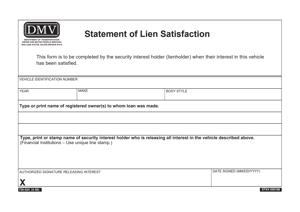
DMV 735-524 – Statement of Lien Satisfaction
Fill out nowJurisdiction: Country: United States | Province or State: Oregon
The DMV 735-524 – Statement of Lien Satisfaction is a document used to confirm that a lien on a vehicle has been paid in full. If you are dealing with a vehicle title in Oregon, this form can be an important part of clearing the record.
When someone finances a vehicle, the lender usually places a lien on the title. That lien gives the lender a legal interest in the vehicle until the loan is fully paid. Once the debt is satisfied, the lien must be formally released.
The DMV 735-524 – Statement of Lien Satisfaction provides written proof that the lender’s claim has ended. Without this confirmation, the vehicle title may still show an active lien, even if you have already paid off the loan.
This form is often used by lenders, vehicle owners, and sometimes dealerships. If you are about to fill it out, you likely need to remove a lien from a vehicle record so the title can be updated.
What is DMV 735-524 – Statement of Lien Satisfaction?
Clear definition
The DMV 735-524 – Statement of Lien Satisfaction is an official form used to declare that a recorded lien on a vehicle has been paid and released. It serves as written evidence that the secured party no longer claims a financial interest in the vehicle.
In simple terms, it tells the Oregon Department of Transportation that the debt connected to the vehicle has been satisfied. After proper submission and processing, the vehicle record can be updated to reflect that the lien is no longer active.
This document is not a loan agreement. It does not create a lien. Instead, it confirms that a previously recorded lien has ended.
Who typically uses this form?
The most common party to complete this form is the lienholder. A lienholder may be a bank, credit union, finance company, or private individual who provided financing for the vehicle.
In some cases, a business that sold the vehicle on credit may also act as the lienholder. If that business placed its name on the title as a secured party, it would use this form to release its interest once paid.
Vehicle owners are directly affected by the form, even if they do not complete it themselves. If you are the registered owner, you may need to request that the lienholder complete and sign this document after the loan is paid off.
Dealerships or title services may handle the paperwork during a trade-in or resale. However, the legal authority to declare satisfaction usually rests with the lienholder.
Why might you need this form?
You may need this form to obtain a clear title. A vehicle cannot typically be transferred to a new owner without resolving any recorded liens.
If you plan to sell your vehicle, a buyer will expect proof that no lender still has a claim. The DMV record must reflect that the lien has been released.
You may also need it if you are refinancing and replacing one lender with another. The original lien must be satisfied before the new lien can be properly recorded.
In some situations, errors occur, and a lien remains on the record even after payment. This form helps correct the official record so it matches the current financial status of the vehicle.
Typical real-life scenarios
- You finish making your final car payment after several years. Even though the loan balance is zero, the title still shows the lender’s name. The lienholder completes this form to confirm that the debt is satisfied.
- You decide to sell your car to a private buyer. During the title transfer process, you discover an old lien is still listed. The buyer cannot receive clear ownership until the lien is formally released.
- You trade in your vehicle at a dealership. The dealer pays off your remaining loan balance. The lender then issues a statement of lien satisfaction so the title can be cleared for resale.
- You inherited a vehicle from a family member. The title shows a lien, but records indicate the loan was paid years ago. The lienholder may need to complete this form to remove the outdated claim from the record.
When would you use DMV 735-524 – Statement of Lien Satisfaction?
You would use this form after a vehicle loan or secured obligation has been fully paid. The key moment is the satisfaction of the debt, not the sale or purchase itself.
It is typically used during title updates. For example, if you are transferring ownership, applying for a new title, or correcting a title record, the lien must first be resolved.
Lienholders use the form when they want to formally release their interest. This may happen after final payment, after a negotiated payoff, or after repossession and settlement of the debt.
Vehicle owners rely on the form when they need proof that the lien no longer exists. Without this document or an equivalent release, the vehicle record may continue to show an active secured party.
In transactions involving multiple parties, such as estate administration or business asset transfers, clearing liens is often one of several required steps. The form supports that process by documenting that the secured claim has ended.
Legal characteristics of DMV 735-524 – Statement of Lien Satisfaction
The DMV 735-524 – Statement of Lien Satisfaction functions as a formal declaration by the lienholder. For it to be effective, it generally must be completed accurately and signed by an authorized representative of the secured party.
The information on the form must match the vehicle record. This usually includes the vehicle identification number, the name of the lienholder, and the name of the registered owner. Inconsistent or incomplete details may delay processing.
Signatures are critical. If the lienholder is a business, the person signing must have authority to act for that entity. Missing signatures or unclear authorization can lead to rejection.
The form confirms the end of a security interest. It does not transfer ownership. It also does not change registration status by itself. Additional filings may be required to update the title or registration.
While lien release procedures share similarities across states, specific formats and submission rules can vary. A document valid in one state may not automatically satisfy requirements in another. This form is tailored for use in Oregon vehicle records.
Errors often arise from incorrect vehicle identification numbers or mismatched names. Even a small typographical mistake can prevent the lien from being properly removed from the system.
Is it legally binding?
Yes, in the sense that it represents an official statement by the lienholder that the debt has been satisfied. When properly completed and accepted, it serves as legal evidence that the secured interest has been released.
The binding effect comes from the authority of the lienholder and the accuracy of the declaration. If the signer has proper authority and the information is correct, the document reflects a change in legal rights related to the vehicle.
However, the form does not erase other possible obligations unrelated to the lien. For example, it does not resolve disputes about the condition of the vehicle or unrelated contractual matters.
If a lienholder mistakenly signs the form without full payment, that situation may create separate legal issues. The form itself records the declared satisfaction, but underlying financial disputes may still require resolution through other processes.
How to fill out DMV 735-524 – Statement of Lien Satisfaction
Step 1 – Identify the vehicle
Start by entering the vehicle’s full identifying information. This typically includes the vehicle identification number and may also include the year, make, and model. Ensure the information matches the title record exactly. Even minor differences can delay processing.
Step 2 – Provide the lienholder’s details
Enter the full legal name of the lienholder as it appears on the vehicle title. If the lienholder is a business, use the complete registered name rather than an abbreviation. Accurate identification helps confirm that the correct secured party is releasing the lien.
Step 3 – Confirm satisfaction of the lien
Indicate clearly that the lien has been paid in full and is satisfied. The form is designed to communicate that no remaining balance is owed under the secured agreement. Review this section carefully before proceeding, since it represents a formal declaration.
Step 4 – Authorized signature
An authorized representative of the lienholder must sign the form. If the lienholder is an individual, that person signs directly. If it is a business, an officer or authorized agent signs and may need to print their name and title. The signature confirms the truth of the statement.
Step 5 – Date the form
Enter the date the lien satisfaction is being declared. This date reflects when the lienholder officially releases its interest. Make sure the date is accurate and clearly written.
Step 6 – Review for accuracy and completeness
Before submission, review every entry on the form. Check spelling, numbers, and signatures. Confirm that all required fields are filled in and legible. Once complete, the form can be submitted with the appropriate title paperwork to update the vehicle record.
Legal terms you might encounter in DMV 735-524 – Statement of Lien Satisfaction
- Lien: A lien is a legal claim against a vehicle used as security for a debt. On this form, the lien refers to the loan or financial obligation that was secured by the vehicle title. The document confirms that this claim has been paid and released.
- Lienholder: The lienholder is the person, bank, credit union, or business that holds the security interest in the vehicle. This is the party that must complete and sign the form to confirm that the debt has been satisfied. The name listed must match the name recorded on the vehicle title or DMV records.
- Security Interest: A security interest is the legal right a lender has in the vehicle until the loan is paid. It allows the lender to repossess the vehicle if payments are not made. This form confirms that the security interest is no longer active.
- Vehicle Identification Number (VIN): The VIN is a unique 17-character number assigned to a specific vehicle. It must be entered exactly as shown on the title or registration. Even one incorrect character can cause processing delays or rejection.
- Certificate of Title: The certificate of title is the official document that proves ownership of the vehicle. When a lien is recorded, it appears on the title. After lien satisfaction is processed, the lien notation is removed from the title record.
- Release of Lien: A release of lien is the formal statement that the debt has been paid in full. This form serves as written proof of that release. It clears the lender’s claim from the vehicle’s record.
- Authorized Representative: An authorized representative is someone legally permitted to sign on behalf of the lienholder. This may be an employee or officer of a financial institution. The person signing must have authority to bind the lienholder.
- Printed Name and Title: Many forms require the signer to print their name and indicate their position or role. This helps verify authority. If the signer’s title is missing or unclear, the document may be questioned.
- Effective Date: The effective date is the date the lien was satisfied or released. This date matters because it establishes when the lender’s legal interest ended. It should reflect the actual payoff date or the date the lienholder confirms full payment.
- DMV Record: The DMV record is the official state record of ownership and lien status. Submitting this form updates that record. Until it is processed, the lien may still appear active in the system.
FAQs
What if the lienholder’s name on this form does not exactly match the name shown on the title?
The name must match the DMV record. If the lienholder has changed names due to a merger, rebranding, or internal restructuring, the document should reflect the name as it appears on the title record or clearly show continuity. If there is a mismatch, processing may be delayed because the DMV needs to confirm that the correct entity is releasing the lien.
Do I need the original signature from the lienholder, or is a copy acceptable?
Most vehicle title releases require an original signature from the lienholder or their authorized representative. A photocopy or scanned version may not be accepted for title updates. Check that the signature is handwritten and that any required printed name and title are included before submitting.
What date should be entered as the satisfaction date?
Use the date the debt was fully paid or the date the lienholder officially released the lien, depending on what the document requests. Do not guess. Confirm the exact payoff date from your loan records or written confirmation from the lender so the information matches their internal records.
Can I submit DMV 735-524 – Statement of Lien Satisfaction myself, or does the lienholder have to file it?
In many situations, the lienholder completes and signs the document, and then you submit it with your title paperwork. The key issue is who signs it, not who delivers it. Make sure the completed DMV 735-524 – Statement of Lien Satisfaction is fully executed before you try to file it.
What happens if the VIN is entered incorrectly?
An incorrect VIN can cause the filing to be rejected or applied to the wrong record. Even a single-digit error can create confusion. Before submitting this form, compare the VIN on the document with the VIN on the vehicle title and, if possible, the physical VIN plate on the vehicle.
Do I need to attach proof that I paid off the loan?
Typically, the signed release itself is the proof that the debt was satisfied. However, you should keep your payoff letter or payment confirmation in your personal records. If there is ever a dispute about the release date or amount, those documents help support the accuracy of this form.
What changes after the DMV processes this document?
Once processed, the lien notation should be removed from the vehicle’s official record. If a new title is issued, it should no longer list the lienholder. This means you can transfer ownership or refinance without the prior lender’s consent.
What if the lienholder refuses or delays signing the release?
If the lender has not confirmed full payment, they may delay signing. Start by reviewing your payoff confirmation and account statements. If you believe the debt is fully paid, contact the lender’s lien release department and request written clarification about what is still required before they will complete the form.
Checklist: Before, During, and After DMV 735-524 – Statement of Lien Satisfaction
Before
- Confirm the loan is fully paid, and you have a payoff confirmation.
- Verify the exact legal name of the lienholder as shown on the title.
- Locate the correct VIN from the title and vehicle.
- Check whether the lienholder requires internal processing time for release.
- Confirm who is authorized to sign on behalf of the lienholder.
- Gather your certificate of title and registration.
- Review the form to understand every required field.
- Make sure you know where and how the completed form must be submitted.
During
- Enter the VIN carefully and double-check each character.
- Write the lienholder’s name exactly as recorded.
- Ensure the satisfaction date matches the lender’s records.
- Confirm that all required fields are completed.
- Have the authorized representative sign in the correct space.
- Print the signer’s name and title clearly.
- Review the document for legibility.
- Check that no required sections are left blank.
After
- Make a clear copy of the signed document for your records.
- Attach the form to your title application if required.
- Submit the paperwork using the correct filing method.
- Track submission if you deliver it by mail.
- Watch for confirmation that the lien has been removed.
- Review any newly issued title for accuracy.
- Store the original release in a safe place.
- Update your personal vehicle records.
Common mistakes to avoid with DMV 735-524 – Statement of Lien Satisfaction
- Mistake: Entering an incorrect VIN because you copied it from memory, which can lead to rejection or misapplied records, so do not forget to verify it against the title and the vehicle itself.
- Mistake: Using an abbreviated or informal lienholder name, which happens when people rely on billing statements, causing delays, so do not forget to match the exact legal name on the title.
- Mistake: Submitting a copy without an original signature, often due to email exchanges, which may result in refusal, so do not forget to confirm signature requirements.
- Mistake: Leaving the satisfaction date blank because you assume it is optional, which can stall processing, so do not forget to confirm and enter the correct payoff date.
- Mistake: Allowing an unauthorized employee to sign, which can invalidate the release, so do not forget to confirm the signer’s authority and title.
- Mistake: Failing to keep a copy for your records, which creates problems if questions arise later, so do not forget to scan or copy the signed document before submitting it.
- Mistake: Submitting the form without checking for additional required paperwork, which can delay title updates, so do not forget to confirm whether a title application must accompany it.
- Mistake: Assuming the lien is removed immediately upon payoff, which can interfere with a sale or transfer, so do not forget to wait for official confirmation that the record has been updated.
What to do after filling out DMV 735-524 – Statement of Lien Satisfaction
Once the form is completed and signed, your job is not quite finished. You need to make sure the release is properly processed and reflected in the vehicle’s official record.
- Step 1: Review the entire document one more time for accuracy and legibility.
- Step 2: Make at least one clear copy for your personal records.
- Step 3: Attach the completed form to your certificate of title or title application if required.
- Step 4: Submit the paperwork using the appropriate delivery method, such as in person or by mail.
- Step 5: If mailing, use a method that allows you to confirm delivery.
- Step 6: Monitor for confirmation that the lien has been removed from the record.
- Step 7: If a new title is issued, review it immediately to ensure the lienholder is no longer listed.
- Step 8: Store the original signed release and any related payoff documents in a secure place.
- Step 9: Update your personal files to reflect that the loan has been fully satisfied.
- Step 10: If you plan to sell or transfer the vehicle, confirm that the record shows a clear title before completing the transaction.
Act promptly. A satisfied lien that remains on record can delay a sale, trade-in, or refinance. Keep organized records so you can respond quickly if questions come up later. When the release is properly processed and documented, you have clear proof that you own the vehicle free of that prior claim.
Disclaimer: This guide is provided for informational purposes only and is not intended as legal advice. You should consult a legal professional.