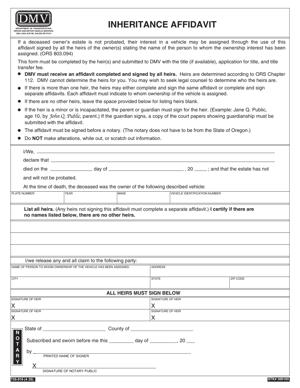
DMV 735-516- Inheritance Affidavit
Fill out nowJurisdiction: Country: United States | Province or State: Oregon
The DMV 735-516- Inheritance Affidavit is a document used to transfer ownership of a vehicle after someone has died. It is commonly used when a vehicle is part of a small estate and no full probate process is required. If you are about to fill it out, you likely want to understand what it does and what information it asks for.
This form allows a qualified heir to claim ownership of a vehicle titled in the name of a deceased person. It is filed with the Oregon Department of Transportation’s Driver and Motor Vehicle Services Division. Once accepted, it helps update the vehicle title into the heir’s name.
You may be using this document because you want to sell the vehicle, keep it, or transfer it to another family member. Without properly transferring the title, you cannot legally complete most transactions involving the vehicle.
The DMV 735-516- Inheritance Affidavit is designed to simplify the transfer process in certain situations. It avoids a full court proceeding when the estate qualifies under state rules. Understanding each section before you begin makes the process smoother and reduces delays.
What is DMV 735-516- Inheritance Affidavit?
Clear definition
The DMV 735-516- Inheritance Affidavit is a sworn statement used to transfer vehicle ownership from a deceased person to an eligible heir. It serves as written confirmation that the person signing has the right to claim the vehicle.
By signing this form, you are declaring specific facts under oath. These facts usually include that the original owner has died, that the estate qualifies for this type of transfer, and that you are legally entitled to the vehicle. The document becomes part of the title record once submitted and accepted.
Unlike a court order, this form is completed and signed outside of court. It relies on your sworn statements rather than a judge’s ruling. That is why accuracy and truthfulness are critical.
Who typically uses this form?
This form is usually used by a surviving spouse, adult child, or another close relative of the deceased. In some cases, another lawful heir may complete it if no spouse or child exists.
It is most often used when the estate is small and limited to personal property such as a vehicle. If no probate case has been opened, or if one is not required, this affidavit may be the practical option for transferring title.
You might also use this form if you are the sole heir and the vehicle is the only significant asset needing transfer. In that case, it can provide a faster administrative path than formal estate proceedings.
Why might you need this form?
You need this form when the vehicle title is still in the deceased person’s name, and you want to legally change it. Without updating the title, you cannot sell the vehicle, register it in your name, or complete certain transactions.
Insurance companies often require the correct owner to be listed before issuing or updating coverage. If you plan to drive the vehicle, the title must reflect proper ownership.
Buyers also expect a clear title. If you try to sell a vehicle that is still titled to someone who has passed away, the transaction can stall. This affidavit helps resolve that issue when the estate qualifies.
Typical real-life scenarios
- A surviving spouse may use this form after their partner dies, especially if the vehicle was titled only in the deceased spouse’s name. The spouse may want to keep driving the car and needs the title changed to reflect current ownership.
- An adult child may complete the form if a parent passes away and leaves behind a vehicle. If there is no will or the will does not require probate for the vehicle, the child may rely on this affidavit to transfer title.
- Sometimes siblings agree that one of them will take ownership of the vehicle. If the estate qualifies, the sibling claiming the vehicle may sign the affidavit to complete the transfer.
- In another situation, a family member may want to sell the vehicle to cover funeral expenses or other final costs. Before a sale can happen, the title must be transferred out of the deceased person’s name. This document provides a pathway to do that when the legal requirements are met.
When would you use DMV 735-516- Inheritance Affidavit?
You would use the DMV 735-516- Inheritance Affidavit when the registered owner of a vehicle has died, and the vehicle needs to be transferred without formal probate. This often applies when the estate falls under certain value limits or qualifies under simplified estate procedures.
It is commonly used when there is no court-appointed personal representative. If no executor or administrator has been officially named, an heir may rely on this affidavit to establish authority over the vehicle.
You might also use this form when the estate includes only one or two vehicles and little else. In these situations, a full probate process may not be opened, and the affidavit serves as the main document for title transfer.
In blended families or situations involving multiple heirs, the person claiming the vehicle may complete this form after confirming that they are entitled to it. In some cases, other heirs may need to sign or provide a written agreement, depending on the facts.
This form is generally part of a broader title transfer process. You may need to submit it along with other required documents, such as a death certificate and a title application. The affidavit supports your right to request the change in ownership.
Legal characteristics of DMV 735-516- Inheritance Affidavit
The DMV 735-516- Inheritance Affidavit is a sworn statement. That means you are declaring that the information provided is true to the best of your knowledge. False statements can carry legal consequences because the form is signed under penalty of perjury.
For the document to be effective, it typically must be complete, accurate, and properly signed. Missing information, inconsistent names, or incorrect vehicle details often lead to rejection or delay. Even small errors, such as mismatched vehicle identification numbers, can cause problems.
Signatures are a key part of its validity. The form may require notarization or certification to confirm your identity and signature. If a required signature is missing or not properly acknowledged, the submission may not be accepted.
The affidavit works only within the limits set by state rules. It generally applies to specific types of estates and property. It does not transfer real estate or resolve disputes between heirs. It focuses solely on transferring vehicle ownership.
Different states have different rules for small estate transfers. While the general idea is similar across jurisdictions, the eligibility thresholds and required statements can vary. This specific form is designed for use within Oregon and aligns with that state’s vehicle title procedures.
It is important to understand what this document does not do. It does not appoint you as executor of the entire estate. It does not override a valid court order. It does not settle disagreements among family members. It serves a narrow but important function: allowing vehicle title transfer under qualifying circumstances.
Is it legally binding?
Yes, the DMV 735-516- Inheritance Affidavit is legally binding once signed and submitted. When you sign it, you are making sworn statements that carry legal weight.
Its binding nature comes from the fact that it is executed under oath. By signing, you affirm that you meet the legal criteria to claim the vehicle. If the information is false or misleading, you may face legal consequences, and the transfer can be challenged.
The form becomes part of the official vehicle record after acceptance. The state relies on the statements in the affidavit to update ownership. That reliance gives the document practical legal effect.
However, the affidavit’s authority is limited to the vehicle transfer process. It does not create broader rights beyond what is stated. If another heir disputes your claim, the affidavit alone may not resolve that conflict. In such cases, a court may need to determine ownership.
How to fill out DMV 735-516- Inheritance Affidavit
Step 1 – Review eligibility requirements
Begin by carefully reading the entire form. Confirm that the estate and the vehicle qualify for transfer using this affidavit. Pay attention to any statements about estate value, heirs, or probate status. Make sure your situation fits within those conditions before completing the rest of the document.
Step 2 – Enter information about the deceased owner
Provide the full legal name of the deceased as it appears on the vehicle title. Include the date of death exactly as shown on the death certificate. Accuracy here is critical, since this information must match official records.
Step 3 – Provide vehicle details
List the vehicle identification number, year, make, and model. Use the information from the current title or registration card. Double-check each number and letter to avoid errors that can delay processing.
Step 4 – Identify the claiming heir
Enter your full legal name and contact information as requested. Clearly state your relationship to the deceased, such as spouse, child, or other qualifying heir. Ensure your name is spelled exactly as it appears on your identification documents.
Step 5 – Confirm estate qualifications
Complete the section where you affirm that the estate meets the required conditions. This may involve confirming that no probate proceeding has been opened or that the estate qualifies under a simplified process. Read each statement carefully before agreeing to it.
Step 6 – Address other heirs if required
If the form includes a section about additional heirs, provide the requested information. This may involve naming other individuals who have an interest in the estate. Follow the instructions about whether their signatures or written consent are needed.
Step 7 – Sign the affidavit under oath
Sign the form in the designated signature area. If notarization is required, do not sign until you are in front of a notary. Bring valid identification so your identity can be verified. Your signature confirms that all statements in the affidavit are true.
Step 8 – Prepare for submission with supporting documents
Gather any additional documents required for submission, such as the original title and a certified copy of the death certificate. Review the completed affidavit one final time for accuracy. Make sure all sections are filled in and all required signatures are present before submitting it to the appropriate office.
Legal terms you might encounter in DMV 735-516- Inheritance Affidavit
- Affidavit: A written statement you swear is true. When you sign this document, you declare under penalty of perjury that the facts about the deceased owner and the vehicle are accurate. The agency relies on your sworn statement to update the title record.
- Decedent: The person who passed away and owned the vehicle. You will enter the decedent’s full legal name exactly as it appears on the current title or registration. Any mismatch can delay processing.
- Heir: A person legally entitled to inherit property from the decedent. This form typically requires you to identify yourself as the heir claiming the vehicle and to state your relationship to the decedent.
- Estate: The total property owned by the decedent at the time of death. In this document, you confirm that the estate qualifies for transfer by affidavit, usually because it meets certain value or administration conditions.
- Personal Representative: The individual formally appointed to manage the estate through a court process. If a personal representative has been appointed, this affidavit may not be appropriate, or additional documentation may be required.
- Certificate of Title: The official record showing legal ownership of the vehicle. The information you provide in this form is used to update the certificate of title in the heir’s name.
- Vehicle Identification Number (VIN): A unique 17-character number assigned to the vehicle. You must enter the VIN exactly as it appears on the title or on the vehicle to avoid rejection.
- Lienholder: A lender or entity that has a financial interest in the vehicle. If there is an active lien, the title cannot transfer free and clear until the lien is released or properly addressed.
- Perjury: The act of knowingly making a false statement under oath. Because this document is signed under penalty of perjury, inaccurate information can lead to legal and financial consequences.
FAQs
Do I need a court order to use the DMV 735-516- Inheritance Affidavit?
In many cases, you use this form specifically to avoid a full court probate process for a vehicle. You must confirm that no personal representative has been appointed or that the estate otherwise qualifies. If a court has already issued authority to someone else, that person’s documents may control instead of this affidavit.
What information must match exactly with the current title?
The decedent’s name and the Vehicle Identification Number must match the existing title record. You should copy the name as it appears, including middle initials or suffixes. Small differences can cause the application to be rejected or flagged for review.
What documents should I attach when submitting this form?
You will typically need a certified copy of the death certificate and the current certificate of title. If there is a lien, you may also need proof that it has been satisfied. Review the instructions to confirm whether identification or additional statements are required.
Can more than one heir sign this document?
If there are multiple heirs with equal rights to the vehicle, all may need to sign or formally release their interest. This form usually asks you to state whether you are the sole heir or to identify others. If others exist, you must address how their interests are handled before the title can transfer.
What happens to the vehicle record after this form is accepted?
Once processed, the vehicle record is updated to show you as the new owner. A new certificate of title is issued in your name. The prior owner’s name is removed from the active ownership record.
Is there a deadline to file after the owner’s death?
The form itself may not list a strict filing deadline, but you should act promptly. Delays can create complications with insurance, registration renewal, or vehicle sale. Check the instructions carefully for any waiting periods or timing requirements tied to estate qualification.
What if the vehicle has an outstanding loan?
You must identify any lienholder listed on the title. If the loan is unpaid, the lien remains attached to the vehicle even after transfer. The title will not be issued free of the lien until the lender provides a release.
Can I sell the vehicle immediately after filing this document?
You can generally sell the vehicle after the title has been properly transferred into your name. Filing the affidavit alone does not automatically give you a marketable title until it is processed and a new title is issued. Wait for confirmation before completing a sale.
Checklist: Before, During, and After DMV 735-516- Inheritance Affidavit
Before
- Confirm that no personal representative has been appointed for the estate.
- Verify that the estate qualifies for transfer by affidavit.
- Locate the original certificate of title.
- Obtain a certified copy of the death certificate.
- Check whether there is a recorded lien on the vehicle.
- Review the vehicle’s VIN directly from the vehicle or title.
- Confirm your legal name matches your identification.
- Identify any other heirs who may have a claim.
During
- Enter the decedent’s full legal name exactly as shown on the title.
- Write the VIN carefully and double-check each character.
- Provide complete vehicle details, including year and make.
- State your relationship to the decedent clearly.
- Answer all eligibility questions about the estate truthfully.
- Disclose any other heirs and address their interests.
- Review the entire form for blank fields.
- Sign the affidavit under penalty of perjury as required.
After
- Make copies of the completed affidavit for your records.
- Assemble all required supporting documents.
- Submit the form and attachments through the approved method.
- Pay any required title or transfer fees.
- Monitor for confirmation or notice of rejection.
- Store the new title securely once issued.
- Update your vehicle insurance to reflect your ownership.
- Keep the death certificate and affidavit copy with estate records.
Common mistakes to avoid with DMV 735-516- Inheritance Affidavit
- Mistake: Entering the decedent’s nickname instead of their legal name, which happens when families use informal names, causing title record mismatches and delays; do not forget to copy the exact name from the title.
- Mistake: Writing the VIN from memory or an old registration card, which leads to digit errors and rejection; do not forget to verify the VIN directly from the title or the vehicle plate.
- Mistake: Ignoring an existing lien because you assume it ended at death, which can block issuance of a clear title; do not forget to confirm and document any lien release.
- Mistake: Failing to identify other heirs, often due to family misunderstandings, which can trigger disputes or processing holds; do not forget to disclose all potential heirs and resolve their interests.
- Mistake: Leaving sections blank because they seem inapplicable, which may result in incomplete application status; do not forget to mark answers clearly or indicate when something does not apply.
- Mistake: Signing without reviewing the penalty of perjury statement, which can expose you to legal consequences if the information is inaccurate; do not forget to read the certification language before signing.
- Mistake: Submitting photocopies of required certified documents, which may not be accepted for processing; do not forget to check whether originals or certified copies are required.
- Mistake: Selling the vehicle before the title is officially updated, which creates problems for the buyer and potential liability for you; do not forget to wait for the new title in your name.
What to do after filling out DMV 735-516- Inheritance Affidavit
Once you complete the form, pause and review everything line by line. Confirm that names, dates, and numbers match your supporting documents. Small inconsistencies can slow down processing.
- Step 1: Make at least two copies of the signed affidavit for your personal records.
- Step 2: Attach the certified death certificate and the original certificate of title.
- Step 3: Confirm whether additional forms are required for title transfer or registration.
- Step 4: Prepare payment for any title transfer or registration fees.
- Step 5: Submit the full packet using the approved submission method.
- Step 6: Track the submission date and keep proof of delivery if you mailed it.
- Step 7: Watch for written confirmation, a receipt, or a request for more information.
- Step 8: Respond promptly if the agency asks for corrections or additional documents.
- Step 9: Once approved, review the newly issued title to confirm your name is spelled correctly.
- Step 10: Update insurance coverage and registration records to reflect your ownership.
After you receive the updated title, store it in a secure place. You may need it for future registration, sale, or loan transactions. Keep your copy of the affidavit and supporting documents with other important estate papers in case questions arise later.
If you plan to sell the vehicle, wait until the new title is in your name. Then complete the transfer to the buyer according to standard procedures. If you intend to keep the vehicle, make sure the registration and plates are properly assigned to you and that your insurance policy reflects you as the legal owner.
Staying organized at this stage prevents future disputes. Clear records protect you and make any later transactions smoother.
Disclaimer: This guide is provided for informational purposes only and is not intended as legal advice. You should consult a legal professional.