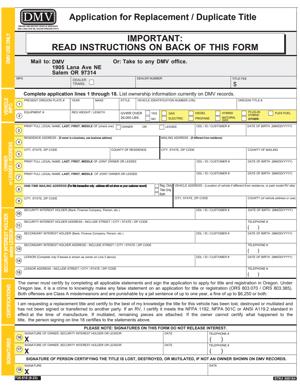
DMV 735-515 – Application for Replacement or Duplicate Title
Request DocumentJurisdiction: Country: United States | Province or State: Oregon
The DMV 735-515 – Application for Replacement or Duplicate Title is the document used in Oregon when you need another copy of your vehicle title. A vehicle title is the official record that shows ownership. If that record is lost, damaged, or no longer usable, this form starts the process of getting a new one.
If you are about to complete the DMV 735-515 – Application for Replacement or Duplicate Title, you are likely dealing with a missing or incorrect title. This form allows the Oregon Department of Transportation to issue a replacement that reflects the current ownership information on file.
A vehicle title is more than just paperwork. It is proof that you own the vehicle. Without it, selling, transferring, or refinancing the vehicle can become difficult. The replacement process helps restore that proof in an official way.
This form is designed for vehicle owners, co-owners, and in some cases, lienholders. It is a structured filing that confirms who owns the vehicle and why a duplicate title is needed. Completing it accurately helps avoid delays or rejection.
Understanding what each section asks for will make the completion process smoother. Small mistakes, such as incorrect vehicle identification numbers or missing signatures, often cause processing delays. Taking time to understand the document before signing can prevent problems later.
What is DMV 735-515 – Application for Replacement or Duplicate Title?
Clear definition
The DMV 735-515 – Application for Replacement or Duplicate Title is an official Oregon DMV form used to request a replacement title for a motor vehicle. It serves as a formal request to issue a new title when the original is no longer available or usable.
A vehicle title is the state’s record of ownership. When you submit this form, you are asking the DMV to issue a duplicate document that reflects the current ownership and lien information in its records. The replacement title generally carries the same legal weight as the original.
This form does not create new ownership. Instead, it reproduces the existing ownership record already recognized by the state. If ownership has changed, a different filing is typically required to transfer title before or along with any replacement request.
The document also acts as a sworn statement. By signing it, you confirm that the information you provide is accurate to the best of your knowledge. This includes the vehicle details and your ownership status.
Who typically uses this form?
Most often, vehicle owners use this form after losing their original title. This can happen during a move, after a natural event such as flooding, or simply due to misplacement over time.
Co-owners may use the form when a jointly held title is missing. In these situations, both names usually remain on the replacement title unless other ownership changes are filed separately.
Lienholders may also be involved. If a lender holds an interest in the vehicle, the title record may reflect that lien. Depending on the circumstances, the lienholder may need to sign or consent to the duplicate title process.
Dealers sometimes encounter this form when assisting customers with title issues. However, the person listed as the legal owner on the DMV record is typically the one who completes and signs the application.
Why might you need this form?
You might need this form if your title was lost. This is one of the most common reasons. Without the physical document, you may not be able to complete a sale or transfer.
You may also need it if your title was destroyed. Damage from water, fire, or tearing can make a title unreadable. In that case, the state may require a duplicate to ensure the record is clear and legible.
Another reason involves errors on the title document itself. If a title contains a printing error or becomes defaced in a way that affects clarity, a replacement may be necessary.
In some cases, the title may have been mailed but never received. When the original document cannot be located, the replacement process provides a way to obtain another official copy.
Typical real-life scenarios
- You are selling your vehicle to a private buyer and discover that you cannot find the title. The buyer requests proof of ownership before completing the purchase. In this situation, a duplicate title request allows you to obtain the document needed to complete the transaction.
- You recently paid off a vehicle loan. The lien was released, but the title you had was misplaced during the process. You now need a clear title showing no active lien. Requesting a replacement can provide a document that reflects the updated record.
- You moved to a new home and realized several important documents are missing, including your vehicle title. When you attempt to register or refinance the vehicle, you are asked for the original title. Filing for a duplicate helps restore your paperwork.
- Your vehicle was damaged in an accident, and the insurance process requires proof of ownership. You cannot locate the title. A duplicate title allows you to provide official documentation of ownership during settlement discussions.
- You inherited a vehicle and located the prior owner’s information, but not the physical title. Before any transfer steps can move forward, a replacement may be required to establish a valid document for further filings.
When would you use DMV 735-515 – Application for Replacement or Duplicate Title?
You would use this form any time the original Oregon title is unavailable, and you need an official replacement. This often occurs before a sale, transfer, refinance, or other transaction involving ownership rights.
If you are preparing to sell your vehicle, a buyer typically expects a valid title. Without it, the transaction cannot move forward in a standard way. Filing for a duplicate allows the ownership record to be presented in a recognized format.
You may also use this form when correcting administrative issues. For example, if the original title was issued but later lost before being signed or transferred, a replacement restores your ability to complete the necessary signatures.
In refinancing situations, lenders commonly request a copy of the title. If you cannot produce it, a duplicate filing can supply the required document reflecting current lien information.
Estate-related matters can also involve this form. When settling an estate that includes a vehicle, the title must often be located. If it cannot be found, a replacement can help clarify the vehicle’s ownership status before further action.
You might also encounter this form when updating vehicle records after a name change. If the title itself is lost during that process, a replacement filing ensures the ownership record remains consistent.
In each case, the key factor is the absence or unusability of the original title document. The form functions as a structured request to issue a legally recognized substitute.
Legal characteristics of DMV 735-515 – Application for Replacement or Duplicate Title
The DMV 735-515 – Application for Replacement or Duplicate Title is an administrative filing. It operates within Oregon’s motor vehicle title system and must meet certain formal requirements to be processed.
For the application to be effective, the information provided must match the DMV’s existing records. This includes the vehicle identification number, owner names, and other identifying details. Inconsistencies can result in rejection or requests for clarification.
Signatures are a central legal element. The person listed as the owner in the DMV record typically must sign the form. If there are multiple owners, signature requirements often depend on how ownership is recorded, such as whether both names are required to act together.
If a lien is recorded on the vehicle, that interest may affect processing. A lienholder’s involvement can influence how the duplicate title is issued and to whom it is delivered.
The form does not change ownership by itself. It does not transfer title to another person, remove a lien, or correct ownership errors unless combined with appropriate additional filings. Its primary function is to replace an existing title document.
Common causes of rejection include missing signatures, incorrect vehicle identification numbers, incomplete owner information, or unpaid required fees. Clerical errors can slow processing and require resubmission.
High-level differences may exist in how states handle duplicate titles. While the general concept is similar nationwide, Oregon’s procedures and documentation standards are specific to its own system. Using the correct Oregon form ensures the request aligns with state records.
This document also becomes part of the official motor vehicle record once processed. Information provided may be retained in state databases and associated with the vehicle’s history.
Is it legally binding?
The DMV 735-515 – Application for Replacement or Duplicate Title is legally significant, but it is not a contract between private parties. Its legal effect comes from being an official request to a government agency.
When you sign the form, you are certifying that the information is accurate. Providing false information on a government document can carry legal consequences. That certification gives the document formal weight.
The duplicate title issued as a result of this filing has the same general legal status as the original title. It serves as official evidence of ownership as recognized by the state’s motor vehicle records.
However, the form itself does not create new rights beyond replacing the document. It does not establish ownership if the DMV record does not already reflect you as the owner. It also does not override existing liens or disputes.
Its binding nature lies in the accuracy and truthfulness of the statements made and in the administrative action it triggers. Once processed, the replacement title becomes the controlling physical document tied to the vehicle’s record.
How to fill out DMV 735-515 – Application for Replacement or Duplicate Title
Step 1 – Review the form and confirm eligibility
Begin by reviewing the entire form before writing anything. Confirm that you are listed as the owner in the current DMV record. Check that the vehicle is titled in Oregon and that the issue involves a lost, destroyed, or unavailable title rather than a transfer of ownership.
Reading through the sections first helps you understand what information you will need, including vehicle details and owner identification.
Step 2 – Enter vehicle information
Locate the section requesting vehicle details. This typically includes the vehicle identification number, year, make, and model. Enter this information exactly as it appears in prior registration or title documents.
Accuracy is critical in this section. Even a single incorrect digit in the vehicle identification number can prevent the DMV from matching your request to the correct record.
Step 3 – Provide owner information
Complete the section listing the legal owner or owners. Enter names exactly as they appear in the DMV record. If there are multiple owners, include each name as shown.
Provide any additional identifying information requested, such as address details. Use your current mailing address if the form asks where the duplicate title should be sent.
Consistency with existing records helps avoid delays. If your name has changed, ensure that any required supporting documentation is addressed according to the form’s instructions.
Step 4 – Indicate the reason for replacement
Identify the reason you are requesting a duplicate title. Common reasons include loss, destruction, or non-receipt of the original title. Mark or state the applicable reason clearly.
This section informs the DMV why a replacement is being requested. Providing a clear and accurate explanation supports proper processing of the filing.
Step 5 – Address lien information if applicable
Review the section concerning liens or security interests. If a lien is recorded, confirm that the information matches the existing record. If the lien has been released, the form may require details reflecting that release.
Ensure that any lienholder information is complete and legible. The presence of a lien can affect how the duplicate title is issued and who receives it.
Step 6 – Review certifications and statements
Before signing, read the certification language carefully. This portion typically states that the information provided is true and correct to the best of your knowledge.
Make sure all entries are complete and accurate. This is your opportunity to correct spelling errors, missing numbers, or incomplete sections before submitting the document.
Step 7 – Sign and date the form
Sign the form in the space provided for the owner’s signature. If there are multiple owners and both are required to sign based on the title record, ensure each required signature is included.
Enter the date of signing. The signature confirms that you are making a formal request and that you acknowledge the statements in the certification section.
Step 8 – Prepare for submission
Review the form one final time to ensure all required sections are filled in. Confirm that signatures are present and that vehicle and owner details are accurate.
Attach any required supporting materials or fees as indicated on the form itself. Once complete, the document is ready for submission according to the instructions provided with the form.
Legal terms you might encounter in DMV 735-515 – Application for Replacement or Duplicate Title
- Duplicate Title: A duplicate title is a new certificate issued to replace the original vehicle title. It has the same legal effect as the original document. When you submit this form, you are asking the state to issue that replacement because the original is unavailable or unusable.
- Registered Owner: The registered owner is the person or business listed in state records as owning the vehicle. This name must match what appears in the DMV database. If your name has changed, you may need to update it before or at the same time you request a duplicate.
- Lienholder: A lienholder is a lender or party that has a financial interest in the vehicle. If you financed the vehicle, the lender may be listed on the title. The form asks for lien information because a duplicate title may be mailed to the lienholder instead of you.
- Vehicle Identification Number (VIN): The VIN is a unique 17-character code assigned to your vehicle. It identifies the exact make, model, and year. You must enter it exactly as it appears on your registration or vehicle plate to avoid processing delays.
- Odometer Disclosure: This is a statement of the vehicle’s mileage at a specific time. In some cases, mileage must be confirmed when title documents are issued. If required, you must provide an accurate reading from the odometer.
- Certification Statement: The certification statement is the part of the form where you confirm that the information you provided is true and correct. By signing, you declare under penalty of law that your statements are accurate.
- Power of Attorney: A power of attorney allows someone else to sign on behalf of the vehicle owner. If another person completes and signs the form for you, they must have proper written authority. That document may need to be submitted with the application.
- Joint Ownership: Joint ownership means more than one person is listed as the vehicle owner. The way names are connected, such as “and” or “or,” affects who must sign. The form must be signed according to how ownership is recorded.
- Release of Interest: A release of interest is a statement from a lienholder or co-owner giving up their claim to the vehicle. If a lien is no longer valid, it may need to be formally released before a duplicate title can be issued without that lien.
FAQs
Do I need to explain why I am requesting a duplicate title?
Yes. This form requires you to indicate the reason for the replacement, such as lost, stolen, destroyed, or mutilated title. You must check or select the correct reason and ensure it matches your situation. The agency relies on your selection to determine eligibility and how the replacement will be processed.
What if my name has changed since the original title was issued?
The name on this document must match the name in the state’s vehicle record. If you recently changed your name due to marriage, divorce, or another reason, you may need to update your owner record before or at the same time you apply. Be prepared to provide supporting documentation if your identification does not match the existing title record.
Do all owners have to sign the DMV 735-515 – Application for Replacement or Duplicate Title?
It depends on how the owners are listed in the vehicle record. If the title shows multiple owners connected by “and,” all must sign. If the names are connected by “or,” typically one signature is sufficient. Review the current registration or prior title to confirm how ownership is shown before submitting the form.
What happens if there is still a lien on my vehicle?
If a lienholder is listed, the replacement title may be issued to that lienholder rather than directly to you. You must accurately provide the lienholder’s name and address as it appears in the record. If the loan has been paid off, ensure the lien has been officially released in the vehicle record before you apply.
Can someone else submit this document on my behalf?
Yes, but they must have proper authority. If someone signs for you, they need a valid power of attorney or other legally recognized authorization. The signature on this form must clearly indicate that the person is acting as your representative.
What information must match exactly with state records?
Your vehicle identification number, plate number, and owner name must match what is on file. Even small differences, like a missing middle initial or transposed Vehicle Identification Number digit, can cause rejection or delay. Review your registration card to copy the information exactly as recorded.
Will requesting a duplicate title change the ownership of the vehicle?
No. This form does not transfer ownership. It only replaces the existing title document in the record. If you want to sell or transfer the vehicle, you must complete a separate ownership transfer process after receiving the duplicate.
How will I know if my application was accepted?
After you submit the DMV 735-515 – Application for Replacement or Duplicate Title, the agency will review it for completeness and accuracy. If information is missing or inconsistent, they may return it or request corrections. If approved, the duplicate title will be issued according to the mailing instructions and lien status shown on the form.
Checklist: Before, During, and After DMV 735-515 – Application for Replacement or Duplicate Title
Before
- Confirm that the original title is truly lost, stolen, or destroyed.
- Locate your current registration card for accurate vehicle details.
- Verify how the owner’s names are listed in the vehicle record.
- Check whether a lienholder is still recorded on the title.
- Gather identification that matches the owner’s name on file.
- Obtain any required lien release documentation if applicable.
- Confirm you have authority if signing for someone else.
During
- Enter the VIN carefully and double-check each character.
- Write the owner’s name exactly as shown in state records.
- Select the correct reason for requesting the duplicate.
- Provide complete lienholder information if one exists.
- Review every section for blanks before signing.
- Read the certification statement in full.
- Sign and date the form in the correct place.
- Ensure all required owners have signed as needed.
After
- Make a copy of the completed and signed form for your records.
- Attach any required supporting documents.
- Submit the form using the approved filing method.
- Pay any required replacement title fee.
- Track your submission if you mailed it.
- Monitor your mail for the issued duplicate title.
- Review the duplicate title for accuracy once received.
- Store the new title in a secure place.
Common mistakes to avoid with DMV 735-515 – Application for Replacement or Duplicate Title
- Mistake: Entering the wrong VIN because you copied it from memory, which leads to processing delays or rejection; always copy it directly from your registration, and do not forget to verify all 17 characters.
- Mistake: Leaving the lienholder section blank because you believe the loan is paid off, which can result in the duplicate being sent to the lender; confirm the lien status in the official record, and do not forget to secure a release if needed.
- Mistake: Having only one co-owner sign when the record requires both signatures, which causes the application to be returned; check how names are connected, and do not forget that “and” usually requires all owners to sign.
- Mistake: Using a nickname or updated name that does not match state records, which can create identity mismatches; use the exact legal name on file, and do not forget to update your name separately if necessary.
- Mistake: Skipping the certification section because it looks routine, which can invalidate the application; read the statement carefully, and do not forget to sign and date the form.
- Mistake: Submitting the form without required attachments, such as a power of attorney, which leads to rejection; confirm what supporting documents apply to your situation, and do not forget to include copies where required.
- Mistake: Failing to keep a copy of your completed application, which leaves you without proof of what was submitted; make a full copy and do not forget to store it with your vehicle records.
- Mistake: Providing an outdated mailing address, which can result in the duplicate title being sent to the wrong place; verify your current address in the record, and do not forget to update it if needed.
What to do after filling out DMV 735-515 – Application for Replacement or Duplicate Title
Once you complete the form, pause before sending it. A careful final review can prevent weeks of delay. Check every required field. Confirm that all signatures are present and dated.
- Step 1: Make a clear copy of the signed form for your records.
- Step 2: Attach any required documents, such as lien releases or power of attorney paperwork.
- Step 3: Confirm the correct payment amount and method, if a fee applies.
- Step 4: Choose the approved submission method, such as mailing or in-person delivery, based on current agency procedures.
- Step 5: If mailing, use a secure envelope and verify the correct mailing address.
- Step 6: If submitting in person, bring identification that matches the owner record.
- Step 7: Keep proof of submission, such as a receipt, tracking number, or date-stamped copy.
- Step 8: Allow processing time and avoid submitting duplicate requests unless instructed.
- Step 9: Check your mail regularly for the replacement title or any follow-up notice.
- Step 10: Review the issued duplicate title immediately for accuracy in names, VIN, and lien information.
- Step 11: If you find an error, contact the agency promptly and follow correction procedures.
- Step 12: Store the new title in a secure, dry location separate from the vehicle.
After you receive the duplicate title, update your personal records. If you were waiting to sell, refinance, or transfer the vehicle, you can now move forward with that separate process. Keep the document protected. A title is proof of ownership, and replacing it takes time and effort.
Disclaimer: This guide is provided for informational purposes only and is not intended as legal advice. You should consult a legal professional.