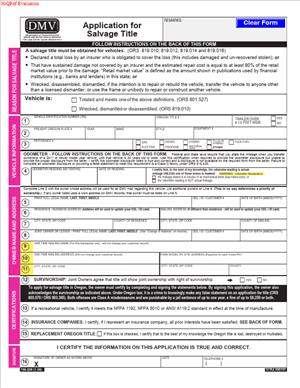
DMV 735-229- Application for Salvage Title
Fill out nowJurisdiction: Country: United States | Province or State: Oregon
The DMV 735-229- Application for Salvage Title is the form you use in Oregon to request a salvage title for a vehicle that has been significantly damaged. If you are dealing with a car that has been declared a total loss or heavily damaged, this document is often part of the next step.
When a vehicle is damaged beyond a certain point, it may no longer qualify for a regular title. Instead, it is issued a salvage title. This label affects how the vehicle can be sold, repaired, registered, or driven in the future.
You may be filling out this form after an accident, a flood, a fire, or another serious event. You might also encounter it if you purchased a damaged vehicle and now need to document its condition with the state.
Understanding how this form works helps you avoid delays. It also helps you make informed decisions about what happens next with your vehicle.
What is DMV 735-229- Application for Salvage Title?
Clear definition
The DMV 735-229- Application for Salvage Title is an official Oregon Department of Transportation form used to apply for a salvage title for a motor vehicle. A salvage title is a special type of title issued to vehicles that have sustained major damage or have been declared a total loss.
This form records key details about the vehicle, including its identification number, ownership information, and the reason it qualifies for salvage status. Once processed, the state updates the vehicle’s title record to reflect its salvage condition.
A salvage title does not automatically mean the vehicle cannot be repaired. It means the vehicle’s history now permanently reflects that it was significantly damaged at some point.
Who typically uses this form?
Vehicle owners often use this form after their car has been declared a total loss by an insurance company. In many cases, the insurance company may also be involved in submitting or handling the paperwork, depending on who retains ownership of the vehicle.
People who purchase damaged vehicles at auctions also use this form. If you buy a wrecked or heavily damaged vehicle, you may need to apply for a salvage title before you can move forward with repairs or resale.
Lenders or financial institutions may become involved if there is a loan on the vehicle. The legal owner listed on the title may need to sign or release interest before a salvage title can be issued.
Auto dealers and dismantlers sometimes handle this form as part of their business operations when they acquire damaged vehicles.
Why might you need this form?
You may need this form if your vehicle has been damaged to the point that repair costs approach or exceed its market value. In many cases, that situation leads to a total loss determination.
You might also need it if your vehicle was stolen and later recovered with significant damage. In that situation, the title may need to be changed to reflect its condition.
If you plan to rebuild a damaged vehicle and later return it to the road, starting with a salvage title is often part of that process. The salvage designation documents the vehicle’s history before any repairs are made.
In some situations, the form is required before a damaged vehicle can be sold legally. The title must accurately reflect its status so future buyers understand its condition history.
Typical real-life scenarios
- You are in a collision, and your car sustains heavy front-end damage. The repair estimate is close to or higher than the vehicle’s value. The insurer declares it a total loss. If you keep the car instead of transferring it to the insurer, you may need to apply for a salvage title.
- Your vehicle is caught in a flood. Even if it still runs, water damage affects electrical systems and structural components. The vehicle is classified as severely damaged. A salvage title documents the history before any resale.
- You purchase a wrecked vehicle from a private seller. The seller provides the original title, but the vehicle clearly qualifies as salvage due to damage. To bring the title status in line with the vehicle’s condition, you complete the application for a salvage title.
- You operate a small auto repair or rebuilding business and buy damaged vehicles at auction. Before repairing and reselling them, you use the appropriate form to convert the title to salvage status as required by state procedures.
When would you use DMV 735-229- Application for Salvage Title?
You use this form when a vehicle meets the threshold for being considered a salvage vehicle under Oregon’s rules. This often happens after a serious accident, natural disaster, or other event that causes major structural or mechanical damage.
It is commonly used after an insurance total loss settlement. If the insurer takes ownership, it may handle the filing. If you retain the vehicle, you may need to complete the application yourself as part of updating the vehicle’s title record.
You might also use this form when transferring ownership of a heavily damaged vehicle. Before the vehicle can be legally sold or registered in its current condition, the title may need to reflect salvage status.
Another common situation is when a vehicle has been dismantled or stripped of major parts. If it no longer qualifies for a regular title due to its condition, a salvage title may be required.
This form becomes part of the vehicle’s permanent record. Once a salvage title is issued, the designation typically follows the vehicle even if it is later repaired and inspected for road use.
Legal characteristics of DMV 735-229- Application for Salvage Title
This form functions as a formal request to change the legal status of a vehicle’s title. It becomes effective once accepted and processed by the appropriate state authority. Until it is processed, the existing title record remains in place.
For the filing to be valid, the information must match existing title and vehicle records. This includes the vehicle identification number, owner names, and lienholder details. Inconsistencies often lead to rejection or delays.
Signatures are critical. If there is more than one owner listed on the current title, each required party may need to sign. If there is an outstanding loan, the lienholder’s interest may need to be addressed before the salvage title can be issued.
Common problems include incomplete fields, incorrect vehicle identification numbers, missing ownership releases, or unpaid required fees. Even small errors can slow processing because the form updates a permanent state record.
High-level differences may exist between states regarding what qualifies as a salvage vehicle and how titles are branded. In Oregon, the process and definitions are set by state rules. A vehicle that qualifies for salvage in one state may be treated differently elsewhere.
This document does not repair your vehicle. It does not certify roadworthiness. It does not automatically allow you to register or drive the vehicle. It only changes the vehicle’s title classification to reflect its salvage condition.
Is it legally binding?
The form itself is not a contract between private parties. It is a formal application submitted to a government agency. Once approved, the resulting salvage title becomes part of the official vehicle record.
By signing the form, you are certifying that the information provided is accurate to the best of your knowledge. False or misleading statements on title documents can create legal consequences because title records are relied upon by buyers, lenders, and public agencies.
When the state issues a salvage title based on your submission, that designation has legal effect. It changes how the vehicle can be transferred, registered, or insured in the future.
How to fill out DMV 735-229- Application for Salvage Title
Step 1 – Review the existing title and ownership details
Start by gathering the current certificate of title for the vehicle. Confirm the exact spelling of the owner’s name, the vehicle identification number, and any listed lienholders. The information on your application must match these records.
Step 2 – Enter vehicle identification information
Provide the vehicle’s year, make, model, and VIN exactly as shown on the title or vehicle documentation. Double-check each character in the VIN. A single incorrect digit can cause the filing to be rejected.
Step 3 – Provide owner information
List the legal owner or owners as they appear on the current title. Include full names and required contact details. If ownership has changed but not yet been recorded, resolve that issue before completing this form.
Step 4 – Address lienholder or security interest information
If there is a loan on the vehicle, include the lienholder’s name and details as required. The lienholder may need to release its interest or provide authorization before a salvage title can be issued. Ensure this section is complete and consistent with the title record.
Step 5 – Indicate the reason for salvage status
Identify the event or condition that qualifies the vehicle for salvage designation. This may involve total loss, major collision damage, flood damage, or other significant harm. Provide clear and accurate information as requested on the form.
Step 6 – Review damage and condition disclosures
Carefully read any statements regarding the vehicle’s condition. Confirm that the description of damage aligns with the vehicle’s actual state. This section helps establish why the salvage title is being requested.
Step 7 – Sign and date the application
All required owners must sign in the designated areas. Use the same signature format that appears on the current title when possible. Add the date of signing where indicated. Missing or incorrect signatures commonly delay processing.
Step 8 – Prepare the form for submission
After completing every section, review the entire document for accuracy. Check names, VIN, and signatures again. Gather any supporting documents required to accompany the application so the submission is complete and ready for processing.
Legal terms you might encounter in DMV 735-229- Application for Salvage Title
- Salvage Title: A salvage title is a special title issued when a vehicle has been declared a total loss or has sustained significant damage. On this form, you are formally requesting that the standard title be replaced with a salvage title. Once issued, the vehicle’s status in the public record changes to reflect that damage history.
- Total Loss: Total loss means the cost to repair the vehicle equals or exceeds a certain percentage of its value, or an insurer has determined it is not economically repairable. If an insurance company has made this determination, you may need to include supporting documentation. The form captures this status so the state can update the vehicle record.
- Vehicle Identification Number (VIN): The VIN is a unique 17-character code assigned to your vehicle. You must enter it exactly as it appears on the vehicle and the existing title. Any mistake in the VIN can delay processing or cause the application to be rejected.
- Registered Owner: The registered owner is the person or entity currently listed in state records as owning the vehicle. The name you enter on the form must match the existing title or ownership documents. If ownership has changed, additional transfer documents may be required.
- Lienholder: A lienholder is a bank, credit union, or other creditor with a legal interest in the vehicle because of a loan. If there is an active lien, you must list the lienholder’s name and address. The lienholder may also need to release its interest before a salvage title can be issued.
- Odometer Disclosure: Odometer disclosure is a statement of the vehicle’s mileage at the time of application. Some vehicles are exempt based on age, but if required, you must provide an accurate reading. Incorrect mileage reporting can create legal problems and delay title processing.
- Damage Disclosure: Damage disclosure refers to a description or classification of the type of damage the vehicle sustained. This may include collision, flood, fire, or theft recovery. The information helps determine whether the vehicle qualifies for salvage status.
- Signature Certification: Signature certification is your sworn statement that the information provided is true and correct. When you sign the form, you are confirming under penalty of law that all entries are accurate. If the vehicle is owned by a business, an authorized representative must sign.
- Title Surrender: Title surrender means you must submit the existing title to the state when applying for a salvage title. This prevents two active titles from existing at the same time. If the title is lost, you may need to apply for a replacement before or along with this document.
FAQs
Do I have to submit the current title with this form?
In most cases, yes. You must surrender the existing title so the state can cancel it and issue a salvage title. Check that the title is properly signed by all listed owners before submitting it with this document.
What if the name on the title does not exactly match my current legal name?
The name on this form should match the name shown on the current title. If your name has changed, you may need to provide documentation that links the old and new names, such as a court order or other legal record. Make sure the signature matches the name you list to avoid delays.
Who is allowed to sign the DMV 735-229- Application for Salvage Title?
The registered owner listed in the vehicle record must sign. If the vehicle is owned by a business, an authorized representative signs and may need to indicate their title or role. If there is more than one owner, follow the ownership format shown on the existing title to determine whether one or all owners must sign.
Do I need proof from the insurance company?
If an insurer declared the vehicle a total loss, you should include documentation that shows that determination. This may be a settlement statement or letter. The state uses that information to confirm why salvage status is being requested.
What happens to the vehicle’s record after this document is accepted?
Once processed, the vehicle’s title status changes in the public record to salvage. Future buyers, insurers, and agencies will see that designation. The change stays with the vehicle identification number.
Can I apply if there is still a loan on the vehicle?
You can complete the form, but you must list the lienholder. In many cases, the lienholder must release its interest or be involved in the process before a salvage title can be issued. Confirm that the lien information is accurate and current before submitting.
Is an odometer reading always required?
Not always. Some older vehicles may be exempt from mileage disclosure requirements. If the form asks for an odometer reading, enter the exact number shown on the dashboard and indicate whether it reflects actual mileage, exceeds mechanical limits, or is not the actual mileage.
How do I know if the DMV 735-229- Application for Salvage Title was accepted?
After submission, you should receive confirmation or a replacement title showing salvage status. Processing times vary. If you do not receive any notice or updated title within the expected timeframe, follow up with the agency to confirm that your application was complete and accepted.
Checklist: Before, During, and After DMV 735-229- Application for Salvage Title
Before
- Locate the current vehicle title and confirm the owner’s names.
- Verify the VIN on the vehicle matches the VIN on the title.
- Gather insurance documents if the vehicle was declared a total loss.
- Confirm whether there is an active lien and obtain lienholder details.
- Check the odometer reading and note the exact mileage.
- Review whether all listed owners must sign.
- Make sure you have valid identification if submitting in person.
During
- Print clearly and use consistent names as shown on the title.
- Enter the full 17-character VIN without errors.
- Provide complete owner contact information.
- List lienholder name and address exactly as shown on loan documents.
- Complete any damage or total loss sections fully.
- Double-check the odometer entry for accuracy.
- Review the entire form before signing.
- Sign and date in the correct signature area.
After
- Make a copy of the completed form and all attachments.
- Attach the original title and any required supporting documents.
- Submit the packet using the approved filing method.
- Keep proof of submission, such as a receipt or tracking number.
- Monitor for confirmation or receipt of the salvage title.
- Store the new salvage title in a secure location.
- Update your personal records to reflect the title status change.
Common mistakes to avoid with DMV 735-229- Application for Salvage Title
- Mistake: Entering an incorrect VIN because you copied it from memory instead of the vehicle or title, which can lead to rejection or processing delays, so always verify all 17 characters directly from the source.
- Mistake: Forgetting to include the existing title when required, often because you assume a copy is enough, which can stop the application from being processed, so do not forget to surrender the original document if requested.
- Mistake: Leaving the lienholder section blank when a loan still exists, usually due to a misunderstanding of ownership status, which can create legal conflicts and delays, so confirm whether a lien is active and list it accurately.
- Mistake: Providing an estimated odometer reading instead of the exact number, often because the vehicle is not nearby, which may cause compliance issues, so do not forget to check the dashboard directly.
- Mistake: Missing a required signature, especially when multiple owners are listed, which can result in the form being returned unprocessed, so review the ownership format and ensure all necessary parties sign.
- Mistake: Failing to attach insurance or total loss documentation when applicable, because you assume the state already has it, which can delay approval, so include supporting papers that explain why salvage status is requested.
- Mistake: Using a nickname or shortened business name instead of the full legal name, which may not match the title record and can cause processing problems, so do not forget to use the exact name shown on official documents.
- Mistake: Signing in the wrong section or forgetting to date the form, often due to rushing, which can invalidate the certification, so double-check placement of your signature and date before submission.
What to do after filling out DMV 735-229- Application for Salvage Title
Once you finish the form, pause before submitting it. Review every field slowly. Look for blank spaces, incomplete addresses, and number errors. Small mistakes can delay processing for weeks.
Next, organize your paperwork into one complete packet. Include the signed application, the original title if required, lien releases if applicable, and any insurance or total loss documentation. Keep the pages flat and legible.
- Step 1: Make a full copy of everything you plan to submit, including the front and back of the title.
- Step 2: Choose the approved submission method, such as mailing or delivering in person, and confirm you are sending it to the correct office.
- Step 3: If mailing, use a method that provides tracking so you can confirm delivery.
- Step 4: If submitting in person, request a dated receipt showing the documents were received.
- Step 5: Mark your calendar with an estimated processing timeframe so you remember to follow up if needed.
- Step 6: Watch your mail for confirmation, requests for additional information, or the newly issued salvage title.
- Step 7: Respond promptly if the agency contacts you for corrections or missing documents.
- Step 8: Once you receive the salvage title, review it immediately to confirm the VIN, owner name, and salvage designation are correct.
- Step 9: Store the salvage title in a safe place, separate from routine vehicle paperwork.
- Step 10: Update any personal files or internal business records to reflect that the vehicle now carries a salvage title status.
If you plan to repair the vehicle, keep detailed records of all parts and labor. You may need that information later if applying for a different title status. Staying organized now will save time and stress later.
Disclaimer: This guide is provided for informational purposes only and is not intended as legal advice. You should consult a legal professional.