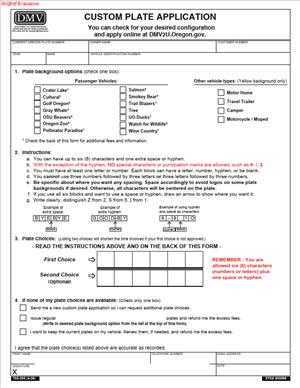
DMV 735-205 – Custom Plate Application
Fill out nowJurisdiction: Country: United States | Province or State: Oregon
The DMV 735-205 – Custom Plate Application is the document you use to request personalized or specialty license plates for a vehicle registered in Oregon. If you want a plate with a custom message or a specific design, this is the form that starts the process.
You complete this form when you want something different from a standard-issue license plate. It allows you to request specific letter and number combinations, and in some cases, choose from approved plate types.
If you are about to fill it out, you likely want to know three things. What information is required? How to avoid rejection. And what happens after you submit it.
This guide explains what the form does, when to use it, and how to complete it clearly and accurately. You will also understand what makes an application valid and what can cause delays.
What is DMV 735-205 – Custom Plate Application?
Clear definition
The DMV 735-205 – Custom Plate Application is an official request form used to apply for personalized or custom license plates in Oregon. It collects information about you, your vehicle, and the specific plate configuration you want.
The form allows you to propose a letter and number combination. It also allows you to select the plate style, if more than one option is available for your vehicle type. You submit it to the state agency that manages vehicle registrations and plate issuance.
This document is not a general registration form. It does not register a new vehicle by itself. Instead, it modifies the type of plate issued for a vehicle that is already registered or being registered at the same time.
Who typically uses this form?
Vehicle owners are the most common users of this form. If your name appears on the vehicle title or registration, you are usually the person who completes and signs the application.
People who have just purchased a vehicle may also use it during the registration process. In that case, the custom plate request is submitted along with other registration documents.
Business owners sometimes use the form for company vehicles. The person signing may be an authorized representative of the business listed on the vehicle registration.
In some cases, co-owners of a vehicle are involved. Depending on how the vehicle is titled, more than one signature may be required.
Why might you need this form?
You use this form when you want a personalized plate message. That could be your name, initials, a nickname, or a short phrase that fits within character limits.
You may also need it if you want to switch from standard plates to a specialty design that allows custom wording. Some specialty plates support personalized messages, while others may not.
Another reason is replacement. If your current custom plate is damaged, lost, or stolen, you may need to submit a new request for the same or a different configuration.
You might also use the form if you want to transfer an existing custom plate message to another eligible vehicle that you own.
Typical real-life scenarios
- You just bought a new car and want plates that reflect your personality. Instead of accepting standard plates, you complete the application to request a specific combination of letters that has personal meaning.
- You have owned your vehicle for years and have decided you want a plate with your business name. You check availability, complete the form, and submit it with the required fee.
- Your previous custom plate was damaged in an accident. The message is still important to you. You apply again to have the same configuration issued on a new set of plates.
- You are transferring ownership of a vehicle within your family. The custom plate on the vehicle will stay with you, not the car. You file the necessary paperwork to keep or reassign the custom message appropriately.
- You operate a small fleet of vehicles and want consistent branding. You apply for related plate combinations across several vehicles to maintain a uniform appearance.
When would you use DMV 735-205 – Custom Plate Application?
You would use DMV 735-205 – Custom Plate Application when you are requesting a custom or personalized plate for a vehicle registered in Oregon. It is typically used at the time of registration, during a renewal cycle, or when making changes to an existing registration.
If you are registering a newly purchased vehicle and want a custom plate from the start, you include this application with your other registration documents. This helps avoid receiving standard plates first and replacing them later.
If you already have standard plates and want to upgrade to a personalized version, you use this form to request the change. In that case, your existing registration remains active, but the plate type changes once approved.
If you are replacing damaged or lost custom plates, this form may be part of the replacement process. The specific circumstances can affect whether you are requesting a new configuration or reissuing an existing one.
Business owners may use it when adding new vehicles to their fleet and want consistent personalized identifiers. Individual vehicle owners use it for personal expression or recognition.
In general, you use this document any time you are asking the state to issue a plate with a specific, requested message rather than a randomly assigned number.
Legal characteristics of DMV 735-205 – Custom Plate Application
This form is an official government application. It becomes effective when it is properly completed, signed, and accepted by the issuing agency.
For the application to be valid, it typically must include accurate vehicle information, correct owner details, and a clearly written plate configuration request. Required fees must also be submitted. An incomplete application can delay processing or lead to rejection.
One common reason for rejection is a requested message that violates content rules. States often restrict combinations that are offensive, misleading, or confusing. Messages that resemble official government plates or emergency vehicles may also be denied.
Another issue arises when the applicant is not the registered owner or does not have the authority to act on behalf of the registered owner. The signature on the form usually confirms that the information provided is true and that the signer has the right to make the request.
Processing time can vary. Approval is not automatic at the moment of submission. The requested combination is typically reviewed for availability and compliance with content standards before final approval.
High-level differences may exist between states. Character limits, spacing rules, and available symbols can vary. In Oregon, the rules for formatting and eligibility are set by state regulation. Those rules determine what combinations are acceptable and how they appear on the plate.
This form does not transfer vehicle ownership. It does not replace the vehicle title. It does not cancel registration by itself. It strictly concerns the request and issuance of custom or personalized plates.
It also does not guarantee that your first choice will be approved. Many applications allow you to list alternate choices in case your preferred combination is unavailable or rejected.
Is it legally binding?
Yes, in the sense that it is a formal request submitted to a state agency and includes your certification that the information is accurate. When you sign the form, you are affirming that the details provided are true and complete to the best of your knowledge.
However, the form is not a contract between you and another private party. It is an administrative application. Its legal effect comes from the state’s acceptance and issuance of the requested plates.
Once approved and issued, the custom plate becomes part of your vehicle’s official registration record. You are generally responsible for maintaining the plate according to registration rules, including proper display and renewal.
If false information is provided or if fees are not properly paid, the application can be denied or the plates can later be invalidated. The legal impact comes from the certification and the state’s reliance on the information you provide.
How to fill out DMV 735-205 – Custom Plate Application
Step 1 – Enter vehicle information
Start by providing the details about your vehicle. This usually includes the plate number if one is already assigned, the vehicle identification number, the year, make, and body style.
Make sure the information matches your registration documents exactly. Small errors in the vehicle identification number or plate number can delay processing.
If you are applying at the same time as a new registration, ensure the information is consistent across all submitted forms.
Step 2 – Provide owner information
Next, enter the name and address of the registered owner. If the vehicle is jointly owned, list all required owners as shown on the registration or title record.
Use your current legal name as it appears in registration records. If your address has recently changed, make sure the information matches your official vehicle record or submit any required update forms at the same time.
If a business owns the vehicle, enter the business name exactly as it appears on the registration, along with the appropriate contact details.
Step 3 – Choose the plate type
Select the type of plate you are requesting. This may include a standard personalized plate or a specialty design that allows custom wording.
Check that your vehicle qualifies for the selected plate type. Some plate designs may be limited to certain vehicle classes, such as passenger vehicles or light trucks.
Indicate clearly which style you want to avoid confusion during processing.
Step 4 – Enter your requested plate configuration
Write your preferred letter and number combination in the space provided. Follow the formatting rules carefully, including character limits and allowed symbols.
Use capital letters if the form requires it. Do not add punctuation or spaces unless the instructions allow them.
If the form provides space for alternate choices, complete those lines as well. This increases the chance that one of your selections will be approved without requiring a new submission.
Think about how the message might be interpreted. Applications are often reviewed for clarity and compliance with content standards.
Step 5 – Review content restrictions and certify compliance
Most applications include a statement explaining that certain types of messages are not allowed. Read this section carefully before signing.
By completing this part, you confirm that your requested configuration does not violate the listed standards. This may include restrictions on offensive language, misleading content, or duplication of protected plate types.
Take a moment to review your entries for spelling and accuracy. Errors here can lead to rejection or unexpected plate wording.
Step 6 – Calculate and include the required fees
Determine the total fee for the custom plate request. This may include an initial issuance fee and, in some cases, an additional surcharge depending on the plate type.
Confirm the amount required for your specific situation. If you are applying during registration or renewal, there may be combined fees.
Ensure the payment method matches the instructions provided with the form. Incorrect payment amounts or methods can delay approval.
Step 7 – Sign and date the application
Sign your name in the space provided. If more than one owner’s signature is required, ensure all necessary parties sign.
Enter the date of signing. The signature confirms that the information is accurate and that you are authorized to request the custom plate.
Unsigned forms are typically considered incomplete and will not be processed.
Step 8 – Submit the completed form
Submit the completed application along with any required supporting documents and payment. Keep a copy of the filled-out form for your records.
After submission, your request will be reviewed. If approved, you will receive instructions about when and how your new custom plates will be issued or mailed.
Processing times can vary. Once issued, install the plates according to vehicle display requirements and retain any updated registration documents provided.
Legal terms you might encounter in DMV 735-205 – Custom Plate Application
- Plate Configuration: This is the exact combination of letters, numbers, or characters you request for your custom plate. On this form, you must print the configuration clearly and in the correct order. The DMV reviews this entry to decide whether it is available and acceptable under content rules.
- Registered Owner: The registered owner is the person or business currently listed on the vehicle’s registration record. The name you enter on this form must match the registration record. If it does not match, the application may be delayed or rejected.
- Vehicle Identification Number (VIN): The VIN is the unique 17-character number assigned to your vehicle. You must enter it exactly as it appears on your registration or title. Even one incorrect digit can prevent the DMV from matching your application to the correct vehicle.
- Content Restrictions: These are rules that limit what you can put on a custom plate. The form requires you to confirm that your requested configuration does not include offensive, misleading, or restricted language. The DMV uses these standards when reviewing your request.
- Availability Review: This is the process the DMV uses to check whether your requested plate is already assigned to someone else. Even if you have not seen it on the road, it may still be in use or reserved. Approval depends on this internal check.
- Special Plate Category: Some custom plates are tied to specific backgrounds or programs. When you select a plate type, you are choosing the category under which your custom configuration will appear. Each category may have its own eligibility rules and fees.
- Certification Statement: This is the section where you confirm that the information you provided is true and correct. By signing, you state that you understand the rules and agree to follow them. False information can lead to the denial or cancellation of the plate.
- Applicable Fees: These are the required payments for processing and issuing a custom plate. The form includes instructions on calculating the total amount. Fees may include an initial issuance charge and, in some cases, ongoing renewal costs.
- Signature of Applicant: This is your formal approval of the entire application. The signature must be from the registered owner or an authorized representative. Without a valid signature, the DMV will not process the form.
FAQs
What happens if my requested plate is already taken?
If your requested configuration is already assigned to another vehicle or reserved, the DMV will not approve it. You will usually need to submit an alternative choice. Some applicants include backup options to avoid starting over. Check that each option follows the same content and formatting rules before submitting.
Can I submit more than one plate choice on this form?
Some versions of this document allow space for alternative choices. If that space is provided, list your second or third options clearly in the order you prefer. If there is no space, you may need to file a new DMV 735-205 – Custom Plate Application if your first choice is denied. Make sure each option meets character limits and content guidelines.
Do I need to own the vehicle before applying?
Yes. The vehicle must already be registered in your name, or you must be listed as an owner on the registration record. This form connects the requested plate directly to a specific vehicle. If the ownership transfer is still pending, wait until the registration is complete before applying.
What if the name on my registration does not exactly match the name I enter?
The name on this document must match the registration record. Even small differences, like a missing middle initial or using a nickname, can cause delays. Review your current registration card and copy the name exactly as shown to avoid processing problems.
How will I know if my custom plate is approved?
After review, the DMV will notify you if your request is approved or denied. Approval usually results in the plate being manufactured and mailed or made available for pickup, depending on the process in place. If denied, the notice should explain the reason so you can correct the issue or submit a new request.
Can my plate be rejected because of its meaning, even if the letters seem harmless?
Yes. The DMV reviews not only obvious words but also combinations that may imply restricted or offensive meanings. Even if a configuration looks neutral at first glance, it can be denied after internal review. When completing DMV 735-205 – Custom Plate Application, think about how your combination could be interpreted by others.
Is my signature really necessary if all information is correct?
Yes. Your signature activates the certification statement. Without it, this form is considered incomplete and will not be processed. Signing confirms that you understand the rules and that the information is accurate.
What changes in the public record once my custom plate is issued?
Once approved, the vehicle’s registration record will show the new plate configuration instead of the previous plate number. The plate becomes officially assigned to your vehicle. The DMV 735-205 – Custom Plate Application serves as the request that triggered that change.
Checklist: Before, During, and After DMV 735-205 – Custom Plate Application
Before
- Confirm the vehicle is currently registered in your name.
- Locate your registration card to copy the exact owner name and VIN.
- Review character limits and formatting rules for custom plates.
- Brainstorm multiple acceptable plate configurations.
- Check that your requested wording does not violate content restrictions.
- Verify the correct plate category for your vehicle type.
- Confirm the total fees required for your chosen plate type.
During
- Print all information clearly and legibly.
- Enter the VIN exactly as shown on your registration.
- Write the owner’s name exactly as it appears on the record.
- Select the correct special plate category, if applicable.
- List your plate configuration carefully in the correct order.
- Double-check spacing and character placement.
- Review the certification statement before signing.
- Calculate fees accurately and confirm the payment amount.
- Sign and date the form in the designated area.
After
- Make a complete copy of the signed application for your records.
- Keep proof of payment with your copy.
- Submit the application using the accepted submission method.
- Monitor your mail for approval or denial notice.
- Respond promptly if the DMV requests additional information.
- Retain any confirmation letters with your vehicle records.
- Install the new plates promptly once received.
- Update any internal fleet or business records, if applicable.
Common mistakes to avoid with DMV 735-205 – Custom Plate Application
- Mistake: Entering the wrong VIN because you copied it from memory instead of the registration, which leads to mismatched records and processing delays, so do not forget to copy all 17 characters directly from the official document.
- Mistake: Using a nickname or shortened business name because it seems simpler, which can cause rejection for name mismatch, so do not forget to match the registration record exactly.
- Mistake: Submitting only one plate option when alternatives are allowed, which can force you to restart the process if it is unavailable, so do not forget to prepare backup choices.
- Mistake: Ignoring spacing or character limits because the design looks correct in your head, which may result in denial during review, so do not forget to count characters carefully.
- Mistake: Forgetting to sign the certification statement because all other sections are complete, which makes the application invalid, so do not forget your signature and date.
- Mistake: Sending the wrong fee amount due to outdated information, which can delay issuance or return of the application, so do not forget to confirm the current fee schedule before submitting.
- Mistake: Choosing wording that could be interpreted as offensive or misleading because it seems harmless to you, which may lead to denial after review, so do not forget to consider multiple interpretations.
- Mistake: Failing to keep a copy of the completed form because you assume approval is automatic, which leaves you without proof of your request, so do not forget to make and store a full copy.
What to do after filling out DMV 735-205 – Custom Plate Application
Once you complete the form, pause before sending it. Review every field one more time. Make sure the VIN, owner name, and plate configuration are correct. Small errors cause big delays.
Create a full copy of the signed application. Keep it with your vehicle records. If you pay by check or another traceable method, keep proof of payment with your copy.
- Step 1: Confirm that all required sections are complete, including vehicle details, owner information, plate selection, and signature.
- Step 2: Verify that the payment amount matches the required fees for your chosen plate type.
- Step 3: Prepare your payment in the accepted format and attach it securely to the application if required.
- Step 4: Submit the form using the approved submission method, such as mailing it to the designated processing address or delivering it in person if allowed.
- Step 5: Note the date you submitted the application so you can track reasonable processing time.
- Step 6: Monitor your mail for confirmation, approval, denial, or a request for additional information.
- Step 7: Respond promptly if you receive a notice asking for clarification or correction.
- Step 8: Once approved, follow instructions about when and how you will receive your custom plates.
- Step 9: Install the new plates on your vehicle according to registration rules and keep any updated registration documents in your vehicle.
- Step 10: If you operate a business or manage multiple vehicles, update your internal tracking systems to reflect the new plate number.
After your custom plates are issued, treat them like any other official registration item. Renew them as required. Keep your address current with the DMV so renewal notices and future correspondence reach you. Staying organized now prevents problems later.
Disclaimer: This guide is provided for informational purposes only and is not intended as legal advice. You should consult a legal professional.