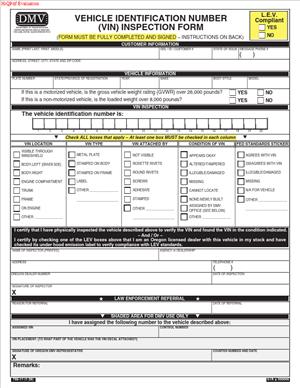
DMV 735-11 – Vehicle Identification Number (VIN) Inspection Form
Fill out nowJurisdiction: Country: United States | Province or State: Oregon
The DMV 735-11 – Vehicle Identification Number (VIN) Inspection Form is used to confirm that a vehicle’s identification number matches official records. If you are registering a vehicle in Oregon, this form may be part of your paperwork. It documents that a physical inspection of the VIN has taken place.
You might come across this form when bringing a vehicle into Oregon from another state. It is also common when registering certain types of vehicles that have not been previously titled in Oregon. The form helps confirm that the vehicle described in your application is the same vehicle being presented.
The inspection recorded on this form helps prevent errors and fraud. A VIN is unique to each vehicle. Matching it correctly protects both you and the state’s records.
If you are about to fill out this form, you likely need to understand what information goes on it, who completes each part, and what makes it acceptable. This guide walks you through the key points so you can approach the form with confidence.
What is DMV 735-11 – Vehicle Identification Number (VIN) Inspection Form?
Clear definition
The DMV 735-11 – Vehicle Identification Number (VIN) Inspection Form is a document used to record a physical inspection of a vehicle’s VIN. The VIN is a 17-character number assigned by the manufacturer. It identifies the vehicle’s make, model, year, and production details.
The form confirms that the VIN displayed on the vehicle matches the number listed on ownership and registration documents. It also creates a written record of who performed the inspection and when it occurred.
This form is part of the vehicle registration and titling process in Oregon. It does not replace a title or registration application. Instead, it supports those filings by verifying the vehicle’s identity.
Who typically uses this form?
You may use this form if you are a vehicle owner applying for Oregon title or registration and your vehicle requires a VIN inspection. This often includes people who recently moved to Oregon or purchased a vehicle from out of state.
Dealers sometimes encounter this form when handling certain transactions. Individuals restoring older vehicles or registering specially constructed vehicles may also need it.
An authorized inspector completes the inspection portion. Depending on the situation, this may be a law enforcement officer or another approved official. The vehicle owner does not perform the inspection themselves.
Why might you need this form?
You may need this form when a vehicle has never been titled in Oregon. The state may require confirmation that the VIN on the vehicle matches the paperwork you submit.
It can also be required if there is a discrepancy in existing records. For example, if a title shows one VIN but the vehicle plate shows another, an inspection helps clarify the correct number.
In some cases, vehicles without standard documentation may require additional verification. The form serves as an official record that someone physically checked the vehicle.
The goal is accuracy. The form reduces the risk of registering the wrong vehicle or recording an incorrect VIN in state records.
Typical real-life scenarios
- You move to Oregon and bring your car with you. When you apply for Oregon title and registration, you are told that a VIN inspection is required because the vehicle was previously titled in another state. The form documents that inspection.
- You buy a used vehicle from a private seller who recently brought it from another state. Before you can complete registration in Oregon, the VIN must be verified. The inspection is recorded on this form.
- You restore an older vehicle that has not been registered for many years. During the process of applying for a new title, a VIN inspection is required to confirm the vehicle’s identity. The form becomes part of your title application file.
- You purchase a trailer or other vehicle type that falls under specific registration rules. A VIN inspection is required before the state will issue registration. The form captures the details of that inspection.
When would you use DMV 735-11 – Vehicle Identification Number (VIN) Inspection Form?
You would use this form during the title or registration process when a VIN inspection is required. It is not a general-use document. It is tied to specific transactions involving vehicle ownership records.
This commonly happens when transferring ownership of a vehicle that has not been previously recorded in Oregon. The inspection confirms that the physical vehicle matches the ownership documents being submitted.
You may also encounter this form if there are concerns about the accuracy of the VIN in existing records. For example, if a digit appears incorrect on a title, an inspection helps resolve the issue before a new document is issued.
Certain types of vehicles may trigger inspection requirements more often. These can include out-of-state vehicles, rebuilt or reconstructed vehicles, and vehicles with incomplete documentation. In each case, the form acts as written proof that the VIN was checked in person.
The form is typically completed before or at the same time as submitting your title and registration paperwork. It becomes part of your overall filing package. Without it, the processing of your application may be delayed if an inspection is required.
Legal characteristics of DMV 735-11 – Vehicle Identification Number (VIN) Inspection Form
The form is effective when it accurately records the VIN and is completed by an authorized inspector. Legibility matters. The VIN must match exactly, character for character, with the number on the vehicle.
Accuracy is critical because a single incorrect digit can identify a completely different vehicle. Errors in transcription are a common reason forms are rejected or questioned.
The inspection must reflect a physical examination of the vehicle. The purpose is to verify what is stamped or affixed to the vehicle itself. The form documents that this step took place.
If required fields are left blank, the submission may not be accepted. Missing inspector information, incomplete VIN entries, or unclear handwriting can cause delays.
This form does not transfer ownership. It does not grant registration. It does not confirm that the vehicle is free of liens or other claims. It only verifies the VIN as observed during inspection.
Different states have different inspection requirements. Some require inspections for most out-of-state vehicles, while others limit them to certain categories. In Oregon, the requirement depends on the vehicle’s history and the nature of the transaction.
Is it legally binding?
The form serves as an official record of a completed VIN inspection. In that sense, it carries legal significance. It documents that an authorized person verified the vehicle’s identifying number.
However, it is not a contract between parties. It does not create obligations between buyer and seller. Instead, it supports an administrative process related to titling and registration.
Its legal effect depends on accurate completion and proper submission. If the inspection is properly performed and recorded, the form can be relied upon as part of the state’s vehicle record. If it contains errors or false information, it may be rejected or lead to further review.
How to fill out DMV 735-11 – Vehicle Identification Number (VIN) Inspection Form
Step 1 – Review the entire form before writing anything
Start by reading the full document from top to bottom. Notice which sections are for the vehicle owner and which are for the inspector. This helps you avoid filling in parts that are not meant for you.
Check that you have your title, registration documents, or bill of sale available. You will need to copy information exactly as it appears on those records.
Step 2 – Enter the vehicle identification number exactly as shown
Locate the VIN on the vehicle. It is often visible through the windshield on the driver’s side dashboard. It may also appear on a door frame label or other manufacturer plate.
Carefully write the VIN in the space provided. Copy all 17 characters exactly. Pay close attention to similar-looking characters, such as the number zero and the letter O.
Do not guess at any character. If a character is difficult to read, the inspector may need to confirm it directly from the vehicle.
Step 3 – Provide vehicle details as requested
The form may ask for information such as the vehicle’s year, make, and body style. Enter this information as it appears on your ownership documents and matches the vehicle.
Consistency matters. If the title says one model year and the vehicle appears to show another, that discrepancy may need clarification before submission.
Write clearly. If you are completing the form by hand, print in block letters to reduce the risk of misreading.
Step 4 – Confirm owner information if required
Some versions of the form include space for owner details. If required, provide your full legal name and other identifying information as requested.
Make sure your name matches the name used on your title or registration application. Differences in spelling or format can cause confusion during processing.
If there are multiple owners, follow the form’s instructions on how to list them. Keep the format consistent with your title documents.
Step 5 – Present the vehicle for inspection
Bring the vehicle to the authorized inspector as required. The inspector will physically locate and review the VIN on the vehicle.
The inspector may check more than one VIN location. This helps confirm that the number is consistent throughout the vehicle.
Remain available during the inspection in case questions arise about the vehicle or its documentation.
Step 6 – Ensure the inspector completes their section fully
After reviewing the VIN, the inspector will fill out their portion of the form. This may include their name, badge or identification number, signature, and the date of inspection.
Check that all inspector fields are completed. An unsigned or undated inspection can lead to rejection of the form.
Do not alter the inspector’s entries. If an error is discovered, it is generally cleaner to complete a new form rather than cross out information.
Step 7 – Review the entire form for accuracy
Before submitting the form with your other paperwork, read it again carefully. Compare the written VIN with the number on the vehicle and your title documents.
Confirm that dates are correct and all required sections are filled in. Make sure the writing is legible and that no fields are left unintentionally blank.
Once you are satisfied that the form is complete and accurate, include it with your title and registration submission as part of your overall filing package.
Legal terms you might encounter in DMV 735-11 – Vehicle Identification Number (VIN) Inspection Form
- Vehicle Identification Number (VIN): A unique 17-character combination of letters and numbers assigned to a specific vehicle. On this form, the VIN is the core detail being verified. The inspector checks that the VIN on the vehicle matches the VIN listed on your ownership or registration documents.
- Odometer Reading: The number of miles shown on the vehicle’s odometer at the time of inspection. While this form focuses on VIN verification, the inspector may record or compare mileage as part of confirming the vehicle’s identity. You must make sure the reading is accurate and clearly visible.
- Vehicle Description: Basic identifying details such as year, make, model, body style, and color. These details help confirm that the VIN corresponds to the correct vehicle. If the description does not match the physical vehicle, the inspection may not be accepted.
- Title: The legal document that shows ownership of the vehicle. The VIN on the title must match the VIN on the vehicle and the VIN written on this form. Any discrepancy can delay your registration or transfer process.
- Authorized Inspector: A person legally permitted to complete the VIN inspection section of the form. This may include certain law enforcement officers or designated officials. Only an authorized inspector can certify the VIN on this document.
- Certification: The inspector’s official statement, usually made by signature, confirming that they physically examined the vehicle and verified the VIN. This certification gives the form its legal effect for vehicle record purposes.
- Altered or Tampered VIN: A VIN that shows signs of being changed, damaged, or removed. If the inspector suspects alteration, they may note it on the form. This can trigger further review before your vehicle can be titled or registered.
- Applicant: The person requesting the VIN inspection, usually the vehicle owner or someone acting on their behalf. Your name and identifying details must match the ownership documents you plan to submit.
- Jurisdiction: The authority under which the inspection is performed. The inspector’s authority must fall within the appropriate government framework for the form to be valid and accepted.
FAQs
What if the VIN on my vehicle does not exactly match the VIN on my title?
You must stop and resolve the discrepancy before submitting this document. Even one incorrect character can cause rejection. Check each letter and number carefully. If the vehicle VIN plate differs from your title, contact the issuing authority for guidance before proceeding.
Can I fill out the inspection section myself on the DMV 735-11 – Vehicle Identification Number (VIN) Inspection Form?
No. Only an authorized inspector can complete and certify the inspection section. You may fill in your portion, but the official verification must be done by someone legally permitted to inspect and sign. If you complete the inspector’s section yourself, the form will not be accepted.
Do I need to bring anything with me to the inspection?
Bring your ownership document, any prior registration paperwork, and personal identification. The inspector may compare the VIN on your paperwork with the VIN on the vehicle. Having complete documents helps prevent delays or follow-up visits.
Where do I find the VIN on my vehicle?
The VIN is usually visible on a metal plate on the dashboard near the windshield on the driver’s side. It may also appear on a door frame label, engine compartment, or vehicle frame. The inspector will look at the physical VIN plate, not just your paperwork.
What happens if the inspector notes possible tampering?
If the inspector believes the VIN has been altered or damaged, they will document that concern. This can pause your title or registration process. You may need further investigation or additional documentation before your vehicle can be processed.
Is there an expiration date for this document after it is completed?
Inspection documents are typically expected to be submitted within a reasonable time after completion. If you wait too long, you may be asked to obtain a new inspection. Submit the completed DMV 735-11 – Vehicle Identification Number (VIN) Inspection Form as soon as possible with your other paperwork.
What if I recently moved and my name or address is different from my title?
Make sure the name on this form matches the name on your ownership document. If your name has changed, you may need supporting documentation. Address differences are usually handled during registration, but name mismatches can delay processing.
Does this form change ownership of the vehicle?
No. This form only verifies the vehicle’s identity. Ownership changes are handled through title transfer documents. This document supports those transactions by confirming that the VIN on the vehicle matches official records.
Checklist: Before, During, and After DMV 735-11 – Vehicle Identification Number (VIN) Inspection Form
Before
- Review your title or ownership document and confirm the VIN is legible.
- Compare the VIN on your paperwork to the VIN physically on the vehicle.
- Clean the VIN plate area so the characters are easy to read.
- Gather your identification and any registration documents.
- Confirm who is authorized to perform the inspection.
- Check that the vehicle is accessible and safe to inspect.
- Verify that all characters in the VIN are clear and not obstructed.
During
- Watch as the inspector locates the VIN on the vehicle.
- Ensure the inspector reads all 17 characters carefully.
- Confirm the year, make, and model listed match your vehicle.
- Ask the inspector to clarify anything you do not understand.
- Make sure the inspector completes every required field.
- Verify that the inspector signs and dates the form.
- Double-check that no required section is left blank.
After
- Review the completed form before leaving the inspection site.
- Make a copy for your personal records.
- Attach the form to your title or registration application.
- Submit all documents together to avoid delays.
- Keep proof of submission or receipt if provided.
- Monitor your mail or account for confirmation of processing.
- Store your copy in a secure location with your vehicle records.
Common mistakes to avoid with DMV 735-11 – Vehicle Identification Number (VIN) Inspection Form
- Mistake: Writing the VIN from memory because you assume it matches your paperwork, which happens when people rush; this can lead to rejected applications, so do not forget to copy it directly from the physical VIN plate.
- Mistake: Allowing an unauthorized person to complete the inspection section because it seems convenient; this causes automatic rejection, so do not forget to confirm the inspector’s authority.
- Mistake: Submitting the form with missing signatures or dates because you did not review it afterward; incomplete forms delay processing, so do not forget to check every required signature line.
- Mistake: Ignoring small discrepancies in vehicle description because they seem minor; even color or model mismatches can raise questions, so do not forget to verify all listed details.
- Mistake: Waiting too long to submit the completed form because you are gathering other paperwork; delays can require a new inspection, so do not forget to file it promptly.
- Mistake: Failing to keep a copy because you assume the agency will store it; if paperwork is lost, you may need another inspection, so do not forget to retain your own copy.
What to do after filling out DMV 735-11 – Vehicle Identification Number (VIN) Inspection Form
Once the form is fully completed and signed by the authorized inspector, your next steps focus on proper submission and recordkeeping. The inspection alone does not update your vehicle records. You must include it with the rest of your required paperwork.
- Step 1: Review the entire completed form line by line. Confirm that the VIN is accurate and matches your title exactly.
- Step 2: Check that the inspector’s signature and date are present and legible. Without these, the document will not be valid.
- Step 3: Make at least one clear copy for your personal records. Store it with your title and registration documents.
- Step 4: Attach the original inspection form to your title application, registration application, or other required vehicle paperwork.
- Step 5: Confirm that all names match across documents. If your name appears differently on any form, resolve that before submission.
- Step 6: Submit the full packet using the approved submission method, whether in person or by mail, following the instructions for your transaction.
- Step 7: If you submit in person, request confirmation that your documents were received and accepted for processing.
- Step 8: If you submit by mail, consider using a mailing method that allows tracking so you can confirm delivery.
- Step 9: Monitor any communication you receive regarding your vehicle application. Respond quickly if additional information is requested.
- Step 10: Once your registration or title is processed, review the new document to ensure the VIN is printed correctly.
By staying organized and proactive, you reduce the risk of delays. Keep all related paperwork together in a secure place. Accurate VIN verification protects you from ownership disputes and record errors in the future.
Disclaimer: This guide is provided for informational purposes only and is not intended as legal advice. You should consult a legal professional.