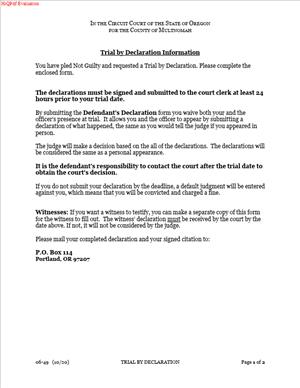
Trial by Declaration
Fill out nowJurisdiction: Country: United States | Province or State: Oregon
A Trial by Declaration is a written way to present your side of a case without appearing in person. Instead of going to court, you submit a signed statement that explains what happened and why you believe the court should rule in your favor.
In Oregon, this process is often used in limited types of cases where the court allows decisions based on written submissions. It can be helpful if you cannot attend a hearing or if the court specifically offers this option.
If you are filling out a Trial by Declaration, you are telling the court your version of events under penalty of perjury. That means you are confirming that everything you write is true to the best of your knowledge.
This document matters because it may be the only information the judge reviews before making a decision. Clear facts, complete details, and proper formatting can affect how your case is understood.
What is Trial by Declaration?
Clear definition
A Trial by Declaration is a formal written statement submitted to the court in place of live testimony. It allows you to explain your position, describe the facts, and present any supporting information in writing.
You sign the document to confirm that the contents are true. The judge reviews your statement, along with any other submitted materials, and makes a decision based on the written record.
This is not an informal letter. It is a court filing. It becomes part of the official case file.
Who typically uses this form?
People who receive certain types of citations or are involved in limited civil matters may use this form when the court allows written proceedings. It is often used by individuals representing themselves.
Defendants commonly use it to respond to a charge without attending court. In some situations, the other party may also have the opportunity to submit a written declaration.
Court clerks process the submission, and a judge reviews it. No in-person testimony is given unless the case moves forward to a different stage.
Why might you need this form?
You may need this form if you choose a written hearing instead of appearing in person. Courts sometimes provide this option for efficiency or convenience.
It can also be relevant if you live far from the courthouse or have scheduling conflicts. In some cases, the court may require written submissions before deciding whether a hearing is necessary.
Using this form creates a structured way to present facts, documents, and explanations in one organized filing.
Typical real-life scenarios
- You receive a traffic citation and believe the officer made an error. Instead of attending court, you decide to explain your version of events in writing. You describe the road conditions, your speed, and any other relevant details.
- You are cited for a minor violation and believe there were special circumstances. You explain what happened, attach photographs, and describe why the citation may not accurately reflect the situation.
- You believe a device or method used to issue the citation was inaccurate. In your written statement, you describe what you observed and why you question the result.
- You cannot attend the scheduled court date due to work or family obligations. The written process allows you to participate without being physically present in the courtroom.
When would you use Trial by Declaration?
You use a Trial by Declaration when the court handling your case allows written testimony instead of an in-person hearing. This option is typically available in specific types of cases, often involving traffic or limited violations.
The court usually sets deadlines for submitting the completed form. You file it with the clerk’s office, and it becomes part of the case record.
In many situations, the other party, such as a law enforcement officer, may also submit a written statement. The judge reviews both sides before making a decision.
You may encounter this process early in your case, soon after receiving a citation. In some situations, it may be offered as an alternative to appearing on the scheduled court date.
This form is not used for full jury trials or complex civil litigation. It is generally limited to matters where written evidence is considered sufficient for an initial decision.
Legal characteristics of Trial by Declaration
A Trial by Declaration is a sworn written statement. Its legal effect comes from your signature under penalty of perjury. That statement confirms that your account is truthful.
For the court to accept it, the document must be complete, signed, and submitted by the required deadline. Missing information, an unsigned declaration, or a late submission can prevent the judge from considering it.
Clarity matters. Judges review many written submissions. A statement that is organized and factual is easier to evaluate than one that is emotional or unclear.
This form does not automatically dismiss a case. It provides your version of events. The judge decides whether the facts support your position.
Procedures may vary slightly between courts. Some courts require additional forms or specific formatting. Always review the instructions provided with the filing packet to understand what is expected in your county.
Is it legally binding?
A Trial by Declaration is legally binding in the sense that you are making sworn statements to the court. Providing false information can have serious consequences because you are signing under penalty of perjury.
The judge’s decision based on the written submissions is also legally effective. It may result in a dismissal, a finding of responsibility, or another outcome allowed by law.
However, this document does not create a private agreement between parties. It is part of a court process. Its effect depends on the judge’s ruling after reviewing all submitted materials.
How to fill out Trial by Declaration
Step 1 – Review the case information at the top of the form
At the top of the document, you will see spaces for the court name, county, and case number. Fill in the Circuit Court of the State of Oregon and Multnomah County if not already printed. Enter your case or citation number exactly as it appears on your paperwork. This ensures the clerk matches your submission to the correct file.
Step 2 – Identify yourself clearly
Provide your full legal name, mailing address, and any other requested contact information. Use the same name that appears on the citation or court documents. Accurate contact details allow the court to send you the decision or any follow-up notices.
Step 3 – State that you are requesting a written trial
The form will include language indicating that you are choosing to proceed by written declaration. Confirm this selection as instructed in the document. This tells the court you are submitting your case in writing instead of appearing in person.
Step 4 – Write your statement of facts
In the space provided, explain what happened. Focus on facts, dates, times, and specific details. Describe events in the order they occurred. Keep sentences clear and direct. Avoid personal attacks or emotional language. The goal is to help the judge understand your version of events quickly.
Step 5 – Refer to any supporting evidence
If the form allows attachments, identify each document you include. For example, you may refer to photographs, diagrams, or records. Label each attachment clearly. In your written statement, mention the attachment so the judge knows how it connects to your explanation.
Step 6 – Review your statement carefully
Before signing, read everything from beginning to end. Check that names, dates, and case numbers are correct. Make sure your explanation is complete and easy to follow. Confirm that all attachments are included and properly labeled.
Step 7 – Sign under penalty of perjury
Sign and date the declaration where indicated. Your signature confirms that the information is true to the best of your knowledge. Do not leave this section blank. An unsigned form may not be accepted by the court.
Step 8 – Submit the form to the court clerk
Deliver or mail the completed document according to the court’s instructions. Ensure it is received by the stated deadline. After submission, keep a copy of everything for your records, including any attachments and proof of delivery.
Legal terms you might encounter in Trial by Declaration
- Declaration: A written statement of facts that you prepare and sign. In this document, your declaration replaces live testimony in court. It must clearly explain what happened from your perspective. The court reads this instead of hearing you speak in person.
- Penalty of Perjury: A statement you sign confirming that everything you wrote is true to the best of your knowledge. If you knowingly include false information, you can face legal consequences. This language usually appears directly above your signature line. Read it carefully before signing.
- Citation: The ticket or charging document issued to you. Your declaration must reference the citation number exactly as it appears. The court uses that number to connect your written statement to the correct case.
- Defendant: The person accused of violating a law. In most situations involving this document, you are the defendant. Make sure your name matches the name listed on the citation and court paperwork.
- Bail: Money you deposit with the court as required before the written trial proceeds. In some cases, the court will not process your declaration without this payment. If you are found not responsible, the bail may be refunded.
- Exhibits: Supporting documents you attach to your declaration. These can include photographs, diagrams, repair receipts, or other records. Each exhibit should be labeled clearly so the judge can refer to it easily.
- Proof of Submission: Evidence that you submitted your documents on time. This may include a date-stamped copy from the clerk or mailing confirmation. Keep this for your records in case there is a dispute about timing.
- Judgment: The court’s final written decision after reviewing the declaration and any opposing statement. The judgment will state whether you are responsible and outline any penalties or next steps. You will receive it by mail or through the court’s standard delivery process.
- Request for New Trial: An option that may be available if you disagree with the written decision. It allows you to request an in-person hearing after the written process concludes. There is often a strict deadline to file this request.
- Case Number: The unique number assigned to your court case. This number appears at the top of your court documents. You must include it on every page you submit so the clerk can file your paperwork correctly.
FAQs
How do I know if I am eligible to use a Trial by Declaration?
Look at your citation and any instructions from the court. This document is typically available for certain violations where a written statement is allowed instead of appearing in person. Check whether your paperwork mentions the option for a written trial and confirm any required deposit or deadline before you prepare your materials.
What information must match exactly on this form?
Your full legal name, citation number, case number, and contact information must match the court’s records. Even small differences, like a missing middle initial or incorrect number, can delay processing. Before you submit, compare your entries line by line with your citation and any court notice you received.
What happens if I miss the filing deadline?
If your declaration arrives after the deadline, the court may reject it and move forward without considering your written statement. The due date is often tied to the citation date or a court notice. Check the deadline carefully and allow enough time for delivery if you are not filing in person.
Do I need to attach evidence, and how should I label it?
You are not always required to attach evidence, but strong supporting documents can help clarify your statement. Label each attachment clearly, such as “Exhibit A – Photograph of Intersection” or “Exhibit B – Repair Invoice.” Mention each exhibit in your written statement so the judge knows when to review it.
Where do I send this document once it is complete?
Send or deliver it to the court listed at the top of your paperwork. The address must match the court handling your case. Include any required payment and make sure the case number appears on all pages so the clerk can file it correctly.
How will I know if the court accepted my filing?
You may receive confirmation through a date-stamped copy, receipt, or mailed notice. Some courts send written confirmation once the document is processed. Keep proof of submission in case you need to confirm that you met the deadline.
What changes in the public record after the judge reviews my Trial by Declaration?
Once the court issues a written decision, the case record will reflect the judgment. If you are found responsible, the penalties will be recorded. If you are not responsible, the record will show that outcome instead. The update becomes part of the official court file tied to your case number.
Can I correct mistakes after I submit this form?
It depends on the timing. If the court has not yet issued a judgment, you may be able to submit a corrected version or additional information, but you must act quickly. Once a decision is entered, changes are much more limited and may require a separate written request.
Checklist: Before, During, and After Trial by Declaration
Before
- Read your citation and all court instructions carefully.
- Confirm that you are eligible for a written trial.
- Mark the filing deadline on your calendar.
- Verify the exact court name and address.
- Gather all supporting documents and photographs.
- Check the required bail or deposit amount.
- Confirm your case number and citation number.
- Draft an outline of the facts you want to include.
During
- Write clearly and stick to the facts.
- Use full names, dates, times, and locations.
- Reference each exhibit in your statement.
- Number your pages and label attachments.
- Double-check spelling of names and numbers.
- Review the penalty of perjury statement before signing.
- Sign and date the document in the correct place.
- Make copies of everything before submission.
After
- Submit the original to the correct court.
- Obtain proof of mailing or a filed copy.
- Store your copy in a safe, organized folder.
- Track the expected timeline for a decision.
- Watch your mail for the court’s judgment.
- Review the judgment carefully once received.
- Note any deadlines for further action.
- Update your personal records with the outcome.
Common mistakes to avoid with Trial by Declaration
- Mistake: Missing the filing deadline because you assumed mailing on the due date was enough, which can result in rejection of your documents and loss of the written trial option; do not forget to allow time for delivery and confirm the court’s deadline rules.
- Mistake: Entering the wrong case number or citation number due to copying errors, which can cause misfiling or delays; do not forget to compare your form directly with your court notice before submitting.
- Mistake: Writing emotional arguments instead of clear facts because you feel frustrated, which can weaken your credibility; do not forget to focus on specific events, dates, and observable details.
- Mistake: Failing to label exhibits properly because you assume the court will sort them out, which can confuse the judge reviewing your file; do not forget to mark each attachment clearly and reference it in your statement.
- Mistake: Forgetting to sign under penalty of perjury because you rushed to finish, which can make the document invalid; do not forget to sign and date in the designated area.
- Mistake: Sending original evidence without keeping copies because you want to provide the best proof, which can leave you without records; do not forget to keep complete copies of everything you submit.
- Mistake: Ignoring required bail or payment instructions because you focused only on the written statement, which can prevent the court from processing your request; do not forget to include any required payment in the correct form.
- Mistake: Failing to read the judgment carefully because you assume the matter is over, which can cause you to miss deadlines for further action; do not forget to review the decision and calendar any next steps immediately.
What to do after filling out the Trial by Declaration
Once your document is complete and signed, pause before you submit it. A careful final review can prevent avoidable delays. Make sure every page includes your case number. Confirm that your contact information is current so the court can reach you.
- Step 1: Make at least two complete copies of everything, including attachments and any payment documentation.
- Step 2: Organize your packet in logical order, with the declaration first and exhibits labeled and attached behind it.
- Step 3: Confirm the correct filing method, whether by mail or in person, and verify the address listed on your court paperwork.
- Step 4: Submit the original documents and include any required bail or deposit in the accepted form.
- Step 5: Obtain proof of submission, such as a date-stamped copy or mailing confirmation, and store it with your case file.
- Step 6: Create a simple tracking note with the date you submitted and the expected timeframe for a response.
- Step 7: Monitor your mail regularly for the court’s written judgment or any notice requesting additional information.
- Step 8: Review the judgment carefully as soon as you receive it, paying attention to findings, financial obligations, and deadlines.
- Step 9: Calendar any follow-up deadlines immediately, especially if you are considering requesting a new trial or taking another permitted step.
- Step 10: Update your personal records to reflect the outcome, including payment confirmations or case closure documents.
Stay organized until the case is fully resolved. Keep your copies even after a final decision. Court records can be important later, especially if questions arise about compliance or payment. Clear documentation protects you.
Disclaimer: This guide is provided for informational purposes only and is not intended as legal advice. You should consult a legal professional.