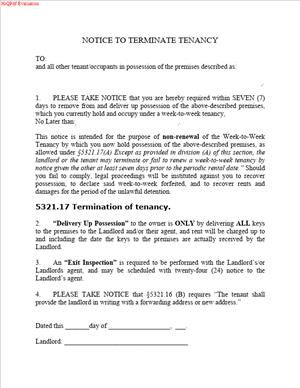
7 Day Notice to Terminate Tenancy
Fill out nowJurisdiction: Country: United States | Province or State: Ohio | County: Cleveland
A 7 Day Notice to Terminate Tenancy is a written document used to formally notify a tenant that a rental agreement is ending in seven days. It is often the first written step in the eviction process. If you are filling out this form, you are likely dealing with a lease violation, unpaid rent, or another issue that affects the rental arrangement.
This document is not a court order. It is a notice. It tells the tenant that the landlord intends to end the tenancy unless the issue is resolved or the tenant leaves within the stated time frame. In Cleveland, this form is closely connected to procedures handled by the local housing court.
If you are a landlord, you may use this form to protect your property rights and document that you gave proper notice. If you are a tenant who received it, understanding what it says is critical. The wording, dates, and delivery method can affect what happens next.
Because this form can lead to court proceedings, accuracy matters. Small mistakes in names, addresses, or dates can cause delays or require you to start over. Knowing how the document works before you complete it can save time and prevent confusion.
What is a 7 Day Notice to Terminate Tenancy?
Clear definition
A 7 Day Notice to Terminate Tenancy is a written notice that informs a tenant that their right to occupy a rental property will end after seven days. It typically states the reason for termination and identifies the rental property and the parties involved.
This form serves as formal communication. It creates a record that the tenant was notified. In many situations, it is required before a landlord can file an eviction action in court.
The notice usually includes the tenant’s name, the property address, the date of the notice, and a clear statement that the tenancy will terminate in seven days. Some versions also describe the specific lease violation or unpaid amount involved.
Who typically uses this form?
Most often, landlords or property managers use this form. They may be individuals who own a single rental unit or companies that manage multiple properties. The key factor is that they have legal authority over the rental property.
Property owners may prepare the document themselves. In other cases, a property manager or authorized agent completes and signs it on the owner’s behalf. The person signing the notice must have authority connected to the rental agreement.
Tenants do not usually prepare this document. They are the receiving party. However, tenants benefit from understanding its contents so they can decide how to respond.
Why might you need this form?
A landlord may need this form when a tenant has not paid rent. Nonpayment is one of the most common reasons for termination notices. The notice gives the tenant a limited time to address the issue or leave the property.
Another reason may be a violation of lease terms. This can include unauthorized occupants, pets that are not allowed, or damage to the unit. The notice explains that the tenancy will end because of that violation.
Sometimes, the tenancy is month-to-month, and the landlord chooses to end it for other permitted reasons. In such cases, the notice formally communicates that the rental relationship will end after the stated period.
Using the correct notice form creates a paper trail. If the matter proceeds to court, the judge may review whether proper notice was given before any filing.
Typical real-life scenarios
- A landlord rents an apartment to a tenant under a written lease. The tenant misses several rent payments. After attempts to collect payment fail, the landlord prepares a 7-day notice stating the amount due and the deadline to vacate.
- In another situation, a tenant repeatedly violates building rules by causing disturbances. The landlord documents complaints and then issues a notice stating that the tenancy will terminate in seven days due to ongoing violations.
- A property owner discovers that a tenant has moved in additional occupants without permission. The lease restricts occupancy. The landlord uses the notice to inform the tenant that the agreement will end unless the situation changes.
- There may also be cases involving damage to the property. If a tenant significantly damages the unit and does not correct the issue, the landlord may deliver a termination notice as part of the process to regain possession.
When would you use a 7 Day Notice to Terminate Tenancy?
You would use a 7 Day Notice to Terminate Tenancy when you need to formally end a tenancy and provide a short, defined notice period. It is commonly used before filing an eviction action in housing court.
The timing depends on the circumstances. If rent is overdue and remains unpaid, the notice may be issued soon after the missed payment. If the issue involves lease violations, the notice may follow written warnings or documented incidents.
Landlords use this document when they want a clear record of communication. Verbal conversations are often not enough. A written notice shows that the tenant was informed of the termination and the time frame involved.
In properties with multiple tenants, the notice may be addressed to all adult occupants listed on the lease. Each person named in the rental agreement may need to be included to avoid confusion later.
Property managers may use the form as part of a standard process. For example, when internal policies require written notice before escalating a matter to court, this document satisfies that requirement.
The form is also used when the landlord intends to file a formal eviction complaint if the tenant does not leave by the deadline. The notice sets the stage for that possible next step.
Legal Characteristics of a 7 Day Notice to Terminate Tenancy
A 7 Day Notice to Terminate Tenancy is effective when it clearly identifies the parties, the rental property, and the termination date. It must state that the tenancy will end after seven days. Clarity is essential. Vague language can create confusion and weaken its impact.
The date on the notice is important. The seven-day period usually begins on the date the notice is properly delivered. Incorrect date calculations can lead to disputes about whether enough time was given.
Delivery method also matters. Notices are often delivered in person, left at the premises, or sent by a permitted method. If delivery cannot be proven, it may create problems in court. Many landlords keep copies and written proof of service for this reason.
Common issues that cause rejection or delay include misspelled names, incorrect property addresses, missing signatures, or failing to state the termination period clearly. Even small errors may require reissuing the notice and restarting the waiting period.
In different areas, the required wording or time frame may vary. Some jurisdictions require specific statutory language to appear in the notice. Others have different notice periods depending on the reason for termination. It is important to use the correct version for the local housing court system.
This document does not remove a tenant from the property by itself. It does not authorize a landlord to change locks or remove belongings. It is a notice of intent to terminate the tenancy. Court involvement may be required if the tenant does not leave voluntarily.
Is it legally binding?
A 7 Day Notice to Terminate Tenancy is legally significant because it formally communicates termination under the rental agreement. When properly completed and delivered, it can satisfy a required step before filing an eviction case.
However, it does not automatically end the tenant’s physical possession of the property. If the tenant remains after the deadline, further legal action may be necessary. The binding effect relates to the notice requirement, not immediate removal.
Its legal weight depends on accuracy and compliance with local rules. If the notice meets required standards and is properly served, it generally supports the next stage of the legal process. If it is defective, a court may find that the termination was not properly initiated.
How to fill out a 7 Day Notice to Terminate Tenancy
Step 1 – Enter the Date of the Notice
Write the full date when you prepare the notice. This date is important because it often starts the seven-day period. Use the complete month, day, and year to avoid confusion.
Step 2 – Identify the Tenant or Tenants
List the full legal name of each adult tenant as shown on the lease agreement. If more than one person signed the lease, include all names. Accurate spelling helps ensure the notice applies to everyone responsible under the agreement.
Step 3 – Provide the Rental Property Address
Enter the complete address of the rental unit. Include the street number, street name, apartment or unit number, city, state, and ZIP code. The address must clearly identify the specific premises covered by the tenancy.
Step 4 – State the Reason for Termination
Clearly describe why the tenancy is being terminated. If the issue is unpaid rent, state the amount owed and the time period it covers. If it involves a lease violation, briefly describe the conduct or condition that violates the agreement. Keep the explanation factual and direct.
Step 5 – Specify the Seven-Day Deadline
State that the tenancy will terminate in seven days from the date of the notice. Make the deadline clear. Some forms include a specific move-out date. If so, calculate the date carefully to reflect the full notice period.
Step 6 – Include Required Statutory Language
Some versions of the form include mandatory wording required by the local housing court. If the form contains preprinted language, do not alter it. If there is a section for statutory language, copy it exactly as required in the form instructions.
Step 7 – Sign and Print Your Name
Sign the notice in the designated area. Print your name below your signature. If you are signing as a property manager or authorized agent, indicate your role or title.
Step 8 – Complete the Certificate of Service
If the form includes a section describing how the notice was delivered, fill it out at the time of delivery. Indicate the method used and the date of delivery. This section creates a record that the tenant received the notice or that delivery was attempted in a permitted way.
Step 9 – Make Copies for Your Records
Before delivering the notice, make at least one copy for your records. Keep the copy in a safe place along with any related lease documents and payment records. This documentation may be useful if the matter proceeds to housing court.
Legal terms you might encounter in a 7 Day Notice to Terminate Tenancy
- Premises: This means the rental property covered by the lease. In this document, you must list the full address of the premises, including the unit number if there is one. The description should match the lease so there is no confusion about which property is involved.
- Material Noncompliance: This refers to a serious violation of the lease or rental agreement. The form often requires you to state what the tenant did or failed to do. You need to describe the conduct clearly so the tenant understands what must change or why the tenancy is ending.
- Notice Period: This is the seven-day timeframe given to the tenant. The notice period starts based on the date of delivery, not just the date written on the form. You must calculate it carefully so the deadline is accurate.
- Service of Notice: Service means how you deliver the document to the tenant. The form typically includes a certificate or statement explaining how and when you served it. Proper service is essential because it proves the tenant received notice.
- Certificate of Service: This is the section where you confirm the method of delivery and the date. You sign it to verify that the information is true. Courts rely on this part to determine whether the notice was properly given.
- Possession: Possession refers to the legal right to occupy the property. When you issue this notice, you are stating that the tenant’s right to possession will end if the issue is not resolved within seven days.
- Cure: To cure means to fix the problem. Some notices allow the tenant to correct the violation within the seven-day period. If cured on time, the tenancy may continue.
- Forcible Entry and Detainer: This is the formal court process used to regain possession of rental property. If the tenant does not comply with the notice, this is often the next legal step. The notice is usually required before filing such a case.
- Authorized Agent: This is someone legally allowed to act on behalf of the property owner. If you are not the owner, you must confirm that you have the authority to sign and deliver the notice. Your role should be clearly stated in the document.
FAQs
When does the seven-day period actually start?
The seven-day period usually begins the day after the notice is served, not the day you write it. Look at the date you list in the certificate of service. Count seven full calendar days from the next day. Write the deadline clearly in the notice so the tenant knows the exact final day to comply or vacate.
What if I misspell the tenant’s name on this form?
Names should match the lease as closely as possible. Small spelling errors may not invalidate the document, but major differences can create confusion. Double-check the lease and any prior correspondence. If you realize the mistake before serving it, correct it and reprint the form so the record is consistent.
Do I need to attach a copy of the lease?
You usually do not attach the lease to the 7 Day Notice to Terminate Tenancy. However, you should have it available for reference. If you mention specific lease sections in your description of the violation, make sure those sections exist and are accurate. Keep a copy in your records in case you need it later.
Can I email the notice instead of delivering a paper copy?
Check what delivery methods are allowed in your rental agreement and by local procedure. This document typically expects personal delivery, posting, or another recognized method. If you choose a method not accepted by the court, the notice may not count. Always complete the certificate of service accurately based on how you delivered it.
What date should I list as the termination date?
List the date that falls after the full seven-day period ends. Count carefully and avoid guessing. If you are unsure, write out the days on a calendar and double-check your math. An incorrect termination date can delay your next steps.
Who is allowed to sign the 7 Day Notice to Terminate Tenancy?
The owner or an authorized agent can sign it. If you are an agent or property manager, make sure your authority is documented. Sign your name clearly and print it below the signature line. Your title or role should be included so there is no confusion about your authority.
What happens if the tenant fixes the problem within seven days?
If the issue is cured within the deadline and the notice allows for correction, the tenancy may continue. Document what was fixed and when. Keep written confirmation for your records. If the same issue happens again, you may need to issue a new notice.
Does filing this document with the court change the public record immediately?
The notice itself is not usually part of the public court record until you file a case. It serves as a required step before starting formal proceedings. If you later file for eviction, you may need to show a copy of this document and proof of service. At that point, the matter becomes part of the court file.
Checklist: Before, During, and After 7 Day Notice to Terminate Tenancy
Before
- Review the lease agreement for specific terms related to termination or violations.
- Confirm the full legal names of all tenants listed on the lease.
- Verify the complete rental property address, including unit number.
- Identify the exact lease violation or reason for termination.
- Gather supporting notes, dates, and any prior written warnings.
- Check your calendar to calculate a correct seven-day deadline.
- Confirm you have the authority to sign the notice if you are not the owner.
- Decide on the method of service you will use.
- Prepare extra copies for your records.
During
- Enter the correct date at the top of the form.
- List every adult tenant named in the lease.
- Write the property address exactly as it appears in the lease.
- Clearly describe the violation in specific, factual language.
- State the precise deadline date after counting seven full days.
- Sign and print your name clearly.
- Include your title if you are acting as an agent.
- Complete the certificate of service immediately after delivery.
- Deliver the notice using the method you selected.
After
- Keep a signed copy of the completed notice.
- Store proof of service with your copy.
- Mark the deadline date on your calendar.
- Monitor whether the tenant cures the issue or vacates.
- Document any communication during the seven-day period.
- Inspect the property if the tenant moves out.
- Prepare documentation in case you need to file in court.
- Update your internal records about the tenancy status.
- Avoid accepting actions that contradict the termination unless you intend to continue the tenancy.
Common mistakes to avoid with a 7 Day Notice to Terminate Tenancy
- Mistake: Miscounting the seven-day period because you start counting on the same day you serve it, which happens when you rush, and this can invalidate the notice, so do not forget to start counting from the next day.
- Mistake: Leaving out one of the tenants listed on the lease because you assume only one person is responsible, which can weaken your position later, so do not forget to include every named tenant.
- Mistake: Writing a vague reason like “lease violation” without details because it feels easier, which can cause confusion or dismissal, so do not forget to describe specific actions and dates.
- Mistake: Failing to complete the certificate of service because you focus only on the main page, which may prevent you from proving delivery, so do not forget to document how and when you served it.
- Mistake: Signing without proper authority because you assume your role is obvious, which can be challenged later, so do not forget to confirm and state your authority clearly.
- Mistake: Using the wrong property address due to copying from memory, which creates identification issues, so do not forget to verify the address against the lease.
- Mistake: Altering the form after service because you notice a small error, which raises authenticity concerns, so do not forget to correct mistakes before delivering it and reissue if necessary.
- Mistake: Ignoring communication during the notice period because you think the form speaks for itself, which can escalate conflict, so do not forget to document all interactions carefully.
What to do after filling out the 7 Day Notice to Terminate Tenancy
Once you complete the form, pause and review it line by line. Check names, dates, and the address. Make sure your description of the violation is clear and factual. Confirm that the deadline is correct.
Next, focus on proper delivery. The notice only works if it is served correctly. Choose your method carefully and follow through exactly as planned.
- Step 1: Make at least two copies of the signed notice before serving it.
- Step 2: Serve the notice using your selected method and note the exact date and time.
- Step 3: Immediately complete and sign the certificate of service.
- Step 4: File your copy in a secure folder, either physical or digital.
- Step 5: Mark the deadline date on your calendar and set a reminder one day before it expires.
- Step 6: Monitor the property and any communications from the tenant during the seven-day period.
- Step 7: Document whether the tenant cures the violation, partially complies, or does nothing.
- Step 8: If the tenant vacates, inspect the premises and document its condition with photos and notes.
- Step 9: If the tenant does not comply, prepare your paperwork for the next legal step through the appropriate housing court.
- Step 10: Keep all related documents together, including the lease, notices, communications, and proof of service.
- Step 11: Update your rent ledger and internal records to reflect the current status of the tenancy.
- Step 12: Stay organized so you can quickly present a clear timeline if the matter moves forward.
Being organized and consistent after serving the notice strengthens your position. Clear records, accurate dates, and documented service can make the difference if you need to explain your actions later.
Disclaimer: This guide is provided for informational purposes only and is not intended as legal advice. You should consult a legal professional.