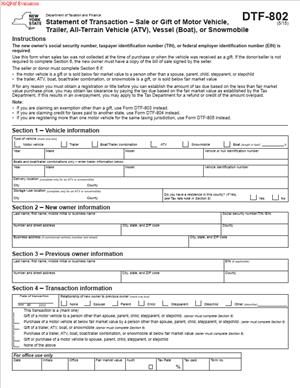
DTF-802 – Statement of Transaction – Sale or Gift of Motor Vehicle, Trailer, All-Terrain Vehicle (ATV), Vessel (Boat), or Snowmobile
Fill out nowJurisdiction: Country: United States | Province or State: New York
If you are transferring ownership of a vehicle or similar property in New York, you may need to complete the DTF-802 – Statement of Transaction – Sale or Gift of Motor Vehicle, Trailer, All-Terrain Vehicle (ATV), Vessel (Boat), or Snowmobile. This document records key details about the transaction for tax purposes.
You fill out this form when a car, trailer, ATV, boat, or snowmobile is sold or given as a gift. It helps clarify the purchase price, whether any money changed hands, and whether sales tax applies.
This form is often completed at the time of registration or title transfer. It supports the information shown on the title and bill of sale. State agencies use it to determine the correct tax treatment of the transfer.
If you are representing yourself and preparing to submit paperwork, this form plays a central role. Understanding what it asks for makes the registration process smoother and reduces the chance of delays.
What is DTF-802 – Statement of Transaction – Sale or Gift of Motor Vehicle, Trailer, All-Terrain Vehicle (ATV), Vessel (Boat), or Snowmobile?
Clear definition
DTF-802 – Statement of Transaction – Sale or Gift of Motor Vehicle, Trailer, All-Terrain Vehicle (ATV), Vessel (Boat), or Snowmobile is a tax-related document used in New York when ownership of certain vehicles or vessels changes hands. It reports the details of the transfer to the state’s tax authority.
The form identifies the buyer and seller, describes the property being transferred, and states the sale price or explains why no payment was made. It is designed to calculate or confirm the amount of sales tax due, if any.
This document is separate from the certificate of title. The title proves ownership. The DTF-802 form explains the financial side of the transaction.
Who typically uses this form?
You may use this form if you are buying or receiving a vehicle, trailer, ATV, boat, or snowmobile in New York. Buyers most often complete and submit it as part of the registration process.
Sellers may also be involved. They may need to provide information about the sale price or confirm that the transfer was a gift.
Family members transferring vehicles between each other commonly use this form. Executors of estates and individuals handling inherited property may also encounter it.
Why might you need this form?
You need this form when registering a transferred vehicle and the state requires proof of the transaction details. It helps determine whether sales tax is due and, if so, how much.
If the sale price is lower than the vehicle’s estimated market value, the form allows you to explain the reason. For example, the vehicle may have damage or mechanical problems.
If the transfer is a gift, the form allows you to declare that no money was exchanged. This affects how the transaction is treated for tax purposes.
Without this completed document, the registration process may be paused. Missing or unclear information can delay issuance of plates or a new title.
Typical real-life scenarios
- You buy a used car from a private seller. There is no dealership involved. When you go to register the car, you complete the form to report the purchase price and calculate the sales tax due.
- You receive a vehicle from a parent as a gift. No money changes hands. The form is used to document that the transfer was a gift and not a sale.
- You purchase a boat at a price below its typical market value because it needs repairs. The form gives you space to explain why the price is lower than expected.
- You inherit a snowmobile from a relative’s estate. During the title transfer process, the form may be used to clarify the nature of the transfer and whether tax applies.
When would you use DTF-802 – Statement of Transaction – Sale or Gift of Motor Vehicle, Trailer, All-Terrain Vehicle (ATV), Vessel (Boat), or Snowmobile?
You use this form when ownership of a covered vehicle or vessel changes and you are registering it in New York. The most common moment is during the application for a new title or registration.
If you bought the property in a private sale, this form often accompanies the title certificate and bill of sale. It provides the financial details that are not fully captured elsewhere.
If the transfer is between family members, especially as a gift, this form is used to explain the relationship and the absence of payment. This helps clarify tax treatment.
If you are transferring property out of an estate, you may use this form as part of the paperwork submitted during registration. It supports the explanation of how ownership passed to you.
Dealership sales are often handled differently because dealers typically collect and report sales tax directly. In private transactions, the buyer usually reports the details using this form at the time of registration.
Legal characteristics of DTF-802 – Statement of Transaction – Sale or Gift of Motor Vehicle, Trailer, All-Terrain Vehicle (ATV), Vessel (Boat), or Snowmobile
This document is a tax reporting form. Its effectiveness depends on accurate and complete information. Names, addresses, vehicle identification numbers, and financial details must match the accompanying documents.
The form generally becomes effective when it is signed and submitted as part of a registration or title application. The information provided is treated as a declaration of the facts surrounding the transaction.
Common reasons for rejection include missing signatures, incomplete sections, inconsistent sale prices, or mismatched vehicle identification numbers. If the sale price listed on the form differs from other documents without explanation, it may raise questions.
In some cases, the state may review the reported sale price if it appears significantly lower than market value. The form provides space to explain circumstances such as damage or mechanical issues.
This document does not transfer ownership by itself. The title certificate handles ownership. The form also does not act as a bill of sale, although it may support one.
While tax rules can vary between states, this form is specific to New York. Other states have their own reporting documents for similar transactions.
Is it legally binding?
When you sign the form, you are declaring that the information provided is true and accurate to the best of your knowledge. In that sense, it carries legal weight.
The form itself is not a contract between buyer and seller. It does not create the sale. Instead, it records the details of a transaction that has already occurred.
Because it is a signed declaration submitted to a state agency, inaccurate information can lead to penalties or further review. Its binding effect relates to the truthfulness of the statements made on it, not to the underlying agreement between the parties.
How to fill out DTF-802 – Statement of Transaction – Sale or Gift of Motor Vehicle, Trailer, All-Terrain Vehicle (ATV), Vessel (Boat), or Snowmobile
Step 1 – Identify the vehicle or vessel
Start by entering the details of the property being transferred. This typically includes the year, make, model, and vehicle identification number. For boats or snowmobiles, include the hull identification number or other required identifier.
Check these numbers carefully against the title. Even a small error can delay processing.
Step 2 – Provide buyer information
Enter your full legal name and current address as the buyer or recipient. Use the same name that appears on your registration and title application.
Make sure your address is complete and accurate. This information connects the transaction to your registration record.
Step 3 – Provide seller or donor information
Fill in the seller’s or donor’s full legal name and address. This should match the information shown on the title certificate.
If more than one person is listed as owner on the title, confirm that the names are reflected correctly. Consistency across documents helps avoid questions.
Step 4 – State the purchase price or gift status
If you paid for the vehicle or vessel, enter the full purchase price. Use the actual amount paid, not an estimated value.
If the transfer was a gift, indicate that no payment was made. The form includes a section to clarify that the transaction was a gift rather than a sale.
Step 5 – Explain a price that differs from market value
If the sale price is lower than expected for that type of vehicle, use the explanation section to describe why. For example, note any major damage, high mileage, or mechanical issues.
Be clear and factual. Provide enough detail to explain the difference without adding unnecessary information.
Step 6 – Indicate any trade-in or additional considerations
If part of the transaction involved a trade-in or other exchange of value, report those details in the appropriate section. Include the value assigned to any traded property.
Ensure the numbers align with the overall purchase price and related documents.
Step 7 – Review tax-related questions
The form may include questions about exemptions or special circumstances. Read each question carefully before answering.
Answer based on the facts of your transaction. Double-check that your responses match the type of transfer you described earlier in the form.
Step 8 – Sign and date the form
Sign the form where indicated. The signature confirms that the information provided is accurate.
Enter the date of signing. Make sure the date aligns reasonably with the date of sale or transfer shown on the title and related paperwork.
After completing these steps, review the entire document once more for missing fields or inconsistencies. A careful final check can help prevent delays during submission.
Legal terms you might encounter in DTF-802 – Statement of Transaction – Sale or Gift of Motor Vehicle, Trailer, All-Terrain Vehicle (ATV), Vessel (Boat), or Snowmobile
- Fair Market Value (FMV): This is the price the vehicle or vessel would reasonably sell for between a willing buyer and seller. On this form, FMV matters when the purchase price is unusually low or when the transfer is a gift. You may need to explain why the price differs from market value to determine the correct tax treatment.
- Consideration: Consideration means anything of value exchanged in the transaction. It can be money, a trade-in vehicle, services, or the assumption of a loan. This form asks about consideration because sales tax is generally based on the total value exchanged, not just cash paid.
- Gift Transfer: A gift transfer occurs when the vehicle or vessel is given without payment. On this document, you must clearly indicate that no money or other consideration was received. The form helps determine whether sales tax applies or if an exemption may be available.
- Trade-In Allowance: This is the value credited to you when you trade in another vehicle as part of the deal. The form may ask you to state the trade-in amount. That amount can affect how taxable value is calculated.
- Sales Tax Due: This is the amount of tax owed based on the transaction details. The information you provide on this document helps determine how much tax must be paid before registration or title transfer is completed.
- Lien: A lien is a legal claim against the vehicle for unpaid debt, usually from a lender. While this form focuses on the transaction value, any existing lien may affect the overall transfer process. If a loan is being assumed, that can count as consideration.
- Purchase Price: This is the total amount agreed upon for the sale. On this form, you must state the actual purchase price. It should match any bill of sale or title endorsement to avoid delays.
- Exemption: An exemption is a legal reason why sales tax may not apply. For example, certain family gifts may qualify. You must indicate the specific reason for claiming an exemption and ensure it matches the facts of your transaction.
- Relationship of Parties: This refers to how the buyer and seller are connected, such as parent and child or spouses. The relationship can matter when claiming a gift or reduced tax treatment. The form may require you to state this relationship clearly.
FAQs
Do I always need to submit this form when transferring a vehicle or boat?
You typically use this document when the purchase price is not clearly stated on the title or when the transaction is a gift. If the title already shows the full purchase price and there are no unusual circumstances, you may not need it. Check whether the title transfer paperwork leaves any gaps about the amount paid or whether tax must be calculated based on additional details.
What if the purchase price is much lower than the vehicle’s market value?
If you enter a price that seems far below fair market value, you should be prepared to explain why. For example, the vehicle may have major damage or mechanical issues. This form gives you space to describe those facts. In some cases, tax may be based on market value instead of the listed price if the explanation is not sufficient.
How do I report a gift on the DTF-802 – Statement of Transaction – Sale or Gift of Motor Vehicle, Trailer, All-Terrain Vehicle (ATV), Vessel (Boat), or Snowmobile?
You must clearly indicate that the transfer is a gift and that no money or other consideration was received. State the relationship between you and the other party if requested. Make sure the title and any bill of sale are consistent with what you report on the form. If money changed hands, even a small amount, it may not qualify as a true gift.
What counts as “consideration” besides cash?
Consideration includes anything of value. This can be a trade-in vehicle, forgiveness of a debt, or taking over an existing loan. If the buyer agrees to assume a loan balance, that amount can affect how tax is calculated. You should report all parts of the deal so the taxable amount is accurate.
Who must sign this form?
The buyer usually signs to certify that the information about the transaction is true. In some situations, the seller may also need to sign, especially if confirming that the transfer was a gift. Check the signature lines carefully and make sure the names match the title and identification documents exactly.
What happens if the information on this form does not match the title?
Inconsistent information can delay the title transfer. For example, if the purchase price on the title differs from what you report here, the agency processing the paperwork may ask for clarification. That can mean additional forms or written explanations before registration is completed.
Does this form change the ownership record by itself?
No. This document supports the title transfer process, but it does not transfer ownership on its own. Ownership changes when the title is properly assigned and accepted. This form helps determine the correct tax and validates the transaction details.
What should I double-check before submitting the DTF-802 – Statement of Transaction – Sale or Gift of Motor Vehicle, Trailer, All-Terrain Vehicle (ATV), Vessel (Boat), or Snowmobile?
Confirm the vehicle identification number, purchase price, and date of sale. Make sure the buyer’s and seller’s names match the title exactly. Review any explanations for low price or gift status to ensure they are clear and complete. An incomplete or unsigned document can delay processing.
Checklist: Before, During, and After DTF-802 – Statement of Transaction – Sale or Gift of Motor Vehicle, Trailer, All-Terrain Vehicle (ATV), Vessel (Boat), or Snowmobile
Before
- Gather the original title and confirm it is properly assigned.
- Confirm the vehicle identification number matches the vehicle.
- Agree in writing on the full purchase price or confirm gift status.
- Determine whether any loan balance will be paid off or assumed.
- Collect details about any trade-in involved in the deal.
- Verify the correct legal names of buyer and seller.
- Check whether you may qualify for a tax exemption.
- Have identification ready for registration or title transfer.
During
- Enter the full vehicle or vessel description accurately.
- Write the exact purchase price without rounding.
- Disclose all consideration, including trade-ins or loan assumptions.
- Clearly mark if the transfer is a gift.
- Provide a clear explanation if the price is below market value.
- Double-check spelling of all names.
- Review every field before signing.
- Sign and date the form where required.
After
- Make copies of the completed document for your records.
- Attach the form to the title transfer paperwork.
- Submit all required documents together.
- Pay any calculated sales tax or fees.
- Keep proof of payment with your records.
- Confirm that the title transfer has been processed.
- Store the final stamped or accepted copy in a safe place.
- Update your insurance and personal records to reflect the change.
Common mistakes to avoid with DTF-802 – Statement of Transaction – Sale or Gift of Motor Vehicle, Trailer, All-Terrain Vehicle (ATV), Vessel (Boat), or Snowmobile
- Mistake: Listing a lower purchase price to reduce tax, which happens when parties try to save money, can trigger review or reassessment, and you must not forget that tax may be recalculated based on market value.
- Mistake: Forgetting to disclose a trade-in or loan assumption, often because you focus only on cash paid, can result in incorrect tax calculation, and you must not forget to include all consideration.
- Mistake: Marking the transfer as a gift when money changed hands, which happens in informal family sales, can lead to penalties, and you must not forget that even small payments may disqualify gift status.
- Mistake: Misspelling names or using nicknames, often due to rushing, can delay processing, and you must not forget to match the title and identification exactly.
- Mistake: Leaving explanation sections blank when the price is far below market value, which happens when you assume it is obvious, can cause follow-up requests, and you must not forget to provide clear details.
- Mistake: Failing to sign and date the form, often overlooked at the end, can invalidate the document, and you must not forget to review all signature lines before submission.
- Mistake: Submitting incomplete paperwork without attaching this form when required, which happens if you misunderstand the instructions, can stall the title transfer, and you must not forget to include it with the full packet.
- Mistake: Providing a vehicle identification number that does not match the title, often due to a typo, can create serious processing issues, and you must not forget to verify the number character by character.
What to do after filling out DTF-802 – Statement of Transaction – Sale or Gift of Motor Vehicle, Trailer, All-Terrain Vehicle (ATV), Vessel (Boat), or Snowmobile
Once you complete the form, your next goal is to make sure the ownership transfer and tax process move forward without delays. Organization matters here. Small oversights can slow everything down.
Start by reviewing the entire document one more time. Look at each number, each name, and each date. Make sure the information matches the title and any bill of sale exactly.
- Step 1: Make at least two clear copies of the signed form, one for you and one for the other party.
- Step 2: Attach the completed form to the title certificate and any supporting documents, such as a bill of sale or lien release.
- Step 3: Confirm the total amount of sales tax due based on the transaction details you provided.
- Step 4: Prepare payment for any required tax and registration fees.
- Step 5: Submit the full document package through the appropriate filing method, ensuring nothing is missing.
- Step 6: Obtain proof that your paperwork was received, such as a receipt or stamped copy.
- Step 7: Monitor the status of the title transfer until you receive confirmation that it has been processed.
- Step 8: Store the finalized documents, including proof of tax payment, in a secure location.
- Step 9: Update your insurance policy to reflect the new ownership or removal of the vehicle.
- Step 10: Keep records of the transaction details for future reference, especially for tax or resale purposes.
If you are the buyer, confirm that the title is issued in your name once processing is complete. Check that all information is correct. If you are the seller, keep your copy of the form and proof of transfer in case questions arise later about taxes or liability.
Careful follow-through protects you. When your paperwork is accurate and complete, the transfer process is smoother, and you reduce the risk of future disputes or unexpected tax issues.
Disclaimer: This guide is provided for informational purposes only and is not intended as legal advice. You should consult a legal professional.