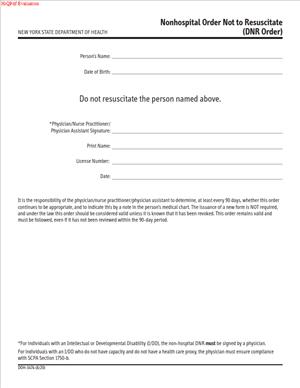
DOH-3474 – Nonhospital Order Not to Resuscitate (DNR Order)
Fill out nowJurisdiction: Country: United States | Province or State: New York
The DOH-3474 – Nonhospital Order Not to Resuscitate (DNR Order) is a medical form used in New York to state that you do not want cardiopulmonary resuscitation, often called CPR, if your heart stops or you stop breathing outside a hospital setting. It is issued through a healthcare professional and is recognized by emergency medical services.
This document is designed for use in homes, nursing facilities, hospice settings, and other nonhospital locations. It tells emergency responders not to attempt CPR if a cardiac or respiratory arrest occurs.
If you are about to fill out this form, you are likely thinking ahead about medical decisions. You may be living with a serious illness, advanced age, or a condition where CPR would not align with your wishes.
Understanding this form helps you avoid confusion during an emergency. Clear documentation can reduce uncertainty for your family and for first responders.
What is DOH-3474 – Nonhospital Order Not to Resuscitate (DNR Order)?
Clear definition
The DOH-3474 – Nonhospital Order Not to Resuscitate (DNR Order) is a physician or authorized practitioner order directing that CPR not be performed if your heart stops beating or you stop breathing outside a hospital.
CPR can include chest compressions, electric shocks, intubation, and assisted ventilation. This form specifically addresses those life-saving measures in an emergency.
It is not the same as a general advance directive. It focuses only on resuscitation in nonhospital settings and must be completed and signed by a qualified healthcare professional to be valid.
Who typically uses this form?
People with advanced chronic illnesses often use this document. That may include individuals with late-stage cancer, severe heart or lung disease, or progressive neurological conditions.
Older adults who have discussed end-of-life preferences with their doctors may also choose this form. Some people in hospice or long-term care settings use it as part of their care plan.
In certain cases, a legally authorized decision-maker completes the process on behalf of someone who lacks decision-making capacity. That person may be a healthcare proxy, legal guardian, or close family member, depending on the situation.
Why might you need this form?
You might need this form if you want to avoid aggressive emergency treatment that is unlikely to improve your quality of life. CPR can be physically traumatic and may not be effective in frail or seriously ill patients.
This document gives clear instructions to emergency medical personnel. Without it, responders are generally trained to attempt resuscitation.
It can also reduce emotional strain on loved ones. When your wishes are documented, family members are less likely to face urgent decisions in a crisis.
Typical real-life scenarios
- You are receiving hospice care at home. Your care plan focuses on comfort rather than life-prolonging treatment. This form communicates that focus to emergency responders.
- You live in a nursing home and have multiple serious medical conditions. Your doctor has discussed the limited benefit of CPR in your situation. You decide you do not want resuscitation attempts.
- You have a progressive neurological disease and want to control how medical interventions are handled in later stages. This document becomes part of your broader advance care planning.
- A family member is acting as healthcare proxy for a loved one who cannot communicate. After discussions with medical providers, the proxy agrees that CPR would not align with the patient’s known wishes. The form formalizes that decision.
When would you use DOH-3474 – Nonhospital Order Not to Resuscitate (DNR Order)?
You would use this form when you want your “do not resuscitate” instruction to apply outside a hospital. In a hospital, separate internal orders are typically used. This document is for homes, assisted living facilities, skilled nursing facilities, and similar settings.
It is often completed after a serious diagnosis or during advance care planning. A physician, nurse practitioner, or other authorized practitioner discusses your medical condition and prognosis with you or your decision-maker.
Emergency medical technicians rely on clear, visible medical orders. In the absence of this document, they may be required to start CPR. The form helps ensure that your wishes are honored during emergency transport or at the scene.
If you move between care settings, such as from a hospital to home, this form may be part of your discharge planning. It bridges the gap between inpatient orders and community-based care.
Legal characteristics of DOH-3474 – Nonhospital Order Not to Resuscitate (DNR Order)
This document is a medical order, not just a personal statement. That distinction matters. It must be signed by an authorized healthcare professional to take effect.
For the form to be valid, it typically includes identifying information, confirmation of the DNR instruction, and the required signatures. Missing signatures or incomplete fields can create confusion during an emergency.
Clarity is critical. If the document is altered, damaged, or illegible, responders may question whether it is valid. In urgent situations, ambiguity can lead to resuscitation efforts being started.
Different states have their own versions of nonhospital DNR orders. While the general purpose is similar across jurisdictions, recognition may vary outside New York. If you travel or relocate, separate documentation may be required.
This form does not address other treatments. It does not automatically refuse hospitalization, antibiotics, pain management, or feeding tubes. It applies only to CPR in the event of cardiac or respiratory arrest.
Is it legally binding?
When properly completed and signed by an authorized healthcare professional, this document is generally treated as a binding medical order in nonhospital settings within New York.
Emergency responders and other healthcare providers are expected to follow valid medical orders. That includes a properly executed DNR order presented at the time of the emergency.
However, if the form is not available, cannot be verified, or appears incomplete, responders may proceed with CPR. The effectiveness of the document depends on correct completion and accessibility during an emergency.
How to fill out DOH-3474 – Nonhospital Order Not to Resuscitate (DNR Order)
Step 1 – Review the purpose with a healthcare professional
Start by discussing your medical condition and goals of care with a physician or other authorized practitioner. The form is not completed in isolation. It reflects a medical decision based on your health status and preferences.
During this conversation, clarify what CPR involves and what outcomes are realistic in your case. Make sure your questions are answered before moving forward.
Step 2 – Confirm the patient’s identity and information
Provide the patient’s full legal name and other identifying details requested on the form. This may include date of birth or other information that helps emergency personnel confirm identity.
Accurate information reduces the risk of confusion, especially in shared living environments or facilities with multiple residents.
Step 3 – Indicate the DNR order
The form includes a clear statement that CPR is not to be initiated in the event of cardiac or respiratory arrest. Review this section carefully so you understand exactly what is being ordered.
This section reflects the core instruction of the document. It is specific to resuscitation and does not automatically limit other treatments.
Step 4 – Obtain the authorized practitioner’s signature
An authorized healthcare professional must sign the form for it to be valid. The signature confirms that the DNR order is a medical decision, not just a personal request.
The practitioner may also include a license number, date, and contact information. These details support the authenticity of the order.
Step 5 – Include consent from the patient or decision-maker if required
If you have decision-making capacity, your consent is typically part of the process. If you do not, a legally recognized surrogate may provide consent according to established priority rules.
The form may reflect who made the decision and in what capacity. Clear documentation helps prevent later disputes.
Step 6 – Distribute and store the completed form properly
After completion and signing, keep the original form in a location that is easy to access during an emergency. Common practice includes placing it in a visible area in the home or in the medical record at a facility.
Inform caregivers, family members, and facility staff that the document exists and where it is kept. Emergency responders must be able to locate it quickly for it to guide their actions.
Legal terms you might encounter in DOH-3474 – Nonhospital Order Not to Resuscitate (DNR Order)
- Cardiopulmonary Resuscitation (CPR): CPR refers to emergency medical procedures used to try to restart your heart or breathing if they stop. On this document, CPR is the specific treatment you are refusing. The order tells emergency personnel not to perform chest compressions, electric shocks, or assisted breathing if your heart or lungs stop.
- Attending Practitioner: This is the licensed healthcare professional authorized to issue the order. It may be a physician or another qualified practitioner allowed under state rules. Their name, signature, and credentials must appear on the form for it to be valid.
- Consent: Consent means agreement to the DNR order. If you have decision-making capacity, you provide consent yourself. If you do not, a legally authorized decision-maker may provide consent based on your known wishes or best interests.
- Decision-Making Capacity: This refers to your ability to understand your medical condition and the consequences of accepting or refusing CPR. The practitioner assesses whether you can make this decision. If you lack capacity, someone legally authorized may act for you.
- Health Care Proxy: A health care proxy is a person you previously appointed in writing to make medical decisions if you cannot. If you have named one, that person may consent to a DNR order on your behalf. The practitioner may ask to see the proxy document before completing the form.
- Surrogate Decision-Maker: A surrogate is someone allowed by law to make medical decisions when you have not appointed a proxy. This may be a close family member. The surrogate’s authority must fit the legal order of priority.
- Nonhospital Setting: This term means any location outside a hospital. It includes your home, assisted living facility, nursing home, or public place. The order is specifically designed to guide emergency personnel in these settings.
- Revocation: Revocation means canceling the DNR order. You can revoke it at any time if you have capacity. This can often be done by telling medical staff you want CPR or by destroying the form.
- Portable Medical Order: This describes a medical order that travels with you. It is not limited to one facility. Emergency responders rely on it wherever you are located outside a hospital.
- Original Document: The original is the signed version issued by the practitioner. Emergency personnel often look for the original form or an approved bracelet or identifier. Keeping the original accessible is critical.
FAQs
Does the DOH-3474 – Nonhospital Order Not to Resuscitate (DNR Order) take effect immediately after it is signed?
In most cases, this form becomes effective once the authorized practitioner signs it. You should check that the signature and date are clearly written. If any required signature is missing, emergency personnel may not honor it.
Who must sign this document for it to be valid?
An authorized practitioner must sign the order. If you have decision-making capacity, you typically provide consent directly. If you do not, the legally authorized proxy or surrogate may need to confirm consent, and the practitioner records that authority on the form.
What happens if my name is spelled differently from my identification?
Your name on this document should match your legal name as closely as possible. Small differences can cause confusion in an emergency. Review the spelling of your full name, date of birth, and other identifiers before the practitioner signs.
Do I need witnesses when completing this form?
Witnesses are not always required for this type of medical order. What matters most is the practitioner’s signature and proper documentation of consent. Ask the practitioner if any additional signatures are needed in your situation.
Can I use this form if I already have a living will?
Yes. A living will explains your wishes, but this document is a medical order directed at emergency personnel. Make sure the instructions in both documents are consistent so there is no confusion about whether CPR should be performed.
Where should I keep the completed DOH-3474 – Nonhospital Order Not to Resuscitate (DNR Order)?
Keep the original in a place that emergency responders can easily find, such as on a refrigerator or near your bed. Tell family members and caregivers exactly where it is stored. If it is locked away, responders may not be able to follow it.
What if I change my mind after signing this document?
You can revoke the order if you have decision-making capacity. Tell your healthcare provider and anyone caring for you that you want CPR. Destroy copies of this form and request written confirmation in your medical record that the order has been canceled.
Does this document affect other medical treatments?
This form only addresses CPR if your heart or breathing stops. It does not automatically refuse other treatments like antibiotics, pain medication, or oxygen. Review the wording carefully so you understand what is and is not covered.
Checklist: Before, During, and After DOH-3474 – Nonhospital Order Not to Resuscitate (DNR Order)
Before
- Talk with your healthcare provider about your diagnosis and prognosis.
- Ask what CPR would likely involve in your specific condition.
- Review any existing advance directives for consistency.
- Confirm who has legal authority to consent if you cannot.
- Gather identification details such as your full legal name and date of birth.
- Locate any health care proxy or surrogate documentation.
- Discuss your wishes with close family members or caregivers.
During
- Carefully review each section of the form with the practitioner.
- Confirm your personal information is accurate and complete.
- Ensure the practitioner clearly indicates the DNR order.
- Verify that consent is properly documented.
- Check that the practitioner signs and dates the form.
- Ask questions about anything you do not understand.
- Request clarification about how emergency responders will recognize the order.
After
- Make several copies of the signed document.
- Place the original in an easily accessible location.
- Inform family and caregivers that the order is in effect.
- Provide copies to your primary care provider and specialists.
- Ask about obtaining an approved bracelet or identifier if available.
- Review the document periodically to confirm it still reflects your wishes.
- Replace the form if it becomes damaged or illegible.
Common mistakes to avoid with DOH-3474 – Nonhospital Order Not to Resuscitate (DNR Order)
- Mistake: Leaving out the practitioner’s signature because you assume verbal instructions are enough, which happens during rushed appointments, can result in emergency responders ignoring the order, so do not forget to confirm the signature and date are on the form.
- Mistake: Storing the original in a drawer or safe, which people do for protection, can prevent responders from finding it in time, so do not forget to place it somewhere visible and accessible.
- Mistake: Failing to review name and date of birth details, often due to simple oversight, can cause identity confusion in an emergency, so do not forget to double-check all personal information.
- Mistake: Not informing family members, which happens when conversations feel uncomfortable, can lead to conflict or 911 calls requesting CPR, so do not forget to clearly communicate your decision.
- Mistake: Assuming the order applies inside a hospital automatically, which is a common misunderstanding, can create gaps in care planning, so do not forget to discuss hospital policies separately with your provider.
- Mistake: Forgetting to update or revoke the form after changing your mind, often because life circumstances change gradually, can result in care you no longer want, so do not forget to formally cancel and destroy outdated copies.
- Mistake: Allowing the form to become damaged or unreadable, which can happen over time, may cause responders to question its validity, so do not forget to replace worn or faded copies.
- Mistake: Relying only on a living will and skipping this medical order, which happens when documents seem similar, can delay recognition by emergency personnel, so do not forget that this order serves a distinct purpose.
What to do after filling out DOH-3474 – Nonhospital Order Not to Resuscitate (DNR Order)
Once the form is complete and signed, your focus shifts to access and communication. An order that cannot be found or understood in an emergency may not be followed. Take practical steps to make your wishes clear and easy to honor.
- Step 1: Make at least three clear copies of the signed document. Keep the original in a safe but visible place.
- Step 2: Place the original in a standard, easy-to-find location in your residence, such as on the refrigerator or near your bed.
- Step 3: Tell close family members, caregivers, and anyone who might call emergency services that the order exists and where it is kept.
- Step 4: Provide a copy to your primary healthcare provider so it can be included in your medical record.
- Step 5: Give copies to any home health agency or long-term care facility involved in your care.
- Step 6: Ask your practitioner whether an approved bracelet or wallet card is available to signal that you have a DNR order.
- Step 7: Review your other advance care planning documents to ensure they align with this order.
- Step 8: Schedule a periodic review with your healthcare provider, especially if your health status changes.
- Step 9: If you revoke or update the order, immediately destroy old copies and notify everyone who received one.
- Step 10: Keep a simple written list of who has copies so you can update or retrieve them if needed.
These steps reduce confusion and increase the likelihood that your decision will be respected. Clear communication is as important as the signed document itself.
Disclaimer: This guide is provided for informational purposes only and is not intended as legal advice. You should consult a legal professional.