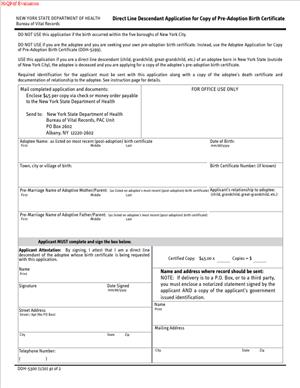
DHO-5300 – Direct Line Descendant Application for Copy of Pre-Adoption Birth Certificate
Fill out nowJurisdiction: Country: United States | Province or State: New York
The DHO-5300 – Direct Line Descendant Application for Copy of Pre-Adoption Birth Certificate is a formal request used in New York to obtain a copy of a person’s original birth certificate issued before adoption. This document is maintained by the New York State Department of Health.
If you are a direct line descendant of an adopted person, this form allows you to ask for access to that earlier record. A direct line descendant is typically a child, grandchild, or further descendant in a straight family line.
This form matters because pre-adoption birth certificates are generally sealed after an adoption is finalized. Access is limited. The application is a structured way to request that record when you meet the eligibility criteria.
When you are about to complete this form, you need to understand what information is required, how you prove your relationship, and what may delay or prevent processing. Clear and accurate completion helps avoid rejection or long delays.
What is DHO-5300 – Direct Line Descendant Application for Copy of Pre-Adoption Birth Certificate?
Clear definition
The DHO-5300 – Direct Line Descendant Application for Copy of Pre-Adoption Birth Certificate is an official application used to request a certified copy of an original birth certificate that was created before an adoption occurred. It applies only when the person whose record is requested was born in New York State and later adopted.
A pre-adoption birth certificate shows the birth information as originally recorded. This may include the birth name and, in many cases, the names of the biological parents as listed at the time of birth.
The form is not the birth certificate itself. It is the request document you submit so the appropriate office can determine whether you are entitled to receive the record.
Who typically uses this form?
You would use this form if you are a direct descendant of someone who was adopted and whose birth was registered in New York State. That often includes adult children or grandchildren of the adopted person.
In many cases, the adopted person is deceased, and a descendant is seeking family history information. The form may also be used when the adopted person is living, but the descendant is handling family documentation matters.
Genealogists acting on behalf of a family member may help gather information, but the actual applicant must qualify as a direct line descendant and provide proof of that relationship.
Why might you need this form?
You may need this form to clarify family history. A pre-adoption birth certificate can provide names, dates, and locations that are not available in other records.
Some people seek the record for personal identity reasons. Learning a biological family name or parent information can help you understand your background more fully.
Others need documentation for inheritance questions, citizenship matters, or estate administration. While the form itself does not resolve legal claims, the information in the birth record may support other processes.
In some situations, medical history is the primary reason. Biological family information can be important when assessing hereditary health risks.
Typical real-life scenarios
- You are the adult child of someone who was adopted decades ago in New York. Your parent has passed away, and you are compiling a complete family history. You want to request the original birth record to understand your biological lineage.
- You are a grandchild of an adopted individual. During estate planning discussions, questions arise about biological relatives. You apply for the pre-adoption birth certificate to clarify family connections.
- Your adopted parent is living but does not wish to handle paperwork. You assist them by completing the application as their direct descendant, providing the required documentation to show your relationship.
- You are researching your ancestry and have reached a point where records are incomplete. The adoption created a gap in the public record. You use the application process to request the original birth certificate and fill in that missing piece.
When would you use DHO-5300 – Direct Line Descendant Application for Copy of Pre-Adoption Birth Certificate?
You would use this form when the birth occurred in New York State, and the record you are seeking is the original certificate issued before adoption. It is not used for amended birth certificates created after adoption.
Timing often depends on your eligibility. If you can document that you are a direct line descendant, and the adopted person’s record is on file with the state, you may submit the application once you have gathered the required information and supporting documents.
You might also use the form when handling family administrative tasks. For example, an executor or family member organizing personal records may discover that the only available birth certificate is the amended post-adoption version and need the earlier one for historical completeness.
This form is specific to descendants. If you are not in a direct line relationship, a different request process may apply, or access may be restricted. The role you hold in the family determines whether this particular document is appropriate for your situation.
Legal characteristics of DHO-5300 – Direct Line Descendant Application for Copy of Pre-Adoption Birth Certificate
This application functions as a formal request to a government agency. It becomes effective when it is properly completed, signed, and submitted with any required identification and supporting documentation.
For the request to be processed, the information must match the records on file. Common reasons for rejection include incomplete fields, missing signatures, lack of proof of identity, or insufficient proof of direct lineage. If required fees are not included or are incorrect, processing may also be delayed.
In New York, adoption records have historically been sealed. Laws and policies may change over time, and eligibility standards can shift. The form reflects the current framework for descendants, but the agency still reviews each submission to confirm eligibility.
The document does not grant automatic access simply because it is filed. Approval depends on meeting the established criteria and providing adequate documentation. The agency verifies the relationship before releasing a copy of the pre-adoption birth certificate.
This application also does not change any legal status. It does not alter adoption records, amend names, or establish parental rights. It only initiates a request for a copy of an existing record.
Is it legally binding?
The application itself is not a contract between you and another private party. It is a sworn or certified request to a state agency. By signing it, you confirm that the information you provide is true and accurate to the best of your knowledge.
Your signature has legal significance because you are attesting to your identity and your relationship to the adopted person. Providing false information may carry legal consequences under general laws that apply to false statements on official documents.
Once approved, the issued birth certificate copy becomes an official record. That certified copy can be used in contexts where proof of birth information is required. The application, however, remains a request document rather than a binding agreement.
How to fill out DHO-5300 – Direct Line Descendant Application for Copy of Pre-Adoption Birth Certificate
Step 1 – Identify the person whose record you are requesting
Begin by entering the full name of the adopted person as it appeared at birth, if known. Include the date of birth and the place of birth in New York State. Provide as much detail as possible to help locate the correct record. If certain details are unknown, complete the fields to the best of your knowledge without guessing.
Step 2 – Provide information about the adoption, if requested
If the form asks for adoption-related details, such as the date of adoption or adoptive name, include accurate information. This helps the agency connect the amended record to the original birth certificate. Consistency between names and dates reduces processing delays.
Step 3 – Enter your personal information as the applicant
Fill in your full legal name, current address, and contact information. This is where the agency will send correspondence and, if approved, the certified copy. Make sure the information is current and legible.
Step 4 – Establish your direct line relationship
Complete the section that describes your relationship to the adopted person. Clearly state whether you are a child, grandchild, or further descendant. Be prepared to attach documentation that shows the chain of relationship, such as birth certificates linking each generation.
Step 5 – Provide proof of identity
Enter the details requested about your identification. The form may require you to list the type of government-issued identification you are submitting. Ensure that copies are clear and match the name provided on the application.
Step 6 – Review the fee and payment section
Locate the portion of the form that addresses the required fee. Indicate the amount enclosed and the method of payment, if applicable. Confirm that the payment matches the stated requirements to avoid rejection for incorrect fees.
Step 7 – Read the certification statement carefully
Before signing, read the certification language on the form. This section explains that you are affirming the truth of the information provided. Make sure every entry is accurate and complete before you proceed.
Step 8 – Sign and date the application
Sign your full legal name in the designated area. Add the date of signing. If the form requires notarization or a witness, follow the instructions in that section and ensure all required signatures are completed.
Step 9 – Assemble and submit the full package
Gather the completed application, copies of identification, proof of direct lineage, and the correct fee. Confirm that no sections are left blank unless instructed. Submit the full package to the appropriate office as directed on the form, and retain a copy of everything for your records.
Legal terms you might encounter in DHO-5300 – Direct Line Descendant Application for Copy of Pre-Adoption Birth Certificate
- Direct Line Descendant: This means you are biologically related in a straight line to the person whose pre-adoption birth certificate you are requesting. Examples include child, grandchild, great-grandchild, and so on. On this form, you must show that your relationship is direct, not through marriage or collateral relatives like siblings or cousins.
- Pre-Adoption Birth Certificate: This is the original birth certificate created before an adoption was finalized. After adoption, a new birth certificate is usually issued with the adoptive parents’ information. This document requests access to the earlier, original record.
- Adopted Person: The individual whose birth was originally recorded and later legally adopted. You will need to provide their identifying details, including name at birth (if known), date of birth, and place of birth. Accuracy here is critical for locating the correct record.
- Applicant: You are the applicant if you are completing and signing the form. The form requires your full legal name, contact information, and signature. You are responsible for ensuring all information is true and complete.
- Proof of Identity: This refers to documents that confirm who you are. The form typically requires a government-issued photo ID or other acceptable documentation. Without proper identification, your application may be rejected.
- Documentary Evidence of Lineage: These are records that prove your direct line relationship to the adopted person. Examples can include certified birth certificates showing parent-child links across generations. You must provide enough documentation to connect you step-by-step to the adopted person.
- Vital Record: A vital record is an official government record of a life event such as birth, death, marriage, or adoption. The pre-adoption birth certificate is considered a vital record. Access to these records is often restricted and controlled by law.
- Certified Copy: A certified copy is an official reproduction of a record that includes a seal or certification from the issuing authority. It is legally recognized as a true copy of the original record. If approved, you will typically receive a certified copy rather than a plain photocopy.
- Notarization: Some applications require your signature to be notarized, meaning a notary public verifies your identity and witnesses your signature. If notarization is required, signing before meeting with a notary can invalidate the application. Always check whether this step applies before signing.
FAQs
Do I need to know the adopted person’s original birth name to complete this form?
You should provide the original birth name if you know it, because it helps locate the correct record. If you do not know it, enter as much accurate information as you can, including date and place of birth. Leave unknown fields blank rather than guessing, and make sure the other identifying details are complete.
How do I prove I am a direct line descendant?
You must submit documents that connect you to the adopted person generation by generation. For example, your birth certificate should list your parents, and your parents’ birth certificate should list their parents, continuing back to the adopted person. Each document must clearly show names and relationships so the reviewer can follow the chain without gaps.
What if there is a name change due to marriage or another legal change?
If a name in your lineage documents does not match because of marriage or another legal change, include supporting records that explain the change. This may include a marriage certificate or court order. The key is to ensure the names across all documents can be logically connected.
Does the DHO-5300 – Direct Line Descendant Application for Copy of Pre-Adoption Birth Certificate require notarization?
You need to review the signature section carefully to see whether notarization is required. If it is, do not sign the form until you are in front of a notary. If it is not required, sign and date the form exactly as your name appears in your identification.
What happens if my documentation is incomplete?
If required documents are missing, the agency may delay processing or deny the request. You may receive a notice asking for additional proof. Respond promptly and send clear copies of the requested items to avoid restarting the process.
Will I automatically receive the record once I submit this document?
Submission does not guarantee approval. The agency will review your eligibility, identity, and proof of lineage before releasing any record. If approved, you will receive the certified copy; if not, you may receive a written explanation.
How long does it take to process this form?
Processing time varies depending on workload and the completeness of your submission. Applications with clear documentation and accurate information are usually handled more efficiently. Incomplete or unclear applications often take longer due to follow-up requests.
What does signing the DHO-5300 – Direct Line Descendant Application for Copy of Pre-Adoption Birth Certificate mean legally?
By signing, you are certifying that the information you provided is true and accurate to the best of your knowledge. You are also confirming that you are entitled to request the record as a direct line descendant. False statements can result in the denial of the request and potential legal consequences.
Checklist: Before, During, and After DHO-5300 – Direct Line Descendant Application for Copy of Pre-Adoption Birth Certificate
Before
- Confirm you qualify as a direct line descendant.
- Gather certified birth certificates linking each generation.
- Obtain any marriage or name change records needed to explain discrepancies.
- Secure a valid government-issued photo ID.
- Review the current fee amount and acceptable payment methods.
- Check whether notarization is required.
- Verify the adopted person’s date and place of birth.
- Make a list of all documents you plan to submit.
During
- Print clearly or type your responses if possible.
- Enter the adopted person’s information exactly as shown in the records.
- Provide complete contact information so you can be reached.
- Double-check spelling of all names.
- Attach copies of all required supporting documents.
- Complete the fee section accurately.
- Review the certification statement carefully.
- Sign and date the form correctly, following notarization rules if applicable.
After
- Make a full copy of the completed form and all attachments.
- Confirm that your payment method is included and correct.
- Submit the application using the approved method.
- Note the date you sent the package.
- Track delivery if you used a traceable mailing option.
- Watch for confirmation or follow-up correspondence.
- Respond promptly if additional documents are requested.
- Store the certified copy safely once received.
Common mistakes to avoid with DHO-5300 – Direct Line Descendant Application for Copy of Pre-Adoption Birth Certificate
- Mistake: Submitting incomplete lineage documents because you assume one birth certificate is enough; this happens when applicants underestimate proof requirements, which can lead to rejection or delay, so do not forget to provide a continuous chain of certified records.
- Mistake: Signing the form before notarization when notarization is required; this often occurs due to rushing, which can invalidate the application, so do not forget to wait and sign in front of the notary if instructed.
- Mistake: Misspelling names or entering inconsistent dates; this happens when copying from memory, which may cause record mismatches, so do not forget to verify every detail against official documents.
- Mistake: Failing to include payment or using an incorrect amount; this is common when fees change, which can stop processing entirely, so do not forget to confirm the exact fee before submitting.
- Mistake: Ignoring name changes due to marriage or court order; this happens when applicants overlook supporting documents, which creates confusion in the lineage chain, so do not forget to attach proof of every name change.
- Mistake: Sending original irreplaceable documents without necessity; this often occurs out of caution, which can risk loss of important records, so do not forget to send certified copies when acceptable and keep originals safe.
What to do after filling out DHO-5300 – Direct Line Descendant Application for Copy of Pre-Adoption Birth Certificate
Once you complete the form, pause before sending it. A careful final review can prevent weeks of delay. Read through every section slowly. Make sure each name, date, and place matches the supporting documents exactly.
- Step 1: Review the entire application for accuracy and completeness.
- Step 2: Confirm that all required supporting documents are attached in logical order.
- Step 3: Make a complete copy of the form, your identification, and all lineage documents.
- Step 4: Prepare the correct payment in the accepted format.
- Step 5: Place the application, copies of documents, and payment together in one package.
- Step 6: Submit the application using the approved submission method.
- Step 7: Record the submission date and any tracking information.
- Step 8: Monitor your mail and email for confirmation or requests for additional information.
- Step 9: Respond quickly if the agency asks for clarification or more documents.
- Step 10: Once you receive the certified copy, store it in a secure place with other vital records.
Keep your copies even after you receive the record. They provide proof of what you submitted and may be helpful if questions arise later. If you plan to use the certified copy for legal or personal matters, consider obtaining extra certified copies at the time of approval to avoid repeating the process.
Stay organized. A clear paper trail makes future requests easier and protects you if you need to demonstrate your direct line relationship again.
Disclaimer: This guide is provided for informational purposes only and is not intended as legal advice. You should consult a legal professional.