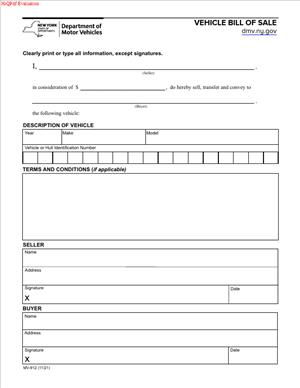
MV-912 – Vehicle Bill of Sale
Fill out nowJurisdiction: Country: United States | Province or State: New York
If you are buying or selling a vehicle in New York, the MV-912 – Vehicle Bill of Sale is one of the key documents you may need. It records the basic details of the transaction in writing. When you are standing at the counter to register a vehicle or transfer ownership, this is often the form that supports the paperwork.
The MV-912 – Vehicle Bill of Sale creates a clear record of who sold the vehicle, who bought it, and for how much. It also identifies the vehicle itself. This written record can help prevent confusion later.
You might be using this form as a private seller. You might also be the buyer trying to complete registration. Either way, you want to know exactly what information belongs on the form and why it matters.
This guide walks you through what the form is, when it is used, and how to complete it carefully. The goal is to help you understand what you are filling out before you sign.
What is MV-912 – Vehicle Bill of Sale?
Clear definition
The MV-912 – Vehicle Bill of Sale is a written document used in New York to record the sale of a motor vehicle. It captures the essential details of a transaction between a seller and a buyer.
At its core, the form confirms that ownership of a specific vehicle has been transferred. It states the purchase price and identifies the vehicle by its key characteristics, such as make, model, year, and vehicle identification number (VIN).
It is not a contract filled with complex terms. Instead, it functions as a straightforward record of the sale. That record can later be used during registration, title transfer, or tax assessment processes.
Who typically uses this form?
Private individuals most commonly use this form when selling or buying a vehicle without a dealership. For example, when you sell your car to a neighbor or purchase a used vehicle through a classified listing, this document often becomes part of the paperwork.
Buyers use it when applying for title and registration. The information in the form may be reviewed to confirm the sale price and calculate taxes or fees.
Sellers use it to document that they transferred the vehicle to someone else. Having a written record helps show when responsibility for the vehicle changed hands.
In some cases, estates, family members, or representatives handling a vehicle after a death may also complete this form as part of transferring ownership.
Why might you need this form?
You may need this form to support a title transfer. When a vehicle changes ownership, written proof of the transaction helps confirm that the transfer was legitimate.
The form also documents the purchase price. That amount may be relevant when determining applicable taxes during registration.
It can serve as personal proof of the terms of sale. If there is later disagreement about the price or the identity of the buyer or seller, the completed document provides a clear record.
In certain situations, it may be required when other documents do not fully reflect the sale details. For example, if a title is missing information about the purchase price, a separate bill of sale may clarify the transaction.
Typical real-life scenarios
- You sell your used car to a coworker. You both agree on a price and sign over the title. You also complete a bill of sale to document the agreed amount and the date of transfer.
- You purchase a vehicle from a private seller online. When you go to register the vehicle, you bring the signed title and a completed bill of sale to show how much you paid.
- A family member passes away and leaves a vehicle behind. The person handling the estate transfers the vehicle to another relative. A bill of sale records the transfer and the stated value.
- You buy an older vehicle that was previously registered in another state. During the registration process, you are asked for written confirmation of the sale price. A completed bill of sale helps provide that information.
- You sell a vehicle that has been sitting unused. Months later, you receive a notice connected to that vehicle. Your copy of the bill of sale shows the exact date you transferred ownership.
When would you use MV-912 – Vehicle Bill of Sale?
You would use this form at the time of a private vehicle sale. It is typically completed on or near the date when the seller hands over the vehicle and the buyer pays the purchase price.
It is often used alongside the vehicle title. While the title transfers legal ownership, the bill of sale records the financial terms and confirms the identities of both parties.
Buyers may use the completed form when applying for registration. The sale price listed can be reviewed as part of the filing process. This is especially relevant when the sale did not involve a dealership that would otherwise generate its own sales documents.
Sellers may use the form as part of their records. If questions arise about when they stopped owning the vehicle, the document provides a dated record of the transaction.
In some transactions, a bill of sale may be used even when ownership is transferred for little or no money. In those cases, the stated price reflects the nature of the transfer, and the document still records the change in possession.
You might also use this form if the title lacks space for certain details. The bill of sale can supplement the information provided on the title itself.
Legal characteristics of MV-912 – Vehicle Bill of Sale
A bill of sale becomes meaningful when it clearly identifies the parties, the vehicle, and the purchase price, and when it is signed by the seller. Accuracy and completeness are essential. Missing or incorrect information can delay registration or raise questions about the transaction.
Legibility matters. If handwriting is unclear or the VIN is incorrect, the document may not serve its intended purpose. Even a single digit error in the VIN can create problems.
The document is generally effective when both parties provide truthful and complete information. A false purchase price or incorrect vehicle description can create complications later.
Requirements may vary in detail depending on the type of vehicle. For example, cars, motorcycles, and certain other motor vehicles may all use similar forms, but supporting documents may differ.
It is important to understand what this form does not do. It does not replace the vehicle title. It does not, by itself, register the vehicle or issue license plates. It also does not guarantee the condition of the vehicle unless separate written terms are included elsewhere.
Is it legally binding?
A bill of sale is typically considered a legally binding record of a transaction when it contains the essential elements of a sale. These usually include identification of the parties, a description of the property, the purchase price, and signatures.
When both parties sign the document voluntarily, and the information is accurate, it generally serves as evidence that a sale occurred. It can be used to support claims about the agreed price or the date of transfer.
However, the document’s enforceability can depend on the surrounding circumstances. If there was fraud, misrepresentation, or lack of authority to sell the vehicle, the validity of the transaction itself may be questioned.
The form does not override other legal requirements. Proper title transfer and registration procedures must still be completed for ownership records to be updated.
How to fill out MV-912 – Vehicle Bill of Sale
Step 1 – Enter the date of sale
Start by writing the full date when the vehicle is sold. Use a clear format that includes the month, day, and year. This date marks the point when ownership and responsibility are transferred from the seller to the buyer.
Make sure the date reflects the actual transaction. Do not leave this section blank, as it establishes the timeline of the sale.
Step 2 – Provide the seller’s information
Enter the full legal name of the seller. Include the seller’s complete address, with street, city, state, and ZIP code.
The information should match the seller’s identification and the vehicle title. Consistency across documents helps avoid confusion during submission or review.
Step 3 – Provide the buyer’s information
Write the full legal name of the buyer. Include the buyer’s residential address in full.
Accuracy is important here because this information connects the vehicle to its new owner. Double-check spelling and address details before moving on.
Step 4 – Describe the vehicle
Enter the vehicle’s year, make, and model. Then provide the full vehicle identification number exactly as it appears on the vehicle and the title.
Copy the VIN carefully, character by character. Even a small error can create delays. Review the number at least once before finalizing the form.
Step 5 – State the purchase price
Write the total amount paid for the vehicle. Record the amount clearly in dollars.
The stated price should reflect the actual transaction. This figure may be used in later processing related to registration or tax assessment.
Step 6 – Sign the form
The seller signs the document to confirm that the information is accurate and that the vehicle has been sold to the named buyer. In many transactions, the buyer also signs to acknowledge the purchase.
Sign using your usual legal signature. Ensure that all required signature lines are completed before considering the form finished.
Step 7 – Review and make copies
Before separating, both parties review every section of the completed form. Confirm that names, VIN, date, and price are correct and legible.
After signing, each party keeps a copy for personal records. Having your own copy provides a clear record of the transaction date and agreed terms.
Legal terms you might encounter in MV-912 – Vehicle Bill of Sale
- Consideration: This is the value exchanged for the vehicle. On this form, it usually means the purchase price the buyer pays. Even if the vehicle is a gift, you must state the value given, which may be listed as zero or described as a gift, depending on the situation.
- Transfer of Ownership: This refers to the legal change from seller to buyer. This document supports that transfer by recording the date, price, and parties involved. It does not replace the title but works alongside it as proof of the transaction.
- Vehicle Identification Number (VIN): The VIN is the unique 17-character code assigned to the vehicle. On this form, you must enter it exactly as it appears on the vehicle and title. A single incorrect digit can delay registration or cause rejection.
- Odometer Disclosure: This records the vehicle’s mileage at the time of sale. Accurate mileage protects both parties. False or missing mileage information can create serious legal and financial issues.
- Lien: A lien is a legal claim against the vehicle by a lender or creditor. If a lien exists, it must be resolved before ownership can fully transfer. The buyer should confirm the title is clear before completing payment.
- As-Is Sale: This means the vehicle is sold in its current condition without guarantees. If the vehicle is sold “as is,” the buyer accepts responsibility for repairs after the sale. This term limits disputes about condition later.
- Seller Certification: This is the seller’s signed statement confirming that the information provided is true and accurate. By signing, the seller affirms they have the right to sell the vehicle.
- Buyer Acknowledgment: This confirms that the buyer agrees to the terms and details listed. The buyer’s signature shows acceptance of the vehicle and the recorded purchase price.
- Notarization: Some vehicle transactions require notarization to verify identities. While this document itself may not always require a notary, certain related paperwork might. You should confirm whether additional certification is needed for your situation.
- Registration: Registration is the process of officially recording the vehicle in the buyer’s name. This form helps support that process by providing proof of the sale price and transfer date.
FAQs
Do I need the MV-912 – Vehicle Bill of Sale if I am already signing over the title?
Yes. The title transfers ownership, but this document provides a separate written record of the sale price and date. It supports tax reporting and registration. Many buyers and sellers use both to protect themselves if questions arise later.
What date should I enter as the date of sale?
Enter the actual calendar date when payment was made and the vehicle changed hands. This date affects registration timing and possible tax calculations. Make sure the date matches any related documents, including the title assignment.
What if I made a mistake while filling out this form?
Do not use correction fluid or scribble over errors. It is better to complete a new copy so all information is clear and readable. Inconsistent or altered information can cause processing delays.
Does the purchase price need to match what I write on other documents?
Yes. The amount listed here should match the price shown on the title transfer and any tax documents. If the numbers differ, it may trigger questions or require additional explanation before registration is accepted.
Can I use this document for a vehicle that is being gifted?
Yes, but you must clearly indicate that the transfer is a gift and state the value as required. Even when no money changes hands, the form still records the transfer details and date.
What happens if the VIN on this document is wrong?
An incorrect VIN can prevent the buyer from registering the vehicle. Always compare the VIN on the vehicle itself with the title and this document before signing. Even one incorrect character can cause rejection.
Do both the buyer and seller need to sign on the same day?
They should sign on or very close to the date of sale. The signatures confirm agreement to the same terms and date. Delays between signatures can create confusion about when the transfer occurred.
Where do I submit this form after it is completed?
This document is typically presented during vehicle registration or retained with your records, depending on the transaction. Check what paperwork is required when you apply to register the vehicle so you bring the correct signed copy.
Checklist: Before, During, and After MV-912 – Vehicle Bill of Sale
Before
- Confirm the vehicle’s VIN directly from the dashboard or door frame.
- Verify the seller’s name matches the name on the title.
- Check whether there is an active lien on the vehicle.
- Agree in writing on the final purchase price.
- Confirm the current odometer reading.
- Review identification for both buyer and seller.
- Prepare a clean, blank copy of the form.
During
- Enter the full legal names of both parties.
- Write the complete and accurate VIN.
- Record the exact odometer reading.
- Enter the full purchase price without rounding.
- Double-check the date of sale.
- Review all entries together before signing.
- Have both parties sign clearly and legibly.
After
- Make at least two copies of the signed document.
- Provide the buyer with the original signed copy.
- Keep a copy with your personal records.
- Store the document with the vehicle title copy.
- Use the document when completing registration paperwork.
- Monitor confirmation of successful registration.
- Retain the document for tax reporting purposes.
Common mistakes to avoid with MV-912 – Vehicle Bill of Sale
- Mistake: Entering the wrong VIN because you copied it from memory instead of the vehicle, which leads to registration rejection and delays; always verify each character directly from the vehicle and the title before signing.
- Mistake: Listing a different purchase price than what appears on other paperwork, often due to informal side agreements, which can trigger tax issues or processing holds; do not forget to keep all documents consistent.
- Mistake: Forgetting to record the odometer reading at the time of sale, which happens when parties rush the transaction and can create disputes about mileage accuracy; make sure you write the exact reading before handing over the keys.
- Mistake: Allowing only one party to sign, usually because the other person is not present, which makes the document incomplete and potentially unusable; ensure both buyer and seller sign before finalizing.
- Mistake: Using nicknames instead of legal names, which causes mismatches with the title and identification documents; do not forget to write full legal names exactly as shown on ID.
- Mistake: Making handwritten corrections after signing, which raises authenticity concerns and may result in rejection; complete a new form instead of altering a signed one.
- Mistake: Leaving blank spaces on the form, often due to uncertainty about certain fields, which can allow later changes or create confusion; fill in every applicable section or clearly mark it as not applicable.
- Mistake: Failing to keep a personal copy, assuming the other party will store it, which leaves you without proof of the transaction if questions arise; always make and safely store your own copy.
What to do after filling out MV-912 – Vehicle Bill of Sale
Once the document is signed, your focus shifts to protecting your interests and completing the ownership transition properly. Do not treat the signing as the final step. The paperwork must support registration, tax reporting, and your records.
- Step 1: Make at least two clear copies immediately after signing.
- Step 2: Give the buyer the signed original unless you agree otherwise.
- Step 3: Attach your copy to a photocopy or scan of the signed title.
- Step 4: Confirm that the title assignment section is completed consistently with the sale details.
- Step 5: Remove your license plates if required and document the date of removal.
- Step 6: The buyer should prepare all required registration documents promptly.
- Step 7: Present the signed bill of sale when applying for registration if requested.
- Step 8: Keep proof of payment with your copy, such as a receipt or confirmation.
- Step 9: Store digital backups in a secure location.
- Step 10: Retain the document for several years in case of tax or ownership questions.
If you are the seller, monitor your records to ensure the vehicle is no longer associated with you. If you receive tolls, tickets, or notices after the sale date, your copy of the signed document helps demonstrate when the transfer occurred.
If you are the buyer, complete registration as soon as possible. Delays can lead to penalties or complications. Keep this document accessible until the vehicle is fully registered in your name and you receive official confirmation.
Treat this paperwork as part of your permanent vehicle history file. Organized records reduce stress and make future sales or disputes easier to manage.
Disclaimer: This guide is provided for informational purposes only and is not intended as legal advice. You should consult a legal professional.