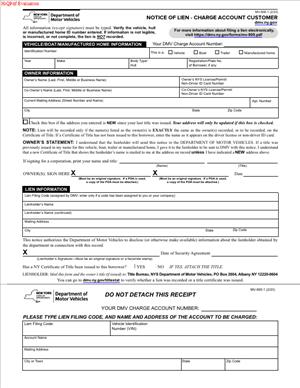
MV-900.1 – Notice of Lien – Change Account Customer
Fill out nowJurisdiction: Country: United States | Province or State: New York
The MV-900.1 – Notice of Lien – Change Account Customer is a New York Department of Motor Vehicles form used to update lien account information. It is part of the state’s vehicle title and lien recording system. If you work with vehicle financing or title liens, this document helps keep official records accurate.
When a lien is recorded on a vehicle title, the DMV keeps information about the lienholder and the related customer account. If that account information changes, the DMV needs written notice. This form is used to report that change.
You may encounter this form if you are part of a lending institution, financing company, or business that files liens electronically or in bulk. It is generally not used by individual vehicle owners.
Accurate lien records matter. They affect title status, vehicle sales, loan payoffs, and releases of lien. If account information is outdated, it can delay processing or create confusion about who holds a security interest in a vehicle.
Understanding what this form does makes the completion process easier. It is designed to update account-level information, not to create or release a specific lien.
What is MV-900.1 – Notice of Lien – Change Account Customer?
Clear definition
The MV-900.1 – Notice of Lien – Change Account Customer is a formal notice submitted to the New York DMV to report a change in the customer information associated with a lien account. A lien account is typically used by lenders or businesses that regularly file liens against vehicle titles.
This document does not create a new lien. It does not remove a lien. Instead, it updates the account details that the DMV uses to manage and process lien-related transactions.
The form helps ensure that communications, title documents, and lien-related correspondence are directed to the correct entity. It keeps the administrative side of lien filing accurate and current.
Who typically uses this form?
This form is most often used by financial institutions, credit unions, auto finance companies, and other secured lenders. These entities may maintain lien accounts with the New York DMV to file and manage liens efficiently.
Large dealerships that provide in-house financing may also use this form if they maintain lien accounts. In some cases, service providers acting on behalf of lenders may complete and submit the document.
Individual vehicle owners generally do not use this form. If you are a private seller or buyer, this document is usually not part of your paperwork.
Why might you need this form?
You may need this form if the legal name of your business changes. For example, if a company rebrands or merges and operates under a new name, the DMV’s lien account records must reflect that change.
You might also use this form if your mailing address for lien correspondence changes. This ensures that titles, notifications, and other documents are sent to the correct location.
Another reason is a change in account ownership or structure. If one business entity transfers its lien account responsibilities to another related entity, the DMV must be notified.
Using the correct form for account changes helps prevent delays in lien filings, releases, or title processing.
Typical real-life scenarios
- A regional bank merges with another bank and adopts a new legal name. The bank continues to finance vehicles in New York. It files this form to update the DMV’s lien account to reflect the new name so future title documents show accurate lienholder information.
- An auto finance company moves its lien processing department to a new address. Without updating the account, lien releases and title notices could be mailed to the old location. Submitting this form aligns DMV records with the company’s current contact details.
- A credit union restructures its operations and assigns lien processing to a newly formed subsidiary. The subsidiary now manages vehicle liens. The form is used to change the account customer information associated with those filings.
- A dealership that finances its own vehicle sales changes its business entity type, such as from a sole proprietorship to a corporation. The dealership updates its lien account customer information to match its new legal structure.
When would you use MV-900.1 – Notice of Lien – Change Account Customer?
You would use this form when the identifying information tied to an existing DMV lien account changes. This often involves changes at the business level rather than changes related to a specific vehicle.
If your organization already has a lien account with the New York DMV and something about the account holder changes, this document is part of the administrative update process. Common changes include business name, address, or organizational structure.
You may also use it during corporate transitions. Mergers, acquisitions, and reorganizations can affect how lien accounts are listed in state records. Updating the account helps maintain continuity in title and lien processing.
In practice, this form is used by compliance departments, title processing units, or administrative staff within lending institutions. It is usually completed as part of internal record updates to ensure external filings match current corporate details.
This form is not typically used for correcting errors on a single title. It relates to the broader account used to file and manage multiple liens.
Legal characteristics of MV-900.1 – Notice of Lien – Change Account Customer
This document functions as an official notice to a state agency. Its effectiveness depends on accurate and complete information. The DMV relies on the details provided to update its internal records.
For the filing to be processed, the information must match existing DMV records for the lien account. Inconsistent account numbers, incorrect business names, or missing signatures commonly cause delays or rejection.
The form must be completed clearly. Illegible entries or incomplete sections can prevent the DMV from making the requested update. Supporting documentation may be required in some situations, such as proof of a legal name change.
Jurisdictional practices can differ from state to state. In New York, lien recording and account management are handled through the DMV’s established procedures. Other states may use different forms or systems, but the purpose is similar: maintaining accurate lienholder information.
This form does not transfer ownership of a vehicle. It does not release a lien. It does not resolve disputes between a borrower and a lender. Its role is limited to updating account-level customer information in the DMV’s records.
Is it legally binding?
The form itself is not a contract between private parties. It is an official notice submitted to a government agency. Once accepted and processed, it updates the DMV’s records.
The information you provide is generally expected to be accurate and truthful. When an authorized representative signs the form, they confirm that the details reflect the current status of the lien account customer.
In that sense, the submission carries legal significance because state records are being updated based on the information provided. If the information is incorrect, it may lead to administrative issues or processing delays.
The legal effect is limited to the DMV’s records. It does not, by itself, change the underlying loan agreement or security agreement between a lender and a borrower.
How to fill out MV-900.1 – Notice of Lien – Change Account Customer
Step 1 – Review the existing lien account information
Begin by gathering the current details associated with your DMV lien account. This typically includes the existing account number, the current legal name on file, and the registered mailing address. Compare these records with your internal documents to confirm what information needs to be changed.
Understanding exactly what is changing helps you complete the form accurately and avoid unnecessary corrections.
Step 2 – Enter the lien account identification details
Locate the section of the form that asks for the lien account number or other identifying information. Enter this information exactly as it appears in DMV records. Even small differences in spelling or formatting can slow down processing.
This step connects your change request to the correct account in the DMV system.
Step 3 – Provide the updated customer information
In the designated section, enter the new or corrected information. This may include a revised legal business name, updated mailing address, or other customer details linked to the account.
Use the full legal name of the business, not a trade name, unless the form specifically allows otherwise. Ensure the address is complete, including any suite or department numbers used for lien processing.
Step 4 – Indicate the nature of the change
If the form includes a section to describe the reason for the update, clearly state the type of change. For example, note whether it is a legal name change, address update, or change due to a merger or reorganization.
Providing a clear explanation supports the administrative review process and helps the DMV understand the context of your submission.
Step 5 – Attach supporting documentation if required
In some cases, documentation may be needed to confirm the change. This can include records reflecting a legal name change or corporate restructuring. Review the form carefully to see whether attachments are requested.
Ensure that any supporting documents are consistent with the information entered on the form. Discrepancies between the form and attachments can delay acceptance.
Step 6 – Sign and date the form
An authorized representative of the lien account customer must sign the form. This person is typically someone with authority to act on behalf of the business in lien and title matters.
Print the signer’s name and title if the form requests it. Enter the date of signing clearly. The signature confirms that the information provided is complete and accurate to the best of the signer’s knowledge.
Step 7 – Submit the completed form to the appropriate office
Follow the submission instructions listed on the form. This may involve mailing the document or submitting it through an established account process with the New York DMV.
Before sending, review the entire document once more. Confirm that all required fields are filled in, the account number is correct, and the signature is present. This final review reduces the chance of processing delays.
Legal terms you might encounter in MV-900.1 – Notice of Lien – Change Account Customer
- Lien: A lien is a legal claim against a vehicle to secure payment of a debt. On this form, the lien already exists. You are not creating a new lien. You are updating who is listed as the lien account customer for DMV records.
- Lienholder: The lienholder is the lender or secured party that holds the legal claim against the vehicle. The name of the lienholder must match the official business name on file. Even small differences in spelling can cause delays.
- Lien Account Customer: This is the customer name associated with the lienholder’s account in the DMV system. It may reflect a business division, servicing entity, or updated legal name. This form changes the customer information without changing the underlying lien itself.
- Account Number: This is the identifying number assigned to the lienholder’s account with the agency. It is not the borrower’s loan number. You must enter the correct account number so the change applies to the right account.
- Secured Party: Another term for the lienholder. It refers to the party with a security interest in the vehicle. The secured party’s identity must stay consistent across all related filings.
- Change of Name: This refers to a legal name change of the lienholder or account customer. It may result from a merger, rebranding, or corporate restructuring. Supporting documentation may be required to prove the change.
- Assignment: An assignment is the transfer of a lien from one lender to another. This form does not assign the lien. It only updates the account customer information. If ownership of the lien changes, a different process is required.
- Effective Date: The effective date is the date the change becomes active in the records. You may need to indicate when the new customer information should apply. Make sure this date aligns with internal corporate records.
- Authorized Signer: This is the individual permitted to sign on behalf of the lienholder. The signer must have authority under the company’s policies. Signing without proper authority can invalidate the request.
- Record Update: A record update means the agency modifies its internal system to reflect new information. The update affects how the lienholder appears in searches and correspondence. It does not change the borrower’s debt terms.
FAQs
What exactly does MV-900.1 – Notice of Lien – Change Account Customer change?
It updates the lien account customer information connected to a lienholder’s account in the motor vehicle records. It does not change the vehicle owner, the borrower’s loan terms, or the existence of the lien itself. You are only correcting or updating the account details used by the agency to identify the lienholder.
Do I need to file this document if my company only changed its mailing address?
If the account customer information includes the mailing address and that address is now outdated, you may need to submit this document to ensure correspondence goes to the correct location. Check the current record and compare it to your new address. If the address is part of the account profile, update it so notices are not misdirected.
What information must match exactly when I complete this form?
The lienholder’s legal name and the assigned account number must match the agency’s existing records. Even small differences, such as missing punctuation or abbreviations, can cause processing delays. Confirm the exact name and number from prior correspondence or account documentation before you submit the form.
Can I use this form to transfer a lien to a different lender?
No. This document does not transfer ownership of the lien. It only updates the account customer information connected to an existing lienholder account. If the lien has been sold or assigned to another lender, a separate assignment process is required.
Who is allowed to sign this document?
An authorized representative of the lienholder must sign. This is usually an officer, manager, or employee with documented authority to act on behalf of the company. Before signing, confirm that internal policies allow you to certify changes to official lien records.
What happens after I submit the MV-900.1 – Notice of Lien – Change Account Customer?
The agency reviews the information and updates its records if everything is complete and accurate. Once processed, future records, titles, and correspondence should reflect the updated account customer information. If there is an error, the form may be returned, or the change may be delayed.
Do I need to notify vehicle owners when I update the account customer information?
This document typically updates internal account information rather than the terms of the lien. However, you should review your internal policies to determine whether borrower communication is required. The public record will reflect the updated lienholder account details once processed.
How can I confirm that the change was accepted?
You can confirm by checking updated records, reviewing official confirmation notices, or verifying that new titles and correspondence display the revised account customer information. Keep a copy of your submitted document so you can compare it with the updated record if questions arise.
Checklist: Before, During, and After MV-900.1 – Notice of Lien – Change Account Customer
Before
- Confirm the exact legal name of the lienholder on file.
- Locate the correct lien account number.
- Identify the specific changes you need to report.
- Gather supporting documents for name or structural changes.
- Verify who has the authority to sign the form.
- Review prior filings to ensure consistency.
- Check internal records for the correct effective date.
During
- Enter the lien account number accurately.
- Print the current lienholder name exactly as on record.
- Clearly state the updated customer information.
- Double-check spelling, punctuation, and spacing.
- Provide any required supporting details.
- Ensure the authorized signer completes the signature section.
- Date the form accurately.
- Review all fields before finalizing.
After
- Make a complete copy of the signed form.
- Submit the form using the approved filing method.
- Track the submission date.
- Monitor for confirmation or returned documents.
- Verify the updated information in official records.
- Store confirmation with corporate records.
- Update internal compliance logs.
- Notify relevant internal departments of the change.
Common mistakes to avoid with MV-900.1 – Notice of Lien – Change Account Customer
- Mistake: Entering the borrower’s loan number instead of the lien account number, which happens because both are called “account numbers,” and this can result in the change being applied incorrectly or rejected, so do not forget to verify you are using the agency-assigned lien account number.
- Mistake: Using an abbreviated or trade name instead of the full legal name, which often occurs after branding updates and can delay processing or cause mismatched records, so do not forget to confirm the exact registered name on file.
- Mistake: Leaving required sections blank because you believe they do not apply, which may lead to rejection or requests for clarification, so do not forget to review each field and mark it appropriately.
- Mistake: Having an unauthorized employee sign the form, which can invalidate the submission and require resubmission, so do not forget to confirm signing authority before filing.
- Mistake: Failing to attach documentation supporting a legal name change, which happens during mergers or restructures and can prevent approval, so do not forget to include proof if required.
- Mistake: Submitting the form but not keeping a copy, which creates problems if the agency cannot locate your filing, so do not forget to retain a complete, signed copy for your records.
- Mistake: Assuming the change is effective immediately upon mailing, which may cause internal record inconsistencies if processing takes time, so do not forget to wait for confirmation before updating all systems.
- Mistake: Ignoring small typographical errors, which often occur during data entry and can cause mismatched records in the system, so do not forget to carefully proofread every line.
What to do after filling out MV-900.1 – Notice of Lien – Change Account Customer
Once you complete the form, pause before sending it. Review it line by line. Make sure the lien account number and legal name are exact. Small errors can slow down processing.
- Step 1: Make at least one clear copy of the signed and dated form for your records.
- Step 2: Assemble any required supporting documents, such as proof of a legal name change or corporate restructuring.
- Step 3: Confirm the correct submission method, whether by mail or other approved channel.
- Step 4: Submit the form according to the official instructions and note the date you sent it.
- Step 5: Track delivery if you are mailing it, and keep proof of submission with your copy.
- Step 6: Wait for confirmation or check the updated records after a reasonable processing period.
- Step 7: Compare the updated record with your submitted information to ensure accuracy.
- Step 8: Correct any discrepancies immediately if the update does not match your request.
- Step 9: Update your internal systems so the lien account customer information matches the official record.
- Step 10: Inform relevant departments, such as servicing or compliance teams, that the change has been processed.
Keep all related documents together. Store the signed form, proof of submission, and confirmation in a secure file. If questions arise later about the timing or accuracy of the change, you will have a clear paper trail.
Finally, review any upcoming filings or renewals to ensure they reflect the updated account customer information. Consistency across records reduces the risk of delays, rejected filings, or confusion in future transactions.
Disclaimer: This guide is provided for informational purposes only and is not intended as legal advice. You should consult a legal professional.