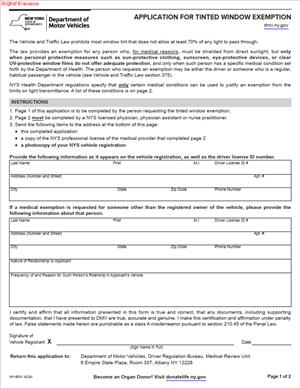
MV-80W- Application for Tinted Window Exemption
Fill out nowJurisdiction: Country: United States | Province or State: New York
If you are completing the MV-80W- Application for Tinted Window Exemption, you are asking for official permission to have darker window tint on a vehicle than the law normally allows. This form is used in New York when a medical condition makes standard window tint limits difficult or unsafe for you.
New York has specific rules about how much light must pass through vehicle windows. These rules apply to most drivers and vehicles. The exemption process exists for people with certain medical needs.
This document connects your medical condition to your vehicle. It requires certification from a licensed medical professional. It also requires your vehicle and registration details.
If you are filling it out, you likely want to make sure you complete it correctly the first time. Errors or missing information can delay review. Understanding what the form does and how it works will help you avoid common problems.
What is MV-80W- Application for Tinted Window Exemption?
Clear definition
The MV-80W- Application for Tinted Window Exemption is a formal request submitted to the New York Department of Motor Vehicles. It asks the state to grant an exception to standard window tint restrictions based on a qualifying medical condition.
In general, New York limits how dark vehicle window tint can be. The law measures this by how much visible light passes through the window. An exemption allows certain windows to have a lower light transmittance than normally permitted.
This form gathers identifying information about you, the vehicle, and your medical condition. It also requires a medical certification. The document is part of an administrative review process, not a court proceeding.
When approved, the exemption applies only under the conditions stated. It does not remove all vehicle equipment requirements. It addresses window tint limits due to medical necessity.
Who typically uses this form?
You would use this form if you have a medical condition that makes exposure to sunlight harmful or painful. This may include certain skin disorders, eye conditions, or other light-sensitive medical issues.
Drivers are the most common applicants. However, vehicle owners who are not the primary drivers may also be involved if the vehicle is registered in their name. The exemption is usually tied to a specific individual and vehicle.
Parents or guardians may complete the form for a minor who has a qualifying medical condition. In that case, the minor’s information and the vehicle’s information must still be accurately provided.
Medical professionals also play a role. A licensed physician or other authorized provider must complete the medical certification section. Without this part, the submission is incomplete.
Why might you need this form?
You might need this form if your medical condition makes bright sunlight a health risk. Some conditions worsen with ultraviolet exposure or strong light. Darker window tint can reduce light entering the vehicle.
You may also need it if you have already installed darker tint and received a warning or citation. An approved exemption can clarify that your vehicle meets an authorized exception.
Another reason is prevention. If your doctor recommends reduced light exposure, you may want official approval before modifying your vehicle’s windows. This can help avoid future compliance issues.
You may also need documentation for vehicle inspections. In New York, inspection stations check window tint. An exemption provides a record that your tint level is medically justified.
Typical real-life scenarios
- You have a diagnosed skin condition that flares up with sunlight exposure. Driving during the day causes irritation or pain. Your doctor confirms that limiting light exposure inside the vehicle may help manage symptoms.
- You have a serious eye condition that makes you extremely sensitive to glare. Even with sunglasses, bright daylight through side windows affects your vision. Your medical provider determines that darker tint would reduce strain.
- Your child has a medical condition requiring protection from ultraviolet rays. You regularly drive your child to school and medical appointments. You seek permission to apply darker tint to protect them during travel.
- You recently moved to New York from another state that allowed darker tint under a medical exemption. You now need to apply under New York rules to maintain compliance with local requirements.
- You purchased a vehicle that already has darker tint installed. After learning about state limits, you consult a medical professional who confirms that you have a qualifying condition. You decide to request a formal exemption rather than remove the tint.
When would you use MV-80W- Application for Tinted Window Exemption?
You would use the MV-80W- Application for Tinted Window Exemption when you want the state to recognize a medical need for darker window tint. Timing often depends on your medical diagnosis and your vehicle status.
Many people apply after receiving a diagnosis that involves light sensitivity. Once a healthcare provider explains the need to reduce sunlight exposure, you may decide to seek official approval.
Some applicants use the form after a traffic stop or inspection issue related to window tint. If an officer or inspector questions the tint level, you may pursue an exemption to resolve the concern.
You might also use this form before installing new tint. If you are planning to modify your windows, you may want confirmation that your medical condition qualifies for an exception.
Vehicle ownership changes can also trigger use of this form. If you buy a new car, you may need to update or reapply so the exemption reflects the current vehicle information.
In some cases, people use the form when renewing registration or addressing other DMV matters. They want to ensure all vehicle records are accurate and reflect any approved medical accommodations.
Legal characteristics of MV-80W- Application for Tinted Window Exemption
This document is an administrative application. It is not a contract between you and another person. It is a request for a government-issued exception to a general rule.
For the application to be effective, it must be complete and accurate. That usually means all required sections are filled in, signatures are present, and the medical certification is properly completed.
Incomplete submissions commonly cause delays. Missing signatures, unclear medical information, or incorrect vehicle identification numbers can result in rejection or requests for correction.
Accuracy matters. If the information about your vehicle or condition is incorrect, the exemption may not match your actual circumstances. Discrepancies can create confusion during inspections or traffic stops.
The exemption, if granted, typically applies only to specific windows and specific vehicles. It does not authorize modifications beyond what is approved. It also does not eliminate other equipment or safety requirements.
Jurisdictional differences can exist. Tint laws vary by state, and an exemption in one state does not automatically apply in another. The form discussed here relates only to New York.
The document does not determine whether your medical condition qualifies in advance. That decision is made through the review process after submission. The form itself is simply the vehicle for that request.
The form also does not prevent law enforcement from verifying compliance. Even with an exemption, officers may check whether the tint matches what was approved.
Is it legally binding?
The MV-80W- Application for Tinted Window Exemption is not legally binding in the way a contract is. It does not create obligations between private parties. Instead, it is part of an administrative decision-making process.
When you sign the form, you are generally certifying that the information you provide is true and accurate. That certification carries legal weight. False statements on official forms can lead to consequences.
The medical professional who completes the certification also affirms the accuracy of the medical information. Their signature confirms that, in their professional judgment, the condition justifies reduced light exposure.
Once the state approves the exemption, the approval becomes an official authorization. At that point, you are permitted to operate the vehicle with tint levels consistent with the exemption terms.
If the application is denied, there is no exemption in place. The standard window tint rules remain applicable unless and until an approval is granted.
How to fill out MV-80W- Application for Tinted Window Exemption
Step 1 – Review the form before writing anything
Start by reading the entire document from top to bottom. This helps you understand what information is required and which sections must be completed by you versus your medical provider.
Pay attention to instructions printed on the form. Look for notes about acceptable ink color, required attachments, or mailing details. Understanding the layout in advance reduces the chance of skipping a section.
Step 2 – Enter your personal information
Fill in your full legal name exactly as it appears on your driver’s license or other official identification. Consistency helps prevent processing issues.
Provide your current residential address. Use the address that matches your DMV records whenever possible. Include any apartment or unit number if applicable.
Add your date of birth and driver license number, if requested. Write clearly and double-check each number for accuracy before moving on.
Step 3 – Provide vehicle information
Locate your vehicle registration document. Use it to copy the vehicle identification number, year, make, and model into the form.
Make sure the license plate number is correct. A single incorrect digit can delay review or cause confusion during inspections.
If the exemption is tied to a specific vehicle, confirm that the registration name matches the applicant’s name. If it does not, ensure that all required owner information is included.
Step 4 – Review the window tint details requested
Some versions of the form ask you to identify which windows require the exemption. Read this section carefully.
Indicate the windows for which darker tint is medically necessary. Provide clear and accurate information. Do not assume that all windows are automatically covered.
If measurements or specifications are requested, ensure they are legible and consistent with your intended tint level. Avoid estimates if exact numbers are required.
Step 5 – Complete your certification section
Most official forms include a statement where you affirm that the information is true. Read this statement fully before signing.
Sign your name in the designated space. Use your usual legal signature. Add the date of signing next to your signature if required.
Check that your signature is inside the appropriate box or line. Signatures placed in the wrong area can cause processing delays.
Step 6 – Have your medical provider complete their section
Take the form to a licensed medical professional authorized to certify medical conditions. Do not fill in the medical certification section yourself unless specifically permitted.
The provider will describe the medical condition and explain why reduced light exposure is necessary. They will also include their license information and contact details.
Ensure the provider signs and dates their portion. An unsigned medical section typically makes the submission incomplete.
Before leaving the office, review the completed section for legibility. Confirm that all required fields are filled in.
Step 7 – Check for completeness and accuracy
Once all sections are filled out, review the entire form again. Compare the vehicle information with your registration document.
Confirm that all required signatures are present. Make sure dates are correct and consistent.
Look for blank fields that may need an entry or a notation such as “not applicable,” if appropriate. Avoid leaving required sections empty.
Step 8 – Make a copy for your records
Before submitting the form, create a complete copy for yourself. Keep it in a safe place with your vehicle documents.
A copy helps you reference what was submitted if questions arise. It can also be useful during the review period before a decision is issued.
Ensure the copy includes all pages and signatures. Partial copies may not be helpful later.
Step 9 – Submit the form as instructed
Follow the submission instructions printed on the form. This may involve mailing the document or delivering it to a designated office.
If mailing, use the correct address and sufficient postage. If delivering in person, bring any additional identification that may be required.
After submission, keep track of any confirmation or receipt if provided. This marks the start of the review process and helps you monitor the status of your request.
Legal terms you might encounter in MV-80W- Application for Tinted Window Exemption
- Medical Necessity: This refers to a health-related reason that justifies darker window tint than normally allowed. On this form, a licensed medical provider must explain why you need protection from sunlight. The explanation must connect your condition to the requested tint exemption.
- Physician Certification: This is the section your medical provider completes and signs. It confirms that a qualifying medical condition exists. Without this certification, your application will not be processed.
- Applicant: You are the applicant if you are requesting the exemption. This section asks for your full legal name, date of birth, and contact information. The details must match your driver record.
- Vehicle Identification Number (VIN): The vehicle identification number is a unique 17-character code assigned to your vehicle. You must enter it exactly as it appears on your registration. A single wrong digit can delay review or cause rejection.
- Registration Information: This includes your license plate number and registration details. The vehicle listed must be currently registered. If you own more than one vehicle, you must identify which one the exemption applies to.
- Exemption Certificate: If approved, you receive proof allowing darker window tint for medical reasons. You must keep this documentation in the vehicle. Law enforcement may request to see it during a traffic stop.
- Attestation: This is your signed statement confirming the information you provided is true. By signing, you are stating that everything on the form is accurate to the best of your knowledge. False statements can result in penalties.
- Authorized Medical Provider: Only certain licensed professionals can complete the medical section. The provider must include their license number and contact information. Incomplete provider details can invalidate the certification.
- Effective Date: This is the date the exemption becomes valid, usually upon approval. It does not automatically backdate to when you completed the form. You should not install non-compliant tint before approval.
- Revocation: This means the exemption can be withdrawn. If your medical condition changes or the information provided is inaccurate, the approval may be canceled. You would then need to comply with standard tint laws.
FAQs
Does the medical provider have to fill out a specific section of the MV-80W- Application for Tinted Window Exemption?
Yes. This document includes a designated medical certification section that only a licensed provider can complete. You cannot fill in that part yourself. The provider must describe the medical condition, sign the certification, and include their license information for the application to be considered complete.
What happens if my name on this form does not match my vehicle registration?
The reviewing agency compares the name you enter with the name on the vehicle registration record. If there is a mismatch, your request may be delayed or denied. Make sure your full legal name appears exactly as it does on your registration and driver record.
Can I use this document for more than one vehicle?
You must list the specific vehicle the exemption applies to. If you want coverage for multiple vehicles, each vehicle’s information must be clearly identified. If the form does not provide space for multiple vehicles, you may need separate documentation.
When does the exemption become effective?
The exemption becomes valid after approval, not when you sign the paperwork. Do not assume you are covered while the application is pending. Wait for confirmation or issuance of an exemption certificate before relying on it.
Do I need to attach any medical records to this form?
In most cases, the provider’s certification is sufficient. However, the agency may request additional documentation if the explanation is unclear or incomplete. Make sure the provider’s statement clearly connects your condition to the need for darker tint.
How will I know if my MV-80W- Application for Tinted Window Exemption is approved?
You will typically receive an approval notice or certificate confirming the exemption. Review it carefully to confirm your name and vehicle details are correct. Keep the approval documentation in your vehicle at all times.
Can someone else sign on my behalf?
If you are unable to sign, a legally authorized representative may be allowed to do so. The representative must indicate their authority clearly. Incomplete or unexplained signatures can cause rejection.
What if my medical condition improves after I receive approval?
If the condition no longer requires a darker tint, you may no longer qualify for the exemption. Continuing to rely on the exemption without a qualifying condition can lead to penalties. Keep your documentation current and accurate.
Checklist: Before, During, and After MV-80W- Application for Tinted Window Exemption
Before
- Confirm you have a qualifying medical condition that requires limited sunlight exposure.
- Schedule an appointment with a licensed medical provider.
- Gather your current vehicle registration and driver information.
- Locate your vehicle’s vehicle identification number and verify it matches your registration.
- Check that your contact details are current and accurate.
- Review the entire form to understand each required section.
- Ask your provider if they are willing to complete the certification section.
- Ensure the vehicle listed is properly registered in your name.
During
- Print clearly using black or blue ink if completing by hand.
- Enter your full legal name exactly as it appears on official records.
- Double-check your date of birth and identification details.
- Carefully copy the vehicle identification number without skipping or switching characters.
- Confirm the license plate number is correct.
- Sign and date the applicant certification section.
- Have your provider complete every required field in their section.
- Verify the provider includes their license number and signature.
After
- Make a complete copy of the signed form for your records.
- Submit the form using the accepted delivery method.
- Track when and how you submitted the application.
- Wait for written confirmation before installing non-standard tint.
- Keep the approval certificate inside your vehicle once issued.
- Update your records if you change vehicles.
- Renew or update the exemption if required.
- Store medical and exemption documents in a safe place.
Common mistakes to avoid with MV-80W- Application for Tinted Window Exemption
- Mistake: Entering the wrong vehicle identification number because you copied it from memory instead of the registration, which leads to processing delays or rejection, and forgetting to double-check all 17 characters before submission.
- Mistake: Leaving the medical certification section incomplete because the provider skipped a line or forgot their license number, causing the application to be denied, and not reviewing the provider’s section before you submit.
- Mistake: Signing in the wrong place or failing to sign at all, which happens when you rush through the form and results in automatic rejection, and not confirming every required signature is present.
- Mistake: Using a nickname instead of your legal name, which creates a mismatch with registration records and delays approval, and not verifying that your name matches official documents exactly.
- Mistake: Installing darker window tint before receiving approval, which can result in fines or citations, and not waiting for written confirmation of exemption.
- Mistake: Submitting outdated vehicle information after a recent registration change, which causes confusion in the review process, and not checking that the plate number and registration details are current.
- Mistake: Failing to keep a copy of the completed application, which leaves you without proof of what was submitted if questions arise, and not storing both digital and paper copies safely.
- Mistake: Assuming the exemption transfers automatically to a new vehicle, which can lead to non-compliance, and not submitting updated information when you change cars.
What to do after filling out MV-80W- Application for Tinted Window Exemption
Once you finish the form and confirm all sections are complete, shift your focus to proper submission and recordkeeping. Small follow-up steps make a big difference. They protect you if questions come up later.
Start by organizing your documents. Place the completed and signed form together with any supporting paperwork. Make sure the pages are in order and legible.
- Step 1: Make a full copy of the signed application, including the medical certification section.
- Step 2: Scan a digital copy and save it in a secure folder with a clear file name and date.
- Step 3: Confirm the correct submission method, whether by mail or in person.
- Step 4: If mailing, use a secure method and keep proof of mailing.
- Step 5: If submitting in person, request a receipt or stamped acknowledgment.
- Step 6: Mark your calendar with the submission date and expected processing timeframe.
- Step 7: Monitor your mail for any requests for additional information.
- Step 8: Once approved, review the exemption certificate for accuracy.
- Step 9: Place the exemption proof in your vehicle where you can easily access it.
- Step 10: Keep the original approval document in a safe location at home.
After approval, stay organized. If you sell the vehicle or register a new one, check whether you must update your exemption. Do not assume it carries over automatically. If your medical condition changes, speak with your provider about whether the exemption still applies.
Maintain a simple file labeled with the form name and approval date. Include copies of correspondence, submission proof, and the final certificate. This record helps if you are ever questioned about your window tint or need to renew or update your documentation.
Good follow-through ensures your exemption remains valid and easy to verify. Careful recordkeeping saves time and reduces stress later.
Disclaimer: This guide is provided for informational purposes only and is not intended as legal advice. You should consult a legal professional.