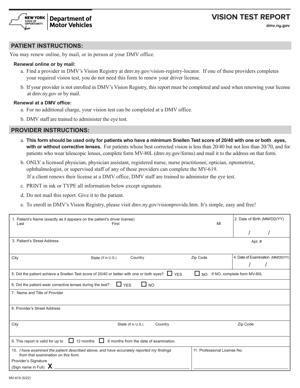
MV-619 – Vision Test Report
Fill out nowJurisdiction: Country: United States | Province or State: New York
The MV-619 – Vision Test Report is a document used to confirm that you meet New York’s vision requirements for driving. It records the results of a vision screening performed by an approved provider. If you are renewing, updating, or restoring your driving privileges, this form may become part of your paperwork.
When you complete the MV-619 – Vision Test Report, you are not filling out the medical findings yourself. A qualified vision provider completes the testing portion. Your role is to provide accurate identifying information and ensure the form is properly submitted.
This document matters because vision is a basic requirement for holding a driver’s license. If your eyesight does not meet minimum standards, your license status can be affected. The form acts as proof that your vision has been checked and meets the required criteria, with or without corrective lenses.
Many people encounter this form during routine license renewals. Others use it after receiving a notice that a new vision test is required. Understanding how it works helps you avoid delays in your renewal or other driver transactions.
What is MV-619 – Vision Test Report?
Clear definition
The MV-619 – Vision Test Report is a standardized New York form used to document the results of a driver’s vision examination. It confirms whether you meet the state’s visual acuity and visual field standards for driving.
The form includes sections for your personal information and sections for the vision provider to record test results. It may also note whether you require corrective lenses to meet minimum standards.
This document becomes part of your driver record once submitted. It is used to determine eligibility for a driver license, renewal, or certain changes to your license.
Who typically uses this form?
Drivers and applicants in New York use this form when proof of a recent vision test is required. This includes people renewing a standard driver license, commercial driver license, or learner permit in situations where in-person testing is not completed at a licensing office.
Vision care professionals also use this form. These may include licensed optometrists, ophthalmologists, or other approved providers authorized to perform vision tests for driver licensing purposes.
Administrative staff at licensing offices review the completed form. They rely on it to verify that your vision meets established standards before issuing or renewing a license.
Why might you need this form?
You may need this form if you renew your driver license by mail or online and must submit proof of a recent vision test. In some cases, your renewal notice indicates that a new vision screening is required.
You might also need it if your driving privileges were restricted due to vision concerns. After treatment or corrective measures, a new vision report can demonstrate that you now meet minimum standards.
In other situations, a licensing authority may request updated medical or vision information. The form serves as official documentation of your current visual condition as it relates to safe driving.
Typical real-life scenarios
- You receive a renewal notice that states a vision test is required. Instead of completing the test at a licensing office, you visit a qualified vision provider. After the exam, the provider completes the form and gives it to you for submission.
- You recently had eye surgery that improved your vision. Previously, you needed corrective lenses to meet standards. A new test shows better results, and the updated form reflects your current visual acuity.
- You failed a prior vision screening at a licensing office. You then schedule a full eye exam. The provider determines that with corrective lenses, you meet the required standard and records that information on the form.
- You are applying for reinstatement of your driving privileges after a suspension related to medical concerns. As part of the review process, you are asked to submit a recent vision test report confirming compliance with vision requirements.
When would you use MV-619 – Vision Test Report?
You use this document whenever official proof of your visual ability to drive is required in New York. This most often occurs during license renewal when in-office testing is not completed.
It may also be used when transferring certain driving privileges, applying for a different class of license, or addressing restrictions related to vision. For example, if your record indicates that corrective lenses are required, updated test results may affect how that restriction appears on your license.
Commercial drivers may encounter additional vision standards. In those cases, the form may be part of a broader medical certification process. The vision report focuses only on eyesight, not overall physical fitness to drive.
Parents or guardians of younger drivers typically do not complete this form themselves. However, if a young driver must provide proof of vision testing outside a licensing office, the same process applies. The provider performs the exam and completes the form.
In short, you use this document when the licensing authority needs written confirmation of your current visual acuity and field of vision from an approved professional.
Legal characteristics of MV-619 – Vision Test Report
The MV-619 – Vision Test Report functions as an official record of a medical screening related to driving eligibility. Its effectiveness depends on proper completion by an authorized provider and accurate identifying information for the driver.
For the form to be accepted, it must generally include your full legal name, date of birth, and other identifying details that match your driver record. The vision provider must record the test results clearly and sign the form where required. Missing signatures, altered entries, or incomplete fields commonly cause delays or rejection.
The timing of the test may also matter. A vision exam that is too old may not be accepted. The form is typically valid only within a certain period before submission. If you wait too long to file it, you may need a new test.
High-level requirements, such as minimum visual acuity and field of vision, are set by state regulations. While many states have similar standards, the exact thresholds and procedures can vary. The form is specific to New York and is designed to align with that state’s rules.
This document does not grant you a license by itself. It does not override other licensing requirements, such as written tests, road tests, identity verification, or fee payment. It only addresses vision standards.
It also does not serve as a general medical certificate. It focuses strictly on eyesight as it relates to driving. Other medical conditions require separate documentation and review.
Is it legally binding?
The form is not a contract between you and the state. However, it has legal significance because it affects your eligibility to hold or renew a driver’s license.
When a licensed provider signs the form, they are attesting that the recorded results are accurate. Submitting false or altered information can lead to administrative action regarding your driving privileges.
For you as the driver, the form becomes part of your official record once submitted. Licensing authorities rely on it to determine whether you meet statutory vision standards. In that sense, it carries legal weight in administrative decisions about your license.
Its binding effect is limited to documenting vision results. It does not create ongoing obligations beyond compliance with stated restrictions, such as a requirement to wear corrective lenses while driving.
How to fill out MV-619 – Vision Test Report
Step 1 – Review the form before your appointment
Obtain the current version of the form and read through it before visiting a vision provider. Check what personal information is required and confirm that you understand which sections you are responsible for completing. This helps prevent mistakes during the appointment.
Step 2 – Enter your personal identification details
Fill in your full legal name exactly as it appears on your driver license or permit. Provide your date of birth, driver identification number if requested, and current address. Write clearly and avoid abbreviations that could cause confusion.
Ensure the information matches your existing driver record. Differences in spelling or numbers can delay processing once the form is submitted.
Step 3 – Complete any driver acknowledgment section
Some versions of the form include a statement that you must sign. Read this section carefully. Your signature generally confirms that the information you provided is accurate and that you understand the purpose of the vision report.
Sign and date the form in the space provided, if required, before or during your appointment as directed.
Step 4 – Have the vision test performed by an approved provider
Schedule a vision examination with a qualified professional authorized to complete the form. During the exam, the provider will test your visual acuity and may assess your field of vision. Follow the provider’s instructions closely to ensure accurate results.
If you use corrective lenses, bring them to the appointment. The provider will note whether you meet the required standard with or without lenses.
Step 5 – Ensure the provider completes all required sections
After the exam, review the form while still at the office. Confirm that the provider has entered the test results in all required fields. Check that they indicated whether corrective lenses are needed to meet standards.
Make sure the provider has signed the form and included any required license or certification details. An unsigned form is often not accepted.
Step 6 – Verify legibility and accuracy
Before leaving, read through the completed document. Confirm that your name, date of birth, and identification number are correct. Ensure the recorded results are clearly written and not ambiguous.
If anything appears incomplete or incorrect, ask for clarification immediately. Corrections are easier to address before you submit the form.
Step 7 – Submit the completed form as instructed
Follow the submission instructions provided with your renewal notice or application process. This may involve mailing the form, submitting it in person, or including it with other required documents. Keep a copy for your records if possible.
Once submitted, the licensing authority will review the vision results along with your other application materials. Your license status will be determined based on whether all requirements, including vision standards, are met.
Legal terms you might encounter in MV-619 – Vision Test Report
- Visual Acuity: This refers to how clearly you can see at a specific distance, usually measured using a standard eye chart. On this form, your visual acuity is recorded for each eye and sometimes both eyes together. The results determine whether you meet the minimum vision standard for driving.
- Corrective Lenses: This means glasses or contact lenses used to improve your vision. The form will indicate whether you were tested with corrective lenses and whether you are required to wear them while driving. If required, that restriction may appear on your driver record.
- Restriction: A restriction is a condition placed on your driver license. On this document, a common restriction is “must wear corrective lenses.” Restrictions limit how you may legally drive and can result in penalties if ignored.
- Authorized Vision Provider: This is the licensed professional allowed to perform and certify your vision test. The form must be completed and signed by an approved provider. If someone without proper credentials fills it out, it may be rejected.
- Certification: Certification is the provider’s formal confirmation that the information is accurate. By signing the document, the provider confirms that the test was performed and the results are truthful. This signature gives the form legal weight.
- Driver Identification Information: This includes your name, date of birth, and driver’s license number. The information must match your official records. Even small mismatches can delay processing.
- Expiration Date: Some vision test results are only valid for a limited time. If you submit the form after that time, it may no longer be accepted. Always check whether the document needs to be recent.
- Medical Review: In some cases, your vision results may trigger a further review. This means the licensing authority may look more closely at your eligibility to drive. It does not automatically mean you will lose your driving privileges.
- Minimum Vision Standard: This is the required level of vision you must meet to legally drive. The form documents whether you meet that threshold. If you do not, you may need corrective lenses or further evaluation.
FAQs
Do I need to submit the original MV-619 – Vision Test Report, or is a copy acceptable?
In most cases, you should submit the original document completed and signed by the vision provider. Photocopies may not be accepted because the licensing agency often requires an original signature. Before submitting, check that the signature and all entries are clearly legible. Keep a copy for your own records in case questions arise.
What happens if my name on this form does not exactly match my driver license?
The information on this document must match your driver record exactly. Differences in spelling, missing middle initials, or name changes can delay processing. If your legal name has changed, update your driver record first or bring documentation that explains the change. Do not assume minor differences will be ignored.
How recent must my vision test be for this form to be accepted?
This document is generally expected to reflect a recent vision exam. If too much time has passed between the test date and submission, it may be rejected. Check the test date before filing. If the exam is outdated, you may need a new one.
Can I complete any part of the form myself?
You are responsible for entering your personal identification details and reviewing the information for accuracy. However, only the authorized provider can complete the vision results and certification sections. Do not fill in medical or test result areas yourself. Altering those sections can invalidate the document.
What if I fail the vision test recorded on this form?
If you do not meet the minimum vision standard, the provider may recommend corrective lenses or further evaluation. You may be retested with glasses or contacts. If the results still do not meet the standard, your driving privileges could be limited or reviewed. Address the issue promptly to avoid delays in your licensing process.
Will this form automatically add a corrective lens restriction to my license?
If the test shows that you need corrective lenses to meet the vision standard, that requirement may be reflected as a restriction on your driver record. This means you must wear glasses or contacts whenever you drive. Failing to comply with a restriction can result in penalties. Review the final license document to confirm what was added.
How do I know if the licensing agency accepted my submission?
After you submit the MV-619 – Vision Test Report, you should receive confirmation through a receipt, updated record, or new license document. If you do not receive confirmation within a reasonable time, follow up with the appropriate office. Keep proof of submission until your record is updated. Do not assume acceptance without verification.
Does this document become part of my permanent driving record?
Vision results may be noted in your driver history, especially if they lead to a restriction. The physical form itself may not be publicly accessible, but its outcome affects your licensing status. Any restriction or change remains in place until updated by a new examination. Keep that in mind if your vision improves or changes later.
Checklist: Before, During, and After MV-619 – Vision Test Report
Before
- Confirm why you need the vision test (renewal, medical review, or new license).
- Verify that your chosen provider is authorized to complete the form.
- Bring valid photo identification to your appointment.
- Have your current glasses or contact lenses with you.
- Review your driver license details to ensure accurate spelling and numbers.
- Check whether there is a deadline for submission.
- Print a clean copy of the form if required.
- Prepare payment for the vision exam if applicable.
During
- Confirm that your personal details are written clearly and correctly.
- Make sure the provider records results for each required field.
- Ask whether you are being tested with or without corrective lenses.
- Review the visual acuity numbers entered on the form.
- Ensure the provider signs and dates the certification section.
- Check that the provider’s license or identification number is included if required.
- Verify that no sections are left blank unintentionally.
- Confirm the test date is clearly written.
After
- Make a clear copy of the completed document for your records.
- Submit the form using the correct method (in person, mail, or other accepted channel).
- Keep proof of submission, such as a receipt or tracking confirmation.
- Monitor your mail or online account for updates.
- Review your updated license for any new restrictions.
- Follow up promptly if you receive a notice requesting additional information.
- Store your copy in a safe place.
- Schedule future eye exams as needed to maintain compliance.
Common mistakes to avoid with MV-619 – Vision Test Report
- Mistake: Submitting the form with missing personal details because you assumed the provider would fill everything out, which can cause rejection and delays, so do not forget to complete and review your identification section yourself.
- Mistake: Using an unauthorized provider since you did not verify credentials beforehand, which may invalidate the certification and require a new test, so do not forget to confirm the provider is approved.
- Mistake: Turning in an outdated vision test because you waited too long after the exam, which can lead to refusal of the document, so do not forget to check the test date before submission.
- Mistake: Allowing illegible handwriting to remain on the form because you felt rushed, which can result in processing errors or rejection, so do not forget to review readability before leaving the appointment.
- Mistake: Forgetting to keep a copy for your records because you assumed it would not be needed, which leaves you without proof if questions arise, so do not forget to make and store a copy.
- Mistake: Ignoring a corrective lens restriction added to your license because you did not carefully review the updated record, which can lead to penalties if you drive without glasses or contacts, so do not forget to confirm any changes to your driving status.
- Mistake: Altering or correcting test results yourself after the provider signs, which can invalidate the document and raise compliance concerns, so do not forget to request corrections directly from the provider.
What to do after filling out MV-619 – Vision Test Report
Once the form is fully completed and signed, your job is not over. You need to make sure it reaches the right place and is properly recorded.
- Step 1: Review every field one more time for accuracy and completeness.
- Step 2: Make at least one clear copy for your personal records.
- Step 3: Confirm the correct submission method required for your situation.
- Step 4: Submit the original document as instructed.
- Step 5: Obtain proof of submission, such as a receipt or confirmation number.
- Step 6: Monitor your mail, email, or online account for status updates.
- Step 7: Check your updated driver record or new license for any restrictions.
- Step 8: Address any follow-up requests immediately if you receive a notice.
- Step 9: Keep your copy of the completed form in a safe place.
- Step 10: Plan your next routine vision exam to avoid future compliance issues.
Act promptly if something looks incorrect on your updated license. Errors are easier to fix soon after processing. If a corrective lens restriction appears and you believe it is incorrect, contact the appropriate office and be ready to provide documentation.
Keep in mind that your ability to legally drive depends on meeting vision standards. Treat this process seriously. Staying organized and proactive will help you avoid delays, suspensions, or unnecessary repeat testing.
Disclaimer: This guide is provided for informational purposes only and is not intended as legal advice. You should consult a legal professional.