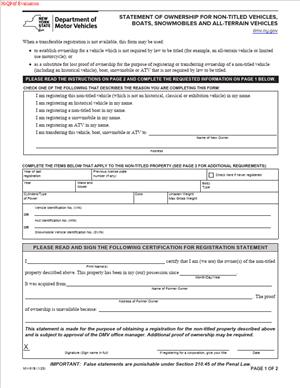
MV-51B – Statement of Ownership for Non-Titled Vehicles, Boats, Snowmobiles and All-Terrain Vehicles
Fill out nowJurisdiction: Country: United States | Province or State: New York
The MV-51B – Statement of Ownership for Non-Titled Vehicles, Boats, Snowmobiles and All-Terrain Vehicles is a New York form used to confirm who owns certain vehicles that do not have a title. It helps you document ownership when a standard title certificate does not exist.
You may need this form if you are trying to register a vehicle, boat, snowmobile, or all-terrain vehicle and you cannot provide a title. In many cases, older or smaller recreational vehicles were never issued a title.
This document allows you to explain how you got the vehicle and to formally state that you are the owner. It becomes part of your submission to the motor vehicle authority.
If you are about to fill it out, you need to understand what information is required, how ownership is described, and what makes the form complete. Small errors can delay processing.
What is MV-51B – Statement of Ownership for Non-Titled Vehicles, Boats, Snowmobiles and All-Terrain Vehicles?
Clear definition
The MV-51B – Statement of Ownership for Non-Titled Vehicles, Boats, Snowmobiles and All-Terrain Vehicles is a written statement used in New York to establish ownership when no title exists. It is typically used as supporting documentation during a registration process.
Instead of transferring ownership through a title certificate, this form records key details about the vehicle and explains how it was acquired. It acts as a sworn statement that the information you provide is true.
The document usually includes identifying details such as the make, model, year, and identification number. It also requires you to describe the transaction or circumstances that led to your ownership.
Who typically uses this form?
This form is commonly used by private individuals. For example, someone who bought a small boat from a neighbor without a title may need it to complete registration.
It is also used by people who inherited a snowmobile or ATV and do not have a title document. In these cases, the form helps clarify the chain of ownership.
In some situations, sellers may complete part of the statement to confirm they transferred ownership. Buyers often rely on it when no formal title transfer is available.
Businesses that deal in recreational vehicles may encounter it when handling older inventory that was never titled. However, it is most often used by individual owners.
Why might you need this form?
You might need this form when you cannot provide a certificate of title but still want to register or legally operate the vehicle. Registration authorities often require proof of ownership before issuing plates or registration documents.
Without a title, there must be another way to show that the vehicle belongs to you. This form provides that explanation in writing.
It may also be required if the original title was lost and no duplicate is available, or if the vehicle type does not normally receive a title in New York.
Filing this document helps create an official record of how ownership changed hands. That record can be important if questions arise later.
Typical real-life scenarios
- You purchase a used ATV from a private seller. The ATV was never titled because of its age. To register it in your name, you complete this statement explaining the purchase and providing the vehicle details.
- You inherit a small boat from a family member. There is no title among the estate documents. To place the boat in your name, you submit a statement of ownership describing the inheritance.
- You find and restore an old snowmobile that was stored for years. The prior owner cannot locate any title paperwork. You use the form to explain how you acquired it and confirm your ownership.
- You buy a non-titled trailer or similar vehicle from someone who never registered it. The form becomes part of your application package to establish a clear ownership history.
When would you use MV-51B – Statement of Ownership for Non-Titled Vehicles, Boats, Snowmobiles and All-Terrain Vehicles?
You would use this form when a title is not available and ownership must be proven another way. This often happens during registration or re-registration.
Buyers use it after purchasing a non-titled vehicle from a private seller. The seller may provide a bill of sale, and the statement of ownership supplements that document.
Heirs or family members use it when transferring a vehicle from an estate without a title. The statement explains the relationship and the method of transfer.
In some cases, long-term possessors of a vehicle use it when there is no clear paper trail. The form allows them to formally describe how they came into possession.
The document is generally part of a larger submission. It is rarely filed on its own. Instead, it accompanies registration applications and other required paperwork.
Legal characteristics of MV-51B – Statement of Ownership for Non-Titled Vehicles, Boats, Snowmobiles and All-Terrain Vehicles
This form functions as a formal declaration of ownership. By signing it, you confirm that the details you provide are accurate to the best of your knowledge.
It typically becomes part of an official record. That means the information may be relied upon when issuing a registration or recording ownership.
For the form to be effective, it must be complete and consistent. Missing identification numbers, incorrect vehicle descriptions, or unclear transfer details can cause delays or rejection.
Legibility also matters. If handwritten entries cannot be read, processing may be paused until clarification is provided.
In New York, specific vehicle types may have different documentation standards. For example, certain boats or snowmobiles may have unique identification requirements. The form must align with those requirements.
It is important to understand what the document does not do. It does not automatically create ownership if the information is false or incomplete. It also does not replace other required forms in a registration process.
Is it legally binding?
Yes, in the sense that you are making a formal statement about ownership. When you sign it, you are certifying that the information is true.
Providing false information on an official ownership statement can carry serious consequences. The signature gives the document weight and credibility.
However, the form itself does not guarantee that ownership will be accepted. Authorities may review the details and compare them with other records before approving a registration.
The legal effect depends on accuracy, completeness, and compliance with applicable rules. The form supports your claim of ownership, but it does not override other requirements.
How to fill out MV-51B – Statement of Ownership for Non-Titled Vehicles, Boats, Snowmobiles and All-Terrain Vehicles
Step 1 – Identify the vehicle or vessel
Start by entering the full description of the vehicle, boat, snowmobile, or ATV. Include the year, make, model, and color if requested. Carefully copy the identification number, such as a VIN or hull identification number, exactly as it appears on the vehicle.
Step 2 – Provide current owner information
Fill in your full legal name and contact details as requested on the form. Make sure the name matches the name you are using for registration. If there are co-owners, include each person as required.
Step 3 – Describe how ownership was obtained
Explain clearly how you acquired the vehicle. State whether it was purchased, inherited, gifted, or obtained in another way. Include relevant dates and the name of the person or entity from whom you received it.
Step 4 – Include seller or prior owner details if required
If the form asks for information about the previous owner, provide their full name and address to the extent known. Ensure that these details match any bill of sale or supporting documents you are submitting.
Step 5 – Review for accuracy and completeness
Before signing, read every section carefully. Confirm that identification numbers, dates, and names are correct. Check that there are no blank fields that require a response.
Step 6 – Sign and date the statement
Sign the form where indicated. Enter the current date in the required format. Your signature confirms that the information provided is true and complete to the best of your knowledge.
Legal terms you might encounter in MV-51B – Statement of Ownership for Non-Titled Vehicles, Boats, Snowmobiles and All-Terrain Vehicles
- Affidavit: An affidavit is a written statement you swear is true. This form functions like an affidavit because you are certifying ownership facts under penalty of law. When you sign it, you confirm that the information about how you acquired the vehicle or vessel is accurate.
- Bill of Sale: A bill of sale is a document that shows a transfer of ownership from a seller to a buyer. If you do not have a formal title, a bill of sale often supports the ownership claim you describe in this form. The details on your bill of sale should match the information you enter.
- Hull Identification Number (HIN): A HIN is a unique number assigned to a boat. It works like a vehicle identification number but for watercraft. You must enter the HIN exactly as it appears on the boat to avoid processing delays.
- Vehicle Identification Number (VIN): A VIN is a unique 17-character code assigned to most motor vehicles. On this form, you must list the VIN exactly as it appears on the vehicle. Even one incorrect character can cause your application to be rejected.
- Prior Owner: The prior owner is the person or entity who owned the vehicle before you. If you acquired the vehicle without a title, you may need to identify the prior owner and explain how the transfer happened. This helps establish a clear chain of ownership.
- Chain of Ownership: This refers to the documented history of who owned the vehicle or vessel over time. When a title is missing, you use this form to explain and reconstruct that chain. The more complete your explanation, the easier it is to process your application.
- Material Misstatement: A material misstatement is a significant false or incorrect statement. If you knowingly provide incorrect information about ownership, that can have legal consequences. Accuracy is critical when describing how you obtained the vehicle.
- Notarization: Notarization is the process of having your signature witnessed and verified by a notary public. Some ownership statements must be notarized to confirm your identity and signature. Check whether your completed form requires notarization before submission.
- Registration: Registration is the official recording of a vehicle or vessel with the state. This form may be used as part of your registration process when no title exists. Registration allows you to legally operate or use the vehicle where required.
- Supporting Documentation: Supporting documentation includes any additional paperwork that backs up your claim of ownership. Examples include bills of sale, receipts, canceled checks, or old registrations. You may need to submit copies along with your statement.
FAQs
Do I need to complete MV-51B – Statement of Ownership for Non-Titled Vehicles, Boats, Snowmobiles and All-Terrain Vehicles if I already have a bill of sale?
A bill of sale alone may not be enough if there is no title available. This document is used to formally explain how you obtained ownership when standard proof is missing. You still attach your bill of sale, but you also complete this form to describe the transaction and confirm the details under your signature.
What information must exactly match other documents I submit?
The vehicle identification number, hull identification number, year, make, and model must match your supporting documents exactly. Your name and address should also match your identification and any bill of sale. If there is a mismatch, even a small spelling error, your paperwork can be delayed or returned for correction.
What should I write in the section that asks how ownership was obtained?
Be clear and specific. State whether you bought, received, inherited, or otherwise acquired the vehicle or vessel. Include dates, the name of the person you obtained it from, and whether you received any paperwork at that time. Avoid vague statements like “purchased years ago” without dates or context.
Does this form need to be notarized?
Some ownership statements require notarization to confirm your identity and signature. Review the signature section carefully to see if a notary acknowledgment is included. If notarization is required and you skip it, your submission may not be accepted.
What happens if I cannot contact the prior owner?
You should still complete this document with as much information as you have. Provide the prior owner’s name, last known address, and explain why you cannot obtain a title or additional paperwork. Leaving the section blank without explanation can slow down processing.
Will this form change the official ownership record immediately?
This document supports your request to register or document ownership, but it does not automatically update records on its own. The agency reviews your statement and any attachments before accepting the change. Ownership is recognized only after your application is approved.
Can I correct mistakes after I sign the form?
If you notice an error before submission, complete a new form rather than crossing out information. Corrections, white-out, or handwritten edits can raise questions about accuracy. If you already submitted it, you may need to provide a corrected version.
Do I need to submit original documents with this form?
You may be asked to provide originals or certified copies of certain documents, such as bills of sale or prior registrations. Review the submission instructions carefully. Keep copies of everything you provide in case questions arise later.
Checklist: Before, During, and After MV-51B – Statement of Ownership for Non-Titled Vehicles, Boats, Snowmobiles and All-Terrain Vehicles
Before
- Confirm that the vehicle or vessel does not have a valid title available.
- Gather all supporting documents, including bills of sale and prior registrations.
- Locate and verify the VIN or HIN directly from the vehicle or boat.
- Check your identification to ensure your name and address are current.
- Review the form to see whether notarization is required.
- Make sure you know the exact date you acquired the vehicle or vessel.
- Confirm the full legal name of the prior owner, if known.
During
- Print clearly in black or blue ink if completing by hand.
- Enter the VIN or HIN exactly as it appears, character by character.
- Provide complete details about how and when you obtained ownership.
- Fill in every required field; do not leave mandatory sections blank.
- Attach copies of supporting documents in an organized manner.
- Double-check spelling of names and accuracy of dates.
- Sign the form only after reviewing all entries for accuracy.
- Have the document notarized if required.
After
- Make a complete copy of the signed form and all attachments.
- Submit the form using the required filing method.
- Keep any receipt or proof of submission.
- Monitor for confirmation or follow-up requests.
- Respond promptly if additional documents are requested.
- Store your copy in a safe place with other vehicle records.
- Update your personal records once ownership is recognized.
Common mistakes to avoid with MV-51B – Statement of Ownership for Non-Titled Vehicles, Boats, Snowmobiles and All-Terrain Vehicles
- Mistake: Entering the wrong VIN or HIN because you copied it from memory instead of the vehicle; this happens easily with long codes, can cause rejection, and you must not forget to verify each character directly from the source.
- Mistake: Leaving the ownership explanation vague because you assume the bill of sale is enough; this can delay review, and you must not forget to clearly describe how and when you acquired the property.
- Mistake: Submitting the form without required notarization because you overlooked the signature section; this leads to refusal of the application, and you must not forget to check whether a notary acknowledgment is required.
- Mistake: Providing names that do not match your identification due to nicknames or abbreviations; this creates record inconsistencies, and you must not forget to use your full legal name.
- Mistake: Failing to attach supporting documents because you think the statement alone is sufficient; this weakens your ownership claim, and you must not forget to include copies of all available proof.
- Mistake: Using correction fluid or crossing out errors because you rushed; this raises concerns about accuracy, and you must not forget to complete a clean new copy if you make a mistake.
- Mistake: Omitting prior owner details because you no longer have contact; this can interrupt the chain of ownership review, and you must not forget to explain the situation fully even if information is limited.
- Mistake: Signing before reviewing all entries; this increases the risk of certifying incorrect information, and you must not forget to double-check every field before adding your signature.
What to do after filling out MV-51B – Statement of Ownership for Non-Titled Vehicles, Boats, Snowmobiles and All-Terrain Vehicles
Once you complete the form, pause and review everything one more time. Accuracy now prevents delays later. Compare the identification numbers, dates, and names against your supporting documents.
- Step 1: Make a full copy of the signed form for your records.
- Step 2: Make copies of every attachment you plan to submit.
- Step 3: Confirm whether you must submit the form in person or by mail.
- Step 4: Assemble your documents in a logical order, with the form on top.
- Step 5: Bring or send proper identification if required for processing.
- Step 6: Pay any required fees associated with registration or processing.
- Step 7: Request a receipt or confirmation that your documents were received.
- Step 8: Track any reference or transaction number provided to you.
- Step 9: Watch for written confirmation or additional information requests.
- Step 10: Store your approved documents with your permanent vehicle or vessel records.
If the agency contacts you for clarification, respond quickly and provide exactly what is requested. Keep copies of any additional documents you submit. Once your ownership is officially recorded, update your insurance and personal files to reflect the recognized status. Organized records make future transfers or renewals much easier.
Disclaimer: This guide is provided for informational purposes only and is not intended as legal advice. You should consult a legal professional.