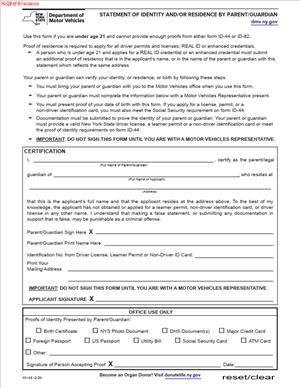
MV-45 – Statement of Identity and/or Residence by Parent or Guardian
Fill out nowJurisdiction: Country: United States | Province or State: New York
The MV-45 – Statement of Identity and/or Residence by Parent or Guardian is a document used in New York when a child or minor does not have enough proof of identity or residency on their own. It allows a parent or legal guardian to confirm key information on the child’s behalf. This form is most often used in connection with motor vehicle or identification transactions.
If you are filling out the MV-45 – Statement of Identity and/or Residence by Parent or Guardian, you are likely helping your child obtain a learner permit, driver license, or non-driver identification card. The form gives the New York Department of Motor Vehicles a way to verify details that cannot be confirmed through standard documents.
This document matters because government agencies require reliable proof of identity and residence before issuing official credentials. When a minor does not have utility bills, leases, or other records in their own name, a parent or guardian’s sworn statement can bridge that gap.
You are not applying for something for yourself with this form. You are confirming information about your child. That distinction is important, because the parent or guardian becomes the person legally responsible for the accuracy of what is written.
Understanding how this form works can help you avoid delays. Small errors, missing information, or unsigned sections can lead to rejection of the submission.
What is MV-45 – Statement of Identity and/or Residence by Parent or Guardian?
Clear definition
The MV-45 – Statement of Identity and/or Residence by Parent or Guardian is a sworn statement completed by a parent or legal guardian. It verifies a minor’s identity and/or New York residence when standard documentation is not available in the minor’s name.
It is not an application for a license or identification card by itself. Instead, it supports another filing. The form supplements identity and residency requirements set by the agency handling the transaction.
By signing the document, you confirm that the information provided about the child is true. The statement is made under penalty of false statements. That means accuracy is critical.
Who typically uses this form?
Parents of teenagers commonly use this form when their child applies for a learner permit or non-driver ID. At that stage, many minors do not have bank accounts, leases, or other documents in their own name.
Legal guardians may also use it. If you have court-ordered guardianship of a minor, you may complete the form to confirm the child’s identity or address.
The form is generally used when the child lives with you. It connects the child’s identity and residence to the adult’s verified records.
In some cases, it may be used when a family recently moved and the child does not yet have independent proof of the new address.
Why might you need this form?
You may need this form if your child cannot meet identification or residency requirements on their own. Many government transactions require multiple forms of proof. Minors often do not have those documents.
The form can help establish a consistent residential address. This is important when applying for a permit or ID card that must display a current New York address.
It may also help verify the relationship between you and the minor. When a parent or guardian signs the statement, it links the adult’s identity to the child’s record.
Without this form, the agency may request additional documentation. Providing a complete and accurate statement can reduce back-and-forth and processing delays.
Typical real-life scenarios
- A 16-year-old is applying for a learner permit for the first time. The teen has a school ID and birth certificate but no mail or bills in their name. The parent completes the form to confirm that the teen lives at the same address.
- A family recently moved within New York. The parent updated their own driver license, but the child has no documents showing the new address. The parent signs the statement to verify the child’s residence.
- A minor is applying for a non-driver identification card for school or employment purposes. The parent provides the sworn statement because the child does not have sufficient proof of residency.
- A legal guardian cares for a teenager under a court order. The guardian uses the form to confirm both identity and residence, attaching documentation that supports the guardianship.
- In each situation, the form serves as supporting evidence. It works together with other required documents rather than replacing them entirely.
When would you use MV-45 – Statement of Identity and/or Residence by Parent or Guardian?
You would use this form during a motor vehicle or identification transaction involving a minor. It is typically part of a larger application process.
For example, when a minor applies for a learner permit, the agency often requires proof of identity and proof of residence. If the minor cannot independently meet those requirements, the parent or guardian may submit this statement as part of the overall filing.
You may also use it when updating records. If a minor’s address needs to be confirmed for official purposes, and there are limited documents available in the child’s name, this statement can help establish residency.
The form is generally used at the time of submission of the main application. It is not a document that is filed on its own without context. It accompanies another request, such as an application for a permit or ID.
In most cases, the parent or guardian appears in person when the form is submitted. The agency may review the adult’s identification as part of verifying the information in the statement.
If you are unsure whether the form is required, it is often because the minor lacks enough acceptable proof under standard guidelines. The form fills that gap.
Legal characteristics of MV-45 – Statement of Identity and/or Residence by Parent or Guardian
This document is a sworn statement. That means the person signing it affirms that the information provided is true to the best of their knowledge. The signature is typically made in the presence of an authorized official or under conditions specified on the form.
For the form to be effective, it must be complete and legible. All required fields must be filled in. Names, dates of birth, and addresses must match the information in related documents.
Identification of the parent or guardian is usually required. The agency may request proof of the adult’s identity and New York residence to support the statement.
Common reasons for rejection include missing signatures, incomplete sections, incorrect addresses, or inconsistencies between the statement and other submitted documents. Even small spelling differences can raise questions during processing.
The form generally applies only within New York. Other states have different forms and requirements for verifying a minor’s identity or residence. This document is tailored to New York procedures and standards.
It is important to understand what the form does not do. It does not grant legal guardianship. It does not replace a birth certificate or other primary identity document. It does not automatically approve an application for a permit or ID. It simply provides sworn confirmation of specific facts.
Is it legally binding?
Yes, in the sense that it is a sworn statement. When you sign it, you are attesting that the information is true. Providing false information on a government form can carry consequences.
The binding nature comes from the declaration itself. You are not entering into a contract with another private party. Instead, you are making a formal statement to a government agency.
The form becomes part of the minor’s official record once accepted. If information later turns out to be incorrect, it may affect the validity of the related license or identification.
At the same time, the form does not create ongoing legal obligations beyond the accuracy of the information provided. It confirms identity and/or residence at the time of signing. It does not require you to take further action unless requested as part of a separate process.
How to fill out MV-45 – Statement of Identity and/or Residence by Parent or Guardian
Step 1 – Review the entire form before writing
Read the full document from top to bottom. Make sure you understand what information is being requested. Confirm that this is the correct form for your situation and that it applies to a minor for whom you are the parent or legal guardian.
Check that you have any supporting identification documents available. You may need to reference them as you complete the form.
Step 2 – Enter the minor’s full legal name and personal details
Write the child’s full legal name exactly as it appears on their birth certificate or other official records. Include the date of birth and any other identifying information requested.
Make sure the spelling is consistent with other documents being submitted. Avoid nicknames or shortened versions of the name unless specifically instructed.
Step 3 – Provide the minor’s current residential address
Enter the complete residential address where the minor lives. This typically includes the street number, street name, apartment number if applicable, city, state, and ZIP code.
Ensure that the address matches the address on your own identification or supporting documents. Inconsistencies can delay processing.
Step 4 – Confirm your relationship to the minor
Indicate whether you are the parent or legal guardian. If the form asks for clarification, provide the requested details.
If you are a guardian, be prepared to present documentation that shows your legal authority. The form itself does not establish guardianship.
Step 5 – Enter your own identifying information
Provide your full legal name as the parent or guardian. Include your residential address and any other personal details required.
Use the same information that appears on your driver license or non-driver ID. Accuracy is important because your identity supports the child’s application.
Step 6 – Review the sworn statement section carefully
Read the declaration language closely. This section explains that you are affirming the truth of the information provided.
Take a moment to confirm that every detail on the form is correct. If you notice an error, correct it clearly according to the form’s instructions.
Step 7 – Sign and date the form as required
Sign your name in the designated space. Enter the date of signing. Use your normal legal signature.
If the form must be signed in front of an authorized official, wait to sign until you are in the proper setting. Follow any instructions provided on the document about witnessing or certification.
Step 8 – Submit the form with the related application
Attach the completed form to the minor’s main application for a learner permit, driver license, or non-driver identification card. Present it along with any required proof of your own identity and residence.
Before submission, do a final check. Confirm that all sections are complete, legible, and consistent with supporting documents. Once submitted, the form becomes part of the official record tied to the minor’s application.
Legal terms you might encounter in MV-45 – Statement of Identity and/or Residence by Parent or Guardian
- Affidavit: An affidavit is a written statement made under oath. On this form, you are declaring that the information about the minor’s identity and residence is true. By signing, you are swearing that your statements are accurate to the best of your knowledge.
- Guardian: A guardian is a person legally responsible for a minor. This may be a court-appointed guardian or someone with legal custody. The form asks you to confirm your relationship and authority to speak on the minor’s behalf.
- Minor: A minor is a person under the age of 18. This document is used when the minor cannot independently prove identity or residency. The parent or guardian steps in to verify those details.
- Proof of Identity: Proof of identity refers to documents that confirm who someone is. The form supports a minor’s identity when standard identification documents are not available. You may still need to show your own identification when submitting the document.
- Residence: Residence means the place where the minor actually lives. The address you list should be the current, physical address. It must match the address used in the related application.
- Sworn Statement: A sworn statement is a declaration made under penalty of law. When you sign this document, you acknowledge that false statements may result in penalties. This makes accuracy critical.
- Legal Custody: Legal custody refers to the legal authority to make decisions for a child. If custody is shared or limited, you should ensure you are authorized to complete and sign this document. In some cases, additional paperwork may be requested to confirm custody.
- Signature Certification: Signature certification means your signature confirms the truth of the information provided. You are not just filling out a form; you are formally certifying facts. The agency relies on your certification when reviewing the application.
- Penalty of Perjury: This phrase means you can face legal consequences if you knowingly provide false information. It reinforces the seriousness of the sworn declaration. You should only sign after reviewing every detail carefully.
FAQs
Do I need to complete MV-45 – Statement of Identity and/or Residence by Parent or Guardian if my child already has a birth certificate?
Possibly. A birth certificate proves identity and age, but it may not prove current residence. This form is typically used when a minor cannot meet all documentation requirements on their own. Review the related application instructions to see whether proof of residence is still required.
Who is allowed to sign this document?
A parent or legal guardian must sign. You should be prepared to show identification and, if necessary, proof of your relationship or custody. If you are not listed as a parent on official records, additional documents may be requested.
Does this form need to be notarized?
You should check the signature section carefully. Some sworn statements require signing in front of an authorized official. If the form does not mention notarization, you still must sign where indicated and follow any instructions about witnessing.
What address should I list as the minor’s residence?
List the minor’s current physical address, not a mailing address unless they are the same. The address should match the one provided on the main application. Inconsistent addresses can delay processing.
What happens if I make a mistake on this form?
If you notice an error before submission, complete a new form rather than crossing out information. Agencies often reject forms with corrections or white-out. If you discover an error after submission, you may need to submit a corrected version of MV-45 – Statement of Identity and/or Residence by Parent or Guardian.
Do I need to attach other documents when I submit this form?
Often, yes. You may need to attach copies of your identification and any supporting documents that confirm custody or residence. Review the checklist provided with the related application to confirm what must accompany this document.
Will the information on this form become part of the minor’s official record?
Yes. The details you provide may be used to update or confirm the minor’s record. That is why names, dates of birth, and addresses must exactly match other documents submitted at the same time.
Can both parents sign this form?
Typically, only one parent or guardian needs to sign, but situations involving shared custody or special requirements may call for additional documentation. If there is any dispute over residence or custody, you should confirm who has authority before submitting this document.
Checklist: Before, During, and After MV-45 – Statement of Identity and/or Residence by Parent or Guardian
Before
- Confirm that this form is required for the minor’s application.
- Gather the minor’s full legal name and date of birth exactly as shown on official records.
- Collect documents showing your identity.
- Locate any custody or guardianship paperwork if applicable.
- Verify the minor’s current physical address.
- Review the related application for consistency in names and addresses.
- Check whether the signature must be witnessed or notarized.
During
- Print clearly in black or blue ink if completing by hand.
- Enter the minor’s full legal name without nicknames.
- Write the complete physical address, including apartment number if applicable.
- Confirm your relationship to the minor accurately.
- Double-check spellings and numbers before moving to the next section.
- Read the sworn statement section word for word.
- Sign and date the form in the correct place.
After
- Make a clear copy of the signed form for your records.
- Attach any required supporting documents.
- Submit the form with the related application.
- Keep proof of submission if filing in person.
- Monitor for confirmation or follow-up requests.
- Respond promptly if additional documents are requested.
- Store your copy in a safe place with other important records.
Common mistakes to avoid with MV-45 – Statement of Identity and/or Residence by Parent or Guardian
- Mistake: Listing a mailing address instead of the minor’s physical residence, which happens when families use a P.O. box; this can cause delays or rejection, so do not forget to confirm the actual street address where the minor lives.
- Mistake: Using a nickname or shortened version of the minor’s name because it is commonly used at home; this creates inconsistencies with official records, so do not forget to use the exact legal name shown on formal documents.
- Mistake: Crossing out errors or using correction fluid, which often leads to rejection since agencies prefer clean forms; do not forget to start a new form if you make a significant mistake.
- Mistake: Signing without reading the sworn statement, often due to rushing; this can expose you to penalties if information is incorrect, so do not forget to review every detail before signing.
- Mistake: Forgetting to attach supporting identification or custody documents, which happens when people assume the statement alone is enough; this may delay processing, so do not forget to review document requirements carefully.
- Mistake: Submitting inconsistent information between this form and the main application, usually caused by copying errors; this can result in processing holds, so do not forget to cross-check all names, dates, and addresses.
What to do after filling out MV-45 – Statement of Identity and/or Residence by Parent or Guardian
Once you complete the form, your job is not quite finished. You need to make sure it is properly submitted and that you keep good records.
- Step 1: Review the completed form one more time for accuracy and completeness.
- Step 2: Make at least one clear copy for your personal records.
- Step 3: Gather all required supporting documents, including your identification and any custody paperwork.
- Step 4: Attach the form to the related application for the minor.
- Step 5: Submit the paperwork using the method required for the application, such as in person or by mail if allowed.
- Step 6: If submitting in person, request confirmation that the documents were received and accepted for processing.
- Step 7: If submitting by mail, consider using a trackable delivery method so you have proof of mailing.
- Step 8: Monitor the status of the minor’s application and watch for any communication requesting additional information.
- Step 9: Respond promptly to any follow-up requests to avoid delays.
- Step 10: Store your copy of the signed form and related documents in a secure location with other important family records.
Keep your records organized. If questions arise later about the minor’s identity or residence, your copy will help you confirm exactly what was submitted. Staying organized now can save time and stress in the future.
Disclaimer: This guide is provided for informational purposes only and is not intended as legal advice. You should consult a legal professional.