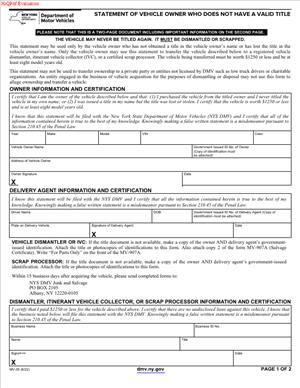
MV-35 – Statement of Vehicle Owner Who Does Not Have a Valid Title
Fill out nowJurisdiction: Country: United States | Province or State: New York
The MV-35 – Statement of Vehicle Owner Who Does Not Have a Valid Title is a written statement used when you own a vehicle but do not have an acceptable title document. In New York, a title is the main proof of ownership for most vehicles. When that title is lost, unavailable, or was never issued in your name, this form may help explain your situation.
You are typically filling out this document as part of a vehicle registration or ownership process. It gives you a structured way to describe how you obtained the vehicle and why you cannot provide a valid title.
This form matters because the title is central to proving legal ownership. Without it, the state cannot easily confirm that you have the right to register, transfer, or otherwise handle the vehicle. The MV-35 – Statement of Vehicle Owner Who Does Not Have a Valid Title helps fill in missing details.
If you are about to complete this form, you likely need clarity about what information is required, how detailed your explanation must be, and what effect signing it has. The sections below walk through each of those points in plain language.
What is MV-35 – Statement of Vehicle Owner Who Does Not Have a Valid Title?
Clear definition
The MV-35 – Statement of Vehicle Owner Who Does Not Have a Valid Title is a sworn written statement. You use it to explain why you do not have a valid vehicle title and to describe how you came into possession of the vehicle.
It is not a replacement title. It does not automatically create ownership. Instead, it provides information that a motor vehicle agency can review when deciding how to process your registration or ownership request.
The form usually asks for identifying details about the vehicle. This may include the year, make, model, and vehicle identification number. It also asks for your personal information and a clear explanation of the circumstances.
When you sign the document, you are confirming that the information you provide is true. The statement becomes part of your vehicle record.
Who typically uses this form?
You might use this form if you bought a vehicle but never received a proper title from the previous owner. This can happen in private sales, especially with older vehicles.
It is also commonly used by people who acquired a vehicle through inheritance. In some cases, the title was lost, misplaced, or never updated before the prior owner passed away.
Another common user is someone who purchased a vehicle years ago and never transferred the title into their name. When they later try to register it, they realize they do not have a valid title document.
In certain situations, people restoring or repairing older vehicles may discover that the title paperwork is incomplete. The form can be part of explaining that gap.
Why might you need this form?
You need this form when the standard proof of ownership is missing. A valid title is usually required to register a vehicle or to transfer ownership to someone else.
If you cannot produce that title, the agency reviewing your paperwork needs an explanation. The form provides a structured way to give that explanation in writing.
Without it, your registration or transfer application may be delayed or rejected. The MV-35 – Statement of Vehicle Owner Who Does Not Have a Valid Title allows you to document the history of the vehicle as you understand it.
It may also be required when there are inconsistencies in ownership records. For example, the name on prior records might not match your name, and there is no formal transfer document.
Typical real-life scenarios
- You buy an older vehicle from a neighbor. The neighbor says the title was lost years ago. You pay for the vehicle and receive a handwritten bill of sale, but no official title. When you go to register it, you are asked to complete this form to explain the situation.
- You inherit a vehicle from a relative. The title cannot be located among their papers. You have other documents showing that the vehicle belonged to them, but not the original title. The form allows you to describe how you became the owner.
- You purchased a vehicle at a small auction. The paperwork you received does not include a standard New York title. When you attempt to register the vehicle, you are asked to provide a written statement about how you acquired it.
- You owned a vehicle many years ago and stored it without registering it. During that time, the title was misplaced. Now you want to put the vehicle back on the road. The form gives you a way to explain the missing document.
- You received a vehicle as a gift. The person who gave it to you believed the title had already been transferred, but the record was never updated. The form can help clarify the timeline of events.
When would you use MV-35 – Statement of Vehicle Owner Who Does Not Have a Valid Title?
You would use this form when you are applying to register a vehicle or otherwise document ownership and you cannot provide a valid title in your name. It often comes up during in-person or mail submissions of vehicle paperwork.
It may also be used when there is a break in the chain of ownership. For example, if the previous owner never transferred the title into their name, and you purchased from them, there may be missing links in the official record.
This form is typically completed by the current possessor of the vehicle. That person is usually the individual seeking registration or formal recognition as the owner.
In some cases, an estate representative handling a deceased person’s property may complete the statement. The purpose remains the same: to explain why a standard title is not available and how ownership changed.
You might encounter this form after your initial application is flagged for missing documentation. Instead of starting over, you may be asked to provide this additional statement to support your filing.
Legal characteristics of MV-35 – Statement of Vehicle Owner Who Does Not Have a Valid Title
This document is generally treated as a sworn statement. That means you are affirming that the information is accurate to the best of your knowledge. False statements can create serious problems.
For the form to be effective, it must be complete and clear. Missing vehicle identification numbers, incomplete names, or vague explanations can lead to delays. Agencies reviewing the document rely on specific details to assess your claim.
Signatures are critical. If the form requires notarization or a specific type of signature, failing to follow those instructions can result in rejection. The signature confirms that you stand behind the contents of the statement.
Common reasons for problems include inconsistent information. For example, if the vehicle identification number on the form does not match other documents, that discrepancy may need further review. If dates do not line up logically, the application can be delayed.
This form does not erase liens. If a lender or other party has a legal interest in the vehicle, a written statement about a missing title does not remove that interest. It also does not guarantee that your registration will be approved.
Different states handle missing titles differently. The requirements and acceptance standards in New York may not match those in other states. The form is designed for use within this specific jurisdiction and fits into its procedures.
Is it legally binding?
The statement is legally significant because you are declaring facts in writing. By signing, you confirm that the information is true. That confirmation carries weight.
However, the form itself does not create ownership by contract. It is not an agreement between you and another private party. Instead, it is a declaration made to a government agency.
Its binding effect relates to the truthfulness of your statements. If the information is accurate, it serves as part of your official record. If the information is false, it can lead to penalties or further investigation.
The legal impact also depends on how the agency evaluates your explanation. The form supports your application, but it does not automatically resolve all ownership questions.
How to fill out MV-35 – Statement of Vehicle Owner Who Does Not Have a Valid Title
Step 1 – Review the entire form before writing
Start by reading the full document from top to bottom. This helps you understand what information is required and what supporting details you may need to gather.
Look for sections asking about the vehicle, your identity, and the history of ownership. Taking a few minutes to review the form reduces mistakes later.
Step 2 – Enter the vehicle information
Provide the year, make, model, and vehicle identification number exactly as they appear on the vehicle and any existing documents. Accuracy is critical here.
If you have a registration card, insurance document, or old paperwork, use it to confirm the details. Even a single incorrect character in the identification number can cause delays.
Step 3 – Provide your personal information
Fill in your full legal name and current address as requested. Use the same name format you are using on related vehicle paperwork.
If the form asks for additional identifiers, such as a driver identification number, enter them carefully. Make sure the information matches your other submissions.
Step 4 – Explain how you obtained the vehicle
Describe clearly how you came into possession of the vehicle. Include dates, names of prior owners, and the type of transaction, such as purchase, gift, or inheritance.
Keep your explanation factual and chronological. State what happened first, what documents you received, and what documents were missing.
Avoid vague statements. Instead of saying the title was “lost,” explain who had it last and when it was last seen, if known.
Step 5 – Explain why you do not have a valid title
State the specific reason the title is unavailable. For example, you might note that the prior owner did not provide it, it was misplaced, or it was never transferred.
If you made attempts to obtain a duplicate or contact a previous owner, briefly describe those efforts. This adds context to your explanation.
Your goal is to make it easy for the reviewer to understand the gap in documentation.
Step 6 – Review for consistency and completeness
Before signing, read your completed form carefully. Check that names, dates, and identification numbers are consistent throughout.
Make sure every required section is filled in. Blank spaces can slow down processing or lead to rejection.
Correct any errors neatly if completing by hand, or prepare a clean copy if necessary.
Step 7 – Sign the statement as required
Sign the form exactly as instructed. If the form requires a signature in the presence of a notary or official, follow those instructions carefully.
By signing, you confirm that the information provided is true to the best of your knowledge. Ensure you are comfortable with every statement on the page before adding your signature.
Legal terms you might encounter in MV-35 – Statement of Vehicle Owner Who Does Not Have a Valid Title
- Affidavit: An affidavit is a written statement made under oath. On this form, your explanation about why you do not have a valid title functions like an affidavit. By signing, you confirm the information is true to the best of your knowledge.
- Registrant: The registrant is the person whose name appears on the vehicle registration. This may or may not be the same as the titled owner. The form may require you to clarify whether you are both the owner and the current registrant.
- Vehicle Identification Number (VIN): The VIN is a unique 17-character code assigned to the vehicle. You must enter it exactly as it appears on the vehicle and prior records. A single incorrect digit can delay processing.
- Chain of Ownership: This refers to the history of who has owned the vehicle. When you explain how you obtained the vehicle, you are describing the chain of ownership. Gaps in this chain can raise questions.
- Supporting Documentation: These are additional papers you may need to submit with the form. Examples include bills of sale, old registrations, or other proof of ownership. The agency uses these to verify your statement.
- Lien: A lien is a legal claim against a vehicle for unpaid debt. If a lien existed or still exists, you may need to disclose that information. Failing to mention a lien can cause the application to be rejected.
- Notarization: Some statements must be signed in front of a notary public. If required, notarization confirms your identity and that you signed voluntarily. Check whether your signature needs this step before submitting.
- Certification: Certification is your formal confirmation that everything you wrote is accurate. This usually appears near the signature line. When you sign, you certify under penalty of law that your statement is true.
- Material Misrepresentation: This means providing false or misleading information that affects the decision on your application. If the agency determines there was material misrepresentation, it can deny your request and take further action.
FAQs
Do I need to submit MV-35 – Statement of Vehicle Owner Who Does Not Have a Valid Title if I simply misplaced my title?
If you only lost your title and you are listed as the owner in the official records, there is often a separate duplicate title process. This document is generally used when you cannot produce a valid title and normal replacement options are not available. Before completing it, confirm whether your situation involves a lost title, an unsigned title, or no title at all, because the reason affects whether this form is appropriate.
What details about the vehicle must match official records?
You must enter the vehicle year, make, model, and Vehicle Identification Number exactly as they appear in prior registration or inspection records. Even small differences, such as a transposed VIN digit, can prevent the agency from locating the vehicle file. Double-check the Vehicle Identification Number directly from the vehicle plate and compare it to any documents you have before writing it on this form.
How detailed should my explanation be about how I obtained the vehicle?
Be specific and chronological. Include the approximate date you received the vehicle, the full name of the person you got it from, and the type of transaction, such as purchase or gift. If you have a bill of sale or receipt, make sure the names and dates in your explanation match those documents. Incomplete timelines are a common reason for follow-up requests.
What if I do not know the previous owner’s full legal name?
Provide as much identifying information as you reasonably can, such as a partial name, nickname, address at the time of sale, or a copy of any document showing their name. Explain clearly why you cannot provide the full legal name. The key is to show that you are not withholding information and that you are giving a truthful account based on what you know.
Does my signature need to be notarized?
Read the signature section carefully. If the form includes language requiring notarization, you must sign in front of a notary and present valid identification. Do not sign it in advance. If notarization is not required, sign exactly as your name appears in the ownership section to avoid name mismatch issues.
What happens after I submit this document?
The agency reviews your statement and any supporting documentation to decide whether to accept your claim of ownership without a valid title. They may compare your information with existing records. If something does not align, you may receive a request for clarification or additional documents before any registration or title action is approved.
Can I correct the form after I have signed it?
If you notice an error before submission, complete a new form rather than crossing out major sections. If you discover a mistake after submitting, you may need to provide a corrected statement. Consistency matters, so make sure any correction matches the rest of your paperwork and supporting documents.
Will this form automatically give me a new title?
This document supports your claim, but it does not automatically create a new title record. The agency must first determine that your explanation and documents are sufficient. Only after approval will the ownership record be updated or a new title process move forward.
Checklist: Before, During, and After MV-35 – Statement of Vehicle Owner Who Does Not Have a Valid Title
Before
- Gather all documents showing how you obtained the vehicle.
- Locate the Vehicle Identification Number directly on the vehicle to verify accuracy.
- Review any prior registration or insurance paperwork for matching details.
- Confirm whether a duplicate title process is available instead.
- Check if notarization is required for your signature.
- Make copies of identification you may need to present.
- Ensure there are no outstanding liens you have not addressed.
During
- Print clearly in black or blue ink if completing by hand.
- Enter the full Vehicle Identification Number without skipping or rearranging characters.
- Write your legal name exactly as it appears on identification.
- Provide a chronological explanation of how you acquired the vehicle.
- Attach copies of supporting documents in logical order.
- Review each section for blank fields that require completion.
- Sign and date the form in the correct location.
- Have your signature notarized if required.
After
- Make a complete copy of the signed form for your records.
- Keep copies of all supporting documents submitted.
- Submit the form using the accepted method for your situation.
- Note the date of submission and any confirmation number.
- Monitor for mailed or electronic correspondence about your case.
- Respond promptly to any request for additional information.
- Store your paperwork in a safe place once processed.
- Update your personal records if ownership status changes.
Common mistakes to avoid with MV-35 – Statement of Vehicle Owner Who Does Not Have a Valid Title
- Mistake: Entering an incorrect VIN because you copied it from memory, which happens when you rely on old paperwork, leading to processing delays or rejection; do not forget to verify the Vehicle Identification Number directly from the vehicle plate.
- Mistake: Giving a vague explanation of how you obtained the vehicle, often due to rushing through the narrative section, which can cause the agency to question the chain of ownership; do not forget to include dates, names, and transaction details.
- Mistake: Signing the form before confirming whether notarization is required, which happens when you skip the signature instructions, resulting in having to redo the document; do not forget to check the certification section first.
- Mistake: Using a nickname or shortened version of your name, which often occurs out of habit, causing name mismatches with official identification; do not forget to use your full legal name consistently.
- Mistake: Failing to attach supporting documents because you assume the statement alone is enough, which can lead to requests for more evidence and delays; do not forget to include copies of bills of sale or prior registrations.
- Mistake: Ignoring possible liens on the vehicle, often because you believe an old loan was automatically cleared, which may block further processing; do not forget to confirm lien status before submission.
- Mistake: Leaving sections blank that require an entry, which happens when a question seems irrelevant, leading to incomplete applications; do not forget to write “N/A” where appropriate instead of leaving spaces empty.
- Mistake: Submitting inconsistent dates between your explanation and attached documents, which can raise concerns about accuracy; do not forget to cross-check all dates before signing.
What to do after filling out MV-35 – Statement of Vehicle Owner Who Does Not Have a Valid Title
Once you complete the form, pause before submitting it. A careful final review can prevent weeks of delay. Read your explanation out loud. Confirm that every date, name, and vehicle detail matches your supporting paperwork.
- Step 1: Make a full copy of the completed and signed form for your records.
- Step 2: Organize your supporting documents in the same order referenced in your written explanation.
- Step 3: Confirm whether you must appear in person or can submit by mail, and prepare accordingly.
- Step 4: If notarization is required and not yet completed, schedule time with a notary and bring valid identification.
- Step 5: Submit the form along with all required attachments and any applicable fees.
- Step 6: Obtain proof of submission, such as a receipt, stamped copy, or tracking confirmation.
- Step 7: Mark your calendar to follow up if you do not receive a response within the expected processing time.
- Step 8: Respond quickly if you receive a request for clarification or additional documentation.
- Step 9: Once your ownership status is updated or a new title is issued, review the new document carefully for accuracy.
- Step 10: Store the new title or registration documents in a secure place and update your insurance or personal records as needed.
Stay organized throughout the process. Keep all related paperwork together in one folder. If questions arise later, you will have a clear record of what you submitted and when. Careful preparation and follow-through make it more likely that your ownership issue will be resolved smoothly.
Disclaimer: This guide is provided for informational purposes only and is not intended as legal advice. You should consult a legal professional.