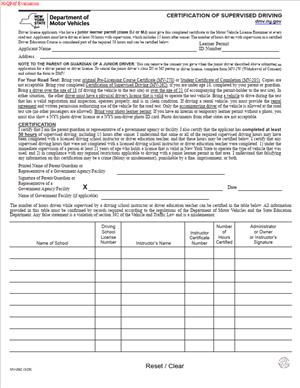
MV-262 – Certification of Supervised Driving
Fill out nowJurisdiction: Country: United States | Province or State: New York
The MV-262 – Certification of Supervised Driving is a required document for certain new drivers in New York. It confirms that you completed the required hours of supervised driving practice before taking your road test. If you are preparing to schedule or attend your driving test, this form is often a key part of your paperwork.
This document is commonly used by junior drivers who hold a learner permit. It records the number of hours you practiced driving and confirms that those hours meet state requirements. Without it, you may not be allowed to move forward in the licensing process.
The form matters because it connects your practice experience to your eligibility for a road test. It serves as written confirmation that you met specific supervised driving standards. It also shows that a qualified adult supervised your practice sessions.
If you are about to fill it out, you need to understand what counts as supervised driving, who can certify your hours, and how the information must be recorded. Small errors or missing signatures can delay your test date.
What is MV-262 – Certification of Supervised Driving?
Clear definition
The MV-262 – Certification of Supervised Driving is a certification document used in New York to verify that a junior learner completed the required amount of supervised driving practice. It is not a test. It is not a license. It is a written confirmation of completed training hours.
The form typically includes the learner’s identifying information and a statement confirming that a set number of hours were spent practicing driving under supervision. A parent, guardian, or another qualifying adult signs the document to certify that the information is accurate.
By signing, the supervising adult confirms that the learner met the minimum practice requirements. The form is then presented as part of the road test process. It acts as a checkpoint before the licensing stage continues.
Who typically uses this form?
This form is most often used by drivers under the age of 18 who hold a junior learner permit. In New York, junior drivers must complete a specific number of supervised driving hours before they are eligible to take the road test.
Parents and legal guardians are frequently the ones who complete and sign the certification. In some cases, another responsible adult who meets the supervision requirements may sign instead. The person signing must have been legally allowed to supervise the practice sessions.
Driving instructors may also be involved in training, but the certification on this form generally relates to supervised practice outside of formal instruction. The person signing confirms the total required hours, not just lessons with a professional.
Why might you need this form?
You need this form if you are a junior driver who must prove completion of supervised driving hours. It is usually required before you can take your road test.
The licensing process for younger drivers often includes several stages. First, you receive a learner permit. Then, you complete required practice hours. After that, you become eligible to schedule and take a road test. The certification document connects the practice stage to the testing stage.
Without submitting a properly completed form, your road test appointment may not move forward. Even if you practiced enough hours, the absence of formal certification can interrupt the process.
The document also creates accountability. It encourages structured practice and confirms that a responsible adult was involved. This helps ensure that new drivers gain meaningful experience before driving independently.
Typical real-life scenarios
- You are 17 years old and have held your learner permit for several months. You have practiced driving after school and on weekends with your parent in the passenger seat. As you prepare to book your road test, you realize you must document those hours. The certification form is how you confirm that the required time was completed.
- You are a parent keeping track of your teenager’s practice sessions. You record time spent driving in different conditions, such as at night or in light traffic. Once the total required hours are reached, you fill out and sign the certification so your child can move to the next step in the licensing process.
- You moved to New York and transferred your learner permit. You learn that supervised driving hours are still required under state rules for junior drivers. Before scheduling a road test, you must complete the certification to show compliance with those requirements.
- You completed a driver education course at school. Even after finishing the course, you still need supervised practice hours with a qualified adult. Once those hours are done, the certification confirms the total experience and supports your road test eligibility.
When would you use MV-262 – Certification of Supervised Driving?
You use the MV-262 – Certification of Supervised Driving near the end of the learner permit stage. It is typically completed after all required supervised practice hours are finished but before or at the time of your road test.
The form becomes relevant when you are preparing to schedule your test or when you are gathering documents to bring to your test appointment. It is part of the transition from supervised learning to independent driving privileges.
Junior drivers are the primary users of this document. A supervising adult, often a parent or guardian, plays an essential role by reviewing the total hours and signing the certification. Both the learner and the supervising adult are involved in the completion process.
The document may also come into focus if your road test is approaching and you are reviewing your checklist of required items. At that stage, confirming that the form is filled out accurately and completely can prevent last-minute complications.
In general, you use this form only once per licensing process for a junior permit. It is not a recurring filing. It is tied to the specific milestone of completing supervised driving requirements and qualifying for the road test.
Legal characteristics of MV-262 – Certification of Supervised Driving
The MV-262 – Certification of Supervised Driving has legal significance because it is a signed statement confirming compliance with state driving requirements. It contains representations about the number of hours completed and the nature of supervision provided.
For the document to be effective, it must be filled out completely and signed by a qualified supervising adult. Missing information, incomplete fields, or an absent signature can result in rejection or delay. Accuracy is important because the form confirms specific facts about your driving practice.
The information provided on the certification is generally expected to be truthful and accurate. A false statement on a government form can carry serious consequences. The supervising adult’s signature is not a formality. It is an acknowledgment that the stated hours were actually completed.
Requirements may vary by state, but in New York, junior drivers must meet clearly defined supervised driving standards before taking a road test. Other states may have different hour requirements or different certification processes. The form discussed here applies specifically within New York’s licensing system.
It is also important to understand what this document does not do. It does not grant you a driver’s license. It does not replace a road test. It does not certify that you are a safe driver. It only confirms that you completed the required supervised practice hours.
Is it legally binding?
The certification is legally meaningful because it is a signed statement made in connection with a government licensing process. When the supervising adult signs the form, they are affirming that the information provided is true.
While the form itself is not a contract between private parties, it is part of an official administrative process. The signature confirms compliance with a legal requirement for junior drivers. In that sense, it carries legal weight.
If the information on the form is inaccurate or intentionally false, there may be consequences under applicable laws related to false statements. The legal impact depends on the circumstances, but the document is more than a casual note. It is part of a formal licensing procedure.
At the same time, signing the certification does not make the supervising adult responsible for all future actions of the new driver. It does not create ongoing legal liability for the learner’s driving after licensing. Its purpose is limited to confirming completion of supervised practice hours.
How to fill out MV-262 – Certification of Supervised Driving
Step 1 – Review eligibility and hour requirements
Before you write anything on the form, confirm that the required number of supervised driving hours has been completed. The certification typically refers to a specific total number of hours, including a portion that may need to be completed at night. Make sure your practice time meets the stated requirements before proceeding.
Step 2 – Enter the learner’s identifying information
Fill in the learner’s full legal name exactly as it appears on the learner permit. Include any required identification details, such as date of birth or permit number, if the form asks for them. Write clearly and double-check for spelling errors.
Step 3 – Confirm the total supervised driving hours
Locate the section of the form where the total number of supervised hours is referenced. Ensure that the stated number reflects the full amount of required practice. The form often includes a pre-printed statement confirming that a minimum number of hours has been completed. Read this statement carefully before moving on.
Step 4 – Provide supervising adult information
Enter the name of the parent, guardian, or qualified supervising adult who oversaw the driving practice. Provide any additional identifying details requested, such as address or relationship to the learner. The person listed must be someone legally permitted to supervise a learner driver.
Step 5 – Review the certification statement
Before signing, read the certification language in full. This section usually states that the supervising adult affirms the truth of the information and confirms that the required hours were completed under appropriate supervision. Make sure the statement accurately reflects the situation.
Step 6 – Sign and date the form
The supervising adult signs the form in the designated signature area. The signature should be handwritten if a physical copy is used. Add the date of signing where requested. Ensure that the date is accurate and matches the completion of the required hours.
Step 7 – Check for completeness before submission
Review the entire document for blank spaces, missing signatures, or unclear writing. Confirm that all required sections are filled out. Once you are satisfied that the information is complete and accurate, keep the form with your other required documents for your road test appointment.
Legal terms you might encounter in MV-262 – Certification of Supervised Driving
- Learner Permit: A learner permit is the limited driving credential issued before you receive a full driver’s license. On this form, the permit identifies the young driver who completed supervised driving hours. The permit number must match DMV records exactly, including any letters and digits.
- Supervised Driving: Supervised driving refers to practice driving done with a qualified adult in the vehicle. This document confirms that the required number of supervised hours has been completed. The hours must meet specific conditions, such as including a minimum number of hours at night.
- Certification: A certification is a formal statement that something is true. On this form, the parent or guardian certifies that the listed driving hours were actually completed. By signing, the adult affirms the accuracy of the information.
- Parent or Guardian: The parent or guardian is the adult legally responsible for the minor driver. This person must supervise or oversee the supervised driving practice and sign the form. The DMV relies on this person’s statement to confirm eligibility for the road test.
- Road Test Eligibility: Road test eligibility means you meet all requirements to schedule and take the driving test. This form is one of those requirements for many young drivers. Without it, you may not be allowed to proceed to the next licensing step.
- Minimum Hour Requirement: The minimum hour requirement is the total number of practice hours required before taking the road test. The form asks you to confirm that this minimum has been met. It may also require a specific number of hours under certain conditions, such as nighttime driving.
- Night Driving Hours: Night driving hours are supervised hours completed after dark. The form typically requires confirmation that a set number of these hours were included in the total. This ensures exposure to different driving conditions.
- Signature Under Penalty: A signature under penalty means the signer understands that false statements can lead to legal consequences. When the parent or guardian signs, they confirm that the information is truthful. Providing false information can result in delays, denial of testing, or other penalties.
- Department of Motor Vehicles (DMV): The DMV is the state agency that processes driver licensing documents. This form is submitted to the DMV as part of the road test process. The DMV reviews it to confirm that supervised driving requirements have been met.
- Minor Applicant: A minor applicant is a driver under the age of 18 who is applying for a driver license. This document applies specifically to minor applicants who must complete supervised driving hours before advancing.
FAQs
Do I need to submit MV-262 – Certification of Supervised Driving before scheduling a road test?
You generally need this document completed before you take your road test. In many cases, you bring it with you to the test appointment. If you arrive without it, the examiner may refuse to conduct the test. Make sure it is fully signed and dated before your appointment.
Who is allowed to sign this form?
A parent or legal guardian must sign this document. The signer should be the adult responsible for supervising or overseeing your practice driving. Check that the name entered matches the signer’s identification and any records connected to your permit application.
What if I did more than the minimum required hours?
You only need to certify that you met or exceeded the required minimum. There is usually a space to confirm the total number of hours. Make sure the total reflects at least the required amount and includes any required nighttime hours.
Do I need to attach a log of my driving hours?
This document typically does not require you to attach a detailed log when you submit it. However, you should keep your personal driving log in case there are questions. If an examiner asks for clarification, having a record helps support the certification.
What happens if the names do not match my permit exactly?
Names on this form should match the learner permit exactly, including middle initials if listed. If there is a mismatch, the DMV may delay processing or refuse the road test. Double-check spelling, order of names, and any suffixes before signing.
Can someone other than my parent count toward my supervised hours?
Supervised hours may be completed with other qualified adults, depending on the rules. However, the certification itself must be signed by a parent or guardian. The signer is confirming that all required hours were completed, even if some were with another eligible supervisor.
What date should be listed on the form?
The date entered should be the date the parent or guardian signs the certification. It should be after all required supervised driving hours are complete. Do not predate the form or sign it before finishing the required practice.
What changes in the DMV record after I submit this document?
When you submit this document, the DMV updates your file to show that you met the supervised driving requirement. This allows you to proceed with the road test process. It does not automatically grant you a license; it simply confirms eligibility for the next step.
Checklist: Before, During, and After MV-262 – Certification of Supervised Driving
Before
- Confirm you have completed at least the required total number of supervised driving hours.
- Verify you included the required number of nighttime driving hours.
- Check your learner permit for the exact spelling of your name and permit number.
- Make sure the supervising parent or guardian is available to review and sign.
- Gather your personal driving log for reference.
- Review road test eligibility requirements to ensure this form is the only remaining item.
During
- Enter the learner’s full legal name exactly as shown on the permit.
- Write the correct learner permit number without missing digits.
- Confirm the total supervised driving hours meet or exceed the minimum.
- Ensure nighttime hours are included in the total, if required.
- Have the parent or guardian carefully read the certification statement.
- Sign and date the form in the correct spaces.
- Double-check all fields for blanks or errors before finalizing.
After
- Make a clear copy or take a photo of the completed form for your records.
- Store the original in a safe place until your road test appointment.
- Bring the original signed form to the road test.
- Keep your personal driving log in case you are asked for additional proof.
- Monitor your road test appointment confirmation details.
- Replace the form if it becomes damaged or unreadable before submission.
Common mistakes to avoid with MV-262 – Certification of Supervised Driving
- Mistake: Listing fewer than the required supervised hours because you did not track them carefully, which happens when you rely on memory, leading to road test denial; do not forget to total your hours accurately before signing.
- Mistake: Forgetting to include required nighttime hours because you focused only on daytime practice, which can delay eligibility; do not forget to confirm that nighttime driving is part of your total.
- Mistake: Misspelling the learner’s name or permit number due to rushing, which can cause processing issues at the test site; do not forget to copy details directly from the permit.
- Mistake: Having the wrong person sign the form because a different adult supervised most sessions, which can make the certification invalid; do not forget that a parent or legal guardian must sign.
- Mistake: Signing before completing all required hours in an effort to schedule the road test sooner, which may be treated as a false certification; do not forget to wait until every required hour is finished.
- Mistake: Bringing a photocopy instead of the original signed document to the road test, which may result in refusal of the test; do not forget to carry the original form.
- Mistake: Leaving sections blank because they seem minor, which can lead to rejection at check-in; do not forget to review every line before submission.
- Mistake: Dating the form incorrectly or using an old date, which may raise questions about accuracy; do not forget to enter the actual date of signature.
What to do after filling out MV-262 – Certification of Supervised Driving
Once you complete the form, your next steps matter. This document is a key part of moving from a learner permit to a full driver license. Handle it carefully.
First, review every entry one more time. Look at the learner’s name, permit number, total hours, and signature. Small mistakes can cause delays on test day.
- Step 1: Make a clear copy or take a high-quality photo of the signed form for your personal records.
- Step 2: Store the original document in a safe, dry place where it will not be folded or damaged.
- Step 3: Confirm your road test appointment date, time, and location.
- Step 4: Gather all other required items for the road test, such as your learner permit and any required identification.
- Step 5: Bring the original signed form with you to the road test appointment.
- Step 6: Present the document to the examiner or check-in staff when requested.
- Step 7: Keep your copy of the form even after the road test, in case questions arise later.
- Step 8: If you pass the road test, follow the instructions given to complete the licensing process.
- Step 9: Update your personal records to reflect the date you completed supervised driving and submitted the certification.
- Step 10: Safely discard extra draft copies that contain personal information to protect your privacy.
If the form is lost before your test, complete a new one with the required signature. Do not attempt to alter or recreate a signature. If your test is postponed, confirm that the form is still complete and readable before the new date.
Treat this document as part of your official driving record. Keep your copy with other important licensing papers. Staying organized helps you avoid repeat steps and unnecessary stress as you move toward becoming a fully licensed driver.
Disclaimer: This guide is provided for informational purposes only and is not intended as legal advice. You should consult a legal professional.