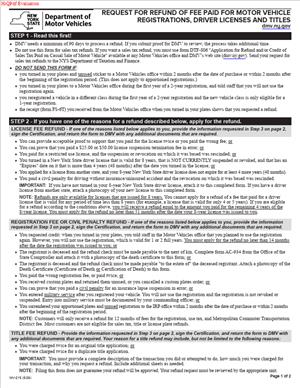
MV-215 – Request for Refund of Fee Paid for Motor Vehicle Registrations, Driver Licenses and Titles
Fill out nowJurisdiction: Country: United States | Province or State: New York
If you paid a fee to the New York Department of Motor Vehicles and believe you were entitled to get that money back, the MV-215 – Request for Refund of Fee Paid for Motor Vehicle Registrations, Driver Licenses and Titles is the form used to ask for that refund. It is a written request that explains what you paid, why you think a refund is owed, and how the payment was made.
This form is designed for people who have already completed a transaction related to a vehicle registration, driver’s license, or vehicle title. It is not used to cancel a transaction before payment. Instead, it addresses situations where the fee was paid and later determined to be unnecessary, duplicated, or incorrect.
When you fill out this document, you are formally asking the agency to review your case. The form creates a record of your request. It also gives the agency the information it needs to locate your payment and evaluate whether a refund can be issued.
Understanding how this form works can save time and prevent delays. Small errors, missing details, or unclear explanations can slow down the review process. Knowing what information to gather before you begin makes the completion and submission process more straightforward.
What is MV-215 – Request for Refund of Fee Paid for Motor Vehicle Registrations, Driver Licenses and Titles?
Clear definition
MV-215 – Request for Refund of Fee Paid for Motor Vehicle Registrations, Driver Licenses and Titles is an official refund request document used in New York. It allows an individual or business to ask for the return of money paid for certain motor vehicle–related services.
The form focuses on three main categories of transactions: vehicle registrations, driver licenses, and vehicle titles. These are common services that require fees. If a payment was made in error, duplicated, or later determined to be unnecessary, this document provides a structured way to explain the situation.
The form typically asks for identifying details, such as your name, address, and contact information. It also requests information about the vehicle or license involved, the amount paid, the date of payment, and the reason you believe a refund is appropriate. Supporting documentation is often required to help verify your claim.
This document does not automatically guarantee repayment. It starts a review process. The agency evaluates the information you provide and determines whether the payment qualifies for a refund under its rules.
Who typically uses this form?
You might use this form if you are a vehicle owner who paid a registration fee that turned out to be incorrect. For example, you may have paid twice for the same registration period or paid for a vehicle that was later sold or transferred sooner than expected.
Drivers who paid for a license transaction in error may also use it. This could include duplicate payments for a renewal or paying a fee for a service that was later canceled.
Businesses sometimes use this form as well. Dealerships, fleet operators, and companies that manage multiple vehicles may discover overpayments or administrative mistakes during routine record checks. In those cases, the business representative completes the form on behalf of the organization.
In short, anyone who paid a qualifying motor vehicle–related fee in New York and believes a refund is owed may use this document to make a formal request.
Why might you need this form?
You might need this form if you discover that you paid more than required for a transaction. Overpayments can happen because of clerical errors, misunderstandings about eligibility, or duplicate submissions.
You may also need it if a transaction was reversed or not completed, but the fee was still processed. In that situation, the form allows you to explain what occurred and request a review of the payment.
Another reason is when circumstances change shortly after payment. For example, you may have registered a vehicle and then sold it soon after. Depending on the timing and the type of fee, part of the amount paid might be eligible for review.
The form is also useful when a payment was made under incorrect information. If a vehicle was classified in the wrong category and a higher fee was charged, this document gives you a way to present corrected details.
Typical real-life scenarios
- You renew your vehicle registration online and later realize that the payment was processed twice. Your bank statement shows two charges for the same amount on the same day. In that case, this form allows you to document both charges and request review of the duplicate payment.
- You transfer ownership of a vehicle and pay a title fee. After the transaction, you learn that the title had already been issued and that the additional fee was unnecessary. The form lets you describe the transaction and attach proof of the prior title issuance.
- You surrender your license plates earlier than expected. You had already paid for a full registration period. Depending on timing and applicable policies, part of the registration fee may be subject to review. The form provides space to explain the timeline and attach evidence of plate surrender.
- You apply for a driver license renewal but later determine that your renewal was not due yet. If you paid a fee that was not required at that time, the form creates a record of your request for refund consideration.
- A business reviews its financial records and finds that multiple vehicles were registered under an incorrect weight class. The higher fee was paid by mistake. The company can use this form to identify each affected vehicle and request evaluation of the difference paid.
- You make a payment by mail and later submit another payment in person, not realizing the first payment had already been processed. When both payments clear, you can use the form to explain the sequence and provide copies of receipts or bank statements.
- Each of these scenarios involves a completed payment. The common thread is that you believe the fee paid was incorrect, duplicated, or not required under the circumstances.
When would you use MV-215 – Request for Refund of Fee Paid for Motor Vehicle Registrations, Driver Licenses and Titles?
You would use this form after a motor vehicle–related fee has already been paid, and you believe the amount should be returned in full or in part. It is not used before payment and does not replace other transaction forms.
Timing often matters. Refund requests are generally made after you discover an error or after a related transaction changes the situation. For example, a cancellation, transfer, or correction may trigger the need for a refund review.
Vehicle owners commonly use the form after registration or title transactions. Drivers may use it after license renewals or duplicate license requests. Businesses use it when reviewing multiple accounts and identifying inconsistencies in payment records.
You might also use it if your payment method was charged incorrectly. For instance, if you were charged for a service that was not completed, the form provides a structured way to describe what happened and supply supporting details.
The form is appropriate when there is a specific payment to reference. You will need details such as the date, amount, and type of transaction. Without that information, it can be difficult for the agency to locate the payment and evaluate your request.
In general, this document is used when you are asking for a financial adjustment related to motor vehicle services that have already been processed.
Legal characteristics of MV-215 – Request for Refund of Fee Paid for Motor Vehicle Registrations, Driver Licenses and Titles
This form functions as a formal written request. It creates an official record that you are asking for a refund and provides the information needed for review. Its effectiveness depends on accuracy, completeness, and supporting documentation.
To be considered valid, the form must typically include correct identifying information. This includes your name, contact details, and specific information about the vehicle, license, or title involved. Omissions can delay processing because the agency may not be able to match your request to a specific transaction.
Clear explanations are important. If the reason for the refund is vague, the reviewer may not understand what happened. A concise but detailed description of the payment and the issue helps avoid confusion.
Supporting documents often play a key role. Copies of receipts, canceled checks, transaction confirmations, or registration documents help verify your claim. Without documentation, the agency may have limited ability to confirm the payment history.
Common reasons for rejection or delay include missing signatures, incomplete fields, incorrect transaction dates, or lack of proof of payment. Submitting inconsistent information, such as mismatched vehicle identification numbers or license numbers, can also create problems.
Refund policies may vary depending on the type of fee and the timing of the request. Some fees are structured in ways that do not allow for partial refunds once processed. Others may be reviewed on a case-by-case basis. The form itself does not override those underlying rules.
This document does not cancel a registration, license, or title. It does not change ownership records. It does not automatically adjust your driving privileges. Its purpose is limited to requesting a return of money previously paid.
Is it legally binding?
The form is not a contract between you and the agency. It is a request for administrative review. By signing it, you confirm that the information you provided is true to the best of your knowledge.
Your signature may be treated as a certification that the statements in the form are accurate. Providing false information can have consequences under general laws related to written statements made to government agencies.
The agency is not legally required to approve every request simply because the form is submitted. Approval depends on whether the payment qualifies for a refund under applicable rules and whether sufficient documentation is provided.
Once a refund is approved and issued, that action becomes part of the official record of your transaction history. Until then, the form serves as a request under review rather than a binding agreement guaranteeing payment.
How to fill out MV-215 – Request for Refund of Fee Paid for Motor Vehicle Registrations, Driver Licenses and Titles
Step 1 – Review your payment records
Before writing anything on the form, gather your documents. Locate receipts, transaction confirmations, bank or card statements, registration certificates, license documents, or title paperwork related to the payment in question. Confirm the exact amount paid, the date of payment, and the type of service involved. Having accurate information in front of you reduces errors and helps you complete the form consistently.
Step 2 – Enter your personal or business information
Provide your full legal name as it appeared on the original transaction. If a business made the payment, use the registered business name. Include your current mailing address and contact details. This information allows the agency to identify who is making the request and where to send any written response or refund.
Step 3 – Identify the vehicle, license, or title involved
Fill in the specific details requested about the vehicle or driver’s license connected to the payment. This may include the vehicle identification number, plate number, driver’s license number, or title number. Enter these carefully. Even a small error in a number can make it difficult to locate the correct record.
Step 4 – Provide payment details
State the exact amount paid and the date the payment was made. Indicate the method of payment, such as check, card, or other accepted method. If there were multiple payments, clearly distinguish each one and match them to supporting documents. Consistency between the form and your attachments is important.
Step 5 – Explain the reason for the refund request
Use the space provided to describe what happened. Keep your explanation clear and direct. State the original transaction, the issue you discovered, and why you believe a refund is appropriate. Refer to attached documents when relevant, such as receipts or proof of duplicate charges. Avoid unrelated details and focus on the payment in question.
Step 6 – Attach supporting documentation
Make copies of all relevant documents and include them with your submission if required. Do not send original documents unless specifically instructed in the form. Ensure each attachment supports the information you entered, such as proof of payment or evidence of a corrected transaction.
Step 7 – Review the completed form
Read through every section before signing. Check names, numbers, dates, and amounts. Confirm that your explanation matches the documents attached. Correct any blank fields that apply to your situation. A careful review helps prevent delays caused by missing or inconsistent information.
Step 8 – Sign and date the form
Sign the form in the space provided. Enter the date of your signature. Your signature confirms that the information you provided is accurate to the best of your knowledge. If a business is submitting the request, the authorized representative signs on behalf of the organization.
Step 9 – Submit the form as directed
Follow the submission instructions listed on the form. This may involve mailing the document or delivering it to a specified office. Ensure that all pages and attachments are included in the final submission. Keep copies of everything you send for your records.
Legal terms you might encounter in MV-215 – Request for Refund of Fee Paid for Motor Vehicle Registrations, Driver Licenses and Titles
- Applicant: The person or business requesting the refund. On this form, you are the applicant if you paid the fee and are asking to get that money back. Your name must match the name on the original transaction unless you provide proof that you are authorized to act for someone else.
- Registrant: The individual or entity listed on the vehicle registration. This may be you, your business, or another party. If you are not the registrant but paid the fee, the form may require clarification or supporting documents.
- Refund Request: Your formal written demand to return a fee that was paid. This form creates a record of your request and explains why you believe the payment should be refunded. The reason you give must match the situation shown in your documents.
- Proof of Payment: Documents that show you actually paid the fee. This can include a receipt, transaction confirmation, canceled check, or account statement. The agency uses this to verify the amount and date of payment.
- Supporting Documentation: Any additional paperwork that backs up your explanation. Examples include registration cancellation confirmations, duplicate payment receipts, title transfer records, or official notices. Missing documents can delay review.
- Transaction Number: A reference number linked to your original payment or motor vehicle record. It helps staff locate the correct record quickly. You usually find it on your receipt or confirmation notice.
- Authorization: Written permission allowing you to act on someone else’s behalf. If you are requesting a refund for a company, family member, or client, you may need proof that you are authorized to sign and submit the form.
- Signature Certification: Your signature confirms that the information you provided is accurate. By signing, you declare that the statements are true to the best of your knowledge. Inaccurate information can lead to denial or further review.
- Processing Time: The period the agency takes to review and decide on your request. This does not start until the form and all required documents are received. Incomplete submissions often extend processing time.
- Overpayment: A situation where you paid more than the required fee. This might happen because of duplicate transactions, calculation errors, or canceled services. You must clearly explain how the overpayment occurred.
FAQs
Can I submit MV-215 – Request for Refund of Fee Paid for Motor Vehicle Registrations, Driver Licenses and Titles if I lost my original receipt?
Yes, but you must still prove that you paid the fee. Look for a transaction confirmation email, bank or credit card statement, canceled check, or online account record showing the date and amount. Make sure the payment details you enter on this form match the documentation you attach. If the agency cannot verify the payment, your refund may be denied.
What name should I put if the registration was in my business name but I paid personally?
Enter the registrant’s name exactly as it appears on the registration record, then clearly state your relationship to that registrant. If you are requesting the refund on behalf of a business, include proof that you are authorized to act for the company. The name on the form must connect clearly to the original payment and registration record.
Do I need to return license plates or other items before requesting a refund?
In many situations, eligibility for a refund depends on whether plates or documents were surrendered or canceled. Check your records to confirm the date of surrender or cancellation. Enter that date accurately on this document if required. Keep any receipt or confirmation showing the items were returned.
How do I explain the reason for my refund request?
Be specific and factual. State what you paid for, the date you paid it, and why you believe the fee should be refunded. For example, explain if you paid twice, canceled a registration before it became effective, or were charged in error. Avoid vague statements and refer directly to the documents you are attaching.
What happens if the amount I request does not match the agency’s records?
The agency will compare your claimed amount with its transaction history. If there is a mismatch, your request may be delayed while staff reviews the discrepancy. Double-check the exact fee paid and enter the correct amount as shown on your proof of payment. If you are unsure, attach all relevant receipts so the reviewer can verify.
Can someone else sign this form for me?
Yes, but only if they have proper authorization. The person signing must indicate their relationship to you and may need to attach written proof of authority. The signature confirms that the information is accurate, so it should be signed by someone who understands the details of the payment and request.
Will submitting this form automatically cancel my registration or license?
No. This document only requests a refund of fees. If you need to cancel or surrender a registration, license, or title, you must complete the appropriate process separately. Make sure any cancellation steps are completed before or at the same time, if your refund depends on them.
How will I know if my refund request was approved?
You will typically receive written confirmation or the refund itself by mail or through the original payment method, depending on the situation. Keep a copy of this form and all attachments so you can compare them with any response. If you do not receive confirmation within the expected processing time, follow up with your transaction details ready.
Checklist: Before, During, and After MV-215 – Request for Refund of Fee Paid for Motor Vehicle Registrations, Driver Licenses and Titles
Before
- Gather your original payment receipt or transaction confirmation.
- Locate the vehicle registration, title, or driver license details involved.
- Confirm the exact amount you paid and the date of payment.
- Check whether plates or documents were surrendered and note the date.
- Collect any cancellation or duplicate payment proof.
- Verify the correct legal name of the registrant.
- Obtain written authorization if acting for someone else.
- Review your mailing address for accuracy.
During
- Write your full legal name exactly as it appears on the original record.
- Enter the correct vehicle identification or license number.
- Provide the precise payment amount and date.
- Clearly explain the reason for the refund in plain language.
- Attach copies, not originals, of supporting documents unless required.
- Double-check that all fields are complete and legible.
- Sign and date the form in the designated space.
- Confirm that contact information is current and readable.
After
- Make a complete copy of the signed form and all attachments.
- Submit the form using the method instructed.
- Note the date you submitted the request.
- Track delivery if you mail the documents.
- Monitor your mail or account for confirmation.
- Store all related paperwork together in one file.
- Follow up if you do not receive a response within the expected timeframe.
- Record the refund amount once received for your financial records.
Common mistakes to avoid with MV-215 – Request for Refund of Fee Paid for Motor Vehicle Registrations, Driver Licenses and Titles
- Mistake: Leaving sections blank because you think they do not apply, which happens when you rush, can lead to processing delays or rejection, so do not forget to review every field and mark it appropriately.
- Mistake: Entering a nickname or shortened business name, which often occurs out of habit, can cause record mismatches, so do not forget to use the exact legal name shown on the registration or title.
- Mistake: Claiming the wrong refund amount due to estimating instead of checking receipts, which may result in denial or extra review time, so do not forget to verify the exact amount paid.
- Mistake: Failing to attach proof of payment because you assume it is already on file, which can stall your request, so do not forget to include clear copies of supporting documents.
- Mistake: Signing without confirming the explanation is accurate, which may create inconsistencies in the record, so do not forget to reread your reason statement before signing.
- Mistake: Submitting the form before completing required cancellations or plate returns, which can make you ineligible for a refund, so do not forget to complete all prerequisite steps first.
- Mistake: Providing outdated contact information because you recently moved, which can prevent you from receiving notices or the refund, so do not forget to update your address on the form.
What to do after filling out MV-215 – Request for Refund of Fee Paid for Motor Vehicle Registrations, Driver Licenses and Titles
Once you complete the form, slow down and review everything one more time. Small errors cause big delays. Make sure your explanation matches the documents you attached. Confirm that your signature and date are present.
- Step 1: Make a full copy of the signed form and every attachment for your records.
- Step 2: Organize the documents in the order listed on the form so they are easy to review.
- Step 3: Submit the form using the instructed method and keep proof of submission.
- Step 4: If mailing, consider using a method that confirms delivery and keep the receipt.
- Step 5: Mark your calendar with the submission date and estimated processing period.
- Step 6: Monitor your mail, email, or account for any communication about missing information.
- Step 7: Respond promptly if additional documents or clarification are requested.
- Step 8: When you receive the refund, confirm the amount matches what was approved.
- Step 9: Keep the refund notice with your vehicle or financial records for future reference.
- Step 10: Update your personal or business accounting records to reflect the refunded amount.
Stay organized. Keep everything together in one file, digital or paper. If you later need to prove that you requested the refund or confirm the amount returned, you will have a clear paper trail. Good recordkeeping protects you and makes future transactions smoother.
Disclaimer: This guide is provided for informational purposes only and is not intended as legal advice. You should consult a legal professional.