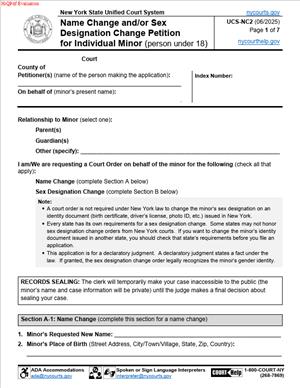
UCS-NC2 – Name Change and or Sex Designation Change Petition for Individual Minor
Fill out nowJurisdiction: Country: United States | Province or State: New York
The UCS-NC2 – Name Change and/or Sex Designation Change Petition for Individual Minor is a court filing used to ask a judge to approve a change for a child under 18. It is part of a formal process, not a private agreement. The court reviews the request before any change becomes official.
This document matters because it affects how a minor is legally identified. Once approved, the change can impact records across schools, health systems, and government agencies. Accuracy and clarity on this form are essential.
You may be filling this out during a stressful or time-sensitive moment. Many people encounter this form while supporting a child’s identity, safety, or family stability. The form is structured, but each section has a specific purpose.
This content is written to help you understand what the form is asking for. It explains how the document works, when it is used, and how people typically complete it. It does not replace court instructions or legal review.
What is UCS-NC2 – Name Change and/or Sex Designation Change Petition for Individual Minor?
Clear definition
UCS-NC2 – Name Change and/or Sex Designation Change Petition for Individual Minor is a written request submitted to a New York court. It asks the court to approve a legal change to a minor’s name, sex designation, or both. The request is made on behalf of the minor, not by the minor alone.
The form collects identifying information about the child and the adults involved. It also asks for the reason for the requested change. The court uses this information to decide whether to grant the petition.
This document becomes part of a court case file. If approved, it leads to a court order that authorizes the change. That order is what allows records to be updated.
Who typically uses this form/document?
This form is commonly used by a parent or legal guardian of a minor. In some situations, more than one adult may be involved in the filing. The adults are usually responsible for completing and signing the document.
Caregivers who have legal authority over a child often encounter this form. That can include adoptive parents or others with court-recognized responsibility. The form is not designed for adults seeking changes for themselves.
The minor is the subject of the petition, but not the filer. Information about the minor’s current legal status is central to the document.
Why you might need this form/document
You might need this form when a child’s legal name no longer matches how they are known in daily life. This mismatch can create confusion in school, medical care, or travel. A court-approved change can resolve those inconsistencies.
The form is also used when a minor’s sex designation on legal records does not reflect their lived identity. A court order may be required before government records can be updated. This form begins that process.
In other cases, the form is part of a broader family change. Events like adoption, guardianship changes, or family safety concerns sometimes lead to a name change request. The court uses this filing to evaluate those circumstances.
Typical real-life scenarios
- A parent may complete this form after a child has used a chosen name for years. Teachers, doctors, and peers already recognize that name. The legal record, however, still shows the birth name.
- Another common situation involves a child whose sex designation causes distress or administrative problems. The family may seek a legal update so records align across systems. The form provides a structured way to explain the request.
- Some families use this document after adoption. The child’s last name may change to reflect the new family unit. The petition allows the court to formalize that change.
- There are also safety-related scenarios. A family may request a name change to protect a child’s privacy. The court reviews these requests carefully, based on the information in the filing.
When would you use UCS-NC2 – Name Change and/or Sex Designation Change Petition for Individual Minor?
This form is used before any legal change occurs. It is not used to report a change that already happened. The filing asks the court to approve the change in advance.
People often use the form when administrative updates are blocked without a court order. Schools, health insurers, or government agencies may require official documentation. The petition is the first step toward obtaining that documentation.
The form is also used when consistency matters across records. A mismatch between documents can cause repeated problems. The petition addresses the issue at the legal level.
Adults filing the document are usually acting in a representative role. They are presenting information to the court on the minor’s behalf. Timing often depends on school calendars, medical needs, or upcoming travel.
Legal characteristics of UCS-NC2 – Name Change and/or Sex Designation Change Petition for Individual Minor
This document has legal significance because it initiates a court case. It must be completed in full and signed as required. Incomplete or unclear information can delay review.
The form is effective only when accepted by the court. Filing alone does not change any record. The court evaluates the content before issuing an order.
Common problems include inconsistent names, missing dates, or unclear explanations. The court relies on the written record, so clarity matters. Information that conflicts with other filings can raise questions.
Processes and requirements can vary by jurisdiction. While the general structure is consistent within New York, details may differ elsewhere. This document does not function the same way outside the issuing court system.
The form does not update records by itself. It does not change a birth certificate, school file, or medical record. Those updates typically require a separate step after a court order is issued.
Is it legally binding?
The petition itself is not legally binding. It is a request for the court to act. Legal effect comes only if the court approves the request and issues an order.
Once a court order is granted, that order carries legal authority. Agencies rely on it to make official changes. Without the order, the petition has no binding effect.
The accuracy of the petition matters because it becomes part of the court record. Statements made in the document are treated as representations to the court. That is why careful completion is important.
How to fill out UCS-NC2 – Name Change and/or Sex Designation Change Petition for Individual Minor
Step 1 – Review the title and caption
The top of the form identifies the court and the type of request. This section connects the petition to the correct court system. Information here frames the entire filing.
Step 2 – Identify the minor
This section asks for the minor’s current legal name and other identifying details. The court uses this information to confirm who the request is about. Consistency with existing records is important.
Step 3 – List the requesting adult or adults
The form requires information about the person submitting the petition. This establishes the adult’s role in the case. Contact details allow the court to communicate about the filing.
Step 4 – Describe the requested change
Here, the form asks what change is being requested. This may involve a name change, a sex designation change, or both. The description should be clear and specific.
Step 5 – Explain the reason for the request
This section provides space to explain why the change is being sought. The court relies on this explanation to understand the context. The narrative connects the request to the minor’s circumstances.
Step 6 – Address prior legal history if requested
Some versions of the form ask about past name changes or related court cases. This helps the court assess the full background. Accurate disclosure avoids confusion during review.
Step 7 – Review statements and acknowledgments
The form includes statements that the filer is asked to affirm. These statements relate to the truthfulness of the information provided. Reading this section helps you understand what the signature represents.
Step 8 – Sign and date the form
The signature section finalizes the petition. It indicates that the information is complete to the best of the filer’s knowledge. The date shows when the request was made.
Step 9 – Prepare the form for submission
After completion, the form is ready to be submitted to the court. Formatting, legibility, and completeness affect how smoothly the filing is processed. This step concludes the preparation of the UCS-NC2 – Name Change and/or Sex Designation Change Petition for Individual Minor.
Legal terms you might encounter in UCS-NC2 – Name Change and/or Sex Designation Change Petition for Individual Minor
- Petitioner: The petitioner is the adult asking the court to approve the change. On this form, that is usually a parent or legal guardian. You list your information because the court needs to know who is making the request and what authority you have to act for the child.
- Minor: The minor is the child under 18 whose name and/or sex designation you want to change. The form focuses on the minor’s current legal identity. Every detail you provide ties back to the minor, not to you.
- Legal name: A legal name is the name currently recognized on official records. This is the name shown on documents like a birth certificate or prior court order. On this form, you must use the legal name exactly as it appears now, even if the child uses a different name day to day.
- Proposed name: The proposed name is the new name you want the court to approve. You write it clearly so the court knows exactly what you are asking for. This is the name that will appear in the court order if the petition is granted.
- Sex designation: Sex designation refers to how sex is recorded on legal documents. On this form, you indicate the current designation and the designation you are requesting. The court uses this information to understand what change you want reflected in official records.
- Jurisdiction: Jurisdiction is the court’s authority to hear the case. By filing this form, you are asking a specific court to review your request. The court checks its jurisdiction to confirm it has the power to issue an order for this minor.
- Affidavit: An affidavit is a written statement made under oath. Parts of this form function like an affidavit because you are affirming that what you write is true. The court treats these statements seriously.
- Court order: A court order is the written decision issued by the judge. This form does not change anything by itself. Only the court order, issued after review, allows you to update records.
- Filing: Filing means officially submitting the form to the court. Until the document is filed and accepted, the court does not review it. Filing starts the legal process.
FAQs
Who is allowed to sign this form for a child?
You sign this document as the adult who has legal authority to act for the child. The court expects the signer to be a parent, legal guardian, or someone with court-recognized responsibility. When you sign, you are confirming that you have the right to make this request and that the information you entered is accurate.
Do I need to request both a name change and a sex designation change?
No. This form lets you request a name change, a sex designation change, or both. You should only complete the sections that apply to what you are asking for. Leaving unrelated sections blank is normal when the change does not apply.
What name should I use when listing the child’s current information?
You must use the child’s current legal name, not a nickname or chosen name. The court uses this to match existing records. If the name does not match prior documents, the court may not be able to process the request.
How detailed should the reason for the request be?
The reason should explain why the change is being requested and how it relates to the child’s situation. You do not need to tell your entire family history. Focus on facts that help the court understand the purpose of the change and why it is being made now.
Does filing UCS-NC2 – Name Change and/or Sex Designation Change Petition for Individual Minor automatically change school or medical records?
No. Filing this document only asks the court to review your request. Records are updated only after the court issues an order. You will later use that order to request changes from schools, doctors, and other agencies.
What happens if the other parent does not agree?
This form still records your request, but disagreement can affect what happens next. The court may require additional steps or information. The key point for you is to complete the form honestly and clearly, because the court relies on what is written here.
Do I need to attach proof or extra documents to this form?
Sometimes attachments are required, depending on the situation. This form itself will indicate whether additional documents are expected. You should review the form carefully and confirm that any required attachments are included before filing.
Will this form become part of the public record?
Yes, this document becomes part of the court file once it is filed. That is why accuracy matters. If privacy is a concern, you should pay close attention to what information the form asks for and avoid adding unnecessary personal details.
Checklist: Before, During, and After UCS-NC2 – Name Change and/or Sex Designation Change Petition for Individual Minor
Before
- Confirm you have legal authority to file on behalf of the minor.
- Gather the minor’s current legal documents for reference.
- Decide exactly what changes you are requesting.
- Review the entire form so you know what information is required.
- Set aside time to complete the form without rushing.
- Prepare consistent spelling for names and places.
- Check whether attachments are mentioned on the form.
During
- Enter the minor’s current legal name exactly as it appears on records.
- Clearly write the proposed new name if requesting a name change.
- Complete only the sections that apply to your request.
- Provide a clear, factual reason for the change.
- Review each section before moving on to the next.
- Read all statements carefully before signing.
- Sign and date the form where required.
After
- Make copies of the completed form for your records.
- Submit the form using the required filing method.
- Track confirmation that the court accepted the filing.
- Keep all receipts or filing acknowledgments.
- Monitor for court notices or requests for more information.
- Store the filed copy in a safe place.
- Prepare for the next steps if the court schedules further action.
Common mistakes to avoid with UCS-NC2 – Name Change and/or Sex Designation Change Petition for Individual Minor
- Mistake: Using a nickname instead of the current legal name, which happens because it feels more natural, but can prevent the court from matching records, so always check official documents before filling in names.
- Mistake: Skipping sections without reading them, which often happens when you are in a hurry, but can lead to delays or rejection, so do not forget to review every page.
- Mistake: Giving vague reasons for the request, which happens when people fear oversharing, but can leave the court without context, so remember to explain the purpose clearly.
- Mistake: Forgetting to sign or date the form, which happens during last-minute reviews, but makes the filing incomplete, so always check the signature section.
- Mistake: Including inconsistent spellings, which happens when copying from memory, but creates confusion in the court record, so confirm spelling from reliable documents.
- Mistake: Filing without keeping copies, which happens because filing feels final, but leaves you without proof later, so always keep personal copies.
- Mistake: Assuming filing equals approval, which happens due to misunderstanding the process, but can cause problems with agencies, so remember that only a court order changes records.
- Mistake: Adding unnecessary personal details, which happens when trying to be thorough, but increases privacy exposure, so stick to what the form actually asks for.
What to do after filling out UCS-NC2 – Name Change and/or Sex Designation Change Petition for Individual Minor
Once you finish the form, your next steps focus on submission and follow-through. The form itself does not create a change. What matters is how you handle it after completion.
Start by making at least two copies of the completed document. One copy is for your records. Another is useful if you need to reference what you filed while communicating with the court.
- Step 1: Review the completed form one last time for missing fields, signatures, and dates.
- Step 2: Make clear, readable copies of the entire document.
- Step 3: Submit the form using the court’s required filing method.
- Step 4: Obtain confirmation that the court accepted the filing.
- Step 5: Store proof of filing with your copies.
- Step 6: Watch for mail or electronic notices from the court.
- Step 7: Respond promptly if the court requests more information.
- Step 8: Keep a simple log of dates, filings, and communications.
- Step 9: Once a court order is issued, make certified copies if needed.
- Step 10: Use the court order to update your own records and track which agencies you contact.
After filing, patience matters. Courts review petitions on their own timeline. Your role is to stay organized and responsive.
When you receive a court order, read it carefully. Make sure the information matches what you requested. This order is the document you will rely on when updating records elsewhere.
Disclaimer: This guide is provided for informational purposes only and is not intended as legal advice. You should consult a legal professional.