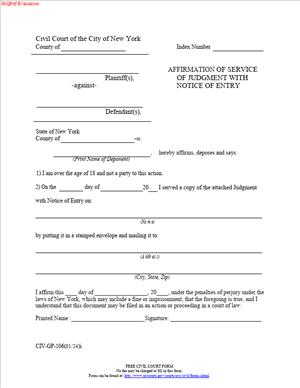
CV-GP-106-i – Affirmation of Service of Judgment with Notice of Entry
Fill out nowJurisdiction: Country: United States | Province or State: New York
CV-GP-106 – Affirmation of Service of Judgment with Notice of Entry is a court form used after a judgment has already been entered. It focuses on what happened next, not on how the case was decided. The document records that a copy of the judgment, along with a notice of entry, was formally delivered to the other party.
This form matters because courts often rely on written proof of service. The court file needs to show when and how the judgment was shared. Without that record, later steps in the case may remain unclear or disputed.
People usually encounter this form at a procedural moment. The case is no longer about arguments or evidence. It is about documenting communication between parties after the court’s decision.
If you are self-represented, this form can feel confusing because it does not explain the judgment itself. It only confirms delivery. Understanding the limited purpose helps you complete it accurately.
The language may look formal, but the role of the document is practical. It creates a clear timeline showing that notice of the judgment was given in a recognized way.
What is CV-GP-106 – Affirmation of Service of Judgment with Notice of Entry?
Clear definition
CV-GP-106 – Affirmation of Service of Judgment with Notice of Entry is a sworn statement. The person who served the judgment signs it to confirm specific details. Those details usually include what was served, how it was served, and when service occurred.
The affirmation does not restate the court’s decision. It does not explain why the judgment was entered. Its only function is to confirm service of the judgment and notice of entry.
Because it is an affirmation, the signer is stating that the information is true. The form becomes part of the court record once filed.
Who typically uses this form/document?
This form is commonly used by a party to the case that arranged for service. That may be the person who won the judgment or someone acting on their behalf.
In many situations, the person who completes the form is not the judge or the court clerk. It is often the individual who mailed or delivered the judgment papers.
Self-represented litigants also use this document. When there is no attorney involved, the responsibility for documenting service often falls directly on the party.
Why you might need this form/document
You might need this form to show that the other party received formal notice of the judgment. Courts typically rely on written proof rather than verbal claims.
The document can help establish a clear date of service. That date can affect timelines that begin after notice of entry is given.
Without this filing, the court file may not reflect that service occurred. That gap can create uncertainty later in the case record.
Typical real-life scenarios
- A judgment is entered after a hearing, and the winning party sends a copy to the other side by mail. The affirmation is then completed to document that mailing.
- A default judgment is entered because one party did not appear. The other party serves the judgment and files this form to show notice was provided.
- A case ends with a written judgment, and both parties need a clear record of when the judgment was officially shared. The affirmation provides that record.
- A self-represented person receives a judgment and later questions whether notice was properly given. The filed affirmation shows what was served and when.
When would you use CV-GP-106 – Affirmation of Service of Judgment with Notice of Entry?
This form is used after the court has already entered a judgment. It is not used before the decision and not during trial or motion practice.
The timing is connected to service, not entry. The judgment exists first. The form follows the act of delivering that judgment to another party.
People often encounter this step when moving the case forward administratively. It may come up before enforcement activity or before the case is closed in the court file.
In general, the form is used by someone who wants the record to clearly show that notice of entry was given. It is less about advocacy and more about documentation.
Legal characteristics of CV-GP-106 – Affirmation of Service of Judgment with Notice of Entry
This form gains its effect from accuracy and completeness. Courts generally look for clear identification of the judgment, the method of service, and the date.
Common problems arise when information is missing or inconsistent. Examples include unclear dates, incomplete addresses, or mismatched case captions.
Although forms like this exist across jurisdictions, details may vary. Some courts use affirmations, while others use affidavits. Terminology and formatting can differ.
This document does not enforce a judgment by itself. It does not collect money, change deadlines, or modify the judgment. It only records that service occurred.
Is it legally binding?
The affirmation is binding in the sense that it is a sworn statement. The signer is attesting that the facts listed are true.
Its legal weight comes from that sworn nature. Courts treat false statements differently than simple unsigned correspondence.
The document does not bind the other party to anything new. It does not create obligations beyond what the judgment already establishes.
How to fill out CV-GP-106 – Affirmation of Service of Judgment with Notice of Entry
Step 1 – Review the caption and case information
The top of the form identifies the court and the parties. This section usually mirrors the caption from the judgment itself. Accuracy matters because the form is filed under that case.
Check names, index numbers, and court identifiers carefully. This information connects the affirmation to the correct case file.
Step 2 – Identify the judgment being served
The form asks you to describe the judgment that was delivered. This may include the date the judgment was entered.
This section clarifies exactly which document was served. Courts rely on this detail to avoid confusion when there are multiple orders or judgments.
Step 3 – State who served the documents
The affirmation requires identification of the person who completed service. This is the individual signing the form.
The court uses this information to understand who is making the sworn statement. It also links responsibility for the accuracy of the details provided.
Step 4 – Describe the method of service
You will need to state how the judgment and notice of entry were served. Common methods include mailing or personal delivery.
The description usually includes enough detail to show that the service followed an accepted method. Vague statements can create questions later.
Step 5 – Provide the date and location of service
This part of the form records when the service occurred and where it took place or was initiated.
Dates are especially important because many timelines run from the service of notice of entry. Clear dating helps prevent disputes.
Step 6 – Identify the recipient
The form typically asks for the name and address of the person or entity served.
This confirms that the service was directed to the correct party. It also allows the court to see that the address matches what is in the case record.
Step 7 – Affirm the truth of the statement
The final section includes language affirming that the information is true. The signer acknowledges that the statement is made under oath.
This step transforms the document from a simple notice into a sworn affirmation. That distinction is what gives the filing its formal weight.
Step 8 – Sign and date the form
The signer adds a signature and date. Some forms also include space for a printed name.
The date of signing may differ from the date of service. Both dates appear in the record for clarity.
Step 9 – Prepare the form for filing
After completion, the form is ready to be submitted to the court clerk. Filing places it into the official case file.
Once filed, the affirmation becomes part of the court’s record, showing that service of the judgment with notice of entry occurred.
Legal terms you might encounter in CV-GP-106 – Affirmation of Service of Judgment with Notice of Entry
- Affirmation: An affirmation is a sworn statement that you sign to confirm that the facts are true. In this document, you are not arguing anything. You are confirming what you did and when you did it. Your signature tells the court you are taking responsibility for accuracy.
- Service: Service means delivering documents in a recognized way. On this form, service refers only to how the judgment and notice of entry were delivered to the other party. It does not describe earlier service in the case.
- Judgment: A judgment is the court’s final written decision. This document does not explain the judgment. It only identifies which judgment was served, so the court can track notice.
- Notice of Entry: A notice of entry is a short document stating that the judgment has been entered by the court. When paired with the judgment, it signals that the decision is official and recorded. This form confirms that both were delivered together.
- Date of Service: The date of service is the day delivery occurred or was sent. This date matters because future timelines often depend on it. On this form, you must state this date clearly.
- Method of Service: The method of service explains how delivery was made. Examples include mailing or personal delivery. The court uses this detail to understand whether the service followed a recognized process.
- Recipient: The recipient is the person or entity who received the judgment papers. This form requires you to identify the recipient so the court can see that notice went to the correct party.
- Index Number: The index number is the court’s tracking number for the case. This number ties the affirmation to the correct file. A wrong number can cause filing confusion.
- Sworn Statement: A sworn statement is one made under oath or affirmation. It carries more weight than an unsigned letter. This is why accuracy on this form is essential.
FAQs
Do I need to file CV-GP-106 – Affirmation of Service of Judgment with Notice of Entry if the court already mailed the judgment?
If the court mailed the judgment, you usually do not complete this form for that mailing. This document is used when you or someone acting for you served the judgment and notice of entry. Check the judgment paperwork to see who handled service before filling anything out.
What exact date should I list as the date of service?
Use the date the documents were actually delivered or placed in the mail. Do not use the judgment entry date unless the service happened on the same day. The court reads this date as the start of post-judgment timelines.
Who is allowed to sign this document?
The person who performed the service signs. That is the person who mailed or delivered the judgment and notice of entry. You should not sign for someone else.
Do the names on this form have to match the judgment exactly?
Yes. The party names should match the judgment caption word for word. Differences can raise questions about whether the correct case and parties are involved.
Do I attach anything to this form when filing it?
This form usually stands on its own. It describes what was served rather than attaching copies. Keep copies of what you served for your records in case questions arise.
What happens if the clerk accepts this document for filing?
Once accepted, it becomes part of the public case record. The court file then shows when notice of the judgment was given. This helps clarify later deadlines and procedural steps.
Can I correct this document after it is filed?
If you notice an error, you generally prepare a corrected version rather than altering the filed one. The court record should clearly show accurate service details. Act promptly so confusion does not grow.
Does this document change what the judgment says or requires?
No. This form only records service. The judgment itself controls rights and obligations, and this document does not modify it.
Checklist: Before, During, and After CV-GP-106 – Affirmation of Service of Judgment with Notice of Entry
Before
- Confirm that a judgment has already been entered
- Verify who completed the service of the judgment and notice of entry
- Gather the exact judgment title and entry date
- Check party names and index numbers against the judgment
- Confirm the method of service used
- Locate the full address used for service
- Decide who will sign the affirmation
- Make a blank copy for backup
During
- Enter the court name and index number carefully
- Identify the judgment by date and description
- State the service method clearly and specifically
- Write the exact date the service occurred
- List the recipient’s name and address fully
- Read the affirmation language before signing
- Sign and date in the correct section
- Review for missing fields or unclear handwriting
After
- Make copies for your records
- File the original with the court clerk
- Confirm the filing was accepted
- Note the filing date for your timeline
- Store copies with the judgment papers
- Update your case notes or calendar
- Check that the docket reflects the filing
- Keep proof of filing if provided
Common mistakes to avoid with CV-GP-106 – Affirmation of Service of Judgment with Notice of Entry
- Mistake: Listing the judgment entry date instead of the service date, which happens when dates are confused, causes unclear timelines and can be avoided by double-checking when delivery occurred.
- Mistake: Signing the form even though you did not serve the documents, which often happens in shared households, weakens the affirmation and can be avoided by having the actual server sign.
- Mistake: Using party names that do not match the judgment, which happens when nicknames or abbreviations are used, creates record mismatches and can be avoided by copying directly from the judgment.
- Mistake: Forgetting to specify the method of service, which happens when the form is rushed, leaves the record incomplete, and can be avoided by stating how delivery was made.
- Mistake: Filing without keeping copies, which happens when focus is only on submission, makes later questions harder to answer, and can be avoided by copying everything first.
- Mistake: Leaving address details incomplete, which happens when relying on memory, raises doubts about proper service, and can be avoided by checking the address used.
- Mistake: Filing before the judgment exists in the record, which happens when steps are out of order, leads to rejection, and can be avoided by confirming entry first.
- Mistake: Assuming acceptance means accuracy, which happens when clerks accept filings without review, leaves errors uncorrected, and can be avoided by self-review.
What to do after filling out CV-GP-106 – Affirmation of Service of Judgment with Notice of Entry
After completing the form, your focus shifts from writing to record management. This document is about clarity and proof, so how you handle it matters as much as how you filled it out. Think in terms of creating a clean paper trail.
You should treat the signed affirmation as an official record. Handle it carefully. Do not make handwritten changes after signing. If something is wrong, plan to correct it with a new filing.
- Step 1: Make at least two copies of the completed form for your own records.
- Step 2: File the original with the court using the same method you use for other case filings.
- Step 3: Ask the clerk or system for confirmation that the filing was accepted.
- Step 4: Note the filing date in your case calendar or notes.
- Step 5: Place one copy with the judgment and notice of entry documents.
- Step 6: Keep another copy in a general case file for quick reference.
- Step 7: Check the case record later to confirm the affirmation appears on the docket.
- Step 8: Use the recorded service date when calculating any future deadlines.
- Step 9: If enforcement or follow-up steps are planned, rely on this filing as proof of notice.
- Step 10: Review your records periodically to ensure all post-judgment documents are organized.
Disclaimer: This guide is provided for informational purposes only and is not intended as legal advice. You should consult a legal professional.