CIV-LT-13A – Affirmation in Opposition
Fill out nowJurisdiction: Country: United States | Province/State: New York
What is a CIV-LT-13A – Affirmation in Opposition?
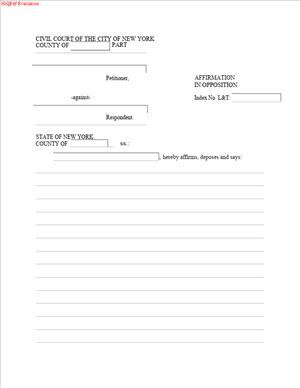
The CIV-LT-13A is a standard court form used in New York City Housing Court. It is an attorney’s sworn written statement opposing a motion or order to show cause in a landlord‑tenant case. You use it to present facts, attach proof, and argue why the court should deny the other side’s request. It becomes part of the official record in your case.
This form applies to cases in the Civil Court of the City of New York. It is most common in the Housing Part, which handles nonpayment and holdover proceedings. It is the attorney’s version of an opposition affidavit. A licensed New York attorney may affirm facts and arguments without a notary. If you are not an attorney, you would use an affidavit in opposition instead.
You typically use this form when the other side seeks relief by motion or an order to show cause. Common requests include stays of eviction, vacatur of a default, dismissal of the case, summary judgment, discovery, or other orders. Your affirmation explains the facts and law that support denying those requests. You attach exhibits to prove your points. You also tell the judge what outcome you want.
Attorneys for both landlords and tenants use this form. A landlord’s attorney may use it to oppose a tenant’s request to stay a warrant of eviction. A tenant’s attorney may use it to oppose a landlord’s motion for summary judgment in a nonpayment case. Commercial tenants also use it in holdover matters. Property managers who are not attorneys cannot submit this form themselves. They must work with counsel or provide a supporting affidavit.
You would need this form when the court sets a deadline for opposition papers. The moving party files and serves their motion or order to show cause. You then prepare and serve this affirmation in opposition. The court reads both sides before the hearing or return date. Your goal is to meet that deadline and present clear, supported reasons to deny the relief.
Typical scenarios include opposing a motion to vacate a judgment after a default. You may argue that there was no reasonable excuse or no valid defense. You may oppose a motion to dismiss for improper service by pointing to affidavits of service. You may oppose a request for a broad stay where the balance of harms favors your client. You may oppose discovery demands that are not allowed in summary proceedings. In each case, the structure is the same. You identify the request. You answer point by point. You back up your position with exhibits and clear facts.
The CIV-LT-13A is simple in format and specific in purpose. It is not a narrative letter. It is not a standalone application. It responds to a motion that is already before the court. It tells the judge what happened, why it matters, and what the court should do now. It ends with a request for the relief you want, usually a denial of the motion and related orders.
When Would You Use a CIV-LT-13A – Affirmation in Opposition?
You use this form when you receive a motion or order to show cause in your Housing Court case and you want to oppose it. The court or the moving papers will set a return date and a deadline for your opposition. You must submit the affirmation and exhibits by that date. You must also serve the other side.
If you are a landlord’s attorney, you might use it when a tenant asks to stay an eviction after judgment. You would explain the case history and attach key exhibits, like the judgment and warrant. You would address the claimed hardship or defenses. You would argue that the legal standard for a stay is not met. You would ask the court to lift or limit any stay.
If you are a tenant’s attorney, you might use it when the landlord moves for summary judgment in a nonpayment case. You would lay out factual disputes over rent, repairs, or notices. You would attach photos, emails, ledgers, and inspection records. You would argue that material facts are in dispute. You would ask the court to deny summary judgment and set the case for trial.
If you represent a commercial tenant, you might oppose a holdover based on alleged lease violations. You would address cure notices, lease clauses, and timelines. You would attach the lease and payment proof. You would argue a lack of proper notice or an effective cure. You would seek denial or a conditional stay to cure.
You also use this form to oppose jurisdictional challenges. For example, the other side may claim bad service and ask to dismiss. You would attach affidavits of service and any corroborating evidence. You would explain why the service was proper. You would ask the court to deny a traverse hearing or limit it to narrow issues.
Another common use is opposing a motion to vacate a default. The other side must show both a reasonable excuse and a meritorious defense. You would address both prongs. You would attach proof of notice and court history. You would explain why the delay and the reasons are not credible or sufficient. You would argue that the defense lacks merit on the facts or the law.
If the other side seeks discovery, you may oppose on summary‑proceeding grounds. You would explain why the demands are not necessary or are too broad. You would propose narrow alternatives if needed. You would ask the court to deny or limit discovery to specific items.
In each situation, the structure stays the same. You identify the relief sought by the other side. You present your facts and exhibits in a clear order. You apply the relevant standards. You request denial and any other appropriate relief, like dissolving a stay or setting conditions.
Legal Characteristics of the CIV-LT-13A – Affirmation in Opposition
This form is an attorney’s affirmation, which is legally recognized in New York. It carries the same weight as an affidavit for an attorney. It does not require a notary. The attorney affirms under penalty of perjury that the contents are true. Because it is a sworn statement, false statements can trigger penalties. The court relies on such affirmations to decide motions.
The affirmation must be based on personal knowledge or a clear basis. An attorney can affirm facts learned from case files or records. If a fact is outside the attorney’s knowledge, consider a supporting client affidavit. You can attach both to the same filing. The court reviews the entire record together. The judge gives more weight to facts supported by exhibits or firsthand declarations.
Enforceability comes from two places. First, the court’s rules require factual support for motions and opposition. Second, the affirmation is part of the court file. The judge may deny relief if you fail to rebut key points with credible proof. Clear, organized exhibits help the judge find and trust your facts. Poorly supported claims carry less weight.
The form is not a contract. It does not bind the parties like a settlement. It is a procedural filing that affects how the court rules. It can support sanctions or fee requests if rules allow. It can also preserve objections and defenses for later review. Precision and accuracy matter.
General legal considerations apply. Serve all parties by the method allowed in your case. Follow any deadlines in the motion papers or the judge’s rules. Use the correct caption and index number. Redact confidential personal information. Avoid attaching settlement communications. Do not include hearsay if you can attach direct proof instead. If you want affirmative relief, a separate cross‑motion may be required. This form alone usually cannot grant you new relief. It is meant to oppose what the other side seeks.
Housing Court part rules vary by county and judge. Some parts prefer legal arguments in a separate memorandum. Others accept the full argument within the affirmation. The core content remains the same. Keep your facts tight. Tie each point to an exhibit. Ask for a clear outcome at the end.
How to Fill Out a CIV-LT-13A – Affirmation in Opposition
1) Confirm you are the right filer.
- Use this form only if you are a New York attorney.
- If you are self‑represented, use an affidavit in opposition instead.
- If you represent an entity, confirm you are counsel of record.
2) Gather case and scheduling information.
- Find the exact case caption from prior court papers.
- Note the index or docket number for the LT case.
- Identify the county and Housing Part or courtroom.
- Record the judge’s name, return date, and any deadlines.
- Identify the moving paper’s title and date.
3) Set up the caption.
- Copy the caption exactly as it appears in the case.
- Include the same spacing and party titles (Petitioner/Respondent).
- List the index number and the county.
- Add the judge’s name and the part, if required, on the form.
4) Title the document.
- Use “Affirmation in Opposition” as the title below the caption.
- Identify the motion you oppose, for clarity.
- Example: “In Opposition to Respondent’s Order to Show Cause.”
5) Write the attorney identity paragraph.
- State your name, firm, and role as counsel for your client.
- State that you are admitted to practice in New York.
- State that you submit this affirmation in opposition to the identified motion.
6) Add a brief procedural background.
- State how and when you received the motion or order to show cause.
- Identify the relief the other side seeks.
- Provide the scheduled return date and any stays now in place.
7) Present the relevant facts in an organized way.
- Use short, numbered paragraphs.
- Stick to facts that matter to the relief at issue.
- Use dates, amounts, and names. Avoid vague terms.
- Reference exhibits as you go. Example: “See Exhibit A.”
8) Attach and label exhibits.
- Include key documents like the lease, ledgers, notices, and service proofs.
- Include photos, emails, and letters, if they are relevant and legible.
- Label each exhibit clearly (A, B, C) and add a brief description.
- Ensure pages are readable and in order.
9) Respond point by point to the motion.
- Track the structure of the moving papers.
- Answer each claim or requested order with facts and proof.
- Admit undisputed points. Dispute inaccuracies with exhibits.
- Explain prejudice or harm if relief is granted.
10) Include concise legal arguments.
- State the standards that apply to the requested relief.
- Apply those standards to your facts.
- Keep arguments focused and supported by your exhibits.
- If needed, add a short memorandum. Keep it consistent.
11) Add any supporting client affidavit, if needed.
- Use a client affidavit for facts outside your personal knowledge.
- Attach it as a separate exhibit and reference it in the text.
- Make sure it is properly sworn and notarized.
12) Request specific relief at the end.
- Ask the court to deny the motion in full.
- Ask to vacate any temporary stay if appropriate.
- Ask for conditions or timelines if denial is not granted outright.
- Request fees or sanctions only if the law and facts support it.
13) Add the affirmation statement and signature block.
- Include a statement that you affirm the truth under penalty of perjury.
- Date and place the affirmation within New York State.
- Sign above your printed name.
- Include your firm name, address, phone, and email.
- Add your client’s name and your role as attorney for that party.
14) Review for accuracy and compliance.
- Check the caption, index number, and judge’s name.
- Verify exhibit labels and references match.
- Confirm the pages are numbered and in sequence.
- Remove sensitive personal data or redact as needed.
- Ensure your request for relief is clear and specific.
15) Prepare proof of service.
- Serve all parties by the allowed method and deadline.
- If you or your office serves by mail, prepare an attorney’s affirmation of service.
- If a non‑party serves by hand, use an affidavit of service from that person.
- List the names, addresses, method, and date of service.
16) File with the court by the deadline.
- File the affirmation, exhibits, and proof of service together.
- Follow the judge’s part rules for format and delivery.
- If courtesy copies are required, deliver them on time.
17) Bring working copies to the return date.
- Bring a full set of your papers and exhibits.
- Bring the other side’s motion for quick reference.
- Be ready to show the judge the exact exhibit page.
18) Avoid common pitfalls.
- Do not miss the opposition deadline.
- Do not use the wrong caption or index number.
- Do not ignore key points raised by the motion.
- Do not rely on an argument without exhibits.
- Do not include settlement communications.
- Do not forget to ask for specific relief.
- Do not omit proof of service.
19) Tailor the content to the relief sought.
- For a stay request, address irreparable harm and the balance of equities.
- For a vacatur motion, address the excuse and defense.
- For dismissal, address service and jurisdiction facts.
- For summary judgment, highlight factual disputes.
20) Keep it concise and readable.
- Use short sentences and clear paragraphs.
- Lead with the most important points.
- Use headings within the affirmation if the judge allows.
- Avoid repetition. Each paragraph should move the needle.
If you follow these steps, your CIV‑LT‑13A will be complete, clear, and on time. The judge will have the facts, exhibits, and arguments needed to rule. Your record will be clean. Your client’s position will be preserved.
Legal Terms You Might Encounter
- Affirmation is a signed statement where you declare facts under penalty of perjury. It does not need a notary. You use this form to give your affirmed facts and arguments against a motion.
- Affidavit is a sworn statement signed before a notary. If you are not allowed to affirm, you use an affidavit in opposition instead. Do not mix the two formats.
- Motion is a written request asking the court to take action. Your affirmation responds to that request and explains why the court should deny it.
- Order to Show Cause is a motion that comes with a judge’s order and a quick deadline. It lists a return date and what you must do before then. Your affirmation answers the issues raised by that order.
- Return Date is the date and time set for the court to review the motion. You must serve and file your affirmation by the deadline tied to that date. You should also appear unless the court says you do not need to.
- Relief Sought is the specific result the moving party wants. It could be a judgment, an eviction, a dismissal, or other relief. Your affirmation should address each item of relief and explain why it should be denied or changed.
- Caption is the case heading on the first page. It includes the court name, parties, and case number. Your affirmation must have the exact caption from your case.
- Index Number or LT Number is your case number. It must match the number on the motion papers. The clerk uses it to file your affirmation with the right case.
- Service is how you deliver your opposition papers to the other side. It must be done by someone allowed to serve. Your affirmation should be served on the party or the party’s attorney.
- Proof of Service is a separate document that shows how and when you served the other side. The person who served signs it. File it with your affirmation.
- Exhibit is a document you attach to prove a fact. Common exhibits include leases, ledgers, notices, emails, and receipts. Label them A, B, C, and so on.
- Penalty of Perjury is the legal statement that your facts are true. It carries consequences if you lie. Your affirmation must include that statement before your signature.
- Housing Part is the landlord-tenant part of the court. This form is used in that part for these cases. The same rules for service, proof, and deadlines apply.
FAQs
Do you need to be an attorney to sign this affirmation?
You need to be someone who is allowed to affirm without a notary. Many attorneys use this form for that reason. If you are not eligible to affirm, use an affidavit in opposition instead. The content is similar, but an affidavit must be notarized.
Do you need to notarize this form?
No. An affirmation does not need a notary. You must include the penalty of perjury statement and sign and date it. Make sure your name and contact details are clear.
Do you have to attach exhibits to support your facts?
Attach any document you rely on. The judge reads what you attach. If you say rent was paid, attach receipts or bank records. If you notice defects, attach the notices. Label each exhibit and refer to it in the text.
Do you need to respond to every point in the motion?
You should address each request for relief. You do not need to repeat arguments that do not apply to you. Focus on the facts and law that defeat the relief sought. Use headings or clear paragraphs to track each issue.
Do you still need to appear on the return date if you filed?
Yes, unless the court says otherwise. Bring a full set of your opposition and exhibits. Bring your proof of service. Be ready to answer questions. If you cannot appear, contact the court for instructions as early as possible.
Do you file the affirmation before or after service?
Serve first, then file with proof of service. File by the deadline. You can file in person or as directed by the court. Keep your stamped copy as proof of filing.
Do you need a separate affirmation for each motion?
Yes. If there are multiple motions, prepare a separate affirmation in opposition to each. Use the correct return date and relief for each motion. Keep your exhibits organized so the judge can track them.
Do you need a proposed order with your opposition?
It is not required in most oppositions. If you want specific alternative relief, you may add a short request at the end. Be clear about what you want the court to order if it denies the motion.
Checklist: Before, During, and After the CIV-LT-13A – Affirmation in Opposition
Before signing
- Gather the motion papers you are opposing.
- Find the return date and any service deadlines.
- Verify the case caption and index number.
- List each item of relief the motion requests.
- Outline the facts that answer each request.
- Collect exhibits you will attach:
- Lease, rent ledger, notices, and proof of service of notices.
- Payment records, emails, texts, letters, photos, or videos.
- Prior orders, stipulations, and prior motion papers.
- Confirm parties’ names and addresses for service.
- Decide who will serve your papers. Pick a neutral adult.
- Prepare a proof of service form for the server.
- Set an internal deadline at least one business day early.
- Calendar the return date and plan your court appearance.
During signing
- Check that the caption matches the case exactly.
- Confirm the index or LT number is correct on all pages.
- State you oppose the motion and identify it by date.
- Track each request for relief with a clear response.
- Lay out key facts in order, with dates and names.
- Cite only facts you can prove with attached exhibits.
- Reference each exhibit by letter in your text.
- Insert the penalty of perjury statement before the signature.
- Add your printed name, role, address, phone, and email.
- Number every page and include exhibit separators.
- Sign and date the affirmation in ink if filing paper copies.
- Make a clean copy set for service and filing.
After signing
- Serve the other side or their attorney by an allowed method.
- Have your server complete and sign the proof of service.
- File your affirmation and proof of service with the court.
- Bring a full set of opposition papers to the return date.
- Keep one complete set for your records.
- Track delivery dates and times of service on a log.
- Confirm the court accepted your filing before the return date.
- Prepare a short outline of your oral points for the court.
- Note any orders or directives made on the return date.
- Store the filed papers and proof of service securely.
Common Mistakes to Avoid CIV-LT-13A – Affirmation in Opposition
Using the wrong form or format.
- If you are not allowed to affirm, you must use an affidavit in opposition. If you file the wrong format, the court may reject it. Don’t forget to check whether you need a notary.
Missing or wrong case details.
- A wrong index number or caption can misfile your papers. The court may not read your opposition in time. Don’t forget to match the case caption exactly as it appears on the motion.
Skipping exhibits that prove your facts.
- Bare statements are less persuasive without proof. The judge relies on what is attached. Don’t forget to include ledgers, receipts, notices, and prior orders.
Serving late or not serving at all.
- If the other side is not served, the court may ignore your opposition. Late service can limit what the judge will consider. Don’t forget to have a neutral adult serve and complete the proof.
Ignoring the relief sought.
- If you do not address each request, the judge may grant it. You risk orders you could have avoided. Don’t forget to answer every item of relief with facts and law.
Leaving out the penalty of perjury statement.
- Without it, your affirmation may be defective. The court may require resubmission or disregard your facts. Don’t forget to include the declaration above your signature.
What to Do After Filling Out the Form CIV-LT-13A – Affirmation in Opposition
File and serve on time.
- Serve the other side or their attorney first. Use a neutral adult server.
- Have the server complete a proof of service. Check dates and addresses.
- File your affirmation and proof with the court before the deadline.
- Confirm the clerk’s receipt and keep a stamped copy.
Prepare for the return date.
- Bring your affirmation, exhibits, and proof of service to court.
- Bring the motion papers you are opposing.
- Prepare a short summary of your key points.
- Be ready to answer questions and propose practical solutions.
Coordinate with other filings.
- If you have a cross-motion, keep it in a separate filing.
- Refer to your affirmation in opposition in that filing if needed.
- Keep your exhibits consistent across filings. Avoid duplicates.
Handle corrections or amendments.
- If you find an error, fix it before the service if possible.
- If already served, prepare an amended affirmation marked “Amended.”
- Serve and file the amended version with a new proof of service.
- Explain the change in a short note in the first paragraph.
Distribute and store copies.
- Keep a complete set for your records, including exhibits.
- Keep the stamped court copy and proof of service together.
- Provide a copy to any client or co-counsel you represent.
- Save a digital copy with clear file names and dates.
Track outcomes and deadlines.
- Note any directives issued on the return date.
- Calendar any follow-up deadlines the court sets.
- If the court issues a decision after submission, get a copy.
- Review the decision and plan any next steps, such as compliance or appeal deadlines.
Plan next actions if the motion is granted in part.
- Identify what was granted and what was denied.
- Assess whether further proof or hearings are required.
- Decide if you need to renew, reargue, or seek other relief.
- Update your client or stakeholders on outcomes and next steps.
Maintain professional presentation.
- Use consistent formatting and clear headings in your papers.
- Keep exhibits legible and complete.
- Avoid handwritten edits on filed copies.
- Confirm all pages are numbered and in order.
Prepare for settlement discussions.
- Bring proof that supports your settlement position.
- Know your bottom line and your client’s goals.
- If a stipulation is reached, read every term before signing.
- Make sure any stipulation does not waive rights you need to keep.
Stay organized for the case.
- Keep a master index of all filed documents.
- Track each motion, opposition, and decision by date.
- Keep contact details for all parties current.
- Update your calendar with all court dates and deadlines.
Disclaimer: This guide is provided for informational purposes only and is not intended as legal advice. You should consult a legal professional.