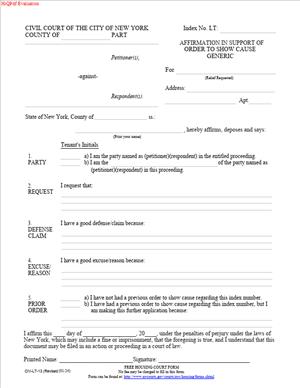
CIV-LT-13 – Affirmation in Support of Order to Show Cause Generic
Fill out nowJurisdiction: Country: United States | Province or State: New York
If you are preparing the CIV-LT-13 – Affirmation in Support of Order to Show Cause Generic, you are asking a judge to take urgent action in an existing case. This document explains your side of the situation in writing. It tells the court why immediate review is necessary.
This form is used in the Civil Court of the City of New York. It is often connected to landlord-tenant matters, but it can relate to other civil issues handled in that court. You complete it when you want the court to reconsider, pause, or address something quickly.
An affirmation is a written statement made under penalty of perjury. That means you are declaring that everything in the document is true to the best of your knowledge. The judge relies on what you write when deciding whether to sign the Order to Show Cause.
For self-represented people, this form can feel intimidating. You may be trying to stop an eviction, reopen a case, or correct a default judgment. Understanding what the document is asking for makes the completion process clearer and more focused.
This guide explains what the form is, when it is used, and how to fill it out in a practical way. You will see what information matters and how to present it clearly.
What is CIV-LT-13 – Affirmation in Support of Order to Show Cause Generic?
Clear definition
CIV-LT-13 – Affirmation in Support of Order to Show Cause Generic is a written statement submitted to a judge along with a proposed Order to Show Cause. In it, you explain the facts that justify urgent court review. The affirmation provides the background and reasons for your request.
An Order to Show Cause is a court order that sets a short deadline and often a quick hearing date. The affirmation supports that request. It answers the question: “Why should the court act now?”
This document is not the order itself. It is the explanation that helps the judge decide whether to sign the order and schedule the matter.
Who typically uses this form?
This form is commonly used by tenants or landlords in the Civil Court of the City of New York. It may also be used by other parties in civil cases handled by that court. Most often, it is completed by people without attorneys.
Tenants may use it to stop or delay an eviction. Landlords may use it to address a default, correct an error, or request relief related to a court order. Either side can use it when something urgent has happened or when they missed a court date and need the case reopened.
Court staff may provide the form as part of a packet. You are responsible for filling in the facts and signing it properly.
Why might you need this form?
You may need this form if a judgment was entered against you because you did not appear in court. In that situation, you are asking the court to vacate, or undo, that judgment. The affirmation explains why you missed the date and what defenses you have.
You may also need it if a warrant of eviction has been issued and you need a temporary stay. The affirmation would describe your circumstances and explain why immediate relief is necessary.
Sometimes you discover new information after a decision is made. If that information could change the outcome, you may ask the court to reconsider. The affirmation lays out those new facts.
In other cases, there may have been a mistake in the paperwork or service of documents. You can use the affirmation to describe that issue and request that the court address it promptly.
Typical real-life scenarios
- A tenant receives a notice that a marshal is scheduled to carry out an eviction in a few days. The tenant did not attend the original hearing because they were hospitalized. The tenant completes the affirmation explaining the medical emergency and asking the court to stay the eviction and reopen the case.
- A landlord wins a default judgment because the tenant did not answer the petition. Later, the landlord learns that the service may have been defective. The landlord files an affirmation requesting guidance or correction so the process is legally sound.
- A party appears in court but misunderstands the next court date. When they fail to appear, the case is decided without them. The affirmation explains the misunderstanding and states that the party has a valid defense that the court did not hear.
- A tenant pays the rent after judgment but before eviction. The tenant files the affirmation explaining the payment and asking the court to stop the eviction and allow the case to be resolved based on the updated facts.
- In each of these situations, the document provides a clear timeline. It tells the judge what happened, when it happened, and why the court’s immediate involvement is needed.
When would you use CIV-LT-13 – Affirmation in Support of Order to Show Cause Generic?
You would use this form when time matters. An Order to Show Cause is generally reserved for situations that cannot wait for a regular motion schedule. If you need the court to act quickly, this form supports that request.
It is often used after a default judgment. If you did not appear in court and a judgment was entered, you may ask the court to vacate that judgment. The affirmation explains both your excuse for missing court and your defense to the claims.
You might also use it when a warrant of eviction has already been issued. In that case, you are typically asking for a stay, which is a temporary pause. The affirmation should clearly state why immediate harm could occur without court intervention.
Landlords may use it to address procedural issues. For example, if there was a clerical error or confusion about service, the affirmation can describe what occurred and why the court should review the matter quickly.
This form is not limited to one type of request. It is tied to urgency. If waiting for a standard motion would cause serious consequences, an Order to Show Cause, supported by this affirmation, may be the vehicle used to bring the issue before the judge.
Legal characteristics of CIV-LT-13 – Affirmation in Support of Order to Show Cause Generic
This document is a sworn statement. When you sign it, you are affirming that the facts are true under penalty of perjury. That gives the document legal weight. The court relies on the accuracy of what you write.
For the form to be effective, it must clearly identify the case. That includes the names of the parties, the index or docket number, and the court. If the case information is incorrect, the filing may be delayed or rejected.
The affirmation must contain specific facts, not general complaints. Judges look for dates, events, and explanations. Vague statements such as “I had problems” are less persuasive than a clear description of what happened and when.
Common problems include missing signatures, incomplete case captions, or failure to explain both parts of a default situation. In many cases involving a missed court date, the court expects two things: a reasonable excuse and a potentially valid defense. If one of these is missing, the request may not be granted.
Procedural details can vary slightly depending on the type of case within the Civil Court of the City of New York. Housing matters often have specific practices. The overall structure, however, remains similar: a written affirmation supporting urgent judicial review.
This document does not automatically stop enforcement. The judge must review and sign the Order to Show Cause. Until that happens, prior court orders generally remain in effect. The affirmation is a request for action, not the action itself.
It also does not replace other required filings. If additional forms are necessary for your specific request, they are usually submitted together. The affirmation works as the factual foundation for the package.
Is it legally binding?
Yes, in the sense that it is a sworn statement. When you sign the affirmation, you are legally declaring that the information is true. False statements can have serious consequences.
The document becomes part of the official court record once filed. The judge may rely on it in making a decision. The opposing party may also review it and respond.
However, the affirmation by itself does not create a binding agreement between parties. It does not change rights or obligations on its own. Any binding effect comes from the judge’s signed order that follows, if the request is granted.
How to fill out CIV-LT-13 – Affirmation in Support of Order to Show Cause Generic
Step 1 – Complete the caption
At the top of the form, fill in the court name exactly as shown for the Civil Court of the City of New York. Enter the names of the petitioner and respondent as they appear in your case. Add the correct index or docket number. This information must match the existing case record.
Step 2 – Identify yourself and your role
State your full legal name and identify your role in the case, such as tenant, landlord, petitioner, or respondent. Make it clear whether you are the person bringing the request. If you are self-represented, indicate that you are appearing without an attorney if the form provides space for that detail.
Step 3 – State what you are asking the court to do
Clearly describe the relief you are requesting. For example, you may be asking to vacate a default judgment, stay an eviction, or reopen a case. Use direct language. The judge should be able to understand your request in one reading.
Step 4 – Provide the procedural history
Explain what has happened in the case so far. Include relevant dates, such as when the petition was served, when court appearances occurred, and when a judgment was entered. Present the events in chronological order. This helps the judge follow the timeline.
Step 5 – Explain your reason for urgency
Describe why this matter cannot wait. If an eviction is scheduled, include the date. If wages are about to be restrained or property affected, explain that clearly. Connect the urgency to specific facts rather than general concerns.
Step 6 – If applicable, explain your default
If you missed a court date, explain why. Be specific about the circumstances, such as illness, emergency, or lack of notice. Provide enough detail to make the situation understandable without adding unrelated information.
Step 7 – State your defense or underlying position
If you are asking to reopen a case, briefly describe your defense or the facts that could change the outcome. For example, you might state that rent was paid, conditions were not repaired, or service was improper. Keep this section focused and factual.
Step 8 – Attach and reference supporting documents
If you have documents that support your statements, refer to them in the affirmation. Examples may include receipts, medical records, or notices. Label them clearly when attaching them to your submission so the court can identify them easily.
Step 9 – Review for accuracy and completeness
Read the entire document carefully. Confirm that names, dates, and numbers are correct. Make sure your request is clearly stated and that your explanation is consistent throughout the form.
Step 10 – Sign and date the affirmation
Sign your name in the space provided. Print your name, address, and contact information if required. By signing, you are affirming that the contents are true. Date the document on the day you sign it.
Legal terms you might encounter in CIV-LT-13 – Affirmation in Support of Order to Show Cause Generic
- Affirmation: An affirmation is a written statement you sign, declaring under penalty of perjury that everything in it is true. Unlike an affidavit, it is not notarized. In this form, your affirmation is the evidence the judge relies on to decide whether to sign the Order to Show Cause.
- Order to Show Cause (OSC): An Order to Show Cause is a request asking the court to schedule a hearing and, often, to temporarily stop something from happening until that hearing. Your affirmation explains why the court should grant this request. The judge reviews your written reasons before deciding whether to sign the order.
- Stay: A stay is a temporary pause of a court action or enforcement. In housing cases, this often means stopping a warrant of eviction. If you are asking for a stay, you must clearly explain why it is needed and for how long.
- Warrant of Eviction: A warrant of eviction authorizes a marshal or sheriff to remove a tenant from the property. If a warrant has been issued, your affirmation should state that fact and include relevant dates. The urgency of your request often depends on whether a warrant is already in place.
- Default: A default happens when you fail to appear in court or fail to respond as required. If you are asking the court to vacate a default, you must explain both why you missed court and that you have a potentially valid defense. Both parts are important.
- Meritorious Defense: A meritorious defense is a legally valid reason why the other side should not win. In your affirmation, you briefly describe your defense with specific facts. The judge looks for enough detail to see that your position is not frivolous.
- Service: Service means formally delivering legal papers to the other party. When you request an Order to Show Cause, the judge may set instructions for how and when you must serve the papers. You must follow those instructions exactly.
- Ex Parte: Ex parte refers to a request made to the court without the other party present. Many Orders to Show Cause are initially reviewed ex parte. Your written affirmation must be complete because the judge may rely only on what you submit at that stage.
- Relief Requested: Relief requested means what you are asking the court to do. In this document, you must clearly state the specific action you want, such as vacating a judgment, restoring a case to the calendar, or staying an eviction. Vague requests can lead to denial.
- Return Date: The return date is the court date set for the parties to appear and argue the Order to Show Cause. If the judge signs the order, the return date will be written on it. You must appear on that date or risk losing the relief you requested.
FAQs
Do I need to notarize this document?
No. An affirmation is signed under penalty of perjury and does not require notarization. Make sure you sign and date it where indicated. If you forget to sign, the court may reject the papers because an unsigned affirmation has no legal effect.
What specific dates should I include in my explanation?
Include the date of the original court appearance you missed, the date the judgment was entered, and the date you learned about the judgment or warrant. If you are facing eviction, include the date you received a marshal’s notice. Judges look closely at timing to decide whether your request is prompt and reasonable.
How detailed should my explanation be?
Be specific but focused. State concrete facts such as illness, travel, lack of notice, or confusion about the court date, and explain how you learned about the case outcome. Avoid general statements like “I couldn’t make it.” The judge needs enough detail to understand exactly what happened and why it was not intentional.
Do I have to attach proof to support what I’m saying?
If you have documents that support your explanation, attach copies. This might include medical notes, travel records, payment receipts, or correspondence. Label each attachment and refer to it in your affirmation so the judge can easily match your statements to the proof.
What happens after I file the CIV-LT-13 – Affirmation in Support of Order to Show Cause Generic?
The judge will review your papers and decide whether to sign the Order to Show Cause. If it is signed, the order will list any temporary relief granted and set a court date. You must then serve the signed order and supporting papers as directed.
Can I ask for more than one thing in this form?
Yes, you can request multiple types of relief, such as vacating a default and staying an eviction. Be clear and list each request separately in your explanation. The judge may grant some requests and deny others, so clarity helps.
What if my name is spelled differently on other court papers?
Use the exact name as it appears in the case caption. If there is a spelling error, you can mention it in your affirmation and clarify that you are the same person. Consistency avoids confusion and ensures the court file matches your request.
Will this document automatically stop an eviction?
No. Filing this document does not automatically stop enforcement. Only if the judge signs the order and grants a stay does the pause take effect. Read the signed order carefully to confirm whether a stay was granted and under what conditions.
Checklist: Before, During, and After CIV-LT-13 – Affirmation in Support of Order to Show Cause Generic
Before
- Review the judgment or decision you are challenging.
- Gather all relevant dates, including court appearances and notices received.
- Collect supporting documents that back up your explanation.
- Confirm the correct case caption and index or docket number.
- Outline the specific relief you are asking the court to grant.
- Check whether a warrant of eviction has been issued.
- Make sure your contact information is current and accurate.
During
- Complete the caption exactly as it appears on prior court papers.
- Clearly state your name and your role in the case.
- Explain why you are making the request at this time.
- If you defaulted, explain both the reason and your defense.
- Refer to each attachment clearly in the body of your affirmation.
- Write in numbered paragraphs if space allows for clarity.
- Sign and date the affirmation in the correct place.
- Review every page to ensure it is legible and complete.
After
- Make copies of all papers for your records.
- Submit the papers to the court clerk following filing procedures.
- Wait for the judge’s decision on whether the order is signed.
- If signed, carefully read all instructions in the order.
- Serve the signed order and supporting papers as directed.
- Keep proof of service if required.
- Appear in court on the return date listed.
- Bring copies of all documents to the hearing.
Common mistakes to avoid with CIV-LT-13 – Affirmation in Support of Order to Show Cause Generic
- Mistake: Giving vague reasons for missing court because you feel embarrassed, which leads to denial since the judge cannot assess credibility, so do not forget to provide specific facts and dates.
- Mistake: Failing to explain your defense because you focus only on why you missed court, which can result in rejection for lack of a meritorious defense, so do not forget to state why you believe you should win.
- Mistake: Leaving out key dates because you assume the court file speaks for itself, which may weaken your urgency argument, so do not forget to list judgment and notice dates clearly.
- Mistake: Forgetting to sign the affirmation because you are rushing, which makes the document invalid, so do not forget your signature and the date.
- Mistake: Ignoring service instructions in the signed order because you think filing is enough, which can void the relief granted, so do not forget to follow service directions exactly.
- Mistake: Submitting no supporting documents when you have them available, which reduces credibility, so do not forget to attach copies of proof that support your statements.
- Mistake: Using a different name or case number than what appears on the caption because of old paperwork, which can cause processing delays, so do not forget to match the court record exactly.
- Mistake: Missing the return date after the order is signed because you think the paperwork is sufficient, which can lead to losing the relief, so do not forget to appear in court as scheduled.
What to do after filling out CIV-LT-13 – Affirmation in Support of Order to Show Cause Generic
Once you complete your affirmation, pause and review it carefully. Read it as if you are the judge seeing the case for the first time. Make sure your explanation is clear, chronological, and supported by any documents you have attached.
- Step 1: Make at least two complete copies of everything, including attachments.
- Step 2: Organize the papers in order, with the affirmation on top and exhibits behind it.
- Step 3: Submit the original set to the court clerk following the court’s filing process.
- Step 4: Ask the clerk how you will be notified if the judge signs the Order to Show Cause.
- Step 5: Check the signed order immediately for a stay, conditions, and a return date.
- Step 6: Follow the service instructions written in the signed order exactly and within the deadline.
- Step 7: Complete any required affidavit of service and keep a copy for yourself.
- Step 8: Mark the return date on your calendar and plan to arrive early.
- Step 9: Prepare a short, clear summary of your explanation to present in court if asked.
- Step 10: Bring all original documents and copies with you to the hearing.
Keep your copies in a safe place. If the judge grants relief, review the decision carefully. You may need to comply with conditions, such as making payments by a certain date or returning to court for further proceedings.
If the judge denies your request, read the order to understand why. The written decision may explain what was missing or insufficient. That information helps you understand the status of your case and what steps, if any, remain available.
Throughout the process, stay organized. Keep a folder with your affirmation, signed orders, proof of service, and notes from court appearances. Clear records make it easier to respond to future court dates and avoid further defaults.
Disclaimer: This guide is provided for informational purposes only and is not intended as legal advice. You should consult a legal professional.