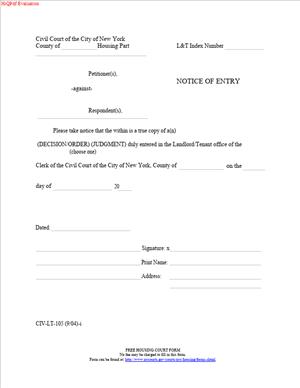
CIV-LT-105 – Notice of Entry
Fill out nowJurisdiction: Country: United States | Province or State: New York
What is a CIV-LT-105 – Notice of Entry?
The CIV-LT-105 is a Notice of Entry used in New York City Housing Court (within the Civil Court of the City of New York). Its purpose is straightforward: to notify all parties that a court order or judgment has been entered by the clerk. You serve this notice together with a true copy of the entered decision (showing the clerk’s entry stamp/date). That pairing—notice plus entered copy—creates a clear, auditable record of entry and formal notice.
Parties on both sides use this form: landlords, tenants, property managers, attorneys, and self-represented litigants. It is not a pleading, and it does not request relief. You use it only after the court has issued a decision and the clerk has entered it. Common contexts include a final judgment after trial, a motion decision (granted or denied), an order vacating a default, an order awarding attorney’s fees or use and occupancy, or an amended/corrected order that supersedes a prior one.
Serving the Notice of Entry typically starts key deadlines. Time to appeal often runs from service of the order or judgment with Notice of Entry. Deadlines to move to reargue (and sometimes to renew) may also turn on the same service. Because so much depends on the timing, the Notice of Entry supplies certainty: which document governs, the date it was entered, and when and how service occurred.
In fast-moving Housing Court matters—such as where a stay of a warrant is in place, or a party plans to seek appellate relief—the Notice of Entry signals that the decision is officially on the docket and that time periods tied to the entry have begun. It protects all parties by standardizing the starting point for those timelines and by eliminating ambiguity about which version of an order controls.
When Would You Use a CIV-LT-105 – Notice of Entry?
Use the CIV-LT-105 after the clerk has entered the court’s order or judgment. Entry is a clerical act that makes the decision part of the official record. Most appeal and post-decision periods do not begin until the entered decision is served with Notice of Entry. Once you confirm entry and obtain a stamped/dated copy, prepare and serve the Notice of Entry with that attachment.
Common Usage Scenarios
- After a landlord is awarded a judgment of possession and, if applicable, a money judgment in a nonpayment or holdover case. Serving starts the appeal period and clarifies the precise relief entered.
- After a tenant obtains an order vacating a default and staying enforcement, the serving gives formal notice of the stay and any conditions.
- Following a motion decision (e.g., dismissal, access, restoration to calendar, use and occupancy, fees, or stay). Serving starts time to reargue, appeal, or comply, as applicable.
- After entry of an amended or corrected order (“nunc pro tunc”) or a Decision and Order that resolves open issues, each entered decision should have its own Notice of Entry.
Do not use this form to start a case, file a motion, or submit a proposed order. Use it only to give formal notice that the clerk has entered a decision and to attach the entered document so there is no uncertainty about what governs.
Legal Characteristics of the CIV-LT-105 – Notice of Entry
A Notice of Entry does not change the substance of the court’s decision. It merely confirms that the decision has been entered and gives formal notice that starts deadlines tied to service “with notice of entry.” In Housing Court practice, those deadlines—especially for appeals and motions to reargue—are often strict, making the Notice of Entry pivotal.
Key features
- It is effective because it is paired with a true copy of the entered order/judgment. The attached copy should show the clerk’s entry stamp or date so the recipient can verify entry.
- Proper service is essential. A non-party adult should serve and sign a notarized affidavit of service that details when, how, and on whom service was made. That affidavit is your proof if timing or sufficiency is disputed.
- It creates a reliable timeline. This helps with appeal deadlines and with compliance periods measured from service with notice (e.g., “within 10 days after service with notice of entry”).
- It does not supersede the decision. The order or judgment controls. The Notice of Entry documents the fact of entry and provides formal notice to all appearing parties.
Defective service—wrong address or recipient, missing the entered attachment, or a defective/un-notarized affidavit—can undermine the notice and delay or prevent deadlines from starting. Serve everyone who appeared (including all counsel of record, intervenors, and any undertenant parties who appeared) using addresses in the court file or most recent papers.
Service methods must be allowed by court rules, court order, or written consent. Personal delivery and first-class mail are common in Housing Court. If a judge directed a specific method, or parties consented to email or another method, follow that exactly and describe it in the affidavit. When in doubt, use a recognized method and document it precisely. Personal delivery or first-class mail to counsel of record (or to self-represented parties at their service address) is standard.
Because the Notice of Entry starts deadlines that may be non-extendable, calendar-related dates should be carefully factored in, factoring in the service method and time-computation rules. If a later amended order is entered, serve a fresh Notice of Entry for that document to trigger new deadlines.
How to Fill Out a CIV-LT-105 – Notice of Entry
1) Confirm entry and get the right attachment.
- Obtain the version of the order/judgment/Decision and Order that shows the clerk’s entry stamp/date. Do not use drafts or copies without proof of entry.
- If the stamp/date is unclear, get a clean copy from the clerk.
- Ensure the attachment is complete: all pages and any riders/exhibits that are part of the entered decision.
- Keep a clean copy for your file; consider scanning a PDF for records.
2) Complete the case caption.
- Identify the court as “Civil Court of the City of New York.”
- Specify the County: Bronx, Kings (Brooklyn), New York (Manhattan), Queens, or Richmond (Staten Island).
- Use the exact caption as on the pleadings and the entered decision, including “a/k/a” names or corporate designations.
- Enter the docket/index number precisely (e.g., “LT-123456/2025”). If the form has a Part/Room field, include it.
- If the form lists the judge, match the name/title shown on the entered decision.
3) Title the document.
- Title it “Notice of Entry.” Follow any form formatting (e.g., centered/bold).
- If using letterhead, keep the title plain and prominent.
4) Draft the notice language (the main clause).
- Use standard phrasing, such as:
“Please take notice that the attached is a true copy of the [Order/Judgment/Decision and Order] of Hon. [Judge], entered in the Office of the Clerk of the Civil Court of the City of New York, County of [County], on [entry date].”
- Use the exact label from the decision (e.g., “Decision and Order”).
- Include the clerk’s entry date (not the signature date, unless they are the same).
- If you have multiple orders entered on different dates, serve separate Notices of Entry.
5) Identify the parties for service.
- List every attorney or self-represented party who has appeared. If a party has counsel, serve counsel unless ordered otherwise.
- Use service addresses from the latest filings or the court’s records. If counsel updated contact details, use the updated ones.
- For multiple recipients, create a clear service list with names, firm (if any), role, and address.
6) Sign and date the notice.
- The attorney of record signs, or the party signs if self-represented. Print the signer’s name.
- Include firm (if any), address, phone, and email you intend to use for the case.
- Date the notice on the day you finalize it. The affidavit should reflect the actual service date.
7) Attach the entered order or judgment.
- Place a complete, legible copy of the entered decision behind the notice and secure the packet.
- Confirm the attachment shows the clerk’s entry stamp/date; include any page that bears the stamp.
- If the entered decision includes incorporated exhibits, include them so the recipient has the complete entered document.
8) Arrange service by a non-party adult.
- The server must be at least 18 and not a party. A neutral process server or non-party colleague is safest.
- Serve each opposing attorney or self-represented party using a permitted method (e.g., personal delivery or first-class mail, or as ordered/consented).
- For personal delivery, instruct the server to note the recipient’s name/title and the time/place of delivery for the affidavit.
- For mail, use separate envelopes for each recipient and retain proof of mailing (e.g., postal receipt) in addition to the affidavit.
- One server may serve all recipients if the affidavit itemizes details for each.
9) Complete the affidavit of service.
- Use the affidavit section on the CIV-LT-105 if available, or attach a separate captioned affidavit.
- The server should state their name, age, and that they are not a party.
- For each recipient, list the name/capacity, address, method (personal or mail), and date/time of service. Be specific and consistent.
- The server must sign before a notary public, who completes the jurat with date/county/commission details.
- If service occurred on multiple dates or by multiple methods, itemize clearly; attach a continuation page if needed.
10) Keep records and consider filing the proof.
- Keep a full set: the signed Notice of Entry, the attached entered decision, and the original notarized affidavit. Retain postal proof if mailed.
- Consider filing the Notice of Entry and affidavit so the court file reflects service with notice. This helps avoid later timing disputes.
- Calendar all deadlines triggered by service with notice, including appeal/reargument periods. Account for weekends, holidays, and service-method rules.
- For appeals, time commonly runs 30 days from service with Notice of Entry. Verify any nuances tied to your service method and set early reminders.
Key sections to check before you serve
- Parties: Names/addresses match the court file and counsel of record.
- Clauses: The notice identifies the correct document type and exact entry date.
- Signatures: The notice is signed/dated with printed name and contact info.
- Schedules/Attachments: A complete, legible, entered copy is securely attached.
This form belongs to the Civil Court of the City of New York.
Legal Terms You Might Encounter
- Entry: The clerk’s act of officially recording an order/judgment. Entry puts the decision on the record and, when served with notice, typically starts appellate/post-judgment periods.
- Order: A directive resolving a motion or discrete issue. It may impose conditions or deadlines and can be interim or final as to identified issues.
- Judgment: A final determination of rights/relief, often including possession and/or money damages. It may be enforced via warrant of eviction and execution, as applicable.
- Decision and Order: A document that explains the court’s reasoning and states the ruling. When entered, it is served with a Notice of Entry like any order/judgment.
- Clerk’s Stamp/Entry Stamp: The stamp/noted date showing entry by the clerk. Use this date in your Notice of Entry and attach the copy that bears it.
- Service: Delivery of papers by a permitted method under rules, court order, or written consent. Precision in method and documentation is critical.
- Affidavit of Service: A sworn statement by the server detailing who was served, where, when, and how. It is the core proof if service is challenged.
- Docket/Index Number: The unique case identifier (e.g., LT-XXXXX/20XX). It must match across the notice and the attached decision.
- Counsel of Record: The attorney who has appeared for a party. Serve counsel, not the party, unless the court orders otherwise.
- Stay: A pause on enforcement ordered by the court. Serving Notice of Entry clarifies stay terms and starts any compliance periods measured from service.
- Appeal: A request for higher-court review. The clock commonly runs from service of the entered order/judgment with Notice of Entry.
- So-Ordered Stipulation: A party agreement endorsed by the judge and entered as an order. Once entered, it is served with a Notice of Entry.
- Amended Order/Nunc Pro Tunc: A corrected/amended order. When entered, it generally requires a new Notice of Entry to start deadlines tied to the corrected version.
- Reargument vs. Renewal: Reargument asks the court to reconsider due to matters overlooked/misapprehended; renewal relies on new facts or changes in law. Deadlines differ and often hinge on service with notice.
FAQs
Do you need to wait for a stamped copy before serving a Notice of Entry?
Yes. Wait until you have a copy that shows the clerk’s entry stamp/date. Serving a draft or an unstamped copy usually will not start deadlines and invites disputes over timing. If the stamp is faint or cropped, obtain a clearer copy before serving.
Do you have to file the Notice of Entry with the court after you serve it?
Service triggers deadlines in most cases, not filing. Still, filing the Notice of Entry and affidavit of service is good practice because it completes the court file and reduces later disputes about what was served and when. This can streamline appellate or motion practice.
Do you serve every party or only those who appear?
Serve every party who has appeared, including all counsel of record and any self-represented litigants. If a party is represented, serve counsel, not the party, unless the court directs otherwise. If multiple attorneys of record appear for one party, serve them all.
Do you need someone else to serve it, or can you do it yourself?
Use a non-party adult to serve and to sign a notarized affidavit of service. Even if rules might permit party service for some papers, using a non-party minimizes challenges and avoids needless motion practice over service sufficiency.
Do you have to attach the decision, or is the notice alone enough?
Attach a true copy of the entered order/judgment/Decision and Order. The notice communicates that the entry occurred; the attachment proves which decision governs, and the entry date. A notice without the entered attachment generally does not start deadlines.
Do you have to send a separate Notice of Entry for each new order?
Yes. Serve a separate Notice of Entry for each entered order/judgment. If an amended or corrected decision is later entered, serve a fresh Notice of Entry so deadlines run from the controlling version.
Do you start over if you discover a mistake in your notice or service?
If the error raises doubt about what was served, who was served, or when service occurred—such as an incorrect docket number, missing attachment, wrong address, or lack of notarization—promptly re-serve a corrected Notice of Entry with proper proof. Deadlines run from valid service.
Do you have to serve by a specific method, like mail or personal delivery?
Use a method permitted by rule, court order, or written consent. In Housing Court, personal delivery and first-class mail are common. If parties consented to email or another method, ensure consent is clear/current and describe it precisely in the affidavit. When unsure, choose a standard method and document it carefully.
Checklist: Before, During, and After the CIV-LT-105 – Notice of Entry
Before signing
- Entered copy: Have a complete, legible copy showing the clerk’s entry stamp/date.
- Case details: Confirm caption, docket number, judge, and county match the entered decision.
- Recipients: Prepare a list of all counsel of record and self-represented parties with current service addresses.
- Service plan: Select permitted methods per recipient; line up a non-party server; prepare separate envelopes if mailing.
- Proof prep: Obtain an affidavit of service form and locate a notary.
During signing
- Body text: Confirm document label (order/judgment/Decision and Order), judge’s name, and exact entry date.
- Identifiers: Double-check caption, docket number, and county for consistency.
- Signature block: Sign/date; include printed name, firm (if any), address, phone, and email.
- Attachment: Securely attach the entered, stamped decision; ensure the entry stamp is visible.
After signing
- Service: Have the non-party server deliver by the chosen permitted method to all recipients.
- Affidavit: Server completes and notarizes the affidavit, itemizing dates, methods, addresses, and recipients.
- Recordkeeping: Keep a full set—notice, attachment, and original notarized affidavit—plus any postal proof.
- Court file: Consider filing the notice and affidavit so the record reflects service with notice.
- Calendaring: Immediately docket all deadlines tied to service with Notice of Entry and monitor for responses.
Common Mistakes to Avoid CIV-LT-105 – Notice of Entry
- Missing the entry stamp/date: An unstamped or un-entered copy rarely starts deadlines and invites disputes. Verify the attachment shows the entry.
- Serving the wrong person: Serve counsel of record if a party is represented, unless ordered otherwise. Serving the party directly can be ineffective.
- Acting as your own server: Use a non-party adult and obtain a notarized affidavit of service to avoid challenges to validity.
- Misstating the docket or caption: Even small errors can trigger confusion or rejection. Proofread carefully.
- Omitting an appearing party: Skipping co-respondents, intervenors, undertenants, or additional counsel can force re-service and stagger deadlines.
- Using nonstandard service without authority: Do not rely on email/alternative methods absent consent or court order. Stick to permitted methods and document them.
- Failing to calendar: Log deadlines immediately after service and set reminders keyed to service date and method.
What to Do After Filling Out the Form CIV-LT-105 – Notice of Entry
Once the Notice of Entry is prepared and the entered decision is attached, arrange prompt service on all required recipients via an approved method using a non-party adult server. Ensure the server completes and signs a detailed affidavit of service before a notary. If mailing, retain postal proof (e.g., certificate of mailing or receipt). Keep the original notarized affidavit together with a full copy set of the notice and attachment in your file.
Consider filing the Notice of Entry and affidavit with the court so the official record reflects that service occurred, including the service date and method. Immediately calendar all deadlines that run from service with Notice of Entry. This commonly includes time to appeal and, where applicable, time to seek reargument or comply with directions measured from service with notice.
If you discover an error—wrong docket number, missing pages, omitted recipient, or a defective affidavit—prepare and promptly re-serve a corrected Notice of Entry with a new affidavit of service. Update your calendar to track deadlines from the valid service date. If the court later issues an amended or corrected decision, treat it as a new entry and serve a fresh Notice of Entry so deadlines run from the controlling version. Maintain a clear service log noting dates, methods, recipients, and any filing activity with the court.
Disclaimer: This guide is provided for informational purposes only and is not intended as legal advice. You should consult a legal professional.