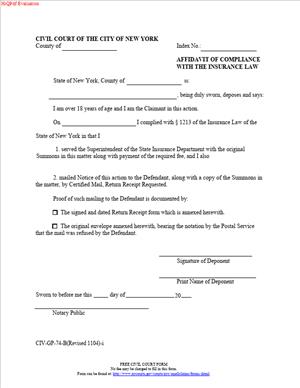
CIV-GP-74-B-i – Affidavit of Compliance with the Insurance Law
Fill out nowJurisdiction: Country: United States | Province or State: New York
The CIV-GP-74-B – Affidavit of Compliance with the Insurance Law is a sworn statement used in New York City Civil Court matters. It explains, in plain terms, how insurance requirements connected to a case have been met. The document focuses on compliance, not argument.
You usually encounter this form right before or during a court filing. It often appears when insurance coverage matters to the court’s authority to move a case forward. The timing can feel tight, which makes clarity important.
This affidavit is written for people who need to formally confirm insurance-related facts. That includes individuals, business owners, and representatives involved in civil cases. Many people using it are not lawyers.
The form matters because courts rely on sworn statements to confirm compliance. If insurance law requirements are not clearly addressed, filings can stall. This document is designed to present those facts in a structured way.
Filling it out carefully helps the court understand what coverage exists and how it aligns with legal requirements. It does not replace insurance policies or resolve disputes. It simply puts specific facts on the record.
What is CIV-GP-74-B – Affidavit of Compliance with the Insurance Law?
Clear definition
CIV-GP-74-B – Affidavit of Compliance with the Insurance Law is a written affidavit. An affidavit is a sworn statement made under oath. In this document, the signer affirms that certain insurance-related obligations have been met.
The form is structured to capture identifying information, details about insurance coverage, and a declaration of compliance. It is designed for submission to the Civil Court of the City of New York. The content is factual rather than argumentative.
The affidavit format means the signer attests that the statements are true to the best of their knowledge. This sworn aspect gives the document weight in court proceedings. It is not a casual explanation.
Who typically uses this form/document?
People involved in civil court cases commonly use this document. That may include individual litigants, small business owners, property owners, or authorized representatives. The common thread is a need to address insurance law compliance in a pending matter.
Self-represented parties often encounter this form when navigating procedural requirements. It may also be prepared by someone acting on behalf of an organization, such as a manager or officer.
The person signing the affidavit is usually someone with knowledge of the insurance coverage. That person is identified clearly in the document. The court expects the signer to understand the statements being made.
Why you might need this form/document
You might need this form when a court requires confirmation that insurance requirements tied to a case have been satisfied. Insurance compliance can affect whether a case proceeds or pauses.
Courts often use affidavits to streamline fact-checking. Instead of submitting multiple documents at once, the affidavit summarizes compliance. Supporting documents may exist separately.
The form helps create a clear record. It tells the court who is insured, what coverage exists, and how it aligns with legal standards. This clarity can prevent procedural confusion.
Typical real-life scenarios
A tenant brings a case involving property conditions, and insurance coverage becomes relevant. The court asks for confirmation that the required insurance is in place. The affidavit is used to present that confirmation.
A small business owner is involved in a civil dispute. The case requires proof that the business maintained certain insurance during a specific period. The affidavit summarizes that information for the court.
A property owner responds to a court notice requesting verification of insurance compliance. The affidavit is completed and filed to address that request directly.
An individual acting on behalf of a company needs to explain insurance status without submitting full policy documents at that stage. The affidavit provides a sworn overview instead.
When would you use CIV-GP-74-B – Affidavit of Compliance with the Insurance Law?
This document is used during the life of a civil court case. It often appears after a case has started but before a specific procedural step can move forward. Timing depends on when insurance compliance becomes an issue.
You may see it required after receiving a court notice or order. Sometimes the need arises when another party raises a question about insurance coverage. The affidavit serves as a formal response.
In many cases, the form is used alongside other filings. It does not stand alone as a complete submission. It complements pleadings, motions, or responses already on file.
The roles involved can vary. Plaintiffs, defendants, petitioners, and respondents may all encounter this requirement. The key factor is whether insurance law compliance is relevant to the court’s review.
Legal characteristics of CIV-GP-74-B – Affidavit of Compliance with the Insurance Law
This document has legal significance because it is sworn. The signer typically swears or affirms that the statements are true. That sworn nature is what gives it evidentiary value.
For effectiveness, the affidavit generally needs to be complete and clear. Missing information, unclear dates, or inconsistent statements can cause problems. Courts may reject or question affidavits that are vague.
Common issues include incorrect party names, mismatched case numbers, or insurance details that do not align with the relevant time period. These issues often delay proceedings rather than resolve them.
High-level differences can exist by jurisdiction. While affidavits are broadly similar, specific wording or formatting expectations may vary. New York City Civil Court has its own accepted forms and practices.
This document does not decide the outcome of a case. It does not grant rights or impose penalties by itself. It also does not replace actual insurance policies or endorsements.
Is it legally binding?
An affidavit is legally binding in the sense that it is a sworn statement. The signer is attesting to the truth of the contents. Courts treat these statements seriously.
The binding nature relates to honesty and accuracy. Making false statements in an affidavit can have consequences. The court relies on the assumption that the signer understands what is being affirmed.
The affidavit binds the signer to the facts stated at the time of signing. It does not bind the court to a particular decision. It simply becomes part of the court record.
How to fill out CIV-GP-74-B – Affidavit of Compliance with the Insurance Law
Step 1 – Review the title and case caption
Start by reading the title at the top of the form. The title identifies the document and its purpose. Check the case caption to confirm the court, party names, and case number match your matter.
Accuracy here matters because the court uses this information to link the affidavit to the correct file. Even small discrepancies can create confusion. Take time to compare it with other case documents.
Step 2 – Identify the person making the affidavit
The form asks for the name of the person making the sworn statement. This is the affiant. The affiant is usually someone with direct knowledge of the insurance coverage.
Provide the full legal name as used in the case. The form may also request the affiant’s role or relationship to a party. This context helps the court understand why this person is qualified to make the statement.
Step 3 – State the basis of knowledge
This section explains how the affiant knows the information being stated. It may refer to personal involvement, review of records, or responsibility for insurance matters.
A clear explanation builds credibility. The court looks for a logical connection between the affiant and the facts. Vague descriptions can weaken the affidavit’s usefulness.
Step 4 – Describe the insurance coverage
Here, the form typically asks for details about insurance policies. That can include the type of coverage, the insurer, and relevant dates. The focus is on compliance with insurance law requirements.
Be precise with dates and coverage descriptions. The court often looks at whether coverage was in effect during a specific period. Clarity helps prevent follow-up questions.
Step 5 – Address compliance with the insurance law
This part connects the insurance details to legal compliance. The affiant states that the coverage meets applicable insurance law requirements. The language is usually structured for this purpose.
Stick to factual statements. The affidavit is not a place for argument or explanation beyond what the form requests. The goal is to confirm compliance clearly.
Step 6 – Review for completeness and consistency
Before signing, read the entire document from start to finish. Look for internal consistency in names, dates, and descriptions. Ensure nothing important is left blank.
This review step helps catch errors that can delay acceptance. Courts often expect affidavits to be complete when submitted. Corrections later can require additional filings.
Step 7 – Sign and notarize the affidavit
The affidavit must be signed by the affiant. Because it is sworn, the signature usually occurs in the presence of a notary or other authorized official. The notary confirms the identity of the signer.
The notarization section completes the oath. Without it, the document may not be treated as a valid affidavit. Once signed and notarized, the document is ready for submission.
Legal terms you might encounter in CIV-GP-74-B – Affidavit of Compliance with the Insurance Law
- Affiant: The affiant is the person who signs this document under oath. On this form, the affiant is usually someone with direct knowledge of the insurance coverage. You must be comfortable that this person can truthfully confirm the facts stated.
- Notary Public: A notary public is the official who witnesses your signature and administers the oath. This form is not complete without notarization. The notary section confirms that you swore the statements were true when you signed.
- Policy Period: The policy period is the date range during which the insurance coverage was active. This form often focuses on whether coverage existed during a specific time tied to the case. Dates must line up with the court’s concern.
- Coverage Type: Coverage type describes what kind of insurance is in place, such as liability or other required coverage. On this form, you list coverage types to show legal compliance. Vague descriptions can raise questions.
- Insurer: The insurer is the entity that issued the insurance policy. You must name the insurer exactly as it appears on the policy documents. Misspelling or shortening the name can cause confusion.
- Compliance: Compliance means meeting the insurance requirements set by law. In this document, you are not arguing compliance. You are stating facts that show compliance exists.
- Case Caption: The case caption is the heading that lists the court, parties, and case number. This form must match the caption used in your other filings. Any mismatch can delay acceptance.
- Sworn Statement: A sworn statement is a statement made under oath. This form qualifies as one once it is signed and notarized. The court relies on sworn statements as truthful representations of fact.
- Authorized Representative: An authorized representative is someone permitted to sign on behalf of a business or organization. If you sign in this role, the form should make your authority clear. Courts expect this clarity when entities are involved.
FAQs
Who is allowed to sign CIV-GP-74-B – Affidavit of Compliance with the Insurance Law?
The signer must be someone with direct knowledge of the insurance information. That might be you, a business owner, or a manager responsible for insurance records. When you sign, you are swearing that the information in this document is accurate to the best of your knowledge.
What dates should I use for the insurance coverage period?
You should use the exact start and end dates shown on the insurance policy. The court often checks whether coverage existed during a specific window related to the case. Double-check that the dates you enter match the period the court is asking about.
Do I need to attach insurance policies to this form?
This document usually stands on its own as a sworn summary of compliance. You typically do not attach full policies unless the court or another filing specifically asks for them. Keep copies available in case you are later asked to produce them.
What happens if the names on the policy and the case caption do not match?
You should pause and resolve the mismatch before filing. Courts compare names across documents. If this document lists a different name than the case caption, the clerk may question whether the coverage applies to the right party.
Does filing this document change what is in the public court record?
Yes, once accepted, this form becomes part of the case file. It adds sworn information about insurance compliance to the public record of the case. It does not remove or replace earlier filings.
What if my insurance coverage changed after the date listed?
This document records facts as of the time period stated. If coverage later changes, that change is not reflected unless you file a new or updated sworn statement. Keep track of any changes in case the court asks.
How do I know if the court accepted this document?
Acceptance is usually shown by a filing stamp or electronic confirmation. You should look for proof that the clerk received and processed it. Keep that confirmation with your case records.
Can errors on this form be corrected later?
Minor errors may be corrected by filing an amended affidavit if allowed. Errors matter because this document is sworn. It is better to correct mistakes promptly than leave inaccurate information on the record.
Checklist: Before, During, and After CIV-GP-74-B – Affidavit of Compliance with the Insurance Law
Before
- Confirm the case caption matches your other court papers
- Identify the correct person to act as the affiant
- Locate the full insurance policy or declaration page
- Verify insurer name spelling and policy number
- Check coverage dates against the relevant case period
- Review any court notice requesting this document
- Plan for notarization before filing
During
- Enter names exactly as they appear in the case caption
- State the affiant’s role and basis of knowledge clearly
- List coverage types without guessing or summarizing loosely
- Use exact policy period dates from the insurance record
- Read each statement to confirm it is factually true
- Sign only in the presence of a notary
- Ensure the notary completes their section fully
After
- Make at least one copy for your personal records
- File the original using the court’s accepted method
- Confirm the document was received and accepted
- Note the filing date in your case timeline
- Store insurance records with the filed affidavit
- Monitor the case for any follow-up requests
- Update your internal records to reflect the filing
Common mistakes to avoid with CIV-GP-74-B – Affidavit of Compliance with the Insurance Law
- Mistake: Listing approximate insurance dates because you are rushing, which can misstate coverage and delay the case, so do not forget to verify dates directly from the policy.
- Mistake: Using a nickname or shortened business name, which happens when copying from memory and can cause rejection, so do not forget to match the case caption exactly.
- Mistake: Having the wrong person sign, often because authority is assumed, which can invalidate the affidavit, so do not forget to confirm the signer’s role and knowledge.
- Mistake: Skipping notarization due to oversight, which makes the document incomplete, so do not forget to sign only in front of a notary.
- Mistake: Leaving sections blank because they seem obvious, which raises questions for the clerk, so do not forget to complete every required field.
- Mistake: Filing without keeping copies, which happens under time pressure and causes problems later, so do not forget to retain proof of filing.
- Mistake: Mixing explanation with argument, which can distract from compliance facts, so do not forget this form is about stating facts only.
What to do after filling out CIV-GP-74-B – Affidavit of Compliance with the Insurance Law
Once the document is complete and notarized, your focus shifts to proper handling and follow-through. This form becomes part of the official court file, so treat it as a permanent record. Careful post-filing steps help you avoid confusion later.
Start by organizing your paperwork. Keep the signed original separate from your copies until filing is complete. Make sure you know how the court expects submissions to be made in your case.
- Step 1: Make at least two copies of the signed and notarized document.
- Step 2: File the original using the method accepted for your case, such as in person or electronically if available.
- Step 3: Obtain confirmation that the filing was received, such as a stamped copy or electronic receipt.
- Step 4: Place the confirmation and a copy of the filed document in your case folder.
- Step 5: Update your case timeline to note the filing date and purpose of the affidavit.
- Step 6: Store the related insurance policy documents with the affidavit for easy reference.
- Step 7: Watch for court notices that may respond to or reference this filing.
- Step 8: Be prepared to provide additional information if the court asks for clarification.
- Step 9: If your insurance status changes later, note the date and details for your records.
- Step 10: Review your internal records to ensure they reflect what was sworn to in the affidavit.
Staying organized after filing helps you respond quickly if questions come up. It also protects you if you need to confirm what was submitted and when.
Disclaimer: This guide is provided for informational purposes only and is not intended as legal advice. You should consult a legal professional.