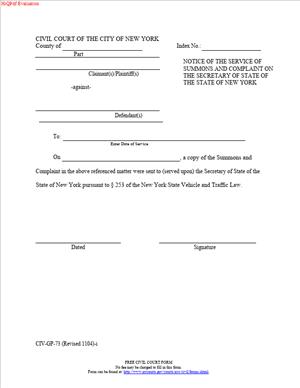
CIV-GP-73 – Notice of Service of Summons and Complaint on the Secretary of State of the State of New York
Fill out nowJurisdiction: Country: United States | Province or State: New York
What is a CIV-GP-73 – Notice of Service of Summons and Complaint on the Secretary of State of the State of New York?
This form is a court-issued notice used in the Civil Court of the City of New York. You use it after you serve a business defendant through the New York Secretary of State. It tells the defendant that you served the summons and complaint on its statutory agent. It also tells the court you sent that notice. It helps prove that the defendant had an added chance to respond.
In New York, many business entities appoint the Secretary of State as their agent for service of process. That includes corporations, LLCs, LLPs, and some other entities. When you sue one of these entities, you can serve the Secretary of State instead of serving the business directly. The Secretary of State then mails the legal papers to the business at the address on file. But that may not be enough when you ask for a default judgment. The court often requires an extra mailing that alerts the defendant that service has occurred. CIV-GP-73 is designed for that purpose.
You complete the form with your case details. You state when service on the Secretary of State took place. You identify the business you served. You mail the completed notice to the business at its last known address. You then file the form, along with your proof of mailing, with the court. The form becomes part of your proof of notice.
Who typically uses this form?
Plaintiffs are suing business entities in the Civil Court. That includes small business owners, landlords with corporate tenants, vendors, contractors, and consumers. It also includes attorneys and collection professionals handling business debt or breach cases. Self-represented litigants can use it as well.
Why would you need this form?
Because many default judgment requests fail for lack of proper notice, the court wants proof that the business had a fair warning beyond the Secretary of State mailing. This form adds that layer of notice. It reduces the risk of delay or denial. It shows the court that you acted in good faith to reach the defendant.
Typical usage scenarios include unpaid invoices, commercial lease disputes, property damage claims, or breach of contract cases. The common thread is that the defendant is a business entity served through the Secretary of State. You mail this notice soon after that service. You then keep a record for your default judgment motion or your case file.
In short, CIV-GP-73 is a notice and a safeguard. It does not replace the service of the summons and complaint. It documents and strengthens it. It helps you move your case forward without avoidable setbacks.
When Would You Use a CIV-GP-73 – Notice of Service of Summons and Complaint on the Secretary of State of the State of New York?
You use this form after you have already served a business defendant through the Secretary of State. This step happens when the defendant is a corporation, LLC, LLP, LP, or similar entity that lists the Secretary of State as agent for service. You would have delivered duplicate copies of the summons and complaint and paid the required fee. The Secretary of State then accepts service and mails it to the entity.
Use the form when you want to give the defendant an extra warning that the case is active. It becomes crucial if you plan to seek a default judgment. The court will look for proof that you mailed this notice to the defendant at its last known address. If you do not mail it, your default request may be denied.
Consider a few practical situations. You run a design studio and sued a New York LLC that never paid your invoice. You served the LLC by delivering the summons and complaint to the Secretary of State. The LLC has not answered. You complete CIV-GP-73 and mail it to the LLC’s current business address, or the address you last used. You keep a copy and proof of mailing. You then file the form with the court. You are now positioned to request a default if needed.
Or imagine you are a landlord with a corporate tenant who vacated and owes rent. You cannot locate a principal at the company. You serve the Secretary of State and then send this notice to the tenant’s last known address. That shows you tried to reach them directly.
Or you are a consumer who sued a company over a defective service. You served the company via the Secretary of State. You then mail this notice to the company’s listed office. You avoid a common reason for denial when you later ask for a default judgment.
Typical users include business owners, commercial landlords, vendors, and pro se litigants. Attorneys and agents use it as routine practice in Civil Court matters. The timing matters. Do it promptly after service on the Secretary of State. If you intend to seek a default, mail it early. Leave time for delivery and any waiting period before you move.
Legal Characteristics of the CIV-GP-73 – Notice of Service of Summons and Complaint on the Secretary of State of the State of New York
This form is part of your litigation record. It is not a contract. It does not create obligations by agreement. Its purpose is to give notice and satisfy court requirements tied to default judgments against business entities. It also supports fairness. It tells the defendant that service was made through the Secretary of State on a certain date. It tells them a lawsuit is pending. That reduces the risk of surprise.
Is it legally binding?
It is a sworn or signed notice that becomes part of the court file. It is binding in the sense that you declare facts to the court. The court can rely on it as proof that you mailed the notice. If you misstate facts, you risk sanctions. If you complete it properly, it supports your request for relief.
What ensures enforceability?
Your compliance with court rules and practice. You must fill it out fully and accurately. You must mail it to the proper address. You must use the correct case caption and index number. You must sign and date it. You should include a proof of mailing, often as an affidavit of mailing. If the form has a notary section, have it notarized. You should keep the Secretary of State service receipt and attach a copy of it when needed.
General legal considerations apply. Service on the Secretary of State gives the court personal jurisdiction if done correctly. But the court still wants added notice before granting a default. This form is the tool to show that you gave that notice. Mailing must be to the defendant’s last known address or a current business address. Use a reliable address. It can be the one on the Secretary of State’s records, a lease address, a billing address, or a recent business location. If you have multiple addresses, choose the most recent and likely to reach the entity. You can mail to more than one address to be safe, and note that in your affidavit.
This form does not extend your time to serve, answer, or move. It does not change your statute of limitations. It supports your proof. If the defendant appears after you mail it, you proceed as in any contested case. If the defendant defaults, your file is stronger. The court can grant relief with confidence that proper notice occurred.
How to Fill Out a CIV-GP-73 – Notice of Service of Summons and Complaint on the Secretary of State of the State of New York
Set aside a clean copy of the form and your case file. You will need the summons and complaint, the index number, and your Secretary of State service receipt. You will also need the defendant’s last known address. Follow these steps.
1) Complete the court caption.
- At the top, enter: Civil Court of the City of New York.
- Enter the county where your case is filed. Use the county on your summons.
- List the full names of the plaintiff(s) and defendant(s) as they appear on the summons.
- Enter the index number assigned by the clerk. If you do not have it, look at your stamped summons.
- If your case has a calendar number, list it where the form asks, if applicable.
2) Identify the defendant entity correctly.
- Use the exact legal name of the business as it appears in your pleadings.
- Include the entity type, such as Inc., LLC, LLP, or Corp.
- If there are multiple business defendants, use one form per defendant. Do not combine.
3) State the date and method of service on the Secretary of State.
- Enter the date you or your process server delivered the summons and complaint to the Secretary of State.
- Confirm that delivery was accepted and the fee paid. Use your receipt to verify the date.
- If you know the address to which the Secretary of State mailed the papers, include it. It is usually the service of process address on file.
4) State clearly that the service was made through the Secretary of State.
- Use plain language. Example: “On [date], the summons and complaint were served on the Secretary of State as statutory agent for [Defendant Name].”
- Do not claim personal service on the business unless that happened. Keep this notice accurate.
5) Add the mailing notice to the defendant.
- State that you are mailing this notice to the defendant’s last known address.
- List that address in full. Include suite numbers and any attention line.
- If you are mailing to more than one address, list each address. You can attach a page if needed.
6) Complete the sender details.
- Enter your name, address, phone, and email if you have an attorney, list counsel’s information.
- Sign and date the notice where indicated. Print your name clearly. If you are an attorney, include your firm name.
7) Prepare the mailing.
- Make a copy of the signed notice for your records.
- Place the original notice in an envelope addressed to the defendant’s last known address.
- Use first-class mail. You can use certified mail as a backup, but it is not required in most cases.
- Mail the notice promptly after service on the Secretary of State. Do not wait until you need a default. Give the defendant time to respond.
8) Complete the affidavit of mailing.
- Many versions of this form include an affidavit of mailing at the bottom or on the back.
- The person who placed the notice in the mail must sign the affidavit. It can be you or someone in your office.
- The affidavit usually requires a notary. Bring a valid ID and sign in front of the notary.
- The affidavit should state the date of mailing, the address used, and the method (first-class mail).
9) Assemble your proof packet.
- Keep the Secretary of State service receipt. It shows the date and acceptance of service.
- Keep a copy of the notice you mailed.
- Keep the affidavit of mailing. If you used certified mail, keep the receipt and tracking.
- When you later move for default, attach these documents to your motion papers.
10) File and serve as the court requires.
- If the court requires you to file the notice now, file it with the clerk. If not, keep it for your motion.
- Always bring a copy to any appearance related to service or default.
- If the court asks for extra proof, provide it. That can include a second mailing or a recent address search.
Key tips to avoid rejection
- Match the caption exactly to your summons and complaint.
- Use the correct county for Civil Court.
- Spell the business entity name correctly, including commas and suffixes.
- Do not guess the service date. Confirm it from the receipt or the process server’s affidavit.
- Mail to an address likely to reach the business. If the address is old, try to find an updated one. Use recent invoices, leases, or business records.
- If the defendant has counsel of record, you can mail a courtesy copy to counsel. Still mail to the business address for compliance with notice rules.
- If you sued multiple entities, prepare and mail a separate CIV-GP-73 for each one.
- Keep your sentences clear and simple. Avoid extra statements or arguments.
What if you do not know a good mailing address? Check your records. Look at contracts, emails, checks, or past correspondence. Use the address from the Secretary of State’s public record. If you have several addresses, mail to each one. List them all in your affidavit of mailing. The court wants to see a reasonable effort.
What if the notice comes back undeliverable? Keep the returned envelope. Do a quick search for an updated address. Mail the notice again to any new address you find. Update your affidavit or prepare a second one. Judges appreciate a practical effort. You show diligence without delay.
Does the notice replace service of the summons and complaint? No. It is an added notice only. You still need proper service on the Secretary of State. Keep the original affidavit of service or the Secretary of State receipt. Without proper service, this notice cannot cure the defect.
How long should you wait after mailing before moving for default? Give enough time for delivery and response. Many litigants wait at least 20 days after the mailing. That window supports fairness and aligns with common default practices. If you can wait a bit longer, do. It helps avoid pushback.
Finally, treat this form as part of your service proof strategy. Complete it carefully. Mail it promptly. Keep your records in order. If the defendant defaults, your motion will be stronger. If the defendant appears, you have still met your duty of notice. Either way, you move ahead with confidence.
Legal Terms You Might Encounter
- Summons. This is the court paper that tells the defendant that a case has started. It gives a deadline to respond. On this form, you confirm that the summons you served relates to this case and defendant.
- Complaint. This is your written claim. It explains what you want and why. When you complete this notice, you are confirming the complaint you served on the business through the Secretary of State.
- Service of process. This means legally delivering the summons and complaint to the defendant. The form records that you served the papers through the Secretary of State, which is a valid method for certain business entities.
- Secretary of State service. Many business entities can be served by delivering legal papers to the Secretary of State as their agent. On this notice, you state when and how that service happened, and you identify the entity you served.
- Business entity. This refers to corporations, LLCs, LLPs, and similar companies. The form ties your case to the exact legal entity name you served. You should ensure the name on the notice matches the served entity.
- Index or docket number. This is the case number assigned by the court. The notice must show that number, so the clerk can match your filing to the correct case.
- Affidavit or proof of service. This is a sworn statement that says how the service happened. The CIV-GP-73 notice is not the affidavit itself, but it points to the fact that service was made on the Secretary of State, and it complements your proof.
- Agent for service. This is a person or office authorized to accept legal papers for a business. In this context, the Secretary of State is the statutory agent. Your notice confirms that you used this agent to serve the defendant.
- Date of service. This is the day the Secretary of State accepted the papers. You must list this date on the notice. It affects the defendant’s response deadline and your later steps in the case.
- Certificate or receipt number. When you serve through the Secretary of State, you may receive a receipt or transaction number. If you have one, include it on the notice to support your filing and help the clerk verify the service.
FAQs
Do you need to file CIV-GP-73 every time you serve a business through the Secretary of State?
Yes. File this notice in the case whenever you serve the summons and complaint through the Secretary of State. It creates a clear court record that service occurred and when.
Do you attach the summons and complaint to the notice?
Attach a copy of the summons and complaint you served, along with any receipt or letter confirming acceptance by the Secretary of State. This helps the clerk match your notice to the actual papers served.
Do you need to notarize the CIV-GP-73?
No. This notice typically does not require notarization. You still must complete it accurately and sign it. Your separate affidavit or proof of service may not need notarization, depending on how you completed service.
Do you use CIV-GP-73 for individuals, or only for businesses?
Use it when you serve a business entity by delivering the summons and complaint to the Secretary of State. For individuals, this notice does not apply. Confirm the defendant’s status before you file.
Do you still need an affidavit of service if you file CIV-GP-73?
Yes. CIV-GP-73 does not replace your affidavit or proof of service. File your notice and keep your proof of service organized and ready for the court. You may need it to confirm timing or defend your service.
Do you file one notice for each defendant?
Yes. File a separate notice for each business defendant served through the Secretary of State. Each notice should show the correct entity name, date of service, and related details.
Do you need the exact legal name of the business on the notice?
Yes. Use the exact legal name as it appears on the business’s registration records. Minor differences can cause delay or rejection. Align the name on the notice with the name on the summons and complaint.
Do you need to e-file the notice?
File the notice in the same way you file other documents in your case. If the case is in a court location or program that uses electronic filing, follow those procedures. If it’s paper filing, submit hard copies to the clerk.
Checklist: Before, During, and After the CIV-GP-73
Before signing: Gather what you need
- Case caption with the correct court, county, and part.
- Docket or index number assigned by the court.
- Exact legal name of the business defendant as shown on your summons and complaint.
- Entity type, if known (corporation, LLC, LLP, etc.).
- Date the Secretary of State accepted service.
- Any receipt, letter, or proof from the Secretary of State that confirms acceptance.
- Your filed summons and complaint, to double-check consistency.
- Your contact information for the signature block.
- A copy of any affidavit or proof of service you already prepared.
- A checklist of all defendants to confirm that you file one notice per entity.
During signing: Verify these sections
- Case information. Confirm the docket number, court name, and party names match your summons and complaint.
- Defendant details. Make sure the business name is exact and complete. Include designations like Inc., LLC, or LLP.
- Service details. Enter the acceptance date by the Secretary of State. If you have a receipt or transaction number, include it.
- Method confirmation. Confirm that the way you delivered the papers aligns with the rules for Secretary of State service for that entity type.
- Attachments. Include copies of the summons and complaint and any acceptance document from the Secretary of State.
- Signature and date. Sign and date the notice. Use legible print for your name and contact information.
- Copies. Prepare at least two copies—one to file, one for your records. If there are multiple defendants, prepare sets for each.
After signing: Filing, notifying, and storing
- File the notice with the court where your case is pending. Use the court’s filing method for your case.
- Ask the clerk if a filing fee applies for this notice. If it does, be ready to pay.
- Mark your calendar with the service date and expected response deadline under the governing rules.
- If opposing counsel has appeared, send them a courtesy copy of the filed notice.
- If you discover an error after filing, prepare and file a corrected notice promptly.
- Keep stamped copies of the notice, the affidavit or proof of service, and the Secretary of State receipt together.
- Update your internal case timeline, including next steps like default procedures if no response is filed by the deadline.
- Store all documents in the case file, both digitally and as hard copies, if required.
Common Mistakes to Avoid
Using the wrong business name.
- Consequence: The court may question your service, causing delays or rejection.
- Tip: Don’t forget to copy the name exactly as it appears on your summons and complaint, including Inc., LLC, or LLP.
Omitting the service date.
- Consequence: The court cannot confirm timing, which affects response deadlines and next steps.
- Tip: Always enter the date the Secretary of State accepted the papers, not the date you mailed or prepared them.
Relying on the notice instead of a proof of service.
- Consequence: You may lack admissible proof if service is challenged.
- Tip: Keep and file your affidavit or proof of service. The notice complements it, but does not replace it.
Failing to attach supporting documents.
- Consequence: The clerk may reject the filing or request more information.
- Tip: Attach the summons, complaint, and any acceptance letter or receipt from the Secretary of State.
Mixing multiple defendants on one notice.
- Consequence: The record becomes unclear, and the clerk may return the filing.
- Tip: File one notice per business defendant served through the Secretary of State.
What to Do After Filling Out the Form
- File promptly. Submit the completed CIV-GP-73 in your case as soon as possible after service through the Secretary of State. The court needs this record to track deadlines.
- Confirm docket accuracy. After filing, check the docket or case file to see the notice listed with the correct date. If you do not see it, follow up with the clerk.
- Track the response deadline. Use the service acceptance date to calculate the defendant’s answer or appearance deadline under the applicable rules. Build in reminders a few days before and after the deadline.
- Prepare for the next step. If the defendant appears, be ready to share a copy of the notice and your proof of service. If no response arrives by the deadline, review your options for a default process under the rules.
- Correct errors quickly. If you notice a typo or wrong date, file an amended or corrected notice. Attach the same supporting documents and explain, in simple terms, what you corrected.
- Coordinate with co-defendants. If there are multiple business defendants, repeat the same process for each. Track each service date and each response deadline separately.
- Keep complete records. Store a stamped copy of the filed notice, your proof of service, and any Secretary of State receipt in your case file. Good records support motions and settlement discussions.
- Stay consistent. Make sure the information on the notice matches your summons, complaint, and affidavit of service. Consistency reduces objections and speeds up court processing.
Disclaimer: This guide is provided for informational purposes only and is not intended as legal advice. You should consult a legal professional.