CIV-GP-42i – Notice of Transmittal of Transcript
Fill out nowJurisdiction: Country: United States | Province or State: New York
What is a CIV-GP-42i – Notice of Transmittal of Transcript?
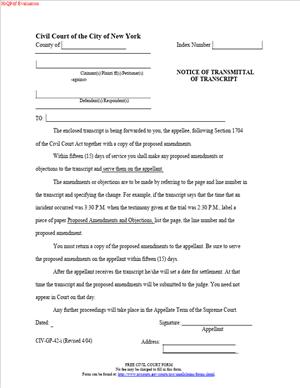
The CIV-GP-42i is a cover notice used in the Civil Court of the City of New York. You use it to send a certified transcript from the Civil Court to another office or court. In practice, you most often attach this notice to a certified Transcript of Judgment you got from the Civil Court Clerk. You then transmit both to the County Clerk for docketing. Docketing turns your Civil Court money judgment into a county-level judgment lien against the debtor’s real property in that county. The notice identifies the case, the judgment, the parties, and where the transcript should go. It also tells the receiving office what you are asking them to do.
You may also see this notice used when a transcript of proceedings is transmitted in connection with an appeal. In that context, the notice travels with the transcript to ensure the appellate record is complete and traceable. The core function is the same. It formally documents that a certified transcript is being sent, by whom, to whom, and for what purpose.
Who typically uses this form?
Judgment creditors and their attorneys use it after a Civil Court money judgment. Landlords who won a rent judgment, small business owners who prevailed on an unpaid invoice claim, or consumers who won a small claims case use it. Commercial creditors use it when they want a county lien to strengthen collection. Court staff may also use it to transmit certified transcripts internally or to another court, but as a litigant, you focus on using it for docketing or record transmission.
Why would you need this form?
Because the receiving office expects a clear, standardized cover that ties the transcript to the correct case and action. If you mail a transcript without a proper notice, your request can stall. The County Clerk needs to know the judgment details, the correct debtor name, and the filing instructions. The notice provides that roadmap in one place. It helps you avoid misdocketing, delays, or rejected filings.
Typical usage scenarios
You win a Civil Court money judgment in New York County. You obtain a certified Transcript of Judgment from the Civil Court Clerk. You prepare the CIV-GP-42i notice. You attach a check for the County Clerk’s docketing fee. You mail or deliver the package to the New York County Clerk. The County Clerk then dockets the judgment. Your judgment becomes a lien on the debtor’s real property in New York County. You can repeat the process in other counties as well. Another example. You are preparing an appeal and must transmit a certified transcript of proceedings. You attach this notice to the transcript so the receiving clerk can log and route it quickly. In both scenarios, the notice is your official cover sheet and proof of transmittal.
In short, the CIV-GP-42i is a practical, administrative tool. It does not change the judgment. It ensures your certified transcript lands in the right hands with clear instructions.
When Would You Use a CIV-GP-42i – Notice of Transmittal of Transcript?
You use this notice when you need to send a transcript from the Civil Court to another office that will act on it. The most common reason is docketing a Civil Court money judgment with a County Clerk. Docketing expands your enforcement options. It also creates a lien on any real property the debtor owns in that county. If your debtor owns property in Kings County but your Civil Court case was in New York County, you can obtain a transcript and transmit it for docketing in Kings County. The notice guides that process.
Landlords often use it after housing or general civil matters that result in money judgments. Small claims winners use it to pursue collection beyond the Civil Court tools. Contractors and service providers use it to reach assets when a debtor will not pay voluntarily. Consumer and commercial creditors use it to perfect county liens while they pursue other enforcement, such as income executions or bank restraints.
You also use this notice when you send a transcript of proceedings for an appeal. If you are the appellant, you may have a transcript prepared. The record on appeal relies on that document. The notice follows the transcript to the appropriate clerk so it is logged and matched to your appeal. This helps avoid confusion about which case, which part, and which hearing date the transcript covers. It also helps show that you met your transmission obligations.
There are less common situations too. If the Civil Court issues a certified transcript needed by another tribunal or administrative body, you may send it with this notice. The function remains the same. You give the recipient a clear, formal notice of what the transcript is, where it came from, and what you need done.
If you are self-represented, you use the notice the same way an attorney would. You fill it out, attach the certified transcript, pay the required fee, and transmit the packet to the correct destination. You also keep copies for your records and serve copies on the other side when required.
Timing matters. You will usually request a transcript soon after your judgment is entered. Interest accrues on judgments, but docketing early helps protect your priority. If you are appealing, you will work within strict deadlines to settle and transmit transcripts. The notice helps you show that you sent the transcript to the right place on time.
Legal Characteristics of the CIV-GP-42i – Notice of Transmittal of Transcript
The notice itself does not create or alter rights. It is not the judgment. It is not an order. It is not a lien. It is a formal cover that accompanies a certified transcript issued by the Civil Court Clerk. The legal weight comes from the certified transcript and the underlying judgment or proceedings. The notice ensures the transcript is properly received, logged, and acted upon by the destination office.
Why is it important?
Because receiving offices rely on accurate, standardized information to process filings, the County Clerk will docket a judgment only from a certified Transcript of Judgment. The notice confirms what is enclosed, states who is sending it, and requests docketing. It lists the debtor’s correct legal name and addresses, which are critical for indexing. It cites the Civil Court index or docket number, the date of judgment, and the amount. It may also reflect interest and costs. The County Clerk uses that information to index and docket the lien correctly.
What ensures enforceability?
The enforceability lies in the judgment and the clerk’s docketing of the certified transcript. When the County Clerk dockets a Civil Court judgment, the lien attaches to real property in that county under state law. The notice helps ensure you get to that point without defects. Proper certification, correct fees, and accurate party names matter. If anything conflicts, the County Clerk defers to the certified transcript. The notice can also serve as a record of your transmission in case questions arise later.
There are a few legal considerations you should keep in mind. You must transmit a certified transcript, not a copy. Certification by the Civil Court Clerk is required. You must send the transcript to the correct County Clerk. Different counties maintain separate dockets. You should list the debtor’s name exactly as it appears on the judgment. Include any known alternate names or business names used in the case. This helps indexing and future searches. You should include the correct fee, payable to the County Clerk in the destination county. If you are sending a transcript of proceedings for appeal, you should comply with the procedural requirements for settling and transmitting the record. The notice documents the handoff, but it does not excuse missed deadlines.
Remember that the notice is a filed communication. Treat it as part of the record. Be accurate, complete, and consistent with the certified transcript. Do not try to add new terms or change amounts in the notice. If you need to amend a judgment, use proper motion practice in the Civil Court before you request or transmit a new transcript.
How to Fill Out a CIV-GP-42i – Notice of Transmittal of Transcript
Start by gathering what you need.
Obtain your certified transcript from the Civil Court Clerk. If this is for docketing a lien, you need a certified Transcript of Judgment. If this is for appeal, you need the certified transcript of proceedings. Have your case caption, Civil Court index or docket number, the judgment date, and the amount. Confirm the correct spellings of party names and any known alternate names. Note the destination clerk’s office and its county. Check the current fee and prepare the payment.
Complete the case caption at the top.
Enter the court name as Civil Court of the City of New York. Identify the county of the Civil Court part where the case was filed, such as New York, Kings, Queens, Bronx, or Richmond. Write the full case title exactly as it appears on the judgment. List the plaintiff or petitioner and the defendant or respondent. Include middle initials, suffixes, and any doing-business-as names that appear on the judgment. Consistency helps the receiving clerk index the docket correctly.
Enter the Civil Court index or docket number.
Use the exact number assigned in your Civil Court case. If there is a calendar number or housing part index, include it only if it appears on your judgment or transcript. Do not invent or shorten numbers. Precision reduces processing delays.
Identify the type of transcript enclosed.
State whether you are transmitting a Transcript of Judgment for docketing or a transcript of proceedings for appeal. If it is a Transcript of Judgment, specify that it is certified by the Civil Court Clerk. If it is a transcript of proceedings, note the hearing dates and the part or judge if the form provides space for that detail. If the form includes a check box or a line for “Nature of Transcript,” select or write the accurate description.
State the destination.
Name the receiving office clearly. If you are docketing a lien, the destination is the County Clerk for a specific county. Write, for example, County Clerk of [County], not the Civil Court Clerk. If you are transmitting for appeal, state the appropriate clerk for the appellate court that will receive the record. The form’s addressee line is your instruction to the receiving office. Do not leave it blank.
Provide judgment details when docketing.
Enter the date of entry of the judgment. List the principal amount awarded. Include costs and disbursements if they appear on the judgment. If the Civil Court adds a clerk’s fee or statutory costs, reflect them as shown on the certified transcript. If the form asks for interest, indicate the rate and the date from which interest runs, as shown on the judgment. Do not recalculate or adjust the numbers on your own. The receiving clerk will follow the certified transcript.
Identify the judgment debtor and creditor.
For the debtor, use the exact legal name on the judgment. If the judgment lists multiple defendants, identify the debtor or debtors against whom the judgment was entered. If the case lists a business entity, include the entity type if shown, such as LLC or Inc. If you know alternate names that appear on the judgment, include them, for example, a/k/a or d/b/a. For the judgment creditor, use the exact name on the judgment. If you are an assignee of record, ensure the assignment is already reflected in the Civil Court record before you transmit. The County Clerk will rely on the certified transcript.
Add addresses for indexing and notice.
Include the last known mailing address for the debtor. Include the creditor’s address. If the form provides separate lines for service addresses, complete them. The County Clerk may mail a docketing notice or return receipt to the address you provide. Accurate addresses also help with later enforcement steps.
List attachments and enclosures.
State that you enclose the certified transcript. If required, state that you enclose a check or money order for the docketing fee in the correct amount. If you include a self-addressed stamped envelope for return receipts, note it. If you include an affidavit of service on the opposing party, list it as an enclosure. Being explicit helps the recipient confirm a complete packet.
Select the method of delivery and date.
If the form includes a delivery method section, indicate whether you are filing in person, by mail, or by a courier. Enter the date you are sending the packet. If you are meeting an appeal deadline, this date can matter. Keep proof of mailing or a filed-stamped copy for your records.
Complete the service section, if present.
Some versions of the notice include a service acknowledgment or an affidavit section. If the receiving office requires you to serve a copy of the notice and the transcript on the other side, complete this section. Identify who you served, how you served them, and when. If service is not required, you may still choose to send a courtesy copy to avoid disputes later.
Sign and date the notice.
Print your name, title, and contact information. If you are self-represented, identify yourself as the judgment creditor or appellant. If you are counsel, include your firm name and attorney of record information. A signature confirms that you sent the transcript and that the information is accurate to the best of your knowledge. Unsigned notices can be rejected or ignored.
Review for consistency before you send.
Compare each entry on the notice to the certified transcript and the judgment. The case caption, judgment date, and amounts must match. The debtor’s name must match. Correct any typographical errors. Confirm that the County Clerk’s county is correct. Confirm the fee and that the payment instrument is payable to the correct office. Small errors can delay docketing or cause misindexing.
Transmit the packet and keep records.
If you file in person, ask for a stamped copy of the notice as proof of transmittal. If you mail the packet, use a trackable method. Keep a full copy of everything you sent, including the certified transcript, the notice, the check stub, and any proof of mailing. If the receiving office returns a receipt or docket number, save it. You will need it for future enforcement or for referencing the docket in another filing.
Follow up as needed.
If you do not receive confirmation within a reasonable time, contact the receiving office. Ask whether the transcript was docketed or logged. Provide the case caption, Civil Court index number, and the date you transmitted. If there is an issue, correct it promptly. Common issues include missing certification, incorrect fee amounts, or mismatched party names. Your prompt follow-up protects your lien priority and keeps your appeal on track.
Practical tips that can save time
Order multiple certified transcripts if you plan to docket in more than one county. Prepare a separate notice and fee for each county. Use the exact debtor name as it appears on the judgment every time. If you later file an execution or a restraining notice, match the name format you used for docketing. Keep a spreadsheet of where and when you docketed, the docket numbers, and the counties. Consistency helps you avoid confusion months or years later.
If you are transmitting a transcript of proceedings for appeal, coordinate with the Civil Court Clerk about the settlement of the transcript. Once settled, transmit the notice as directed. Include any required certifications or stipulations. Track appeal deadlines separately. The notice does not change those deadlines. It documents that you transmitted the transcript to the proper clerk.
Finally, remember the scope of the notice. It is a transmittal tool. It does not substitute for the certified transcript. It does not replace a notice of appeal or a judgment enforcement document. Use it to move your certified transcript to the right office, in the right way, at the right time. That keeps your judgment enforceable and your appeal record clean.
Legal Terms You Might Encounter
- A transcript is the word-for-word written record of what was said in court. The CIV-GP-42i accompanies that transcript when you send it to the court and the other side, so they know exactly what you’re transmitting and why.
- Transmittal means you are formally sending something and creating a clear paper trail. Here, the notice tells the court and all parties that the transcript has been delivered, and it lists the key details of what’s included.
- The caption is the case title at the top of your form and transcript, showing the parties’ names in the correct order. Make sure the caption on the notice matches the caption on the transcript, or the filing may be delayed or misfiled.
- An index number (sometimes called a docket number) is the unique case identifier. Your notice must match the index or docket number on the transcript and the court’s records so the clerk can route your papers to the correct file.
- The court reporter (also called a stenographer) is the professional who takes down the proceedings. The notice typically identifies the reporter and confirms that a certified transcript is being transmitted. You do not certify the transcript; the reporter does.
- Certification is the reporter’s signed statement that the transcript is accurate and complete. Do not transmit an uncertified transcript unless the court explicitly allows it. Your notice should reflect that certification is attached or included in the transcript.
- Settlement of the transcript refers to the process where parties review the transcript, raise any objections or corrections, and the court resolves disputes. Your notice helps trigger that review by alerting everyone that the transcript is in circulation and ready for any required steps.
- The record on appeal is the set of documents that the appellate court will review. The transcript often becomes part of that record. Your notice helps establish the chain of custody and timing for the transcript if you are building an appeal record.
- Service means delivering copies to every other party. Proof of service is your written confirmation that you did so. The notice of transmittal usually requires you to serve the parties and keep proof, because timing and notice can affect appellate and post-judgment steps.
- Proceeding date(s) are the specific dates covered by the transcript. List those dates on the notice. If the transcript covers multiple days, include all of them so no one is confused about what was transmitted.
- Appellant and respondent are the party names used if there is an appeal. If you’re transmitting a transcript for an appeal, your notice should use the correct appellate party designations and be consistent with any notice of appeal already filed.
FAQs
Do you need to file the CIV-GP-42i if you are not appealing?
You typically use this notice when you’re transmitting a transcript to the court and parties for review, settlement, or inclusion in a record. That often happens in appeals, but a judge may also require a transcript for motions or post-judgment issues. If the court directed you to submit a transcript, you should use a transmittal notice to document delivery.
Do you attach the transcript to the notice?
Yes. The notice is not a stand-alone filing. It accompanies the transcript and identifies what you are sending, the proceeding dates, the reporter, and the page count. If the transcript is delivered separately by the reporter, your notice should clearly state what was delivered, when, and by whom.
Do you need the court reporter’s certification before you transmit?
Yes. A certified transcript avoids disputes about accuracy. The reporter’s certification page should be included. If certification is pending, note that status and follow the court’s instructions on whether you can transmit a preliminary version. In most cases, wait for certification to avoid re-filing.
Do you have to serve every party?
Yes. Serve all parties who have appeared in the case, using the service method the court accepts for your case. Keep proof of service. Omitting a party can lead to objections, delays, or a rejected filing.
Do you e-file the notice and transcript or submit paper copies?
Submit them in the manner the court uses for your case. Some cases require electronic filing, while others require paper. Your notice should be filed the same way you file other case documents. If you’re unsure, ask the clerk’s office about the required method for your case type.
Do you pay a fee with this notice?
You pay the court reporter for the transcript. The notice itself usually does not carry a court fee, but filing requirements can vary. Confirm with the clerk whether any copy or processing fee applies. Always attach proof of any transcript payment if the court asks for it.
Do you include exhibits with the transcript?
Only include exhibits if the court or the rules require them at this stage. The notice can list included items. If exhibits are not included now, your notice can state that exhibits remain with the court file and will be handled as directed for the record.
What if you find an error in the transcript after you transmit it?
Prepare an errata or correction request to the reporter, as the process allows. Then serve an amended notice of transmittal identifying the corrected pages or updated certification. Keep both versions in your file with clear dates so the record shows what changed.
What if the case settles or you withdraw an appeal after transmitting the transcript?
Notify the court and the parties that the transcript was transmitted and that the matter is resolved or the appeal is withdrawn. Ask the clerk if any additional steps are required to close out the transcript-related process.
Checklist: Before, During, and After the CIV-GP-42i – Notice of Transmittal of Transcript
Before signing: information and documents you need
- Your case caption and index or docket number exactly as they appear on prior filings.
- The judge’s name, the part or courtroom, and the courthouse location.
- Proceeding date(s) covered by the transcript and the type of proceeding (trial, hearing, motion).
- Court reporter’s full name and contact details.
- Certified transcript, including the reporter’s certification page.
- Page count and any volume numbers if there are multiple volumes.
- A list of all parties and attorneys to be served, with current addresses or e-service details.
- Proof of any transcript order and payment, if requested by the court.
- Filing method for your case (e-file or paper) and any formatting requirements (cover page, labeling).
- A plan for service: how many copies you need, envelopes, and postage if mailing.
During signing: sections to verify on the notice
- Caption accuracy. Confirm party names and their positions match your case.
- Index or docket number. Cross-check it against the transcript cover page.
- Proceeding details. List exact dates and describe the proceeding type.
- Court reporter identification. Spell the name correctly and include contact information if requested.
- Transcript specifics. Include page count, volume numbers, and whether certification is attached.
- Contents of transmittal. State if exhibits or additional materials are included or withheld.
- Your contact information. Provide a reliable phone and email for follow-up.
- Signature and date. Sign in ink if filing paper, or follow the correct e-sign method if e-filing.
- Service certification or affidavit. Complete it fully, listing each served party and method of service.
After signing: filing, notifying, and storing
- File the notice and transcript with the court using the correct method for your case.
- Serve all parties the same day, or as promptly as possible, and complete proof of service.
- If the reporter is delivering the transcript directly to the court, coordinate timing and note it on your notice.
- Calendar any response or objection periods set by the court for transcript review or settlement.
- Confirm the clerk has accepted your filing and that it is linked to the correct case file.
- If objections arise, work with the reporter and parties to resolve them, and be ready to submit corrected pages.
- Keep a complete set in your file: the signed notice, the transcript, the reporter certification, and proof of service.
- Track costs and keep receipts for transcript charges. You may need them later for cost recovery requests.
Common Mistakes to Avoid
Don’t forget to match the index or docket number.
- Consequence: The clerk may reject or misroute your filing, causing delays and duplicate costs.
Don’t transmit an uncertified transcript by mistake.
- Consequence: The court or parties may reject it. You may have to re-serve a certified version, resetting timelines.
Don’t omit proceeding dates or list the wrong dates.
- Consequence: Parties will not know what was transmitted. You may face disputes about completeness and timing.
Don’t skip proof of service or leave someone off your service list.
- Consequence: Your filing may be challenged, and you may need to re-serve and re-file, losing time.
Don’t misidentify the court reporter or leave out contact details when requested.
- Consequence: Corrections become harder and slower, and the court may question the transcript’s authenticity.
What to Do After Filling Out the Form
- File the notice and the transcript promptly using the correct method for your case. If e-filing is required, upload the notice and the transcript in the designated categories. If paper is required, bring the correct number of copies and organize them clearly, with the notice on top.
- Serve all parties and keep proof of service. If you are mailing paper copies, use trackable methods when practical. If you are serving electronically, confirm successful transmission and save the confirmation.
- Confirm receipt with the clerk. Ask whether any additional steps are needed to link the transcript to pending motions or to an appellate record. If the transcript is for an appeal, verify how it will be incorporated into the record.
- Calendar review and objection periods. If the court expects parties to review and propose corrections, set internal deadlines a few days ahead of any anticipated cutoffs. Share correction requests with the reporter promptly.
- Handle corrections quickly. If you or an opponent identifies an error, ask the reporter for corrected pages or an errata sheet. Once corrected, serve an amended notice of transmittal identifying what changed, and file the corrected pages if required.
- Request court action if needed. If disputes about the transcript remain, be ready to ask the court to settle the transcript. Keep your communications clear and focused on specific page and line references.
- Coordinate with the reporter for additional volumes. If you later need more dates or a supplemental transcript, order them promptly and transmit them with a new notice so your record stays complete and organized.
- Update your case calendar. Note any downstream deadlines that depend on the transcript, such as deadlines for briefs or motion responses. Build in time for unexpected corrections.
- Close the loop if the matter resolves. If the case settles or an appeal is withdrawn, notify the court and parties so the transcript process is closed out properly. Keep your file tidy for future reference or audits.
- Archive your materials. Store the signed notice, the certified transcript, any amended notices, the reporter’s certification, and all proofs of service. Label everything with dates and volume numbers. A clean archive will save time if questions arise later.
Disclaimer: This guide is provided for informational purposes only and is not intended as legal advice. You should consult a legal professional.