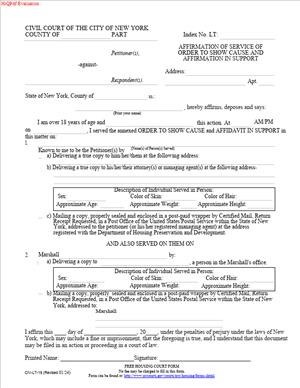
CIV-GP-19 – Affirmation of Service of Order to Show Cause and Affirmation in Support
Fill out nowJurisdiction: Country: United States | Province or State: New York
What is a CIV-GP-19 – Affirmation of Service of Order to Show Cause and Affirmation in Support?
This is a two-in-one form used in the Civil Court of the City of New York, General Civil Part. You use it with an Order to Show Cause. It does two jobs:
- It is your affirmation in support. You explain the facts and the relief you need. You show why the court should sign your Order to Show Cause.
- It is your affirmation of service. You or your server confirms how and when the opposing side was served after the judge signs the Order to Show Cause.
An Order to Show Cause is a fast way to ask for court relief. You bring a request ona shortened time, often with a temporary stay. The judge will set how and when you must serve the papers. The judge will also set the return date, which is the court date for the motion. After serving, you must prove that the service happened as ordered. CIV-GP-19 is the proof the court expects. It is filed before or on the return date, as the judge directs.
Who typically uses this form?
Self-represented litigants in the General Civil Part often use it. So do attorneys, paralegals, and process servers. Small businesses, debtors, creditors, and judgment holders use it when they need quick relief. The cases include consumer credit, contract disputes, property damage, and other civil matters in this court. Housing cases use different forms, so do not use CIV-GP-19 for landlord-tenant matters.
Why would you need this form?
If you need emergency or time-sensitive relief, you likely use an Order to Show Cause. Examples include asking to:
- Vacate a default judgment you learned about from a bank restraint.
- Stay enforcement of a judgment while you ask to vacate it.
- Restore a case to the calendar if it was dismissed.
- Modify or extend a deadline set by the court.
- Compel the other side to do something on short notice.
Your Affirmation in Support gives the judge the facts and legal reasons for your request. Your Affirmation of Service shows you followed the judge’s service directions. Without proof of service, your motion can be denied or marked off.
Typical usage scenario
You prepare the Order to Show Cause package. You include this CIV-GP-19 form, completed for the support part. You bring the package to the clerk for review and then to the judge. If the judge signs the Order to Show Cause, it will set strict service rules. You then serve the opposing side as instructed. You complete the service part of CIV-GP-19 and file it to prove service.
When Would You Use a CIV-GP-19 – Affirmation of Service of Order to Show Cause and Affirmation in Support?
Use this form anytime you move by Order to Show Cause in the Civil Court of the City of New York, General Civil Part. You use it first to support your request. You use it again to show you served the signed Order to Show Cause and all supporting papers.
Here are practical examples:
- You are a defendant who missed court. A default judgment was entered, and your bank account was restrained. You need a stay to stop the restraint and time to vacate the judgment. You prepare an Order to Show Cause. You use CIV-GP-19 to explain why you missed court and your defenses. After the judge signs the order, you serve the plaintiff as directed. You complete the service section to prove service.
- You are a small business that got a default judgment due to a calendar mistake. Sheriff’s levy on business funds is about to start. You need an immediate stay. You use this form to set out the mistake, your defense, and the harm. You then serve the papers on the plaintiff or their lawyer and file the service affirmation.
- You are a plaintiff whose case was dismissed for failure to appear. You want the case restored to the calendar. You use the form to explain the reason for your absence and show a meritorious claim. You then serve the Order to Show Cause by the deadline and file proof using this form.
- You are a debtor served with an income execution. You need the court to stop it while you contest the judgment. You file an Order to Show Cause with this form. You serve the judgment creditor or their attorney and the enforcement officer, if directed. You affirm service using this form.
In each situation, two things matter. You must present clear facts supporting the relief, and you must serve exactly as ordered. CIV-GP-19 supports both goals. It tells your story and proves your compliance.
Legal Characteristics of the CIV-GP-19 – Affirmation of Service of Order to Show Cause and Affirmation in Support
This form is a sworn statement submitted to the court. When you sign it, you affirm the truth of your statements under penalty of perjury. The court relies on it to decide your request and to confirm that proper service occurred.
Is it legally binding?
Yes. Your signature binds you to the truth of the facts you state. If your statements are false, the court can impose penalties. Your Affirmation of Service is the court’s record that you served as ordered. If service is defective, your motion may be denied or adjourned. A temporary stay may be lifted. In serious cases, the court may sanction improper conduct.
What ensures enforceability?
The judge’s signed Order to Show Cause contains clear service directions. It may require personal service, certified mail, or another method. It will set a deadline and a return date. You must follow those directions exactly. Your CIV-GP-19 confirms that you did so. The clerk will file it in the case file. The judge will review it on the return date. If it shows proper service, the motion can proceed. If it does not, the judge may stop the motion or extend the time for service.
General legal considerations
- Service method controls. Serve exactly as the judge ordered. If the order says personal service, do not use mail. If it says certified and regular mail, do both.
- Timing matters. Serve by the date and time set in the order. Late service can void a stay or cause denial.
- Who can serve? Follow the order’s direction on who may serve. For motion papers, a party may sometimes serve. Some judges require a non-party adult. If the order is silent, use a non-party adult to avoid disputes.
- Who to serve. Serve the attorney of record if the other side has one. If not, serve the party at the address in the case file or as the order specifies. If the order lists specific persons or entities, serve each one.
- Proof of mailing or delivery. Keep receipts and tracking. Attach copies to your affirmation of service. Include any signed acknowledgments if required.
- Attach exhibits to your support section. Exhibits should support your facts. Label them clearly and refer to them by letter in your narrative.
Your compliance with the order’s service terms and your clear support facts drive the court’s decision. CIV-GP-19 is how you show both.
How to Fill Out a CIV-GP-19 – Affirmation of Service of Order to Show Cause and Affirmation in Support
You will use this form twice. First, complete the Affirmation in Support when you submit the Order to Show Cause. Then, after service, complete the Affirmation of Service. Follow these steps.
Step 1: Gather your case information
- Case caption. Exact names of the parties as they appear on the court papers.
- Index or docket number. Copy it from your summons or prior orders.
- Part and judge. If known, list the assigned Part and the judge’s name.
- Return date. Leave blank until the judge signs the order. Then fill it in.
- Your role. Plaintiff, defendant, third-party, or nonparty movant.
Keep all papers together. You will attach your exhibits to the support section and serve the same set later.
Step 2: Complete the caption
At the top, fill in:
- Court: Civil Court of the City of New York and the county.
- Parties: Plaintiff(s) and Defendant(s) as in the case.
- Index or docket number.
- Title: “Affirmation of Service of Order to Show Cause and Affirmation in Support (CIV-GP-19).”
Accuracy in the caption helps the clerk file it without delay.
Step 3: Draft the Affirmation in Support
This is your factual statement. Keep it clear, numbered, and concise. Use short paragraphs. Include:
- Your identity and role. State your name and your role in the case.
- The relief you seek. State what you want the court to do.
- Why do you need an Order to Show Cause? Explain the urgency or need for a stay.
- The facts. Lay out dates, events, and key details.
- The legal basis in simple terms. Use plain language. Identify defenses or grounds.
- Harm if relief is denied. Explain concrete harms or prejudice.
- Exhibits. Refer to documents and label them A, B, C, etc.
Example structure:
1. I am the defendant in this action.
2. I ask the Court to sign the Order to Show Cause to stay enforcement and vacate the default judgment.
3. I learned of the judgment on [date] when my bank account was restrained.
4. I missed the court date because [reason]. Attach any proof that supports this.
5. I have a defense to the claim. Briefly explain the defense. Attach supporting documents.
6. I acted promptly after learning of the judgment. Provide the dates to show diligence.
7. If a stay is not granted, I will suffer [specific harms]. State concrete impacts.
8. I attach the following exhibits: bank restraining notice (Exhibit A), proof of address change (Exhibit B), and proposed answer (Exhibit C).
Do not assume the judge knows your file. Give the key facts in order. Avoid long quotes or arguments. Let your documents support your points.
Step 4: Attach exhibits to the support section
Attach only relevant materials. Common exhibits include:
- The judgment and notice of entry.
- Bank restraint or income execution notices.
- Proof of your defense or payments.
- Prior correspondence or court notices.
- A proposed answer or proposed order.
Mark each exhibit with a letter. Refer to each exhibit by letter in your numbered paragraphs. Make copies for service.
Step 5: Sign and date the Affirmation in Support
The form includes affirmation language under penalty of perjury. Sign and date it. Print your name and contact information. If you are an attorney, include your firm information and attorney number. If you are self-represented, include your mailing address, phone, and email if you have one.
If your courthouse requires notarization for non-attorney affirmants, use a notary. When in doubt, notarize to avoid delay.
Step 6: Present your Order to Show Cause package to the court
Your package generally includes:
- The proposed Order to Show Cause.
- Your supporting papers, including CIV-GP-19 (support section completed).
- Any other required forms or proposed orders.
- Copies for the court and all parties.
The clerk will review your paperwork. A judge will then review it and may sign the order. The signed Order to Show Cause will set:
- The return date and time.
- The service deadline.
- The method of service and who can serve.
- Any temporary relief (such as a stay).
Read the order carefully. Highlight each service direction. You must follow it exactly.
Step 7: Serve the signed Order to Show Cause and all supporting papers
Serve the full set of papers. That includes:
- The signed Order to Show Cause.
- Your Affirmation in Support with exhibits.
- Any other documents you filed or that the order lists?
Follow the judge’s directives exactly:
- Method. Personal delivery, certified mail, regular mail, overnight mail, or other methods as stated.
- Timing. By the exact date and time listed. Service must be completed by the deadline.
- Who can serve? If the order requires a non-party adult, do not serve it yourself. If it allows service by mail, you may be able to mail it yourself. When unclear, use a non-party adult.
- Who to serve. Serve the attorney of record or the party, as the order specifies. Some orders require service on additional entities, like a marshal or bank. Serve each listed recipient.
Keep proof:
- For personal delivery: get a description of the recipient and the exact time and place.
- For mail: keep stamped receipts, tracking, and copies of addressed envelopes.
- For overnight delivery: keep the tracking printout and receipt.
Step 8: Complete the Affirmation of Service section on CIV-GP-19
This section is filled out by the person who served the papers. If the order requires a non-party server, the server must be someone other than you. The server should complete:
- Server’s name, age (over 18), and relationship to the parties (state non-party if required).
- Date and exact time of service.
- The address and location of service.
- The method of service used was exactly as ordered.
- The documents served. List them all, including exhibits.
- The name of each person or entity served, and the address or office.
For mail service, include:
- The type of mail (regular, certified, or return receipt requested).
- The post office or mailbox location.
- The city and state of mailing.
- The time of mailing.
For service on an attorney, list the firm and the attorney’s name. For entities, state the recipient or department if known.
The server should affirm that the statements are true under penalty of perjury. The server signs and dates the affirmation. If notarization is required, the server should sign before a notary.
Step 9: File the Affirmation of Service with the court
File your completed CIV-GP-19 with the clerk, as directed in the order. Some orders require filing before the return date. Others allow filing on the return date in the Part. Bring or upload the following, as applicable:
- The signed Affirmation of Service (original).
- Copies of mailing receipts or delivery confirmations.
- Any green cards or tracking printouts, if available.
Keep a full copy set for your records and for the hearing.
Step 10: Prepare for the return date
On the return date, the judge will check the case file. The judge will confirm that the service was done as ordered. If the service is proper, the motion can be heard. Be ready to answer questions about:
- Service details and timing.
- The facts in your support affirmation.
- Your exhibits and defenses.
- Any settlement or stipulation options.
If the service was defective, the judge may adjourn for proper service. The judge may also deny the requested stay. Exact compliance avoids these outcomes.
Practical tips and common pitfalls
- Do not assume mail is enough. Use the exact method stated in the order.
- Do not serve late. Early service is safer. Keep proof.
- Serve all parties listed. If the order lists several recipients, serve each one.
- Include every paper served in your service list. Omitting exhibits can cause problems.
- Write clearly. Illegible handwriting slows filing and review.
- Use the case caption exactly as on the original papers.
- If service failed, act fast. Ask the court for new service directions before the return date.
- If the other side has an attorney, serve that attorney unless the order says otherwise.
What if you cannot complete the service as ordered?
Do not guess. If you cannot find the person or the address is wrong, document your attempts. Before the service deadline, seek guidance from the clerk in the Part. You may need a modified order or an extension. Courts respond better to prompt, documented requests than to late or defective service.
Final check before filing
- Support section is complete, signed, and dated.
- Exhibits are labeled and attached.
- Service followed the judge’s order exactly.
- The service section is complete, signed, and dated by the server.
- Proof, such as receipts or tracking, is attached or available.
- Copies are made for you and for the hearing.
By following these steps, you give the court what it needs. Your support section explains the relief and the reasons. Your service section proves compliance. Together, they let the court reach the merits of your request on the return date.
Legal Terms You Might Encounter
- Order to Show Cause: This is a judge-signed order that sets a hearing date and gives service instructions. It often includes temporary relief. With CIV-GP-19, you confirm you served this order exactly as directed.
- Affirmation in Support: This is the sworn statement that explains why the court should grant the relief you ask for. It attaches any exhibits you rely on. CIV-GP-19 confirms you served the Affirmation in Support along with the Order to Show Cause.
- Service: Service means delivering legal papers to the other side in a way the court accepts. The judge’s order tells you who must be served, how, and by when. CIV-GP-19 records how the service happened.
- Proof of Service (Affirmation of Service): CIV-GP-19 is the proof. The person who served signs it to confirm, under penalty of perjury, that they served the correct papers, on the correct person, by the correct method, on time.
- Return Date: The return date is the court date on the Order to Show Cause. All service steps must happen before this date and often by a specific deadline. You list the service date on CIV-GP-19 so the court can confirm you met the deadline.
- Method of Service: This is how the papers were delivered, such as personal delivery, substituted service, or posting and mailing if the order allows. On CIV-GP-19, you select and describe the method used.
- Substituted Service: If personal delivery is not possible or not required, the order may allow delivery to a person of suitable age and discretion at the recipient’s home or business, sometimes with a follow-up mailing. CIV-GP-19 must show who accepted, their relationship (if known), and the required mailing details.
- Nail-and-Mail (Posting and Mailing): This means attaching the papers to the door or a visible place and mailing copies afterward, but only if the order allows it. CIV-GP-19 must include where you posted, how you mailed, and the dates for both.
- Non-Party Server: The person who serves the papers cannot be a party to the case. They must be an adult who is not involved in the case. CIV-GP-19 is signed by this non-party server.
- Caption and Docket or Index Number: The caption is the case title (names of the parties). The docket or index number identifies the case. CIV-GP-19 must match the caption and number on the Order to Show Cause.
FAQs
Do you have to serve both the Order to Show Cause and the Affirmation in Support?
Yes. You must serve every document in the order listed. That usually includes the Order to Show Cause, the Affirmation in Support, and any attached exhibits. If the order mentions other papers, serve those too. On CIV-GP-19, list each document you served by name.
Do you need a licensed process server to complete service?
Not always. Unless the order requires a licensed server, any adult who is not a party can serve. The server must follow the order’s method and timing. The non-party server signs CIV-GP-19. If the order mandates a specific type of server, follow that instruction.
Can you, as the moving party, sign CIV-GP-19?
No. You cannot serve your own Order to Show Cause. The person who performed the service completes and signs CIV-GP-19. If you served the papers yourself, service is usually invalid. Use a non-party adult and have that person sign the form.
Do you need a notary for CIV-GP-19?
CIV-GP-19 is an affirmation signed under penalty of perjury. It does not require notarization unless the court specifically instructs you to use a notarized affidavit instead. Follow the form’s language and any clerk instructions. If required, use an affidavit of service and get it notarized.
Do you have to mail after substituted service?
If the order requires a mailing after delivery to another person, yes. Substituted service often includes a follow-up mailing. The server should mail the papers as required and keep the receipt. On CIV-GP-19, include the mailing date, method, and where it was mailed.
Do you need to file CIV-GP-19 before the return date?
Yes. File it by the deadline in order. If the order sets a specific filing deadline, meet it. Otherwise, file as soon as service is complete and before the hearing. Keep a stamped copy. Bring a copy to court.
Do you need a separate CIV-GP-19 for each person served?
Yes. Use a separate CIV-GP-19 for each recipient. If you served the same documents on two people, complete two forms. If you used different methods for the same person, complete one for each method.
What if you realize you wrote the wrong date or address on CIV-GP-19?
Correct it right away. If already filed, prepare a corrected or supplemental affirmation explaining the accurate details. File the corrected document promptly. Do not alter the field’s original. Bring copies to court and be prepared to explain the correction.
Checklist: Before, During, and After the CIV-GP-19
Before signing: Information and documents you need
- Court-stamped Order to Show Cause with the judge’s signature and return date.
- The Affirmation in Support and all exhibits that must be served.
- The judge’s service instructions: who to serve, how, and by what date.
- Names of all recipients and their roles in the case.
- Current addresses for each recipient, including apartment, suite, floor, and business name.
- Are any alternate addresses allowed by the order?
- A qualified server: adult, not a party, willing to follow the order.
- Supplies for required mailings: envelopes, postage, certified or first-class slips as ordered.
- A plan for timing: dates for delivery, any follow-up mailings, and filing.
- Extra copies of all papers: one set to serve for each person, plus a set for your records.
During signing: Sections to verify on CIV-GP-19
- Case caption and docket or index number match the Order to Show Cause.
- Court location and part, if the form requests it.
- Server’s full name, contact details, and confirmation that the server is a non-party adult.
- Exact service date and time for each person served.
- Exact service address, including apartment, suite, floor, and business name if applicable.
- Method of service used, consistent with the judge’s order.
- Names and roles of recipients. If delivered to another person, include their name or a clear description and relationship, if known.
- Details of any mailing: date mailed, class of mail, address used, and any receipt or tracking number.
- List of every document served by title (Order to Show Cause, Affirmation in Support, exhibits, and any attachments required by the order).
- Any special instructions from the order followed (posting location, additional mailings, language requirements).
- Server’s signature and date, acknowledging the penalty of perjury statement on the form.
After signing: Filing, notifying, and storing
- Make at least two copies of the signed CIV-GP-19 and any mailing receipts.
- File the original CIV-GP-19 with the court by the deadline in the order.
- If required, e-file or hand-deliver, depending on the court’s process.
- Ask the clerk for a stamped copy for your records.
- Serve any required courtesy copies as directed by the order.
- Keep all mailing receipts, tracking confirmations, and photos of posting (if used) with your copy.
- Calendar the return date and appear with your stamped copy and supporting papers.
- If you later find an error, prepare and file a corrected or supplemental affirmation promptly.
Common Mistakes to Avoid
- Don’t let a party serve the papers. A party cannot serve the Order to Show Cause. If you do, service is usually invalid. Consequence: The court can deny your request, cancel a stay, or adjourn your hearing.
- Don’t miss a required mailing after substituted or posted service. Many orders require a follow-up mailing. If you skip it or mail it late, service is defective. Consequence: The court can reject your proof, deny relief, or schedule a hearing on service.
- Don’t leave out the apartment or suite number. An incomplete address casts doubt on the service. Consequence: Opposing parties may challenge service. The court may set a service hearing, causing a delay.
- Don’t ignore the order’s service method or deadline. The order controls how and when you must serve. Consequence: The court may vacate temporary relief, reject your filing, or adjourn.
- Don’t forget to list every document served. Omitting the Affirmation in Support or exhibits suggests incomplete service. Consequence: The court can find service incomplete and deny or delay your request.
What to Do After Filling Out the Form
- File your proof of service quickly. Submit the signed CIV-GP-19 to the court by the deadline in the Order to Show Cause. If the court uses electronic filing, upload as instructed. If not, file in person or by mail according to the clerk’s guidance. Ask for a stamped copy.
- Confirm what the court received. Check that the filed CIV-GP-19 matches your signed original. Ensure the docket or index number is correct. Confirm that any required mailing receipts or attachments are included.
- Serve any required courtesy copies. Some orders ask you to send extra copies to the other side or to the judge’s part. If required, do it right away and keep proof.
- Track any mailings. If the service included mail, keep tracking numbers, certificates of mailing, and postal receipts. Print online confirmations if available. Keep them with your copy of CIV-GP-19.
- Prepare for the hearing. Bring the stamped CIV-GP-19, the Order to Show Cause, the Affirmation in Support with exhibits, and any receipts or photos. Organize your documents so you can show the judge you followed the service instructions.
- Address problems fast. If you discover an error in the filed CIV-GP-19, prepare a corrected or supplemental affirmation. File it immediately. Bring a copy to the hearing. Do not alter the original on file.
- Handle incomplete service. If you could not serve as ordered, document your attempts. Be ready to explain what happened on the return date. Ask the court for instructions on next steps as appropriate.
- Keep a complete record. Store copies of the filed CIV-GP-19, mailing receipts, posting photos, and your service log. Note dates, times, locations, and any conversations with building staff or recipients.
- Follow up after the hearing. If the court issues further orders, serve them as directed. Each new service may require a new proof of service. Keep filing promptly to avoid delays.
Disclaimer: This guide is provided for informational purposes only and is not intended as legal advice. You should consult a legal professional.