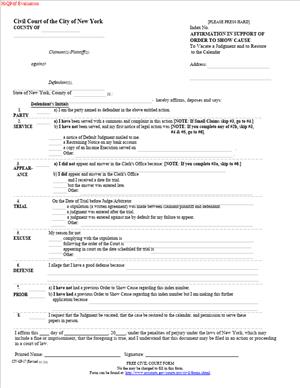
CIV-GP-17 – Affirmation in Support of Order to Show Cause to Vacate a Judgment and to Restore to the Calendar
Fill out nowJurisdiction: Country: United States | Province or State: New York
What is a CIV-GP-17 – Affirmation in Support of Order to Show Cause to Vacate a Judgment and to Restore to the Calendar?
This form is a sworn statement you submit to the Civil Court of the City of New York. You use it to ask a judge to sign an Order to Show Cause. That order asks the court to do two things. First, to vacate a judgment that was entered in your case, often by default. Second, to restore the case to the court’s active calendar so you can be heard. The affirmation is the heart of your request. It tells the judge what happened, why you need relief, and what your defenses or claims are.
Think of the affirmation as your factual roadmap. You explain the key dates, service issues, why you missed court (if you did), and why the case should reopen. You also explain the relief you need right now, such as a temporary pause on garnishment or bank restraints while the court reviews your request.
This form belongs to the Civil Court of the City of New York. It is used in General Civil cases in that court. Typical matters include consumer debt, contract disputes, property damage, and commercial claims. The form is designed for quick, focused presentations to the judge. You give the facts under oath, attach your proof, and ask for specific relief.
Who typically uses this form?
Defendants who have a default judgment entered against them often use it. Plaintiffs also use it when their case was dismissed for failure to appear, and they need the case restored. Small businesses and individuals use it to reopen cases when something went wrong in notice or scheduling. Attorneys file these often. Self-represented litigants can also use this form with help from the clerk.
You might need this form if you learned a judgment exists, but you never got served. You might also need it if you received notice but had a serious, excusable reason for missing court. It helps if you have a real defense or claim. The court expects you to explain both your excuse and your merits.
Typical usage scenarios
A debt collection defendant finds a wage garnishment started without warning. She files a CIV-GP-17 explaining she never got the summons because she moved before service. She shows mail forwarding proof and a lease. She explains her defense, such as identity theft or incorrect balance. She asks the judge to vacate the default, stop enforcement, and restore the case for a hearing. In another scenario, a plaintiff’s case was dismissed when he missed a calendar call due to a medical emergency. He submits a doctor’s note and asks to restore the case to proceed to trial.
In both cases, the affirmation supports an Order to Show Cause. If the judge signs the order, it will set a date for the other side to come to court and respond. It may also temporarily stay enforcement. Your affirmation is what convinces the judge to sign the order and give you that chance.
When Would You Use a CIV-GP-17 – Affirmation in Support of Order to Show Cause to Vacate a Judgment and to Restore to the Calendar?
You use this form when a judgment has been entered, and you need to reopen the case. The most common reason is a default judgment. That means the court entered judgment because you did not answer the lawsuit or did not appear at a hearing. You also use this form when your case was dismissed for not appearing, and you want it restored. The form fits urgent situations because the Order to Show Cause can ask for immediate relief, like a stay on collection.
Defendants use this when they never received the summons and complaint. They also use it when mail was sent to an old address, or the service went to the wrong person. If you have a service problem, tell the court exactly how you learned of the case and when. Ask for a hearing on service if needed. If you knew about the case but missed a date for a good reason, explain the reason clearly. Back it up with documents.
Business owners use this form when a default hits their bank account. A restraint can freeze operating funds without warning. You can ask the court to stop enforcement while it decides whether to vacate the judgment. Contractors often use this form in disputes with invoices and change orders. They attach contracts, emails, and payment records to show a defense or counterclaim.
Plaintiffs use this when the court marked their case off or dismissed it due to a missed appearance. You need to show a reasonable excuse and that your claim has merit. You also show that you are ready to move forward if the court restores the case. For example, you might attach witness statements or repair estimates.
Consumers facing judgment on credit card debt often use this form. So do drivers in property damage disputes. You can also use it if you settled and the other side still entered judgment in error. Show the signed settlement and proof of payment. Ask the court to vacate the judgment and close the case as settled.
Timing matters. Use this form as soon as you learn there is a judgment or a dismissal. If you wait, the court may view your request less favorably. Moving quickly also helps stop harm like garnishment and credit damage. If you have already been garnished or your bank account is restrained, include those documents. Ask for a stay of enforcement of your requested relief.
Legal Characteristics of the CIV-GP-17 – Affirmation in Support of Order to Show Cause to Vacate a Judgment and to Restore to the Calendar
This affirmation is a sworn submission to the court. When you sign it, you swear that your statements are true. False statements can carry penalties. The judge reads your affirmation to decide whether to sign the Order to Show Cause and grant a stay. If the judge signs, the order is legally binding. It directs the parties to appear on a set date and may pause enforcement. It also sets the terms for the service of the papers on the other party.
What makes it enforceable is the court’s authority and your sworn facts. The court has the power to vacate judgments and restore cases. The judge needs a factual basis. That is why your affirmation must give more than conclusions. Explain the facts that show an excusable default or a service problem. Also, explain your defense or claim in simple terms. Attach documents that support your statements. The court relies on both your oath and your exhibits.
Your request to vacate a default usually needs two things. First, a reasonable excuse for the default. Second, a meritorious defense. A reasonable excuse could be lack of proper service, serious illness, a documented emergency, or other good cause. A meritorious defense means you have real arguments that could change the outcome. For example, the wrong person was sued, the wrong amount was paid, a statute of limitations defense, a lack of contract, or payment already made. If you are a plaintiff seeking restoration, you must show a reasonable excuse and that your claim has merit.
If you assert a lack of service, the court may schedule a hearing on that issue. That hearing focuses on how the service was made and whether it was valid. Your affirmation should ask for that hearing if the service was improper. Provide proof of your address and presence or absence on the service date. The judge will consider all of it.
Time is also a legal factor. The court expects you to act promptly after learning of the judgment or dismissal. If you learned about the judgment months ago but did nothing, explain why. If you file quickly, say so. Tell the court the date you learned about the judgment and the date you filed. That timeline helps your credibility.
The Order to Show Cause can include a temporary stay of enforcement. This is common when a default judgment led to a wage garnishment or a bank restraint. Ask for the stay in your affirmation. Be specific about what you want paused and why. If the judge includes a stay, the sheriff, marshal, or other enforcement officer must comply. You must also serve the order on everyone required, including the enforcement officer if the order says so.
Finally, service of your papers after the judge signs the Order to Show Cause is critical. The judge will write how and when you must serve the other side. Follow those directions exactly. File proof of service on time. The court will not hear your request if service is defective. You need to show that the other side received notice and a fair chance to respond.
How to Fill Out a CIV-GP-17 – Affirmation in Support of Order to Show Cause to Vacate a Judgment and to Restore to the Calendar
Follow these steps to complete and file the form correctly.
1) Identify the case and court details
- Write the full case caption exactly as it appears on prior papers. Include the exact names of all parties.
- Fill in the index or docket number assigned by the Civil Court.
- Identify the county/borough of the Civil Court where the case is pending. Use the same location as the original case.
- If you know the judge’s Part, include it. If not, leave it blank, and the clerk will route it.
2) State who you are and your role
- In the opening, state whether you are the plaintiff or the defendant.
- Provide your current residential or business address, phone, and email. This helps with service and notices.
- If you are not an attorney, the form may require a notarized signature. Be prepared to sign before a notary or at the clerk’s office.
3) Explain why you need an Order to Show Cause
- Start with a brief, clear request. Say you seek to vacate a judgment and restore the case to the calendar.
- Ask for a temporary stay of enforcement, if needed. List what needs to stop, such as wage garnishment, bank restraints, or judgment execution.
- If you believe service was improper, request a hearing on service.
4) Provide a clear timeline of events
- State when the case started and how you first learned of it.
- If you missed a court date, state the exact date and reason. Keep it factual and concrete.
- If you never received the summons, explain your address history during the relevant period. Include dates of moves and mail forwarding, if any.
- State when you first learned about the judgment and how. For example, a garnishment letter or a bank notice.
5) State your reasonable excuse for the default or dismissal
- If there is a lack of service, say so directly. Provide facts showing you did not receive the papers. Give details on your residence, work hours, and who lives with you.
- If illness or emergency, identify the date, nature of the emergency, and proof. Attach a doctor’s note, hospital discharge, or similar records.
- If a calendar mistake occurred, explain what happened. Attach any email confirmations or calendar screenshots. Be specific and brief.
6) State your meritorious defense or claim
- Give a short summary of your defense or claim. Use plain language with a few key facts.
- Examples: You paid the debt and attached proof. The amount is wrong, and you attached statements. You were not the account holder and attached identity theft reports. There is no signed contract, and you attach correspondence.
- If you are the plaintiff seeking restoration, state why your claim has merit. Attach invoices, contracts, photos, or witness statements.
7) Attach your exhibits and label them
- Attach documents that support your story. Use clear labels: Exhibit A, Exhibit B, and so on.
- Create a simple exhibit list at the end of your affirmation. For each exhibit, write one sentence about what it is.
- Useful exhibits include pay stubs showing garnishment, bank restraint notices, lease agreements, utility bills, settlement agreements, proof of payment, and medical records.
- Make sure each exhibit is readable. Highlight key dates or amounts if helpful.
8) Ask for specific relief in numbered paragraphs
- Write a short list of the relief you want. Keep each item to one sentence.
- Ask to vacate the judgment and restore the case to the calendar.
- Ask for a temporary stay of enforcement of the judgment until the return date, and until the final decision.
- Ask for a hearing on service if you claim improper service.
- Ask for any other appropriate relief, such as modification of payment restraints to release exempt funds.
9) Address service of the Order to Show Cause
- Propose realistic service methods. Personal service or service by a person of suitable age is common. The judge will decide.
- Propose a service deadline you can meet. Many orders require service several days before the hearing date.
- Be ready to have someone who is not a party serve the papers and sign an affidavit of service.
10) Complete the signature and jurat
- Read the affirmation carefully before signing. Your statements are under oath.
- If the form calls for an affirmation under penalty of perjury, sign where indicated.
- If a notarization is required, wait to sign until you are before a notary or clerk.
- Print your name clearly. Include your address, phone, and email beneath your signature.
11) Prepare the complete packet
- Your packet usually includes: the proposed Order to Show Cause, your CIV-GP-17 affirmation, and your exhibits.
- Make enough copies. You need one for the court, one for each party, and one for yourself.
- Use tabs or labels so the judge can find key exhibits quickly.
12) File the papers with the Civil Court clerk
- Bring your packet to the Civil Court in the correct borough. Go to the General Civil clerk’s window.
- Ask for the Order to Show Cause to be reviewed by a judge. If a fee applies and you cannot afford it, ask about fee waiver procedures.
- Wait for the judge’s decision. If the judge signs, read the order carefully. It sets your service deadline, the return date, and any temporary stay.
13) Serve the signed Order to Show Cause and supporting papers
- Follow the service directions in the order exactly. Do not improvise.
- Use a process server or another adult who is not a party to serve the papers. Have them sign an affidavit of service.
- If the order requires service on a marshal, sheriff, employer, or bank, do that too. This ensures the stay is honored.
14) File proof of service and appear on the return date
- File your affidavits of service by the deadline in order.
- Bring originals of your exhibits to court. Arrive early and check in.
- Be prepared to answer questions about your excuse and your defense or claim. Keep answers short and focused.
15) Comply with the court’s decision
- If the court vacates the judgment and restores the case, you must be ready to proceed. File an answer if directed. Exchange documents as ordered.
- If the court sets a hearing on service, prepare witnesses and records to support your position.
- If the court denies your request, ask about next steps or appeal rights, if appropriate.
Practical tips for completing the form
- Keep sentences short and factual. Avoid arguments or accusations.
- Put dates in month/day/year format to avoid confusion.
- Use full names, not nicknames or initials, for parties and witnesses.
- Do not attach originals that you cannot replace. Use clear copies.
- If you need a stay, state why the delay will cause harm. For example, loss of rent, payroll risk, or frozen exempt benefits.
- If you moved, list every address for the period covering the alleged service. Include start and end dates.
Common mistakes to avoid
- Vague excuses without proof. Always attach something if you can.
- Leaving out the date you first learned of the judgment. The court needs that date.
- Forgetting to ask for a temporary stay. If you need it, say so directly.
- Missing the service deadline in the order. That can sink your request.
- Not showing a defense or claim with some detail. You need both excuse and merit.
If you follow these steps, your CIV-GP-17 will present a clear, complete request. You will give the judge what is needed to consider vacating the judgment and restoring the case to the calendar.
Legal Terms You Might Encounter
- Order to Show Cause: This is a judge’s order that sets a quick hearing and tells the other side to appear and respond. Your affirmation supports the judge’s decision to sign that order. You explain why the judgment should be undone and why the case should return to the calendar.
- Judgment: A judgment is the court’s final decision about who owes what. If you missed court, the judgment may be by default. In this form, you identify the judgment you want the court to vacate, including date and amount.
- Default Judgment: This happens when the court enters judgment because a party did not appear or did not answer. Your affirmation must explain why you defaulted and why the default should be excused.
- Vacate: To vacate means to cancel the judgment so it no longer stands. In this form, you ask the court to vacate the judgment and restore the case so both sides can be heard.
- Restore to the Calendar: When a case is “restored,” it returns to the court’s active schedule. In your affirmation, you ask the court to restore the case to a date when both sides can appear.
- Affirmation (and Affidavit): An affirmation is a sworn statement based on your personal knowledge, made under penalties of perjury. Some forms use an affidavit, which is similar but notarized. Follow the signature block on your form. If it requires a notary, sign in front of a notary and bring identification.
- Personal Knowledge: This means you know the facts first-hand. In your affirmation, you must describe facts you saw, did, or received, not guesses or hearsay. Personal knowledge makes your explanation credible.
- Reasonable Excuse: The court expects a clear reason for missing court or a deadline. Examples include lack of proper service, illness, emergency, or confusion caused by court notice issues. Your affirmation must state the excuse, with dates and any proof attached.
- Meritorious Defense: This is a real, specific defense that could change the outcome. In your affirmation, explain your defense in plain terms. For example, “I already paid,” “I never signed the contract,” or “The amount is wrong,” and attach supporting documents.
- Service and Proof of Service: Service means delivering legal papers to the other side. Proof of service shows that delivery happened as the judge directed. If the judge signs your order to show cause, you must serve the papers as directed and file proof by the deadline.
- Return Date: This is the date set by the judge for both sides to appear and argue the order to show cause. Your affirmation helps the judge decide whether to sign the order, set a return date, and possibly grant a temporary stay.
- Stay: A stay pauses enforcement of the judgment. The judge may grant a temporary stay when signing the order to show cause. In your affirmation, say if you need a stay and why, such as to avoid bank restraints or wage garnishment while the court hears your request.
FAQs
Do you have to explain both your excuse and your defense?
Yes. You must show two things: a reasonable excuse for the default and a meritorious defense. Explain what caused the default with dates and proof. Then explain your defense in simple, specific terms. Attach documents that support both.
Do you need to attach exhibits?
Yes. Attach documents that support your excuse and defense. Examples include proof you were not served, hospital records for the date of default, receipts, canceled checks, emails, contracts, settlement letters, or bank statements. Label each exhibit and refer to it in your affirmation.
Do you need to notarize the form?
Check the signature block. If the form has a notary block, sign in front of a notary and bring ID. If the form is an affirmation that does not require notarization, sign and date exactly as the form instructs. Do not sign in the wrong place.
Do you have to serve the other side?
Yes, if the judge signs the order to show cause, you must serve the signed order, your affirmation, and all exhibits as the judge directs. The judge will check delivery methods and deadlines. Follow those instructions exactly and file proof of service on time.
Do you need to pay a fee to file?
Courts may charge a filing fee for an order to show cause. If you cannot afford the fee, you can ask to proceed without paying by filing a fee waiver application. Ask the clerk for the process when you file.
Do you have a deadline to file after judgment?
Act quickly. Courts expect you to move without delay after learning of the judgment. If you learned about the judgment weeks or months later, explain when and how you learned of it and why there was any delay. Prompt action improves your chances.
Do you need to appear on the return date?
Yes. If the judge signs your order to show cause, you must appear on the return date unless the judge directs otherwise. Bring copies of all papers and exhibits. Be ready to answer questions about your excuse, defense, and service of the papers.
Do you file one affirmation for multiple judgments?
File a separate application for each case. If you have more than one judgment in the same case, list each judgment clearly and attach the relevant proof. Do not combine unrelated cases in one filing.
Checklist: Before, During, and After the CIV-GP-17 – Affirmation in Support of Order to Show Cause to Vacate a Judgment and to Restore to the Calendar
Before signing: Information and documents you need
- Case caption exactly as it appears on the judgment.
- Index or docket number, county/borough, and court part if known.
- Judgment date, amount, and type (default or otherwise).
- The date you learned about the judgment and how you learned.
- Your reasonable excuse for the default, with dates.
- Your meritorious defense was stated simply and specifically.
- Proof supporting your excuse (e.g., medical records, travel records, delivery notices, court notices).
- Proof supporting your defense (e.g., receipts, payment records, correspondence, contracts).
- Proof related to service issues (e.g., envelope marked “return to sender,” incorrect address proof, affidavits from residents).
- Any prior court orders or stipulations in the case.
- Your current address and reliable contact information.
- Names and addresses for service on the other side or counsel, if known.
- If seeking a stay, facts showing immediate harm without a stay (e.g., bank restraint notice).
- A proposed answer, if appropriate, or a short statement of defenses within the affirmation.
- Money for filing fees or a completed fee waiver request, if needed.
During signing: Sections to verify
- Caption and docket number match the judgment and court records.
- Your name, address, phone, and email are correct and legible.
- The judgment details are accurate: date, amount, and court part if known.
- Your excuse section states dates, places, and people involved.
- Your defense section states the legal reason in plain terms and refers to exhibits.
- You clearly request relief: vacate the judgment and restore the case to the calendar. Add stay language if needed.
- Each exhibit is labeled (Exhibit A, B, C…) and mentioned in the text.
- All dates line up across your story and exhibits.
- The notary or affirmation block is correct. Do not sign in the wrong place.
- If notarization is required, sign only in front of the notary and show ID.
- Page numbers appear on all pages. Include a list of exhibits if helpful.
- If you changed a line, initial the change near the correction.
- Attach the affirmation to your order to show cause packet as the court requires.
After signing: Filing, notifying, and storing
- Make at least three complete sets: court, the other side, and your records.
- File your order to show cause packet with the clerk. Include the affirmation and exhibits.
- Ask the clerk about fees or fee waiver processing.
- Wait for the judge to review and, if approved, sign the order to show cause.
- Read the signed order. Note the return date, service method, and service deadline.
- Serve the papers exactly as directed. Use the approved method and person.
- Obtain and file proof of service by the deadline in the order.
- Calendar the return date and plan to appear with originals of key exhibits.
- Store your stamped copies and proof of service together. Keep them accessible for court.
- Track the case status and any mail from the court or the other side.
Common Mistakes to Avoid CIV-GP-17 – Affirmation in Support of Order to Show Cause to Vacate a Judgment and to Restore to the Calendar
- Skipping either the excuse or the defense: Don’t forget that you must show both. If you only say why you missed court, the judge may deny the request. If you only state a defense, the judge may still deny it.
- Vague facts without dates or proof: Don’t rely on general statements like “I was sick.” Give dates, locations, and attach evidence. Without specifics, your credibility suffers, and the court may not grant relief.
- Ignoring the service instructions in the signed order: Don’t improvise. If the order says personal delivery by a non-party by a certain date, follow it exactly. If you serve the wrong way, the court may not hear your request.
- Missing the return date or filing proof of service late: Don’t miss deadlines. Late proof filings or missed appearances can result in the denial or dismissal of your application.
- Using the wrong addresses or outdated contact info: Don’t rely on old addresses. Confirm where to serve the other side or counsel. Update your address with the court. Bad addresses lead to invalid service and wasted time.
What to Do After Filling Out the Form CIV-GP-17 – Affirmation in Support of Order to Show Cause to Vacate a Judgment and to Restore to the Calendar
- Assemble your packet: Place the order to show cause on top, followed by your affirmation and exhibits. Add any proposed order or answer if required.
- File with the clerk: Bring all sets to the clerk’s office for the case’s courthouse. Pay any fee or submit your fee waiver request. Ask the clerk how you will receive the signed order (in person or later).
- Review the signed order: When the judge signs, read every line. Note the return date, time, courtroom, judge, service method, and deadline to serve and to file proof of service. Confirm whether a temporary stay was granted.
- Serve as directed: Arrange service immediately. Use a person who is allowed to serve, using the method the judge specified. Have them complete a proof of service form or statement.
- File proof of service: File it before the deadline. Keep a stamped copy for your records. If the court allows filing by certain methods, follow them exactly.
- Prepare for the hearing: Organize originals and copies of all exhibits. Prepare a short outline of your excuse and defense. Be ready to answer questions about service and your proposed next steps (such as filing an answer).
- Appear on the return date: Arrive early. Check in with the clerk for your part. When called, speak clearly. Focus on your excuse, your defense, and your compliance with service instructions. Hand up exhibits if asked.
- After the decision:
- If vacated and restored: Follow the court’s directions. File an answer by the deadline if the judge directs it. Attend all future court dates. Discuss settlement if appropriate.
- If not granted: Ask about your options. You may be able to renew with new evidence or take other steps. Note any new deadlines.
- If a partial stay is granted: Follow the stay terms exactly. Violations can restart enforcement.
- If you discover an error after filing:
- Before the return date, prepare a short supplemental affirmation that corrects the error and attach any missing exhibits. File and, if required, serve it the same way as the original papers.
- Bring copies of the supplement to court and explain the correction to the judge.
- Keep your records organized: Maintain a binder or digital folder with your stamped papers, exhibits, proof of service, and court orders. Note all dates and outcomes.
- Monitor enforcement: If a stay was granted, provide the signed order to your employer or bank if needed to stop garnishment or restraints. Confirm they received it. Keep notes of all communications.
- Stay engaged: Update your contact information with the court and the other side. Open your mail daily. Respond promptly to any court notices.
Disclaimer: This guide is provided for informational purposes only and is not intended as legal advice. You should consult a legal professional.