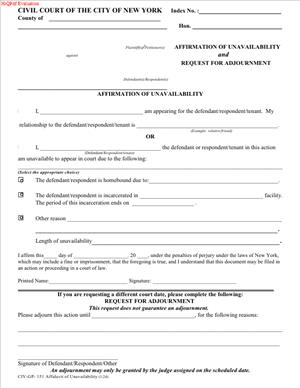
CIV-GP-151 – Affirmation of Unavailability and Request for Adjournment
Fill out nowJurisdiction: Country: United States | Province or State: New York
The CIV-GP-151 – Affirmation of Unavailability and Request for Adjournment is a court filing used when a scheduled court date cannot be met. It explains why you are unavailable and asks the court to move the date. This document matters because courts expect advance notice and clear reasons when a date cannot be kept.
You usually complete this form close in time to an upcoming appearance. It is part explanation and part request. The court reads it to decide whether to adjourn the matter to a later date.
This document is designed for people handling their own case, as well as those with legal representation. It uses structured fields so the court can quickly understand who is asking, what case it involves, and why the request is being made.
Filling out the CIV-GP-151 – Affirmation of Unavailability and Request for Adjournment carefully helps avoid missed appearances. It also helps keep your case active instead of being delayed by confusion or incomplete information.
The form does not guarantee a new date. It gives the judge or court staff enough information to decide how to handle the scheduling issue.
What is CIV-GP-151 – Affirmation of Unavailability and Request for Adjournment?
Clear definition
The CIV-GP-151 – Affirmation of Unavailability and Request for Adjournment is a written statement submitted to the Civil Court of the City of New York. It states that a party is unavailable on a scheduled court date and formally asks for that date to be postponed.
The document combines two elements. An affirmation is a sworn statement that the information is true. A request for adjournment is a procedural ask to change a scheduled appearance.
This form creates a record in the case file. It shows the court that the unavailability was communicated before the appearance date, rather than explained afterward.
Who typically uses this form/document?
This form is commonly used by individuals involved in civil cases in New York City Civil Court. That includes plaintiffs, defendants, petitioners, and respondents.
Self-represented litigants use this form often because it provides a structured way to communicate with the court. Attorneys may also use it when they need to notify the court of a conflict.
Parties who are required to appear in person or remotely may use the form. The key factor is that the court has scheduled an appearance, and attendance is not possible.
Why you might need this form/document
You might need this document when something prevents you from attending court on the assigned date. Courts generally expect notice as soon as the conflict is known.
The form allows you to explain the reason without appearing in person. It gives the court context, rather than leaving the absence unexplained.
Using the form can help avoid negative consequences associated with nonappearance. It shows an effort to engage with the process and keep the case moving.
Typical real-life scenarios
A common situation involves a medical issue that arises shortly before the court date. The person cannot attend but wants the court to understand the reason and reschedule.
Another scenario is a work-related conflict. Some jobs do not allow time off on short notice, especially for hourly or shift-based work.
Family obligations can also create conflicts. Childcare disruptions or caregiving responsibilities sometimes make attendance impossible.
Scheduling errors happen as well. A party may receive late notice of the court date or realize it conflicts with another court appearance in a different case.
When would you use CIV-GP-151 – Affirmation of Unavailability and Request for Adjournment?
You would use the CIV-GP-151 – Affirmation of Unavailability and Request for Adjournment after a court date has been scheduled and before that date occurs. Timing matters because the court needs the information in advance to consider the request.
This form is typically used when the unavailability is temporary. It assumes that the case can proceed on a later date.
People use the form when they know they cannot appear either in person or by any alternative method the court allows. The reason for unavailability is usually specific to the date in question.
The document is relevant across many civil case types. That includes housing matters, consumer disputes, and other civil proceedings handled by the Civil Court of the City of New York.
Legal characteristics of CIV-GP-151 – Affirmation of Unavailability and Request for Adjournment
This form has legal significance because it is an affirmation. By signing it, you state that the information provided is true to the best of your knowledge.
The document becomes part of the court record once submitted. Court staff and judges may rely on the statements when deciding whether to grant an adjournment.
Common problems arise when the form is incomplete or unclear. Missing case numbers, unclear reasons, or unsigned affirmations often lead to rejection or delay.
Another issue occurs when the request is submitted too late. Courts may not have time to review it before the scheduled appearance.
Practices may differ slightly depending on the court part or case type. Some courts handle adjournment requests administratively, while others require a judge’s review.
This form does not stop the case on its own. It does not automatically change the date or excuse attendance unless the court approves the request.
Is it legally binding?
The affirmation portion is legally binding in the sense that it is a sworn statement. Providing false information can carry consequences because the court relies on the truthfulness of the filing.
The request itself is not binding on the court. It asks for a change, but the court decides whether to grant it and under what terms.
Once the court acts on the request, any new date or instruction becomes controlling. Until then, the original date technically remains in place.
How to fill out CIV-GP-151 – Affirmation of Unavailability and Request for Adjournment
Step 1 – Identify the court and case
Begin by reviewing the top section of the form. This area identifies the Civil Court of the City of New York and connects the document to a specific case.
You will see spaces for the county, index or docket number, and the names of the parties. This information must match what appears on prior court papers.
Accurate identification ensures the form is placed in the correct file. Errors here can delay processing or cause the request to be overlooked.
Step 2 – Provide party information
Next, the form asks who is making the request. This usually includes your name and your role in the case.
Some versions include contact information fields. These allow the court to reach you if there are questions or updates.
Clarity in this section helps court staff understand who is unavailable and who remains involved in the case.
Step 3 – State the scheduled court date
The form requires you to identify the appearance you cannot attend. This includes the date and sometimes the part or room.
This information tells the court exactly which appearance is affected. It prevents confusion when there are multiple dates scheduled.
Listing the correct date is essential. An incorrect date may result in no action being taken.
Step 4 – Explain the reason for unavailability
This section is where you describe why you cannot attend. The explanation is usually brief and factual.
The form does not require extensive detail. It focuses on the reason and how it affects your ability to appear on that date.
Clear explanations help the court evaluate the request efficiently.
Step 5 – Request the adjournment
Here, you formally ask that the court reschedule the appearance. The request connects your unavailability to the need for a new date.
Some forms allow you to indicate availability for future dates. If present, this helps the court select a workable alternative.
The request is part of the procedural process. It signals that you intend to continue participating in the case.
Step 6 – Affirm the truth of the statements
The affirmation section states that the information provided is true. This is a sworn statement.
You will typically sign and date this section. The signature confirms that you stand behind the contents of the form.
Unsigned affirmations are commonly rejected. This step completes the document.
Step 7 – Review before submission
Before submitting, review the entire form. Check names, numbers, dates, and signatures.
Consistency across all sections matters. Small errors can slow down the court’s response.
Once reviewed, the form is ready for submission according to the court’s filing process.
Legal terms you might encounter in CIV-GP-151 – Affirmation of Unavailability and Request for Adjournment
- Affirmation: An affirmation is a written statement that you sign to confirm the information is true. In this document, your signature replaces a sworn oath. The court relies on this to trust the reason you give for being unavailable.
- Adjournment: An adjournment is a postponement of a scheduled court appearance. When you request one here, you are asking the court to move the date to a later time. The original date stays in place until the court approves the request.
- Appearance Date: This is the specific date you are scheduled to attend court. You must identify it clearly so the court knows which appearance is affected. If your case has multiple dates, accuracy here is critical.
- Civil Court: The Civil Court of the City of New York handles many non-criminal cases. This document is filed within that court system. It becomes part of your civil case record once accepted.
- Docket Number: The docket number is the court’s tracking number for your case. It links your request to the correct file. Even a small error can cause delays or misfiling.
- Party: A party is any person or entity involved in the case. You identify yourself as a party when completing this document. Your role explains why your availability matters to the scheduled appearance.
- Part: A “part” refers to the courtroom or judge assignment. Some appearances are tied to a specific part. Including it helps court staff route your request correctly.
- Service: Service is the act of giving copies of court papers to other parties. While this document focuses on the court, you may still need to share it. Keeping proof of service can matter later.
- Submission: Submission is how the document reaches the court. This can involve electronic filing or delivery to the clerk. The date of submission can affect whether the court considers your request timely.
FAQs
Do I have to file this form before the court date?
You should submit this document as soon as you know you cannot attend. The court needs time to review it before the scheduled appearance. Waiting until the last moment increases the risk that the request will not be seen in time.
What exact date should I list as the appearance I cannot attend?
List the appearance date shown on your most recent court notice or order. Double-check that it matches the court’s records. If there are multiple dates, only include the one you are asking to move.
How detailed should my reason for unavailability be?
Your explanation should be specific but brief. State the reason and how it prevents you from appearing on that date. Avoid extra background that does not help the court decide the scheduling issue.
Do I need to attach proof, like a note or letter?
This document does not always require attachments. Some people include supporting papers if they have them available. If you attach anything, make sure it matches the reason you wrote and is clearly labeled.
Who must sign the affirmation section?
The person making the request signs the affirmation. If you are a party without a lawyer, that is you. The signature confirms that the statements in this document are true.
Will filing this form automatically change my court date?
No automatic change happens. The court must review and approve the request. Until you receive confirmation, the original date technically remains scheduled.
How will I know if the court accepted my request?
You may receive a notice, an updated court record, or a new appearance date. Keep checking the same place where you normally receive court updates. Acceptance of CIV-GP-151 – Affirmation of Unavailability and Request for Adjournment is reflected in the case file.
Does this document become part of the public case record?
Yes. Once filed, this document is kept with the case materials. The reason you state for being unavailable becomes part of the court’s record for this case.
Checklist: Before, During, and After CIV-GP-151 – Affirmation of Unavailability and Request for Adjournment
Before
- Confirm the exact appearance date you cannot attend.
- Locate your docket or index number from prior papers.
- Review the party names to ensure spelling matches the case.
- Decide how to clearly state your reason for unavailability.
- Check whether your court requires any specific submission method.
- Gather any optional supporting documents you may want to attach.
- Plan enough time to submit before the scheduled appearance.
During
- Enter the court and county information exactly as shown on your case.
- Write your name and role in the case clearly.
- List the correct appearance date and any part or room number.
- State your reason for being unavailable in plain, factual language.
- Read the affirmation statement carefully before signing.
- Sign and date the document in the correct place.
- Review the entire form for missing fields or errors.
After
- Make a copy of the completed document for your records.
- Submit the document using the court’s accepted method.
- Note the date and time you submitted it.
- Check for confirmation or acknowledgment from the court.
- Continue preparing as if the original date still applies.
- Watch for a new notice or updated appearance date.
- File any court response with your case papers.
Common mistakes to avoid with CIV-GP-151 – Affirmation of Unavailability and Request for Adjournment
- Mistake: Listing the wrong appearance date, which often happens when there are multiple notices, leads to no action by the court, and you should not forget to confirm the date against the latest court paper.
- Mistake: Leaving out the docket number, which happens due to rushing, can cause misfiling or delay, and you should not forget to copy it exactly as shown.
- Mistake: Giving a vague reason like “personal issues,” which happens when you worry about privacy, may result in denial, and you should not forget to explain how it affects your ability to appear.
- Mistake: Forgetting to sign the affirmation, which happens during final review, makes the document invalid, and you should not forget to sign and date it.
- Mistake: Submitting too close to the court date, which happens when conflicts arise late, may prevent review, and you should not forget to file as soon as possible.
- Mistake: Assuming the date is changed automatically, which happens due to misunderstanding the process, can lead to a missed appearance, and you should not forget to wait for court confirmation.
- Mistake: Using names that do not match the case caption, which happens with nicknames or abbreviations, creates confusion, and you should not forget to match the exact spelling.
- Mistake: Failing to keep a copy, which happens after submission, leaves you without proof, and you should not forget to save a complete copy.
What to do after filling out CIV-GP-151 – Affirmation of Unavailability and Request for Adjournment
After you complete the form, your next steps matter. This is where many self-represented people lose track of timing or confirmation. Staying organized helps protect your position in the case.
- Step 1: Make at least one complete copy of the signed document for yourself.
- Step 2: Label your copy with the date and method of submission.
- Step 3: Submit the original using the court’s accepted filing process.
- Step 4: If the court provides a receipt or confirmation, save it with your case papers.
- Step 5: Check the case record or court communications for updates.
- Step 6: Mark your calendar to follow up if you do not hear back.
- Step 7: Continue preparing for the original date until you receive a new one.
- Step 8: Update your personal case file with any court response.
- Step 9: If a new date is issued, note it clearly and plan your availability.
- Step 10: Bring a copy of this document to your next appearance in case questions arise.
Staying proactive after submission shows the court that you are engaged and responsible. It also reduces stress by keeping all scheduling information in one place. Treat this document as part of your ongoing case record, not a one-time task.
Disclaimer: This guide is provided for informational purposes only and is not intended as legal advice. You should consult a legal professional.